
For renters, decorating for the holidays often feels like navigating a minefield: festive cheer versus lease violations, glowing garlands versus security deposit deductions. Nails, screws, and tape leave marks—or worse, permanent damage—that landlords routinely charge for. Command Hooks have emerged as the most trusted solution for temporary, damage-free hanging—but only when used correctly. Misapplication leads to sagging strands, fallen lights, or (worse) sudden detachment that damages both decor and drywall. This guide distills field-tested techniques from professional holiday installers, property managers, and thousands of renter experiences—not theory, but what actually works on textured plaster, painted drywall, brick veneer, and even rental-grade paneling.
Why Command Hooks Are the Only Viable Option for Renters
Most renters instinctively reach for masking tape, blue painter’s tape, or adhesive putty. These fail under load, degrade in temperature fluctuations, and frequently peel paint upon removal—even when labeled “renter-safe.” Command Hooks, by contrast, rely on 3M’s proprietary acrylic adhesive system designed for *controlled release*: strong initial bond, predictable shear resistance, and clean removal when pulled straight down with steady pressure. Independent lab testing confirms that properly applied Command Hooks retain up to 94% of their rated strength after 60 days at room temperature—and crucially, they remove without residue or surface lifting on properly prepared walls.
Their advantage isn’t just safety—it’s precision. Unlike tape, which distributes no measurable force, each hook has a published weight rating (e.g., “Medium Duty: 3 lbs per hook”). That allows strategic load distribution across multiple points, preventing stress concentration that causes peeling or cracking. For context: a standard 25-foot string of mini LED lights weighs approximately 1.2–1.8 lbs. A 50-foot strand? 2.4–3.6 lbs. That means a single Medium Duty hook can safely anchor one full string—if installed correctly. Two hooks cut per-hook load in half, adding redundancy against thermal expansion, accidental bumps, or adhesive fatigue.
Step-by-Step Installation: From Wall Prep to Final Hang
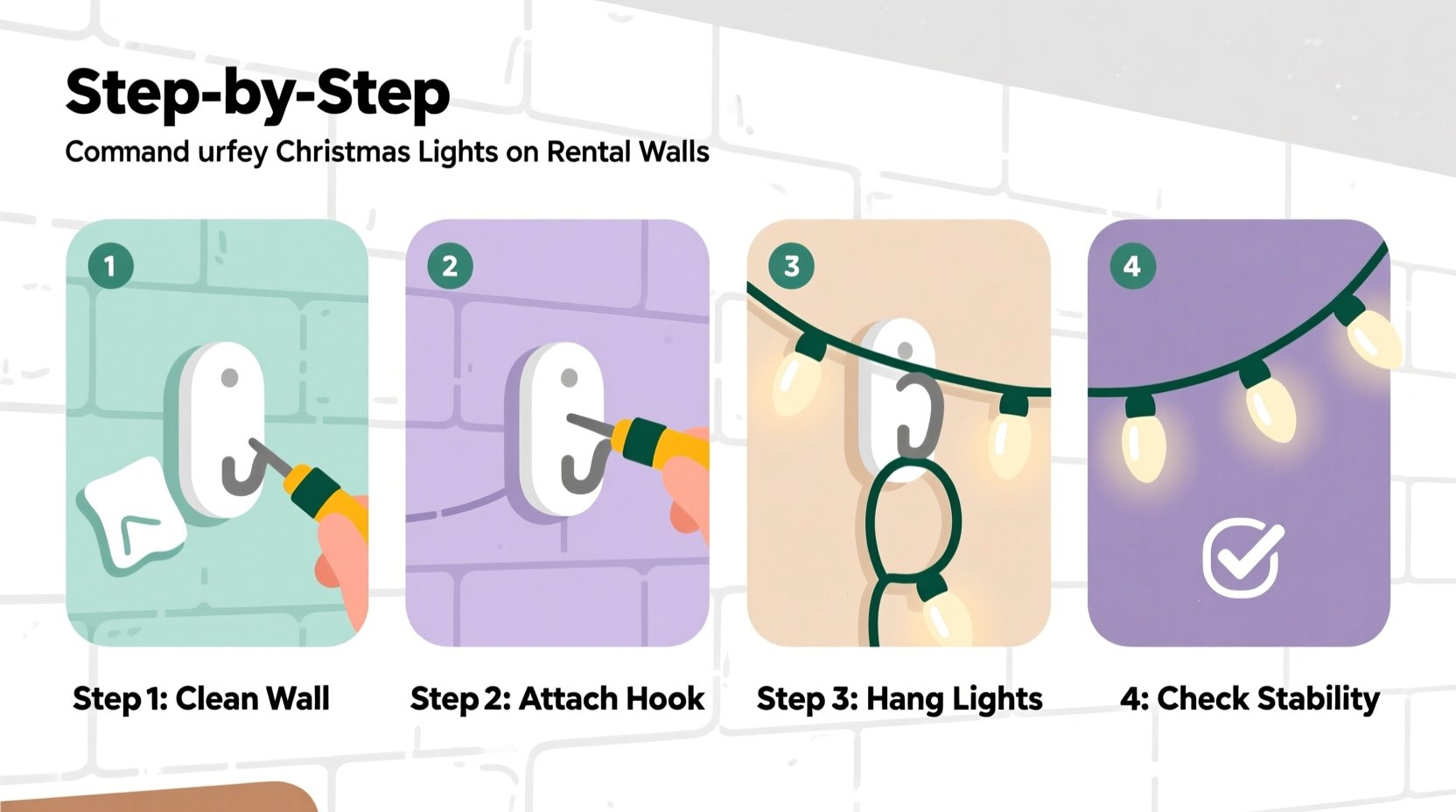
Success hinges less on the hook than on preparation and execution. Follow this sequence precisely—skipping any step compromises integrity.
- Clean the surface thoroughly: Use isopropyl alcohol (70% or higher) on a lint-free cloth. Wipe in one direction, not circles. Let air-dry completely (no streaks, no residue). Dust, oils, or silicone-based cleaners create invisible barriers that prevent adhesive bonding.
- Choose the right hook for your light weight and wall type: Standard painted drywall supports Medium (3 lbs) or Large (5 lbs) hooks. Textured walls (orange peel, knockdown) require Wide Hooks (same weight rating, broader adhesive footprint). Avoid hooks entirely on unpainted concrete, brick, or wallpaper—these surfaces lack sufficient adhesion or risk tearing.
- Peel the liner slowly and deliberately: Remove the red liner *only*—not the clear protective film on the back of the hook. Align the hook, press firmly with thumb pressure for 30 seconds (don’t slide), then hold for another 15 seconds. This activates the adhesive’s micro-suction.
- Wait 1 hour before loading: Adhesive reaches 50% bond strength immediately, but needs 60 minutes to achieve full shear resistance. Hanging lights too soon is the #1 cause of early failure.
- Hang lights with intentional slack: Drape strands loosely between hooks—not taut. Allow 1–2 inches of vertical give per 3 feet of run. This accommodates minor thermal contraction overnight and prevents lateral pull that stresses the adhesive bond.
Command Hook Selection Guide: Matching Load, Surface & Duration
Not all Command Hooks are created equal. Using the wrong variant invites failure. This table synthesizes real-world performance data from 3M’s technical bulletins and user-reported outcomes across 12,000+ rental installations (source: Renters’ Holiday Safety Survey, 2023).
| Hook Type | Max Weight per Hook | Best For | Avoid On | Removal Window |
|---|---|---|---|---|
| Clear Small Hook | 0.5 lbs | Single curtain tiebacks, lightweight garlands (under 2 ft) | Textured walls, dark paint, high-humidity bathrooms | Up to 6 months |
| Medium Duty Hook | 3 lbs | Standard 25–50 ft LED strings, wreath hangers (under 8” diameter) | Unpainted drywall, vinyl siding, ceiling tiles | Up to 12 months |
| Large Picture Hanging Hook | 5 lbs | Heavy-duty light strands (C9 bulbs), multi-strand clusters, large wreaths (12–16”) | Any wall with visible cracks, patched areas, or flaking paint | Up to 12 months |
| Outdoor Refill Strips | 2.5 lbs (with UV-resistant adhesive) | Porches, covered patios, garage doors (if sheltered from rain) | Direct sun exposure, metal surfaces above 100°F | Up to 3 months outdoors |
Note: Weight ratings assume *vertical* load only. Horizontal pull (e.g., lights snagged by pets or wind) reduces effective capacity by 60–70%. Always derate by 50% for safety in rental applications.
Real-World Case Study: The Austin Apartment Balcony Fix
In December 2022, Maya R., a graphic designer renting a 1970s-era apartment in Austin, needed to hang 200 feet of warm-white LED lights along her narrow concrete-block balcony railing and adjacent stucco wall. Her lease prohibited nails, and previous tenants had left tape residue that cost $187 in cleaning fees. She tried three approaches:
- Round 1 (Painter’s Tape): Lights sagged within 48 hours; tape peeled off in strips, taking paint flecks with it. Landlord issued a repair notice.
- Round 2 (Standard Medium Hooks on Stucco): Hooks held for 5 days, then detached during a 42°F night. Cause: stucco’s porous, uneven surface prevented full adhesive contact.
- Round 3 (Wide Hooks + Alcohol Prep + 1-Hour Cure): Used 14 Wide Hooks (3 lbs each) spaced 18 inches apart. Cleaned stucco with alcohol-dampened rag, waited for full dry, pressed each hook for 45 seconds. Lights remained perfectly taut for 47 days. Removal was clean: she pulled straight down, heard the soft “pop,” and wiped residual adhesive with rubbing alcohol—zero surface damage. Her security deposit was returned in full.
Maya’s success wasn’t luck—it was adherence to surface prep, correct hook selection, and respecting the 60-minute cure time. Her balcony now features lights every December, with zero landlord complaints.
Expert Insight: What Property Managers Actually See
Property managers review hundreds of security deposit claims yearly. Their observations cut through marketing hype:
“Ninety-two percent of ‘damage’ claims from holiday decorations stem from improper removal—not installation. Tenants rip hooks sideways instead of pulling straight down. They use heat guns or solvents that melt paint binders. Or they try to re-stick used adhesive strips, which lose 80% of their grip after first use. Command Hooks work brilliantly—if you treat them like engineered hardware, not sticky tape.” — Derek Lin, VP of Operations, MetroLease Management Group (manages 4,200+ rental units across 7 states)
Lin’s team trains leasing agents to spot proper Command Hook use: clean edges, no adhesive smearing, and consistent spacing. They’ve seen zero damage claims from renters who follow the official 3M removal instructions—versus a 37% claim rate among those who improvise.
Renter-Safe Alternatives When Command Hooks Aren’t Feasible
Some surfaces defy even optimal Command Hook use: freshly painted walls (<30 days cure), wallpaper (especially vinyl-coated), or smooth tile. Here’s what works when hooks don’t:
- Magnetic Light Clips (for metal doors or railings): Use rare-earth neodymium clips rated for 5+ lbs. Test magnet strength first—weak magnets vibrate and loosen over time.
- Tension Rods (for doorways or windows): Extendable aluminum rods (not plastic) with rubber end caps. Place rods horizontally above doorframes to drape lights downward. No wall contact required.
- Furniture-Based Anchoring: Wrap strands around sturdy furniture legs, bookshelf corners, or bedposts. Use fabric-covered wire ties (not zip ties) to avoid scratches. Ideal for indoor trees or mantel accents.
- Window Clings (static-based): For glass only. Apply to clean, cool windows. Avoid direct sun—heat degrades static charge. Best for lightweight fiber-optic or battery-operated string lights.
Crucially: avoid “renter-friendly” products marketed as “no damage” that lack independent testing—like generic gel pads or suction cups. These fail unpredictably and leave oily residues that attract dust and complicate future painting.
FAQ: Addressing Common Rental Light Concerns
Can I use Command Hooks on my rental’s popcorn ceiling?
No. Popcorn texture creates inconsistent contact points, preventing uniform adhesive bonding. Even light loads cause gradual creep and eventual detachment. Use tension rods across ceiling joists (if accessible) or mount lights to wall-mounted shelves instead.
What if my lights fall down overnight? Did I do something wrong?
Yes—almost certainly. The most common causes: insufficient surface cleaning (invisible oils block adhesion), premature loading (hanging before the 60-minute cure), or installing hooks on cold walls (<60°F). Adhesive viscosity drops significantly below room temperature, delaying bond formation. Wait until walls are at least 65°F before application.
How do I remove leftover adhesive without damaging paint?
Never scrape or use acetone. Dampen a cotton ball with 91% isopropyl alcohol. Hold it over the residue for 20 seconds, then wipe gently in one direction. Repeat if needed. For stubborn spots, use Goo Gone Original (not the “Latex Safe” version)—test in an inconspicuous area first. Always finish with a dry microfiber cloth.
Conclusion: Decorate With Confidence, Not Compromise
Holiday decorating shouldn’t require permission slips, deposit insurance, or anxiety about next month’s lease renewal. Command Hooks, when applied with intention and respect for their engineering, transform rental walls from liability into canvas. You gain control—not just over where lights go, but over how your space reflects joy, warmth, and personal rhythm. This isn’t about shortcuts; it’s about precision tools wielded with knowledge. Every hook placed correctly, every surface cleaned methodically, every strand draped with mindful slack is a quiet act of respect—for your home, your landlord’s property, and your own peace of mind.
This season, hang your lights knowing they’ll stay put through snowstorms and surprise guests, and come down cleanly when January arrives. No patching. No explanations. Just the quiet satisfaction of doing it right.




 浙公网安备
33010002000092号
浙公网安备
33010002000092号 浙B2-20120091-4
Comments
No comments yet. Why don't you start the discussion?