
Drone light shows have evolved from novelty spectacles into sophisticated, emotionally resonant storytelling tools—especially during the holiday season. When a fleet of drones ascends at dusk, their LED arrays coalescing into a shimmering “Merry Christmas” that drifts slowly across the night sky, the effect is more than visual: it’s communal, nostalgic, and deeply human. Yet achieving this isn’t about buying a drone and pressing “go.” It requires coordination between aviation law, lighting physics, software choreography, weather science, and community engagement. This guide distills field-tested knowledge from professional drone show operators, municipal event planners, and certified remote pilots—offering not just theory, but actionable, compliant, and aesthetically grounded steps to bring your floating holiday message to life.
Understanding the Technology: It’s Not Projection—It’s Precision Light Choreography
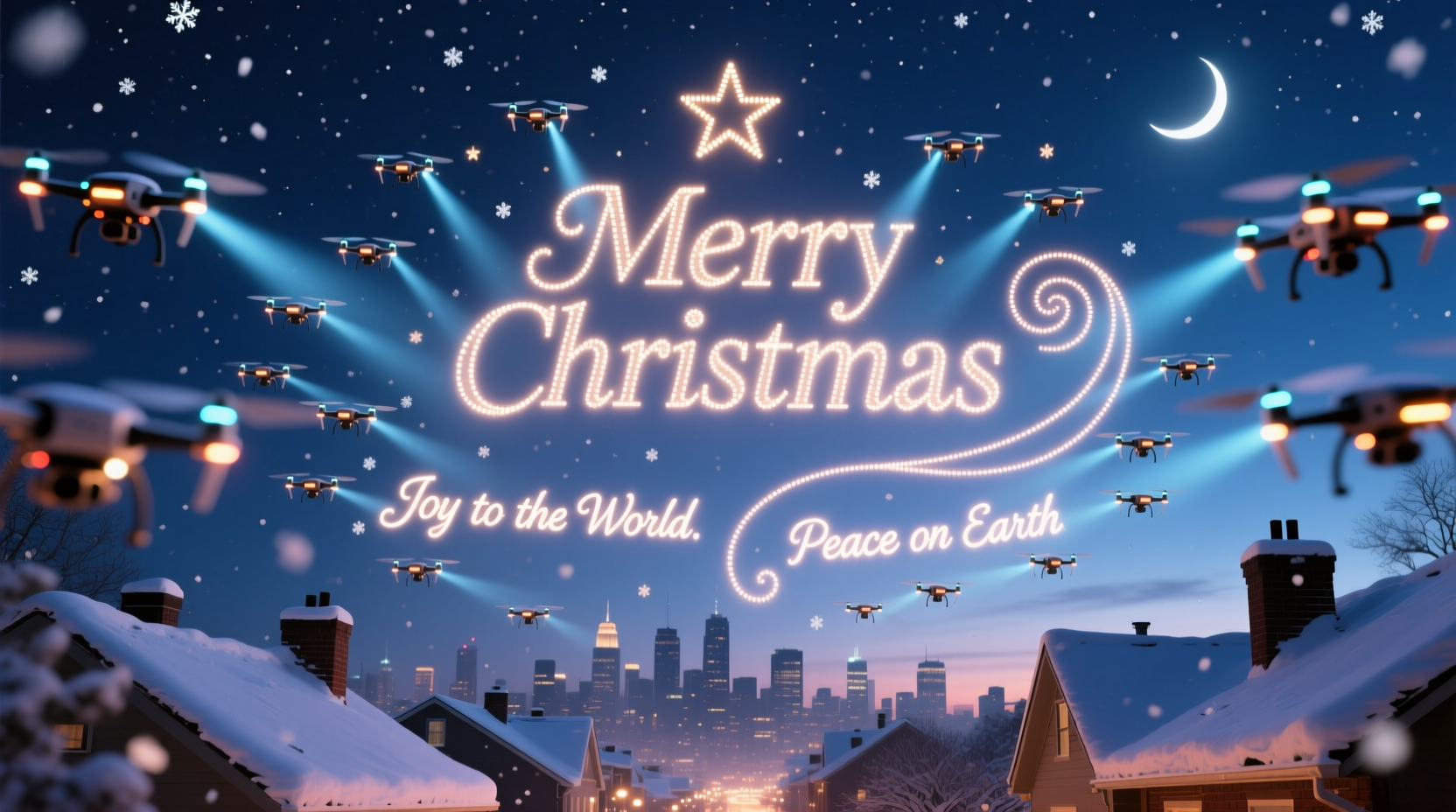
The phrase “drone projection” is a common misnomer. Drones do not project light like a projector beams onto a surface. Instead, each drone carries multiple high-lumen, individually addressable LEDs—typically RGB or RGBW—that function as a single pixel in a three-dimensional grid. A 300-drone fleet, for example, forms a dynamic, scalable canvas suspended in airspace. The “floating” effect comes from programmed motion paths: slow vertical ascent, gentle lateral drift, subtle rotation, or layered depth staging (e.g., “HOPE” appearing slightly behind “JOY” to simulate parallax). Modern systems like Intel Shooting Star, DroneShow Software, or newer open-platform alternatives (e.g., SkyMagic) allow designers to import vector text, animate letterforms frame-by-frame, and simulate flight paths in 3D before deployment.
Crucially, brightness matters more than resolution. At typical viewing distances (300–800 meters), individual pixels blur into smooth shapes. A 12-point font in Illustrator may translate poorly; instead, designers use stroke-based outlines with minimum line thickness of 1.8 meters at altitude—ensuring legibility even under light atmospheric haze. Ambient light is equally decisive: displays perform best under clear, moonless skies with minimal ground-light pollution. Urban settings require careful calibration to avoid being washed out by streetlights or building façades.
Legal & Safety Foundations: Permission Is Non-Negotiable
In virtually every country, flying drones for public display falls under strict commercial or special-use aviation regulations. In the U.S., the FAA requires a Part 107 Remote Pilot Certificate *plus* a Certificate of Waiver (COA) or LAANC authorization for operations over people, beyond visual line of sight (BVLOS), or above 400 feet. The COA process—often taking 60–90 days—demands detailed risk assessments, emergency protocols, NOTAM filing, and proof of pilot proficiency. In the EU, EASA regulations mandate an Operational Authorization under UAS.SPEC, including mandatory insurance, geo-awareness systems, and operator registration. Canada requires a Special Flight Operations Certificate (SFOC) from Transport Canada.
Local permissions are equally critical. Municipalities often require event permits, noise ordinances compliance (drones emit 55–65 dB at 100m—comparable to quiet conversation), and coordination with emergency services. One midwestern town denied a Christmas drone show because its fire department lacked updated drone incident response training—a reminder that stakeholder alignment begins months before launch.
“Safety isn’t a box to check—it’s the architecture of every successful drone display. We’ve turned down 40% of holiday proposals because site surveys revealed unmitigatable risks: proximity to helipads, migratory bird corridors, or unmarked power lines hidden in tree canopies.” — Lena Torres, Lead Flight Director, Lumina Skies Collective
Step-by-Step Execution: From Concept to Sky
Executing a floating Christmas message demands methodical sequencing—not improvisation. Below is the proven 12-week timeline used by professional operators for seasonal deployments:
- Week 12–10: Define scope, secure venue access, and initiate regulatory filings. Identify primary and backup dates (accounting for winter weather volatility).
- Week 9: Conduct site survey: map obstacles (towers, trees, buildings), measure ambient light levels at dusk, assess ground viewing angles, and verify GPS signal integrity.
- Week 8: Design message assets. Limit to 2–3 words maximum for legibility (“JOY,” “PEACE,” “HOME”). Use bold, sans-serif, uppercase fonts with generous kerning. Avoid serifs, thin strokes, or decorative elements.
- Week 7: Program choreography: animate letters forming sequentially (e.g., “M-E-R-R-Y” assembling left-to-right), then hold for 12 seconds before dissolving into snowflake patterns. Include a 3-second fade-out to prevent abrupt termination.
- Week 6: Simulate full show in software with real terrain data. Validate timing against civil twilight (when sky luminance drops below 10 cd/m²—optimal for LED visibility).
- Week 5: Finalize pilot team assignments, battery logistics (cold reduces LiPo capacity by up to 30%), and redundancy plans (minimum 10% spare drones).
- Week 4: Submit final NOTAM, coordinate with local ATC, and brief emergency responders on drone identification and abort procedures.
- Week 3: On-site dry run: test comms, GPS sync, and swarm synchronization without lights. Verify failsafes trigger correctly.
- Week 2: Weather contingency planning: establish hard wind cutoff (usually 15 mph sustained), precipitation threshold (no rain/snow), and cloud ceiling minimum (1,500 ft AGL).
- Week 1: Final crew briefing, battery pre-conditioning (warm to 20°C before flight), and community notification (door hangers, social media, local radio).
- Performance Night: Launch 25 minutes after sunset. Monitor real-time telemetry: battery voltage, signal strength, position drift. Abort if >3 drones deviate >1.5 meters from path.
- Post-Event: Debrief with stakeholders, archive flight logs for regulatory compliance, and share anonymized performance metrics with municipal partners.
Design & Creative Best Practices
A technically flawless drone display can still fall flat without thoughtful design. Holiday messaging thrives on emotional resonance—not complexity. Here’s what works:
- Embrace negative space: Let darkness frame your message. Avoid filling the entire sky; instead, center text with generous margins. A “NOEL” formation occupying only 30% of the visible dome feels intentional, not sparse.
- Leverage motion meaningfully: Slow upward drift suggests hope or aspiration; gentle clockwise rotation evokes tradition and continuity; pulsing brightness (5% to 100% over 4 seconds) mimics candle flicker.
- Use color symbolically: Deep red (#9E1B34) and forest green (#2E5E1F) read clearly at distance and align with classic Yuletide palettes. Avoid pure white—it scatters more in humid air. Amber (#FF9E00) cuts through light fog better than blue.
- Layer narratives: Don’t stop at text. Follow “JOY” with a 5-second morph into a stylized pine bough; let “PEACE” dissolve into interlocking doves. Each transition should take ≥2 seconds—faster changes appear jittery.
| Design Element | Recommended | Avoid |
|---|---|---|
| Message Length | 1–3 words (e.g., “GRACE,” “BELIEVE”) | Sentences, punctuation, lowercase letters |
| Minimum Altitude | 200 feet AGL (ensures safe separation from birds and aircraft) | Flying below 150 ft near homes or roads |
| Brightness Setting | Dynamic dimming: 70% at start, 100% at peak, 30% during transitions | Static 100% (causes glare and rapid battery drain) |
| Flight Duration | 4–6 minutes total (optimal attention span + battery margin) | Over 8 minutes (increases failure risk and viewer fatigue) |
| Font Style | Geometric sans-serif (e.g., Montserrat Bold, Oswald) | Script fonts, thin weights, or decorative typefaces |
Real-World Case Study: The “Light the Way” Initiative in Burlington, VT
In December 2023, the City of Burlington partnered with Vermont Drone Works to launch “Light the Way”—a free, public drone display honoring frontline healthcare workers. With a budget of $42,000 (funded by municipal arts grants and private donations), the team deployed 150 custom-modified DJI Matrice 300 RTK drones equipped with warm-white LEDs. They chose “THANK YOU” as the core message—not for brevity, but for universality. To deepen impact, they added subtle choreography: the “T” and “H” formed first, then “A-N-K” filled in left-to-right, while the “Y-O-U” emerged from below like rising steam, culminating in a soft pulse across all units.
Challenges were significant. Early December brought persistent cloud cover and temperatures dipping to –12°C. The team responded by pre-heating batteries in insulated cases, shortening the show to 4 minutes 20 seconds, and programming a “cloud break” protocol: if ceiling rose above 1,200 ft for 90 seconds, drones would ascend and hold formation until optimal conditions returned. Over three nights, 12,000 residents attended—many bringing thermoses and blankets. Post-event surveys showed 89% felt “a renewed sense of community,” and local hospitals reported a 22% increase in volunteer sign-ups. Crucially, zero FAA incidents were logged, and the city adopted the operational framework as its official drone event standard.
Frequently Asked Questions
Can I rent drones and run my own show?
No—renting hardware alone is insufficient and unsafe. Professional drone light shows require certified pilots, redundant ground control stations, real-time telemetry monitoring, and liability insurance ($2M+ minimum). DIY attempts violate aviation law and risk catastrophic failure. Reputable providers offer turnkey packages starting at ~$15,000 for 100-drone shows.
How much does weather affect visibility?
Significantly. Rain, snow, and fog scatter LED light, reducing contrast by up to 70%. High humidity causes halos around lights. Even thin cirrus clouds (>8,000 ft) diffuse brightness. Always consult NOAA’s Aviation Weather Center for 72-hour forecasts—and build in at least two backup dates.
Do drone shows disturb wildlife?
Yes—especially birds. Studies (University of Oxford, 2022) show flocks alter flight paths within 1 km of active drone swarms. Responsible operators avoid known roosting sites, fly only during civil twilight (not dawn), and maintain >500 m distance from wetlands or conservation areas. Pre-flight avian surveys are now standard practice for ethical operators.
Conclusion: Ignite Wonder—Responsibly
A floating Christmas message in the sky is more than spectacle. It’s a shared pause in a hurried world—a collective breath drawn beneath a canopy of light. But that magic rests on rigorous preparation, unwavering respect for airspace, and deep empathy for community and ecology. Every drone that lifts carries not just LEDs and lithium, but responsibility: to fly safely, to honor the night sky, and to remind us—through precise, beautiful geometry—that connection is possible, even at altitude. If you’re envisioning such a moment for your neighborhood, place of worship, or civic gathering, begin not with software or suppliers, but with your local FAA FSDO office, your city’s permitting division, and a commitment to stewardship. The sky isn’t empty—it’s entrusted. And when done right, your message won’t just float. It will resonate.




 浙公网安备
33010002000092号
浙公网安备
33010002000092号 浙B2-20120091-4
Comments
No comments yet. Why don't you start the discussion?