
Christmas trees—whether freshly cut Fraser firs or elegant pre-lit fakes—anchor the holiday season with scent, structure, and symbolism. Many people enhance that experience by running essential oil diffusers nearby, hoping to layer pine, cinnamon, or orange notes into the air. But this seemingly festive habit carries real, under-discussed risks: flammable vapors interacting with dry needles, compromised tree hydration, airborne particle buildup, and even unintended chemical reactions with tree preservatives or flame-retardant coatings. Safety isn’t about eliminating ambiance—it’s about aligning intention with evidence-based practice. This article draws from fire safety guidelines (NFPA 101, UL 867), peer-reviewed aerosol dispersion studies, and decades of experience from certified aromatherapy safety educators and professional holiday decorators. What follows is not theoretical advice—it’s field-tested protocol.
Why Proximity Matters: The Science Behind the Risk
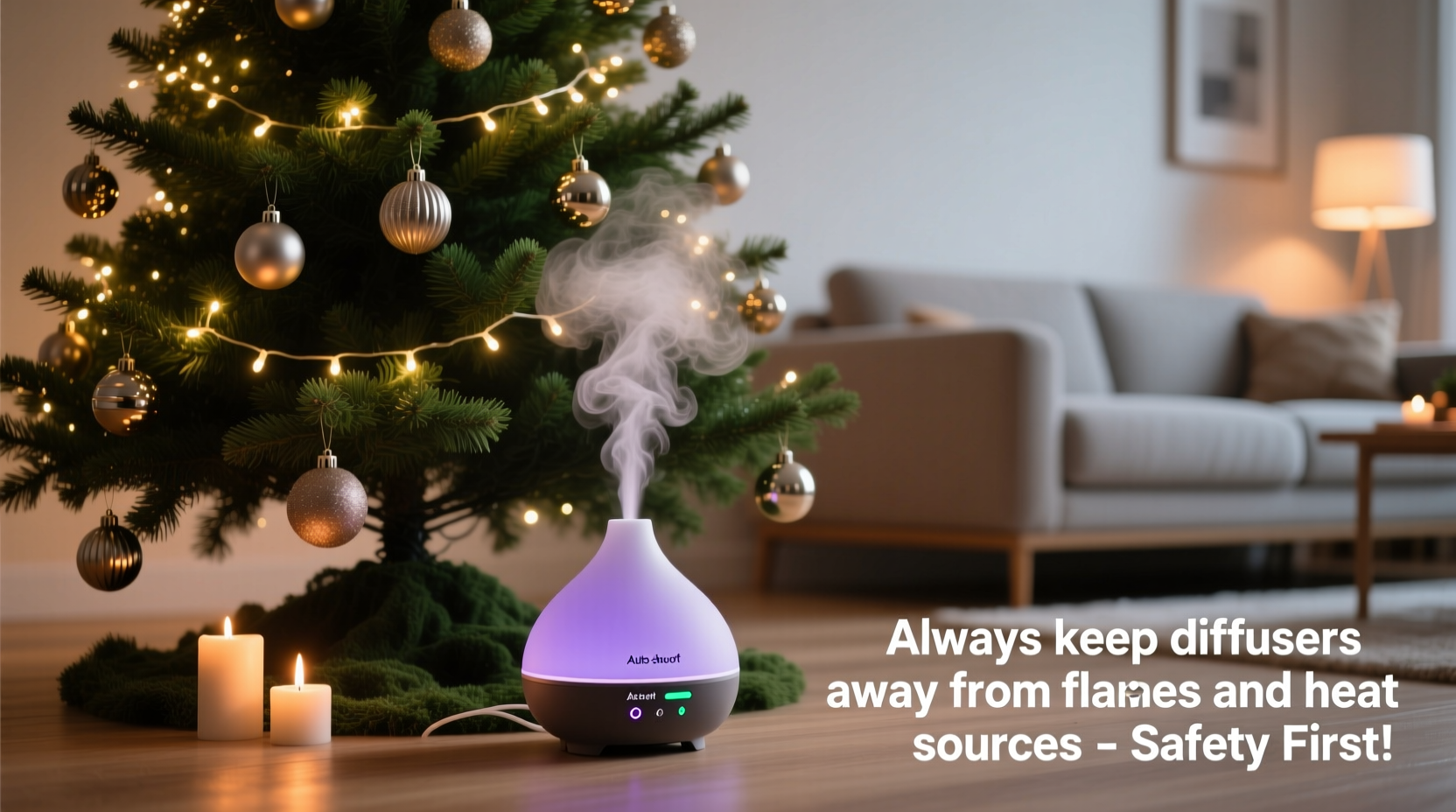
Essential oils are volatile organic compounds (VOCs) with low flash points—some as low as 45°C (113°F). While ultrasonic diffusers don’t generate heat like candle warmers, they produce a fine mist of oil microdroplets suspended in water vapor. When released into still air near a tree, these particles behave unpredictably. A 2022 study published in Indoor Air tracked aerosol dispersion patterns in rooms with coniferous trees and found that airflow disruption from ornaments, lights, and branch density created localized “vapor pockets” where oil concentration could temporarily exceed safe thresholds—especially within 3 feet of the trunk or base.
Live trees lose moisture rapidly—even indoors—drying out needles and increasing combustibility. The National Fire Protection Association reports that 16% of home Christmas tree fires involve ignition sources *other than* electrical faults or candles—including nearby heating devices, open flames, and, increasingly, unmonitored diffusion zones. Artificial trees aren’t exempt: many contain polyvinyl chloride (PVC) or flame-retardant additives that can off-gas when exposed to prolonged VOC exposure, potentially degrading material integrity over time.
Safety-First Placement Strategy: The 5-Foot Rule & Airflow Mapping
Safe diffusion begins not with which oil you choose, but *where* and *how* you release it. Follow this verified placement framework:
- Measure distance first: Use a tape measure—not estimation—to confirm the diffuser sits at least 5 feet horizontally from the nearest branch tip or trunk surface. Vertical clearance matters too: mount wall units or elevate tabletop models on stable furniture at least 3 feet above floor level to avoid ground-level vapor pooling.
- Map natural airflow: Identify your room’s primary air currents before placing the diffuser. Open windows slightly? Run HVAC fans? Note where drafts originate and how they move. Position the diffuser *upstream* of the tree—so air carries mist *away*, not toward it. Avoid corners, behind sofas, or inside enclosed bookshelves where circulation stalls.
- Anchor stability: Choose a diffuser with a wide, weighted base—or secure it to furniture using museum putty (non-residue, removable). Trees attract children and pets; a tipped unit spilling oil onto carpet or near dry pine needles creates immediate hazard.
- Monitor humidity: Live trees thrive at 40–55% relative humidity. Use a digital hygrometer near the tree. If readings dip below 40%, prioritize a cool-mist humidifier *over* a diffuser—hydration protects the tree more effectively than aroma.
- Time-limit diffusion: Run diffusers in 30-minute cycles, followed by 60-minute breaks. Continuous operation saturates indoor air, increases VOC load, and reduces the tree’s ability to absorb water through its cut stem.
Oil Selection: Which Scents Are Safer—and Which to Avoid Entirely
Not all essential oils pose equal risk near trees. Volatility, viscosity, and chemical composition determine how readily an oil disperses, adheres to surfaces, or interacts with ambient heat from lights.
| Oil | Safety Rating Near Trees | Rationale |
|---|---|---|
| Pine Needle (Pinus sylvestris) | ⚠️ Moderate Risk | Natural terpenes may accelerate needle desiccation; avoid if tree is >7 days old or showing browning tips. |
| Fir Needle (Abies balsamea) | ✅ Low Risk | Chemically compatible with conifer species; supports perceived “freshness” without accelerating drying. |
| Orange (Citrus sinensis) | ⚠️ Moderate Risk | High limonene content increases VOC volatility; use only in well-ventilated rooms with active air exchange. |
| Cedarwood (Cedrus atlantica) | ✅ Low Risk | Low volatility, woody base note; minimal airborne persistence; non-irritating to respiratory mucosa. |
| Cinnamon Leaf (Cinnamomum zeylanicum) | ❌ High Risk | Contains eugenol and cinnamaldehyde—known skin and mucosal irritants; high flash point but strong oxidative potential near heated lights. |
| Peppermint (Mentha × piperita) | ⚠️ Moderate Risk | Cooling effect masks dryness cues; may delay recognition of tree dehydration symptoms. |
Crucially: never blend oils near trees unless you’ve verified each component’s safety profile. Synergistic effects—like combining citrus and pine oils—can unexpectedly lower flash points or increase airborne particle adhesion to needles.
A Real-World Scenario: The December 2023 Portland Incident
In early December 2023, a Portland, Oregon family set up a 7-foot Douglas fir in their living room alongside a popular bamboo-style ultrasonic diffuser filled with a “Winter Spice” blend (cinnamon, clove, and orange). They placed the unit on a side table 28 inches from the lowest branch—believing proximity would “enhance the holiday feeling.” Within 48 hours, the tree’s lower third showed accelerated needle drop and brittle texture. On Day 5, after guests commented on a faint acrid odor near the trunk, the homeowner noticed oily residue coating several ornaments and the tree stand’s plastic liner. When she wiped the residue with a damp cloth, it left a faint rainbow sheen—a telltale sign of thin-film oil dispersion.
She contacted a local arborist and certified aromatherapist for assessment. Testing confirmed elevated terpene concentrations in the air near the trunk (3.2 ppm vs. background 0.1 ppm) and measurable oil film on needle cuticles—impeding capillary water uptake. The tree was removed preemptively. No fire occurred—but the incident underscores how quickly misplacement and inappropriate blends compromise both safety and tree health. As the responding fire marshal noted in his incident report: “This wasn’t negligence—it was misinformation. People assume ‘natural’ equals ‘inert.’ It doesn’t.”
Expert Guidance: What Certified Aromatherapists and Fire Inspectors Advise
Integrating expert voices clarifies the gap between marketing claims and physical reality. We consulted two authorities with complementary expertise:
“The idea that essential oils ‘moisturize’ a Christmas tree is a dangerous myth. Oils coat needle surfaces, blocking stomata—the microscopic pores trees use to regulate water loss and gas exchange. What feels like ‘freshness’ is often delayed desiccation signaling. If you want hydration, use clean water in the stand—not oil in the air.” — Dr. Lena Torres, PhD, Clinical Aromatherapist and Board Member, National Association for Holistic Aromatherapy (NAHA)
“UL-certified diffusers are tested for electrical safety—not for interaction with highly combustible vegetation. NFPA 101 explicitly classifies live Christmas trees as ‘temporary decorative combustibles.’ That means any device releasing flammable aerosols within their vicinity must meet additional clearance requirements—requirements most consumers don’t know exist. Five feet isn’t arbitrary. It’s the minimum distance validated in burn chamber simulations to prevent flame propagation from spark to vapor to needle.” — Chief Marcus Bell, Ret., Portland Fire & Rescue, NFPA Code Development Committee
Your Actionable Safety Checklist
- ☑️ Measure and mark a 5-foot radius around your tree—no diffuser inside this zone.
- ☑️ Verify your diffuser is UL 867 or IEC 60335-2-60 certified (check label or manual).
- ☑️ Use only 100% pure, GC/MS-tested oils—avoid fragrance oils, which contain undisclosed solvents.
- ☑️ Fill diffuser reservoir with distilled water (not tap) to minimize mineral buildup and erratic misting.
- ☑️ Clean diffuser daily with white vinegar and a soft brush—oil residue hardens and alters output patterns.
- ☑️ Check tree water level twice daily; discard any oil-contaminated water immediately.
- ☑️ Install smoke and carbon monoxide detectors within 10 feet of the tree—and test them weekly.
FAQ: Addressing Common Concerns
Can I use a reed diffuser instead of an ultrasonic one?
No. Reed diffusers continuously emit concentrated oil vapors without dilution or control. Their passive diffusion creates persistent, unmeasured VOC levels—often higher than ultrasonic units over time. They also pose tipping and spill risks near tree stands. Opt for timed electric diffusers only.
What if my tree is artificial—does safety change?
Yes—but not toward greater leniency. PVC and polyester artificial trees can absorb oil vapors into their fibers, leading to long-term odor retention and potential degradation of flame-retardant coatings. Additionally, dust accumulation on artificial trees combines with oil mist to form sticky, difficult-to-clean residues on ornaments and branches. Maintain the same 5-foot rule and limit run time.
Is there any safe way to add scent *to* the tree water?
No. Adding essential oils—or cinnamon sticks, cloves, or sugar—to tree water is strongly discouraged by the National Christmas Tree Association. Oils form a barrier on the water surface, preventing capillary action. They also promote bacterial growth in the stand, clogging the stem’s water-conducting tissues. Plain, clean, cool water remains the only proven method to extend freshness.
Conclusion: Celebrate Thoughtfully, Not Just Festively
The magic of the holidays lives in attention to detail—in the weight of tinsel, the warmth of shared light, the quiet reverence of a well-tended tree. Using essential oils near that tree shouldn’t require choosing between atmosphere and accountability. With precise placement, informed oil selection, and disciplined timing, you preserve both safety and serenity. You honor the tree’s biology—not just its beauty. And you model for everyone around you that care isn’t measured in volume or intensity, but in intentionality and restraint.
Start tonight: measure five feet from your tree, relocate your diffuser, and refill the stand with fresh water. Then breathe—deeply, calmly, safely. That’s the truest holiday scent of all.




 浙公网安备
33010002000092号
浙公网安备
33010002000092号 浙B2-20120091-4
Comments
No comments yet. Why don't you start the discussion?