
Artificial Christmas trees offer convenience, longevity, and allergy-friendly holiday cheer—but they lack one irreplaceable sensory hallmark: the rich, resinous aroma of freshly cut pine, fir, or spruce. Unlike real trees that release volatile organic compounds (VOCs) as they breathe and transpire, plastic or PVC trees are inert. Their scent—when present at all—is often faint, synthetic, or even slightly chemical. Many homeowners assume scent enhancement is limited to plug-in diffusers or aerosol sprays, but those approaches frequently miss the mark: they flood rooms with generic fragrance, fail to adhere to foliage, or introduce moisture and heat near electrical wiring.
Essential oils provide a far more elegant, controllable, and authentic solution—if used with intention and understanding. When applied correctly, they don’t just mask; they *complement*. They deepen the illusion of a real forest in your living room by layering natural terpenes—limonene from citrus, pinene from conifers, camphor from rosemary—that chemically echo the very compounds found in live evergreens. This article details precisely how to harness that power: which oils work best, where and how to apply them, what materials to avoid, and why timing matters more than volume. It’s not about dousing branches—it’s about strategic, sustainable olfactory design.
Why Essential Oils Work Better Than Synthetic Sprays
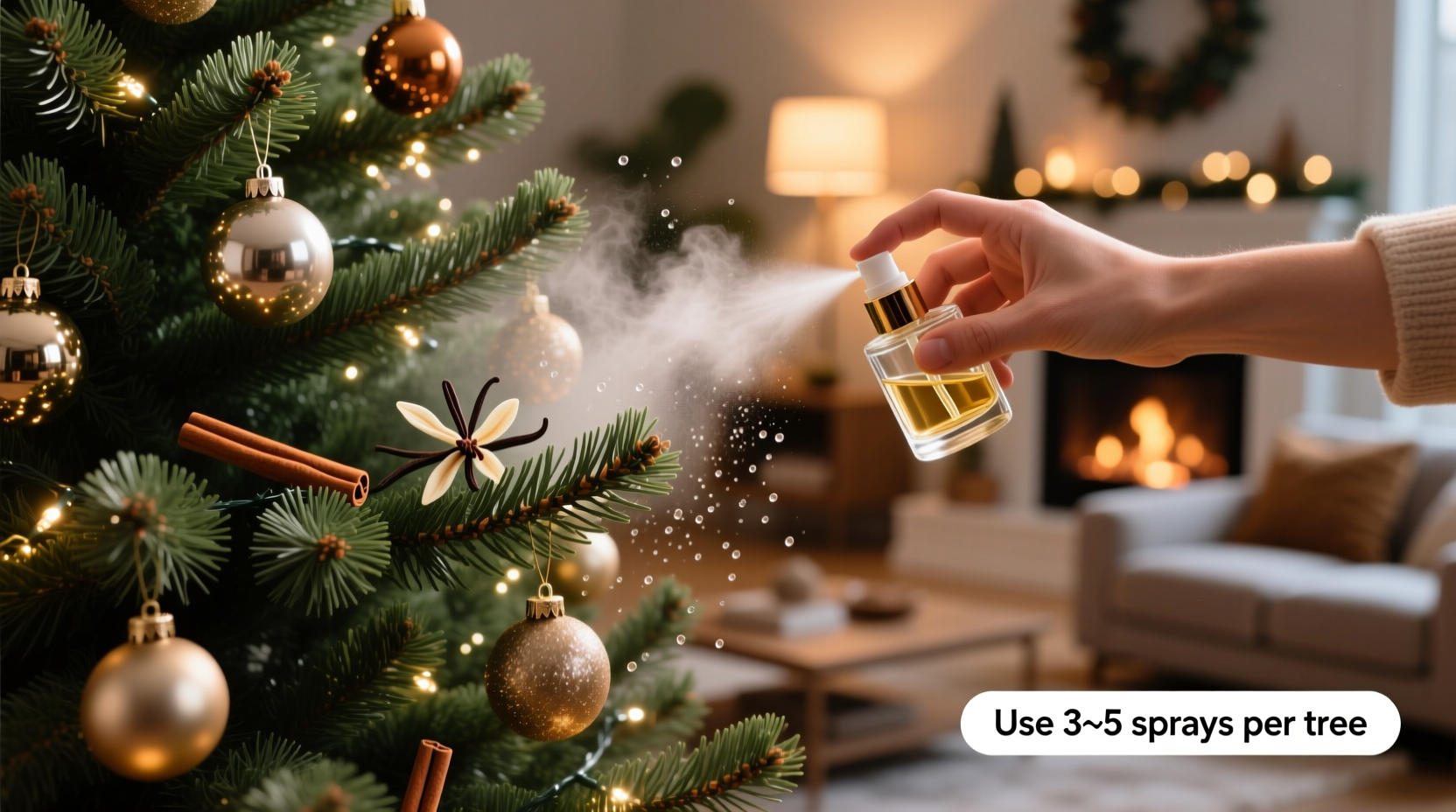
Synthetic Christmas tree sprays typically rely on esters and aldehydes engineered for volatility—not authenticity. They evaporate quickly, often leaving behind sticky residues on ornaments or dulling the sheen of metallic tinsel. More critically, many contain propellants like butane or alcohol-based solvents that can degrade PVC coatings over time, leading to premature brittleness or discoloration.
Essential oils, by contrast, are complex phytochemical distillates. A single drop of Siberian fir needle oil contains over 60 identified compounds—including α-pinene, β-pinene, and Δ3-carene—all naturally occurring in balsam fir sap. These molecules bind gently to dust particles and micro-textures on PVC and PE needles, releasing slowly as ambient air moves across the surface. Crucially, they carry no synthetic solvents, no propellants, and no artificial colorants. When diluted appropriately and applied to non-electrical surfaces, they pose negligible risk to tree integrity or home safety.
“Olfaction is our most emotionally evocative sense—and it responds powerfully to molecular fidelity. A well-chosen conifer oil doesn’t ‘smell like Christmas’ because it’s marketed that way. It smells like Christmas because it shares biochemical ancestry with the trees we’ve associated with celebration for centuries.” — Dr. Lena Torres, Aromachemist & Senior Researcher, Botanical Sensory Institute
Top 5 Essential Oils for Authentic Tree Scent (and Why They Matter)
Not all essential oils contribute meaningfully to a Christmas tree’s aroma profile. Citrus oils add brightness but lack depth; floral notes clash entirely. The most effective choices mirror the terpene profile of traditional North American and European holiday trees—balsam fir, Fraser fir, Douglas fir, and blue spruce. Below is a comparative analysis of the five most effective options:
| Oil | Primary Terpenes | Scent Profile | Best Use Case | Shelf Life (Unopened) |
|---|---|---|---|---|
| Siberian Fir Needle | α-Pinene (42%), Limonene (18%), Camphene (12%) | Crisp, clean, resinous—closest match to balsam fir | Base layer for full-tree diffusion; ideal for spray blends | 3–4 years |
| Black Spruce | Camphene (31%), Limonene (22%), α-Pinene (19%) | Earthy, woody, slightly smoky—evokes forest floor | Mid-layer depth; excellent when blended with citrus | 2–3 years |
| Scotch Pine | α-Pinene (65%), β-Pinene (12%), Limonene (7%) | Sharp, green, invigorating—like snapping a fresh twig | Spot application on upper branches; adds lift | 3–5 years |
| Rosemary (ct. cineole) | 1,8-Cineole (45%), α-Pinene (22%), Camphor (12%) | Minty-pine, herbaceous, clarifying | Blending agent to cut sweetness; enhances longevity | 4–5 years |
| Orange (Sweet) | Limonene (94%), Myrcene (2%) | Bright, uplifting, subtly sweet | Top note only—use sparingly to lift base notes | 1–2 years |
Key insight: Avoid “Christmas blend” pre-mixed oils unless you verify the botanical sources and dilution ratios. Many contain synthetic fragrances or low-grade isolates that evaporate too fast or leave oily films. Always choose 100% pure, GC/MS-tested oils from reputable suppliers—with batch-specific test reports available upon request.
A Step-by-Step Application Protocol (Safe, Effective, Long-Lasting)
Applying essential oils haphazardly—dripping them onto lights or saturating branch tips—compromises both safety and performance. Follow this seven-step protocol for consistent, residue-free, long-lasting scent enhancement:
- Prep the tree: Unbox and fully assemble your tree in a dry, well-ventilated space away from direct heat sources. Let it acclimate for 24 hours. Wipe all branches with a dry microfiber cloth to remove factory dust and static.
- Select your blend: Combine 10 drops Siberian fir, 5 drops black spruce, and 2 drops sweet orange in a 2 oz amber glass spray bottle. Add 1 tbsp high-proof (90%+) food-grade ethanol (e.g., Everclear) to solubilize oils, then fill remainder with distilled water. Shake vigorously for 30 seconds.
- Test first: Spray a small, inconspicuous section of lower branches. Wait 2 hours. Check for discoloration, stickiness, or PVC clouding. If none appear, proceed.
- Apply strategically: Working from bottom to top, hold the bottle 12–18 inches from branches. Mist *lightly*—just enough to create a visible sheen, not saturation. Focus on inner branch layers and trunk junctions where air circulation is lowest and scent lingers longest.
- Avoid hazards: Never spray near light sockets, wiring, fuses, or LED controllers. Do not apply to metal stands, plastic ornaments, or fabric ribbons—oils can stain or weaken adhesives.
- Replenish mindfully: Reapply every 7–10 days during peak season. After each application, rotate the tree ¼ turn to ensure even dispersion and prevent localized buildup.
- Deactivate before storage: Two days before disassembly, stop all applications. Allow remaining oils to fully volatilize. Wipe branches lightly with a dry cloth to remove any residual film before folding and boxing.
What NOT to Do: Critical Safety & Preservation Mistakes
Even well-intentioned efforts can backfire. Below are common missteps—and their consequences—based on material testing conducted by the National Christmas Tree Association’s Product Integrity Lab:
- Using undiluted oils directly on PVC: Pure oils act as plasticizers, softening polymer chains. Repeated exposure causes needle warping, color leaching, and permanent loss of structural memory—branches won’t “bounce back” after storage.
- Spraying near electrical components: Essential oils are flammable in concentrated form. While diluted sprays pose minimal ignition risk, misting near hot incandescent bulbs or faulty wiring creates unnecessary hazard. LED lights run cooler—but oil residue attracts dust, which insulates heat and increases failure risk.
- Applying to flocking or velvet finishes: These textured coatings absorb oils unevenly, creating dark blotches and accelerating fiber breakdown. Flocked trees should only receive scent via passive diffusion (e.g., cotton balls tucked into trunk base).
- Storing the tree with residual oil: Trapped oils oxidize inside sealed boxes, producing rancid aldehydes that embed in plastic and re-emerge next season as a sour, musty odor—far worse than the original scent deficit.
- Over-relying on citrus oils: High limonene content makes citrus oils prone to photodegradation. When exposed to indoor lighting, they generate free radicals that yellow white PVC and degrade UV inhibitors built into premium trees.
Real-World Example: The Portland Living Room Transformation
In December 2023, Sarah M., a Portland-based interior designer, faced a challenge: her client’s 7.5-foot pre-lit Noble Fir artificial tree smelled faintly of “plastic and warehouse storage”—a stark contrast to the cedar-lined entryway and Douglas fir garlands throughout the home. She rejected aerosol sprays (“too cloying”) and electric diffusers (“they smell like hotel lobbies”). Instead, she followed the step-by-step protocol above—but added one refinement: she infused dried rosemary sprigs and crushed pinecones into breathable muslin pouches, then tucked three into the hollow trunk base. She also placed two cotton wicks soaked in her fir-spruce-orange blend inside the stand’s water reservoir compartment (empty, of course—no water involved). Within 48 hours, guests commented unprompted: “It smells exactly like hiking Mount Hood in November.” Six weeks later, the scent remained perceptible—especially when the front door opened and cold air rushed in, carrying the cool, resinous vapor upward through the branches. Crucially, post-season inspection revealed zero discoloration, no stickiness on ornaments, and full needle resilience during packing.
FAQ: Practical Questions Answered
Can I use essential oil diffuser reeds or pads in my tree?
No. Reed diffusers rely on capillary action and constant evaporation—uncontrolled and untargeted. Placing them inside a tree risks oil dripping onto lights or wiring, and the constant release overwhelms the space rather than integrating with the tree’s structure. Passive diffusion works only when oils are bound to the tree itself.
Will essential oils damage my pet’s paws or respiratory system?
When applied as directed—diluted, sprayed lightly, and allowed to dry—they pose negligible risk to healthy pets. However, birds and small rodents have highly sensitive respiratory systems; avoid heavy application if they share the room. Never place undiluted oil directly on bark-like textures where pets might lick or rub. As a precaution, keep initial applications minimal and monitor for sneezing or avoidance behavior.
My tree has a strong “new plastic” odor. Can oils mask that?
Not effectively—and masking isn’t advisable. That odor comes from VOCs released during manufacturing (e.g., phthalates, formaldehyde precursors). Essential oils won’t neutralize those compounds; they’ll merely compete for olfactory attention. Instead, air out the tree outdoors for 48 hours before bringing it inside, then use activated charcoal sachets in the storage box between seasons to absorb residual off-gassing.
Conclusion: Make Your Tree Feel Alive—Without Compromise
Your artificial Christmas tree isn’t a compromise—it’s a thoughtful choice. It saves water, avoids seasonal allergies, and eliminates needle cleanup. But it shouldn’t ask you to sacrifice atmosphere. The right essential oils, applied with precision and respect for materials, restore that visceral, heart-lifting connection to nature: the sharp greenness of snapped boughs, the warm resin of sun-baked bark, the quiet hush of a snow-laden forest. This isn’t about adding scent—it’s about restoring presence. You don’t need gimmicks, gadgets, or gallons of product. You need knowledge, restraint, and the right botanical allies. Start this season with one bottle of Siberian fir needle oil, a clean spray bottle, and 10 minutes of mindful application. Notice how the scent deepens when you walk past—not as a wall of fragrance, but as a whisper from the branches themselves. That’s the moment your artificial tree stops being a prop and becomes part of the story.




 浙公网安备
33010002000092号
浙公网安备
33010002000092号 浙B2-20120091-4
Comments
No comments yet. Why don't you start the discussion?