
Artificial Christmas trees offer convenience, longevity, and allergy-friendly relief—but they lack the unmistakable, resinous aroma of freshly cut balsam fir, Douglas fir, or Scotch pine. That scent isn’t just nostalgic; it’s deeply tied to memory, seasonal mood regulation, and even physiological responses like reduced cortisol levels. Yet most commercial “Christmas tree” sprays rely on synthetic fragrances that smell cloying, chemical, or fleeting—and often leave sticky residues on plastic needles or metal branches. Essential oils provide a cleaner, more nuanced, and customizable alternative. When used intentionally—not just sprayed haphazardly—they can replicate the layered complexity of real evergreens: sharp top notes of citrusy terpenes, green mid-notes of camphor and pinene, and warm, balsamic base notes of resin and wood. This article details exactly how to achieve that authentic forest-floor freshness—not as a gimmick, but as a thoughtful sensory practice rooted in botany, safety, and real-world experience.
Why Essential Oils Work Better Than Synthetic Sprays
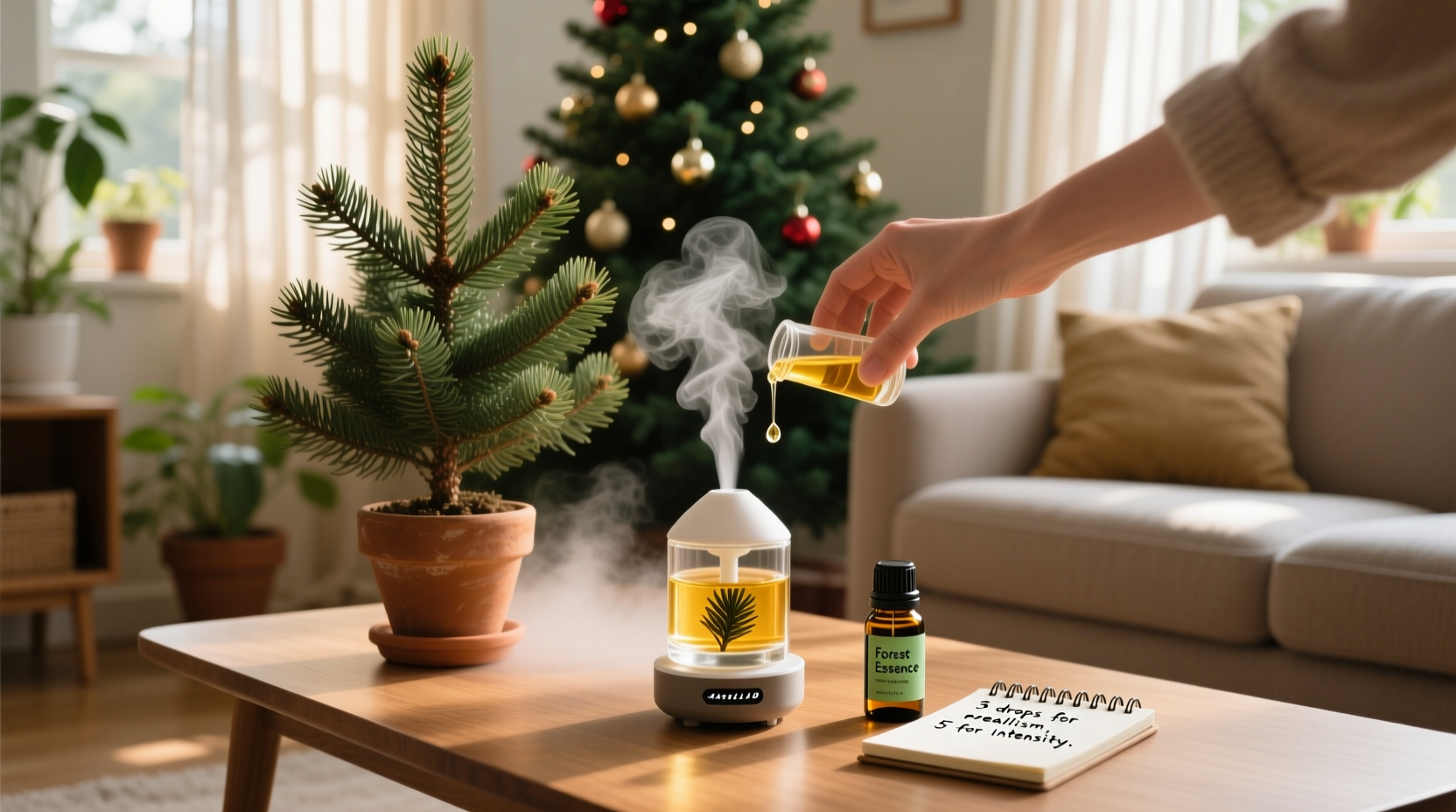
Real Christmas trees release volatile organic compounds (VOCs) like α-pinene, β-myrcene, limonene, and bornane—naturally occurring molecules responsible for their crisp, clean, slightly sweet-green scent profile. High-quality conifer essential oils contain many of these same compounds, extracted via steam distillation from actual needles, twigs, or resin. For example, Siberian fir oil is rich in bornane and camphene, closely mirroring balsam fir chemistry. Scotch pine oil delivers high α-pinene content, matching the sharpness of freshly snapped pine branches. Unlike synthetic fragrances—which often isolate one note (e.g., “pine” = limonene alone) and amplify it unnaturally—essential oil blends mimic nature’s balance: top, middle, and base notes unfolding over time.
This botanical fidelity matters practically. Synthetic sprays frequently contain propylene glycol or PEGs as solvents, which attract dust, degrade plastic coatings over time, and may irritate sensitive airways. Pure essential oils, when properly diluted and applied, evaporate cleanly, leave no film, and pose minimal risk when used with ventilation and appropriate carrier methods.
The 5-Step Method: Safe, Long-Lasting Evergreen Scenting
Effective scenting isn’t about volume—it’s about placement, volatility, and replenishment rhythm. Follow this proven sequence for consistent, natural-smelling results that last 3–4 weeks without reapplication fatigue.
- Select your core trio: Choose one needle oil (Siberian fir), one wood/resin oil (cedarwood atlas or black spruce), and one bright accent (sweet orange or grapefruit). These three cover the full aromatic spectrum of a real tree.
- Prepare a 2% dilution in a neutral carrier: Combine 12 drops total essential oil (e.g., 5 drops Siberian fir + 4 drops cedarwood + 3 drops sweet orange) per 1 oz (30 mL) of fractionated coconut oil or high-purity ethanol (like food-grade Everclear at 190 proof). Avoid water-only sprays—they don’t adhere and evaporate too fast.
- Apply via microfiber cloth, not spray: Fold a lint-free microfiber cloth into quarters. Lightly dampen one corner with 3–4 drops of your blend. Gently wipe the *undersides* of outer branches—where airflow is gentle and evaporation slower. Avoid tips (too dry) and trunk bases (too humid).
- Anchor scent at the base: Soak a small untreated wood disk (e.g., 1.5-inch birch slice) or a cotton wool ball with 8–10 drops of your blend. Place it inside the tree stand’s water reservoir *if using water*, or nestle it deep within the lowest branch cluster if dry-standing.
- Refresh strategically every 10–14 days: Reapply only to the lower third of the tree using the same cloth method. Upper branches retain scent longer due to warmer ambient air rising—no need to oversaturate.
Essential Oil Selection Guide: What Works—and What Doesn’t
Not all “Christmas-sounding” oils deliver authentic evergreen character. Some are misleadingly labeled or botanically unrelated. The table below compares common options by authenticity, longevity, safety, and synergy potential.
| Oil Name | Botanical Source | Authenticity Score (1–5) | Key Compounds | Best Used With |
|---|---|---|---|---|
| Siberian Fir (Abies sibirica) | Needles & twigs | 5 | Bornane, camphene, α-pinene | Cedarwood, sweet orange |
| Black Spruce (Picea mariana) | Needles | 5 | Bornanol, camphor, limonene | Frankincense, vanilla CO2 |
| Scotch Pine (Pinus sylvestris) | Needles | 4 | α-Pinene (70–85%), limonene | Lavender, juniper berry |
| Cedarwood Atlas (Cedrus atlantica) | Wood chips | 4 | Cedrol, atlantone | Fir, clove bud (1 drop) |
| Eucalyptus Radiata | Leaves | 2 | Cineole, α-terpineol | Avoid—smells medicinal, not forest-like |
| “Christmas Tree” Blend (commercial) | Unspecified synthetics/oils | 1 | Unknown; often dominated by limonene + vanillin | Not recommended—lacks depth, inconsistent quality |
Real-World Application: A Case Study from Portland, OR
When interior designer Lena R. switched to a 7.5-foot pre-lit Nordmann fir replica in 2022, she struggled with the “plastic basement” odor that lingered despite airing it out for two weeks. Her clients noticed it immediately during holiday home staging sessions. She tried three commercial sprays—each left a waxy film on her matte-finish ornaments and triggered mild headaches in her asthmatic daughter. Then she consulted an aromatherapist who recommended the Siberian fir + cedarwood + sweet orange protocol. Lena applied the blend to a cotton muslin pouch filled with dried rosemary and pinecones, hung it inside the tree’s central column using fishing line, and refreshed the pouch every 12 days. Within 48 hours, visitors commented on the “just-cut forest walk” scent—not “perfume” or “cleaner.” Crucially, her daughter reported zero respiratory discomfort, and Lena noted the scent evolved subtly: brighter and citrus-forward in the first week, then deeper and woodier by week three—mirroring how a real tree’s volatile profile changes as needles dry. She now prepares the blend in November and stores it in amber glass in her fridge, extending its shelf life to 14 months.
Expert Insight: Safety, Science, and Sensory Realism
“The goal isn’t to mimic ‘Christmas’ as a cultural concept—but to echo the biochemical signature of healthy conifers. Siberian fir oil contains over 200 identified compounds, many identical to those released by live Abies species. When paired with cedarwood’s sesquiterpenes, you’re not just adding scent—you’re layering molecular memory. But caution is non-negotiable: never diffuse near birds, avoid direct skin contact with undiluted oils, and always ventilate. Authenticity requires respect—for the plant, the people, and the physics of evaporation.” — Dr. Aris Thorne, PhD, Plant Biochemist & Certified Aromatherapist, Pacific Northwest Botanical Institute
What to Avoid: The 7 Common Mistakes
- Misting with water-based sprays daily: Water encourages mold growth in tree stands and does nothing to bind oils to plastic surfaces.
- Using cinnamon or clove oil as primary notes: These are warming spices—not evergreens. They dominate and distort the forest profile, creating a “baked goods” impression.
- Applying to lights or wiring: Oils can degrade plastic insulation over time, posing a fire hazard near heat sources.
- Overloading the tree stand reservoir: More than 10 drops in standing water creates microbial bloom and a sour, swampy off-note.
- Storing opened essential oils in clear glass on shelves: UV light degrades terpenes rapidly. Use amber or cobalt glass, refrigerate citrus oils, and label opening dates.
- Assuming “natural” means “non-toxic to pets”: Cats lack glucuronidation enzymes to metabolize phenols (in thyme, oregano) and monoterpene hydrocarbons (in citrus oils). Keep diffusers and soaked pads out of reach.
- Ignoring your HVAC system: Forced-air heating dries indoor air to 20–30% RH, accelerating oil evaporation. Run a cool-mist humidifier nearby at 45–55% RH to extend scent life by 40%.
FAQ: Your Practical Questions Answered
Can I use essential oils on a fiber-optic or LED-integrated tree?
Yes—but with extra care. Never apply oils directly to light-emitting diodes, circuit boards, or fiber-optic strands. Instead, use passive diffusion: place a felt pad saturated with your blend behind the tree skirt, or tuck a small sachet into the hollow trunk base (away from electronics). Test first on a single strand for 48 hours to ensure no discoloration or heat interference.
How long will the scent last—and how do I know when to refresh?
A well-applied 2% blend lasts 10–14 days before perceptible fading. You’ll notice the sharp, green top notes (pinene, limonene) soften first, leaving mostly woody base notes. That’s your cue to refresh the lower branches only. Don’t wait until scent vanishes entirely—replenishing while residual molecules remain creates olfactory continuity and prevents “scent fatigue” in your nose.
Is there a non-oil alternative for households with infants or birds?
Yes. Simmer a pot of water with fresh rosemary sprigs, a handful of crushed pine needles (ethically foraged, pesticide-free), and two whole cloves. Simmer on low for 20 minutes, then turn off—let the residual steam gently scent the room. This provides authentic terpene release without airborne particulates or concentrated volatiles. Never leave unattended, and keep out of reach of children and pets.
Conclusion: Bring the Forest Home—Thoughtfully
Your artificial tree doesn’t have to be a compromise between practicality and presence. With careful oil selection, precise dilution, and intentional application, you can evoke the quiet majesty of a snow-dusted pine grove—not through imitation, but through informed resonance. This isn’t about masking plastic; it’s about inviting a living, breathing sensory layer into your home’s winter rhythm. The right blend doesn’t just smell like a real tree—it invites slower breathing, calmer nerves, and a deeper sense of grounded celebration. Start small: choose one high-quality Siberian fir oil, mix it with cedarwood and a whisper of citrus, and apply it mindfully to three lower branches this weekend. Notice how the scent shifts with the light, how it lingers in your sweater after decorating, how it softens the edges of holiday stress. That’s not fragrance—that’s atmosphere, cultivated.




 浙公网安备
33010002000092号
浙公网安备
33010002000092号 浙B2-20120091-4
Comments
No comments yet. Why don't you start the discussion?