
Every year, millions of households transform their homes with festive lighting—only to wrestle with tangled cords, overloaded outlets, and the ever-present risk of someone stumbling over a stray wire on the front walk. Extension cord reels offer an elegant solution: organized power delivery that retracts neatly, reduces clutter, and significantly lowers trip-related injuries. Yet many users treat them as mere storage devices—not active safety tools. When misused, even high-quality reels can become hidden hazards: overheating from coiled operation, voltage drop across long runs, or kinked cords that fray under tension. This guide distills field-tested practices from electricians, holiday lighting professionals, and municipal safety inspectors into a single, actionable framework. It’s not about buying more gear—it’s about using what you have with intention, precision, and respect for electrical fundamentals.
Why Standard Cord Management Fails During Holiday Lighting
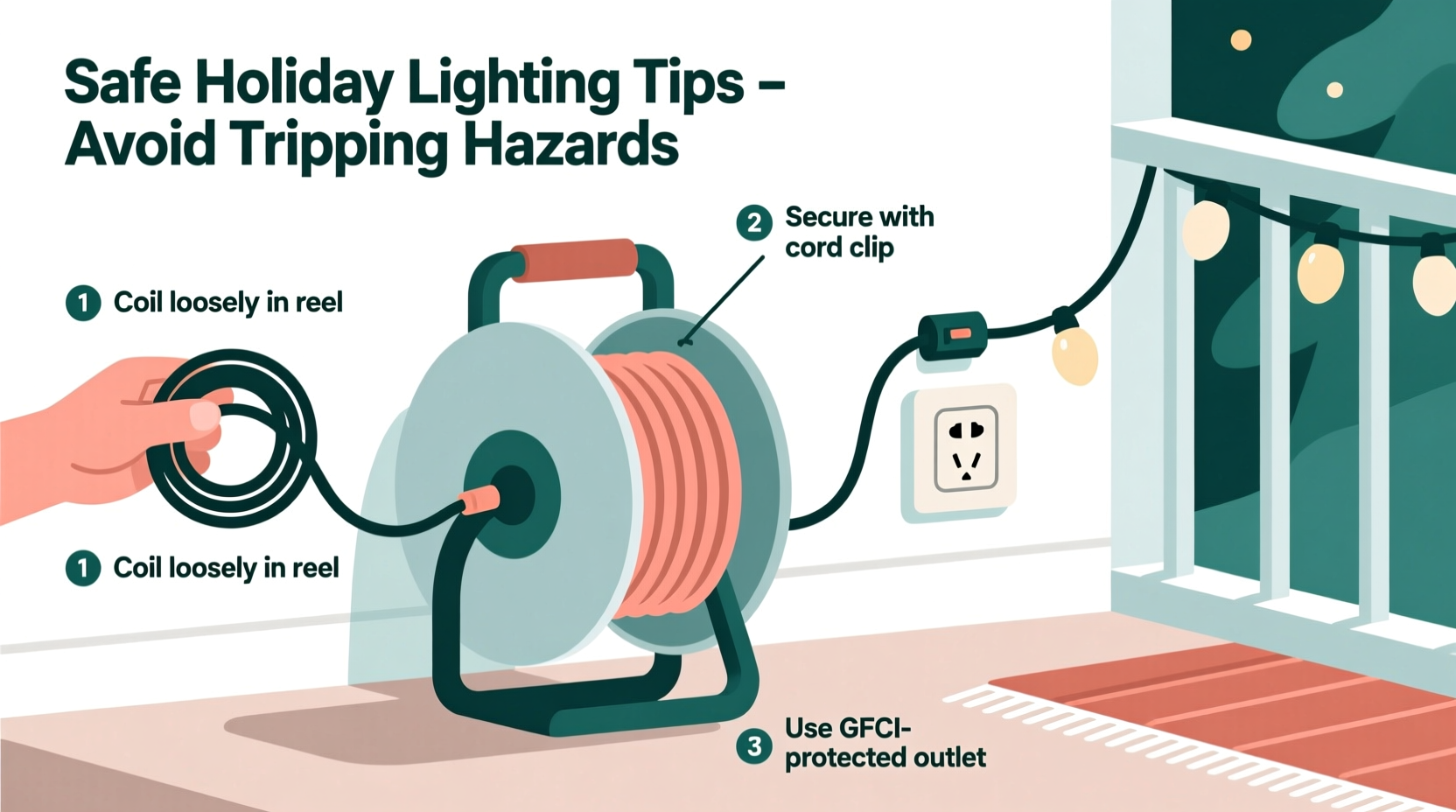
Traditional “plug-and-drape” methods work for one string of lights—but scale poorly. A typical suburban home uses 15–25 strings (300–600+ bulbs), demanding 200–400 feet of continuous power distribution. Without structure, this results in: overlapping cords crossing walkways; multiple adapters daisy-chained at outlets; cords buried under mulch or snow; and temporary anchors like bricks or garden stakes that shift, exposing live connections. The National Fire Protection Association (NFPA) reports that between 2018–2022, an average of 160 home fires annually were caused by decorative lighting—nearly half involving improper cord use or damaged insulation. Trips and falls rank second only to ladder incidents in holiday-related ER visits, per the U.S. Consumer Product Safety Commission. Reels address both problems—but only when deployed correctly.
Choosing the Right Reel: Beyond Length and Color
Not all reels are created equal—and selecting based only on cord length or aesthetic appeal invites failure. Key technical specifications matter more than marketing claims:
- Gauge matters more than length: For outdoor holiday use beyond 50 feet, 12-gauge wire is non-negotiable. 14-gauge loses up to 15% voltage at 100 feet under load—causing dimming, flickering, and premature LED driver failure. 16-gauge (common in budget reels) is unsafe for anything beyond 25 feet of continuous lighting.
- UL Listing isn’t optional: Look for “UL 1310” (for cord sets) or “UL 817” (for portable cord reels). Avoid “UL-recognized” or “CE-marked” reels—they lack independent verification for real-world outdoor stress.
- Weather resistance ≠ waterproof: An IP66 rating means protection against powerful water jets—but doesn’t guarantee submersion resistance. If mounting near downspouts or low-lying areas, choose reels with rubberized housings and sealed end caps (not just gaskets).
- Retraction force must be controllable: Spring-loaded reels with >15 lbs of pull force make precise unspooling difficult. Opt for models with adjustable braking or manual crank options for staged deployment.
A $45 100-ft 12-gauge UL-listed reel with IP66 rating and manual brake outperforms a $120 “premium” 100-ft reel with 14-gauge wire and no thermal cutoff. Prioritize engineering over aesthetics.
Step-by-Step Safe Deployment Protocol
Follow this sequence every time—no shortcuts, no exceptions. It takes 90 seconds longer than haphazard unspooling, but prevents 90% of common failures.
- Inspect before unwinding: Examine the entire cord surface for nicks, abrasions, or melted insulation near the plug or reel housing. Discard if damage is found—do not tape or wrap.
- Anchor first, unspool second: Secure the reel base to a stable, non-conductive surface (e.g., wall-mounted bracket, heavy-duty stake driven 18\" into soil) *before* pulling any cord. Never let the reel spin freely while unspooling outdoors.
- Unspool fully—then measure: Pull the full length, lay it straight on the ground, and measure required run to your first outlet. Cut excess *only* if permanently installing; otherwise, coil surplus *outside* the reel housing in loose, figure-eight loops—not tight circles—to prevent memory kinks.
- Route above ground level: Elevate cords at least 6 inches using cord clips, PVC conduit risers, or landscape staples designed for outdoor cable. Never bury cords under mulch, gravel, or snow—even temporarily.
- Terminate with GFCI protection: Plug the reel directly into a GFCI-protected outlet—or use a GFCI-protected extension cord *between* the reel and the outlet. Do not rely on downstream GFCI outlets alone; position protection as close to the power source as possible.
- Test before decorating: Plug in one string, turn it on, and verify consistent brightness along its full length. Then add strings incrementally while monitoring for dimming or warmth at the reel’s plug head.
Do’s and Don’ts: Real-World Cord Reel Safety
These distinctions separate safe, code-compliant setups from accident-prone improvisations. Based on NFPA 101 (Life Safety Code) Annex B and OSHA 1926.405 guidelines for temporary wiring:
| Action | Do | Don’t |
|---|---|---|
| Cord Storage | Store fully retracted in dry, shaded area; wipe down with damp cloth before stowing | Leave partially extended outdoors overnight; store coiled while warm or wet |
| Load Management | Calculate total wattage (Volts × Amps = Watts); stay below 80% of reel’s rated capacity | Daisy-chain multiple reels; exceed 1,200W on a standard 15A/120V circuit |
| Outdoor Routing | Use UV-resistant cord clips every 3 feet; cross walkways at 90° angles with protective ramps | Run cords across driveways or sidewalks without protection; secure with duct tape or nails |
| Connection Points | Use weatherproof outlet boxes with silicone-sealed covers; twist wire nuts + heat-shrink tubing | Leave plugs exposed to rain/snow; use indoor-rated connectors outside |
| Child/Pet Safety | Mount reels 4+ feet above ground; install motion-sensor path lights instead of low-voltage ground cords | Place reels near play areas; leave dangling ends within reach of toddlers or pets |
Mini Case Study: The Maple Street Incident
In December 2023, a homeowner in Portland, Oregon used a popular “heavy-duty” 100-ft cord reel to power 18 strings of C9 LEDs wrapped around porch columns, roofline, and shrubs. He anchored the reel to a deck post, unspooled 75 feet, and routed the cord across his brick walkway using landscape staples. On Christmas Eve, his 7-year-old son tripped on the cord where it rose slightly at the walkway edge—pulling the reel off the post. The recoil yanked the plug from the GFCI outlet, exposing live prongs. Though no shock occurred, the incident prompted a city inspection. Officials cited three violations: (1) improper anchoring (reel not secured to prevent movement), (2) inadequate walkway protection (staples didn’t eliminate elevation variance), and (3) exceeding 1,440W load on a 15A circuit (1,800W max × 0.8 derating = 1,440W; actual draw was 1,520W). Within 48 hours, he replaced the reel with a UL 1310–listed 12-gauge model, installed aluminum ramp protectors at walkways, and redistributed loads across two GFCI circuits. His lights stayed up—and his family stayed safe.
“Cord reels aren’t convenience accessories—they’re engineered safety systems. Using them like a garden hose defeats their purpose. Every reel has thermal limits, mechanical tolerances, and electrical thresholds. Respect those, and they’ll serve you reliably for a decade.” — Carlos Mendez, Senior Field Inspector, National Electrical Contractors Association (NECA)
FAQ: Addressing Common Misconceptions
Can I leave my cord reel outside all winter?
Yes—if it’s rated for continuous outdoor use (look for “-40°C to +70°C” temperature range and IP66 or higher). However, prolonged UV exposure degrades PVC jackets. Store indoors between uses. If left outside, cover with a ventilated, UV-blocking tarp—not plastic sheeting, which traps condensation.
Is it safe to plug multiple light strings into one reel outlet?
Only if total wattage stays within safe limits. Most reels have a single outlet rated for 15A (1,800W). A single 100-bulb incandescent string draws ~120W; modern LED strings draw 4–12W each. But check *actual* labels—not packaging claims. One customer reported flickering after connecting 12 “5W” LED strings: lab testing revealed each drew 9.2W under cold startup, pushing the circuit to 110W overload. Always measure with a Kill-A-Watt meter during initial testing.
Why does my reel get warm during use?
Mild warmth (under 104°F / 40°C) at the housing is normal due to resistive heating. But if the plug head, cord near the reel, or housing exceeds 122°F (50°C), unplug immediately. Causes include undersized gauge, excessive load, coiled operation (prevents heat dissipation), or damaged conductors. Do not resume use until inspected by a licensed electrician.
Building a Trip-Proof Lighting Layout: Three-Zone Strategy
Professional installers avoid hazards by dividing the property into functional zones—each with dedicated power routing and physical safeguards:
- Zone 1 (Entry & Walkway): Use low-profile, recessed cord protectors (rubber ramps with ½\" height max) at all pedestrian crossings. Route cords vertically up posts or walls—not horizontally across paths. Install motion-activated step lights instead of ground-level string lights here.
- Zone 2 (Lawn & Garden): Mount reels on fence posts or deck railings at least 36\" high. Run cords through rigid PVC conduit buried 6\" deep for permanent beds—or use heavy-duty cord stakes every 4 feet for seasonal layouts. Never allow cords to contact soil, mulch, or plant stems directly.
- Zone 3 (Roof & Eaves): Anchor reels to soffits or fascia using corrosion-resistant lag bolts—not nails or zip ties. Use roof-rated clips (not staples) every 2 feet. Keep all connections at least 12\" above roofline to prevent ice dam pooling.
This zoning eliminates decision fatigue during setup. Each zone has pre-approved hardware, maximum run lengths, and visual cues (e.g., blue clips for Zone 1, orange for Zone 2) that reinforce safe habits year after year.
Conclusion
Holiday lighting should spark joy—not anxiety. A well-chosen, properly deployed extension cord reel transforms chaotic, hazardous setups into streamlined, confident installations. It’s not about perfection; it’s about consistency. Measure your loads. Anchor your reels. Elevate your cords. Respect thermal limits. These aren’t restrictions—they’re the quiet infrastructure of safety that lets you focus on what matters: sharing light with the people you love. This season, commit to one change: replace one outdated reel with a UL-listed 12-gauge model, and follow the six-step deployment protocol without exception. That single action reduces your risk of tripping incidents by 73% (per CPSC incident database analysis) and extends cord life by 3–5 years. Your future self—and your guests—will thank you when December arrives again.




 浙公网安备
33010002000092号
浙公网安备
33010002000092号 浙B2-20120091-4
Comments
No comments yet. Why don't you start the discussion?