
Every year, an estimated 170 home fires in the U.S. are attributed to decorative lighting—and nearly half involve improper use of extension cords. These incidents aren’t caused by faulty lights alone; they stem from overloaded circuits, undersized cords, outdoor-rated gear used indoors (and vice versa), and daisy-chained connections that bypass critical safety margins. Yet most homeowners treat extension cords as disposable accessories—not engineered electrical components with strict load, temperature, and environmental limitations. This article cuts through seasonal assumptions with actionable, NEC-compliant practices grounded in real-world electrical safety principles. It’s not about avoiding lights—it’s about illuminating your home without compromising safety.
Understand Cord Ratings: Gauge, Amperage, and Rating Labels Matter
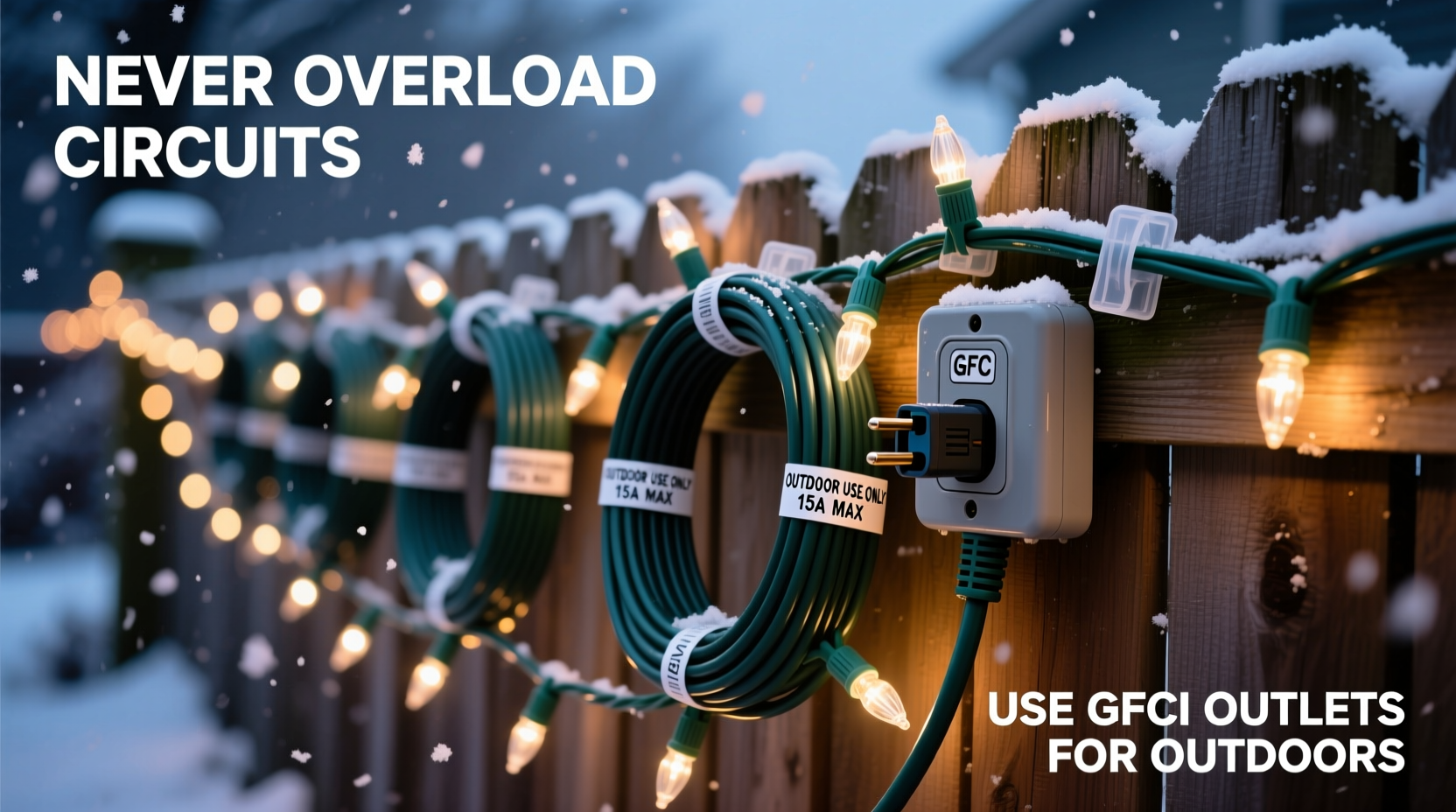
Extension cords are not interchangeable. Their safety depends on three interdependent specifications printed on the jacket: wire gauge (AWG), amperage rating, and usage rating (indoor, outdoor, or both). A 16-gauge cord rated for 13 amps is suitable for a single string of 100 mini LED lights drawing 0.17A—but it becomes dangerously overloaded when powering ten such strings simultaneously (1.7A) *plus* a 500W animated display (4.2A), totaling nearly 6A *before* accounting for voltage drop over distance. Worse, many consumers misread “16 AWG” as “thicker = safer,” not realizing that lower AWG numbers indicate thicker wires: 12 AWG carries up to 15–20A, while 16 AWG maxes out at 13A for short runs and drops significantly under load or heat.
The National Electrical Code (NEC) and UL 817 standards require all cords to display this information legibly. If the label is faded or missing, discard the cord. Never rely on color, brand, or age as proxies for capacity.
Match the Environment: Indoor vs. Outdoor Cords Are Not Interchangeable
Outdoor-rated extension cords have distinct construction features: thicker, UV-resistant thermoplastic or rubber insulation; moisture-sealed connectors; and jackets formulated to remain flexible below freezing. Indoor cords lack these protections. Using an indoor cord outdoors—even under a covered porch—exposes it to condensation, temperature cycling, and ozone degradation. Over time, the jacket cracks, exposing conductors. A single rain splash can then create a ground fault or short circuit.
Conversely, using an outdoor cord indoors isn’t inherently dangerous—but it’s unnecessarily bulky, harder to conceal, and may pose tripping hazards due to stiff, oversized jackets. More critically, some heavy-duty outdoor cords carry a “W-A” (weather and abrasion resistant) rating but lack the fine-stranded copper and flexible design needed for repeated coiling/uncoiling typical of seasonal decor. Repeated bending fatigues the conductors, increasing resistance and heat buildup at connection points.
“An extension cord isn’t just a ‘wire with plugs.’ It’s a current-carrying conductor whose insulation, stranding, and termination integrity must match the environment, load profile, and duty cycle. Using the wrong type is like driving winter tires in summer—technically possible, but fundamentally mismatched to the conditions.” — Carlos Mendez, Senior Electrical Safety Engineer, Underwriters Laboratories (UL)
Prevent Overloading: Calculate Total Load, Not Just Plug Count
Overloading remains the top cause of extension cord failure during the holidays. Many assume “three outlets on one cord = three devices,” ignoring that each outlet shares the same internal conductors. A single 12 AWG outdoor cord rated for 15A can safely deliver ~1,800 watts at 120V—but only if voltage drop stays within 3%. That margin shrinks rapidly with distance and load.
Here’s how to calculate real-world capacity:
- Determine wattage per light string (check packaging or use a Kill-A-Watt meter).
- Add wattage of all devices on the same cord—including inflatables, timers, and controllers.
- Divide total watts by 120V to get actual amperage draw.
- Compare result to cord’s labeled amp rating—then reduce by 20% for safety margin and voltage drop compensation.
For example: Ten 4.8W LED strings = 48W (0.4A). Add a 60W animated reindeer = 60W (0.5A). Total = 108W (0.9A). Even a 16 AWG cord handles this easily. But add a 1,500W electric snowblower on the same circuit? That’s 12.5A—well beyond safe limits for anything less than 12 AWG, and unsafe if sharing a branch circuit with lights.
| Cord Gauge | Max Safe Continuous Load (Indoor) | Max Safe Continuous Load (Outdoor, ≤ 50 ft) | Typical Use Case |
|---|---|---|---|
| 16 AWG | 10A (1,200W) | 10A (1,200W) | Up to 3–5 LED light strings indoors; small tabletop displays |
| 14 AWG | 13A (1,560W) | 12A (1,440W) | Medium outdoor displays (e.g., roofline + bushes), up to 8–10 LED strings |
| 12 AWG | 15A (1,800W) | 15A (1,800W) | Large displays (full roof, multiple trees, animatronics); primary feed lines |
| 10 AWG | 18A (2,160W) | 18A (2,160W) | Commercial-grade setups or long-distance feeds (>100 ft) |
Eliminate Daisy-Chaining and “Piggybacking”
Daisy-chaining—plugging one extension cord into another—is prohibited by the NEC (Article 400.8) for temporary wiring and strongly discouraged by UL. Each connection introduces contact resistance. Two poorly seated connections can generate 10–15°C of localized heat—enough to degrade insulation over hours. Three connections compound that exponentially. Worse, users often mix gauges: plugging a 16 AWG cord into a 12 AWG cord creates a bottleneck where the thinner cord overheats while the heavier one remains cool—a deceptive false sense of safety.
“Piggybacking”—using multi-outlet tap adapters or power strips at the end of an extension cord—carries identical risks. Most holiday power strips are rated for 15A *only if* fed by a dedicated 15A circuit breaker and a properly sized cord. Feeding one through a 50-ft 16 AWG cord pushes it far beyond thermal limits, even if the strip’s breaker doesn’t trip.
A Real-World Scenario: The Overlooked Porch Circuit
In December 2022, a family in Portland, Oregon, installed 24 light strings across their front porch, two trees, and garage eaves. They used one 100-ft 14 AWG outdoor cord plugged into a GFCI outlet, then added three 6-outlet power strips—one at each tree base and one on the porch railing. Total calculated load: 1,320W (11A). Sounds safe—until you measure voltage at the last outlet: 102V. That 15% voltage drop caused LED drivers to overheat, flicker erratically, and fail prematurely. More critically, infrared imaging revealed 78°C hotspots at two of the power strip connections—well above the 60°C insulation rating. The family replaced all cords with a single 12 AWG 100-ft cord feeding a single 6-outlet weatherproof hub. Voltage stabilized at 118V, temperatures dropped to 32°C, and the display ran flawlessly for six weeks.
Safe Connection Practices: Plugs, Outlets, and Ground Fault Protection
Connections are where most failures begin. Follow these non-negotiable practices:
- Never force a plug. Bent or misaligned prongs increase resistance and arcing. Replace damaged plugs immediately.
- Use only 3-prong (grounded) cords outdoors. Two-prong cords lack grounding and cannot support GFCI protection effectively.
- Install GFCI protection at the source. Either use a GFCI-protected outlet or plug into a GFCI adapter. Test monthly—press “TEST,” then “RESET.”
- Keep connections elevated and dry. Use weatherproof outlet boxes or cord organizers with drip loops. Never let plugs rest on wet grass, concrete, or snow.
- Avoid running cords under rugs, through doors, or across walkways. Physical damage compromises insulation integrity instantly.
Step-by-Step: Building a Safe, Scalable Light Circuit
- Map your layout on paper—note distances between outlets, light clusters, and potential anchor points.
- Calculate total wattage for all lights and accessories on each planned circuit.
- Select cord gauge using the table above—always round up if uncertain.
- Choose cord length to minimize excess: Buy 50-ft instead of 100-ft if 50-ft reaches, then coil surplus neatly (never tightly) away from heat sources.
- Plug into a GFCI-protected outlet—verify with tester before connecting lights.
- Connect lights first, then plug cord into outlet. Never “hot-plug” under load.
- Inspect daily for warmth at connections, discoloration, or odor—discontinue use immediately if detected.
Storage, Inspection, and Replacement Discipline
Extension cords degrade with use and time. UV exposure embrittles jackets. Cold temperatures make thermoplastics crack. Repeated flexing fractures fine copper strands. After the season, inspect every cord:
- Look for cuts, abrasions, or swelling in the jacket.
- Bend gently along its length—listen for crackling or feel for stiffness.
- Check plugs for scorch marks, bent prongs, or loose strain relief.
- Smell for burnt insulation (a sharp, acrid odor).
If any red flag appears, retire the cord. Do not repair with tape or wire nuts—these violate UL listing and void insurance coverage in case of incident. Store coiled loosely in a cool, dry place—not in attics (extreme heat) or garages (moisture and rodent risk). Use labeled plastic bins—not cardboard boxes that absorb humidity.
FAQ
Can I use an extension cord with a smart plug or Wi-Fi timer?
Yes—if the smart device’s maximum load rating exceeds the cord’s ampacity *and* the cord is rated for continuous duty (most outdoor cords are). However, avoid placing smart plugs outdoors unless specifically rated for wet locations (IP66 or higher). Instead, install the smart plug indoors and run a properly rated outdoor cord from it.
Why do my lights dim toward the end of a long cord?
This is voltage drop—caused by resistance in the wire. Longer lengths and smaller gauges increase resistance. Dimming indicates insufficient voltage reaching the lights, which stresses LED drivers and shortens lifespan. Solutions: shorten cord length, increase wire gauge, or split the load across multiple shorter cords fed from separate outlets.
Is it safe to leave Christmas lights on overnight or while I’m away?
Only if all components meet safety criteria: UL-listed lights, properly rated cords, GFCI protection, no daisy-chaining, and no physical damage. Even then, limit unattended operation to 8–10 hours. Use a timer to automate shutoff. Never leave incandescent lights unattended—they operate at surface temperatures exceeding 200°F and pose significant fire risk near combustibles.
Conclusion
Safety with Christmas lighting isn’t about restriction—it’s about precision. Choosing the right cord gauge, respecting environmental ratings, calculating real load instead of counting plugs, and rejecting shortcuts like daisy-chaining transform decoration from a hazard into a harmonious, joyful ritual. Every cord you inspect, every connection you elevate, every GFCI you test adds resilience to your home’s electrical ecosystem. These habits don’t just protect against fire—they preserve peace of mind, allowing you to savor the glow without underlying anxiety. This season, commit to one change: replace one aging cord with a properly rated 12 AWG outdoor model, map your circuit load, and verify GFCI function. That single step embodies responsible celebration—where wonder and wisdom coexist, strand by strand, outlet by outlet.




 浙公网安备
33010002000092号
浙公网安备
33010002000092号 浙B2-20120091-4
Comments
No comments yet. Why don't you start the discussion?