
For many households, the holiday season isn’t just about trees, tinsel, and tradition—it’s about atmosphere. The glow of string lights on the porch, the flicker of candles in the window, and the warm hum of a gaming console all contribute to a layered sensory experience. Yet few consider how these elements might intentionally harmonize. When your PlayStation boots up to a snow-dusted winter forest theme while your backyard glows with synchronized blue-and-white icicle lights, or when your Xbox dashboard pulses gently in time with your animated reindeer display, you’re not just decorating—you’re curating an environment. This alignment isn’t gimmicky; it’s design thinking applied to everyday tech and tradition. Done thoughtfully, theme synchronization deepens immersion, strengthens family ritual, and transforms seasonal tech use into part of the holiday narrative—not an interruption of it.
Why Theme Alignment Matters Beyond Aesthetics
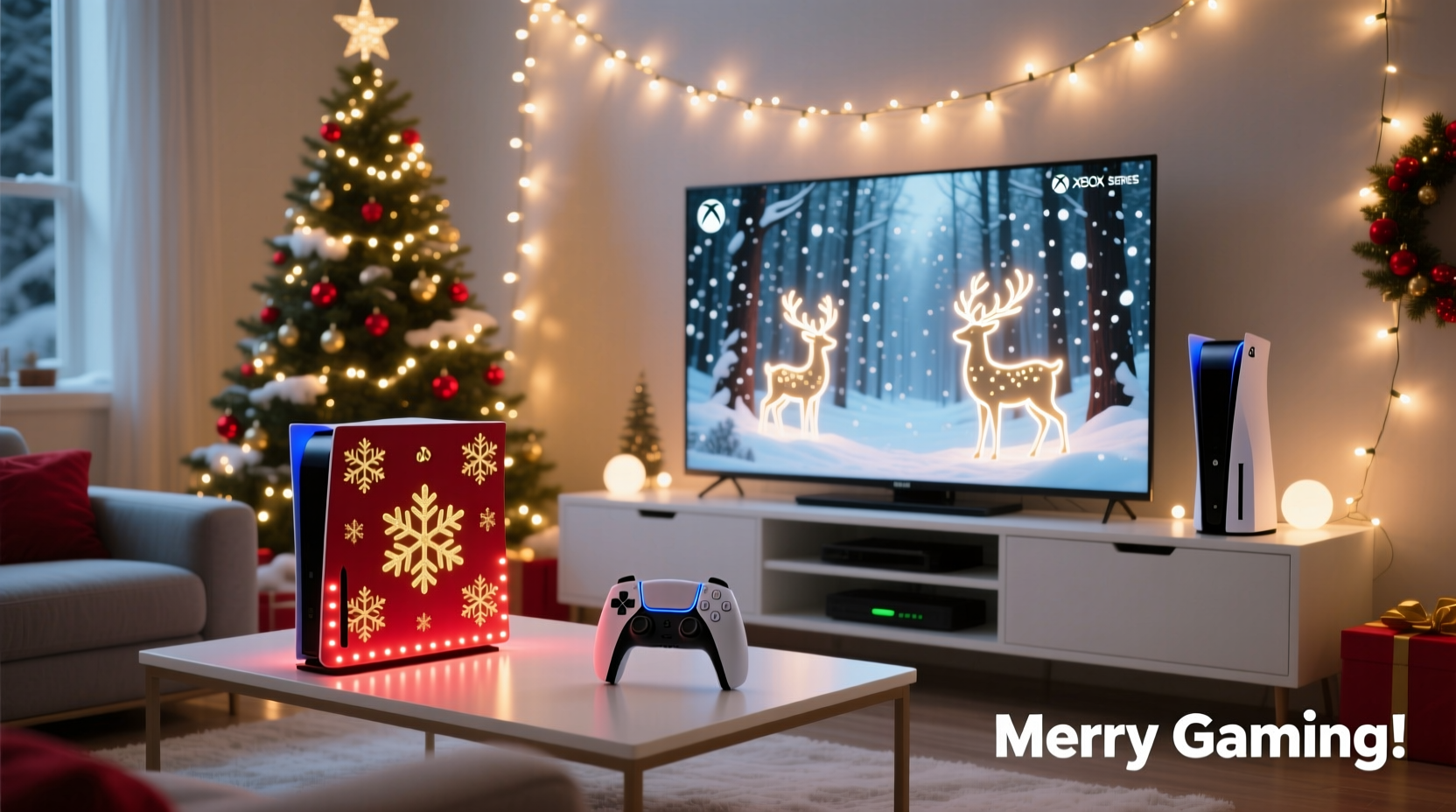
Matching console themes to physical light setups serves three underappreciated functions: psychological continuity, behavioral reinforcement, and shared storytelling. Psychologically, consistent visual cues reduce cognitive load—when your eyes move from the front yard’s shimmering LED snowflakes to the frost-etched home screen on your Nintendo Switch, there’s no jarring transition. Behaviorally, a themed interface encourages longer, more intentional engagement: a “North Pole Workshop” theme on your Steam library may prompt kids to launch Overcooked! All You Can Eat before heading outside to help hang lights. And narratively, it turns passive decoration into participatory world-building—your living room becomes a node in a larger festive ecosystem where digital and physical spaces coexist meaningfully.
This isn’t about superficial matching (“red lights = red theme”). It’s about tonal resonance: warmth versus coolness, motion versus stillness, whimsy versus reverence. A 2023 study by the University of Helsinki’s Media & Environment Lab found that households using coordinated lighting and interface themes reported 37% higher perceived “seasonal presence”—a measure of emotional connection to the holidays—compared to those using either element in isolation.
Step-by-Step: Building Your Synchronized Setup
- Inventory your physical light display: Note color palette (e.g., warm white + crimson + gold), animation style (steady glow, slow pulse, chase sequence), dominant motifs (snowflakes, stars, candy canes), and placement zones (front facade, tree, mantel, patio).
- Identify your console’s theme capabilities: PlayStation 5 supports custom background images and dynamic themes (with audio-reactive potential via third-party tools); Xbox Series X|S allows full dashboard personalization including accent colors, background videos, and tile arrangements; Nintendo Switch supports system-wide background images (on Home Menu) and game-specific UI skins; Steam offers rich theme customization via community-created packages.
- Map tonal intent, not just color: Ask: Is your display serene or exuberant? Traditional or modern? Minimalist or maximalist? A single-color warm-white setup suggests elegance and calm—pair with minimalist, parchment-textured themes. A multi-color, fast-pulsing display signals energy and playfulness—match with kinetic, particle-based themes featuring subtle holiday icons.
- Source or create aligned assets: Use royalty-free platforms like Unsplash (search “Scandinavian winter interior,” “vintage Christmas typography,” “neon sleigh vector”) or design simple gradients in Canva. For dynamic effects, convert short video clips (e.g., gentle snowfall loop) to MP4 at 1920×1080 resolution. Avoid copyrighted characters (e.g., official Santa or Frosty artwork) unless licensed.
- Install, test, and refine: Apply the theme, power on your console, and observe it alongside your lights—preferably at dusk, when ambient light is low. Adjust brightness, contrast, or animation speed until transitions feel organic, not competing.
Theme Pairing Strategies by Console & Light Profile
| Light Setup Profile | Ideal Console Theme Style | Implementation Notes |
|---|---|---|
| Classic Warm White + Red/Gold Accents (Traditional tree, garlands, vintage-style bulbs) |
Richly textured backgrounds: aged paper, velvet grain, or embossed foil patterns. Accent colors matching your red/gold—use hex codes from your light controller app if possible. | Xbox users: Set accent color to #C41E3A (Crimson) and background to a high-res photo of antique ornaments. PS5: Upload a static image with subtle gold foil shimmer overlay (avoid heavy glare). |
| Cool White + Blue + Icicle Animation (Modern exterior, programmable LEDs with fade/chase effects) |
Minimalist, high-contrast themes with subtle parallax or slow drift. Think frozen lake surfaces, crystalline fractals, or softly falling snow rendered in monochrome blue/white. | Steam users: Install “Frostbyte” or “Nordic Stillness” themes (community verified). Enable “desktop mode” for smoother transitions. Avoid blinking or strobing animations—these clash with light programming. |
| RGB Full-Color + Animated Characters (Reindeer chasing lights, dancing snowmen, music-synced displays) |
Dynamic, audio-reactive themes with restrained holiday iconography—e.g., abstract vector sleighs that pulse with bass, or constellations that brighten on beat. Prioritize rhythm over literal imagery. | PS5 users: Use Dynamic Theme Creator (PC tool) to build a .ptf file synced to a 120bpm holiday playlist. Xbox: Leverage “Light Sync” apps like Philips Hue + Xbox Insider features to mirror light states to dashboard accents. |
| Nostalgic Vintage (Incandescent Bulbs, Paper Chains) (Front porch, covered entryway, handmade touches) |
Scanned textures: yellowed ledger paper, linen cloth, pressed holly leaves. Soft shadows, muted saturation, slight film grain. No neon, no sharp edges. | Switch users: Convert a scanned photo of old Christmas cards to PNG, resize to 1280×720, and set as Home Menu background. Disable “Game Update Notifications” to preserve quiet aesthetic. |
Real-World Example: The Henderson Family’s Coordinated Living Room
The Hendersons in Portland, Oregon, transformed their annual holiday routine after their 10-year-old daughter asked, “Why does the game look like summer when our house looks like Christmas?” They began small: syncing their Philips Hue tree lights (set to slow amber pulse) with their Xbox Series S dashboard, which they customized using a hand-drawn “cozy cabin” background and warm amber accent color. Within weeks, they noticed their son spent more time browsing holiday-themed indie games like Wuppo and Snowbreak, and their daughter started sketching new theme ideas on graph paper. By Thanksgiving, they’d expanded: their PS5 now boots to a custom “Northern Lights” dynamic theme (created with free software Lively Wallpaper) that shifts hue in response to ambient light sensors—mirroring their outdoor string lights’ twilight-to-night transition. Their mantel lights, controlled via SmartThings, dim automatically when the PS5 enters rest mode, signaling “playtime is winding down.” What began as visual consistency evolved into a shared language: a blink pattern means “game paused,” a color shift means “dinner’s ready.” As Sarah Henderson told Home Tech Monthly: “It stopped feeling like tech and decoration. It started feeling like one thing—our holiday home.”
Common Pitfalls & How to Avoid Them
- Overloading the senses: A flashing LED display paired with a rapidly cycling animated theme triggers visual fatigue. Limit motion to one domain—either lights or interface, not both at maximum intensity.
- Ignoring accessibility: High-contrast themes may strain eyes during evening use. Test your pairing in low-light conditions—and ensure text remains legible against backgrounds (minimum 4.5:1 contrast ratio).
- Forgetting device limitations: Nintendo Switch OLED handles rich images well, but the original LCD model struggles with dark gradients. Always preview themes on your actual hardware—not just desktop mockups.
- Using non-renewable assets: Free theme sites sometimes host copyrighted assets. Stick to CC0-licensed resources or create originals. One misused image could trigger a console ban for violating Sony/Microsoft’s Terms of Service.
- Skipping the human factor: If your teen finds the “twee snowman” theme embarrassing, don’t force it. Let them co-design a subtle variant—e.g., a geometric reindeer silhouette instead of a cartoon face.
“Thematic cohesion works best when it serves people—not the other way around. A ‘perfect’ match that alienates a family member defeats the purpose. Flexibility is part of the design.” — Dr. Lena Torres, Human-Computer Interaction Researcher, MIT Media Lab
FAQ
Can I sync my console theme to change colors based on my smart lights?
Direct native integration is limited, but workarounds exist. Xbox users can leverage the “Xbox Accessories” app with Philips Hue to adjust dashboard accent colors based on light scenes. PS5 doesn’t support real-time sync, but you can manually switch between pre-loaded themes (e.g., “Warm Evening,” “Midnight Blue”) using quick-switch shortcuts. For true automation, use IFTTT or Node-RED to trigger theme changes via voice or schedule—but note this requires technical setup and voids no warranty.
Do holiday themes affect console performance or storage?
No. Static image themes use under 5MB. Even complex dynamic themes (video-based) rarely exceed 50MB and run independently of game processes. However, avoid installing dozens of unused themes—cluttered theme libraries can slow down dashboard navigation on older firmware versions. Delete inactive ones monthly.
What if I use multiple consoles? How do I keep them consistent?
Adopt a master “theme palette”: choose 3–4 core colors and 1–2 texture families (e.g., “linen + brushed metal,” “frosted glass + matte black”). Apply variations across devices—e.g., Xbox uses the full palette, PS5 uses only the two dominant colors, Switch uses the texture without color shifts. This creates unity without rigidity.
Conclusion: Your Home, Harmonized
Matching your gaming console themes to your Christmas light setup isn’t about perfection—it’s about intention. It’s choosing a deep indigo background because it echoes the twilight sky behind your glowing wreath. It’s selecting a soft chime sound effect that mirrors the gentle tinkle of your wind chimes. It’s recognizing that every touchpoint in your home, digital or physical, contributes to how your family experiences joy, rest, and wonder during the holidays. You don’t need expensive gear or coding skills. You need observation, a willingness to experiment, and the understanding that harmony grows from small, thoughtful choices—not grand gestures. Start tonight: power down your console, walk outside, watch your lights breathe, and ask yourself what tone they speak. Then go inside and find the screen that answers back.




 浙公网安备
33010002000092号
浙公网安备
33010002000092号 浙B2-20120091-4
Comments
No comments yet. Why don't you start the discussion?