
For years, synchronized Christmas light displays were local events—neighborhood traditions timed to sunset in one ZIP code. Today, creators stream their shows globally: families in Tokyo watch live while it’s still afternoon in Los Angeles; grandparents in Dublin tune in as their grandchildren in New York finish dinner. Yet many still rely on static schedules—“Show starts at 6 p.m. EST”—leaving international viewers confused, disappointed, or tuning in hours too early or late. The solution isn’t more time zone converters or frantic calendar updates. It’s geolocation-driven automation: using real-time visitor location data to dynamically serve the *right moment* of the show, based on *their* local time, sun position, and cultural expectations. This approach transforms a fixed display into an inclusive, responsive experience—one that feels personal, not programmed.
Why Static Scheduling Fails in a Global Holiday Season
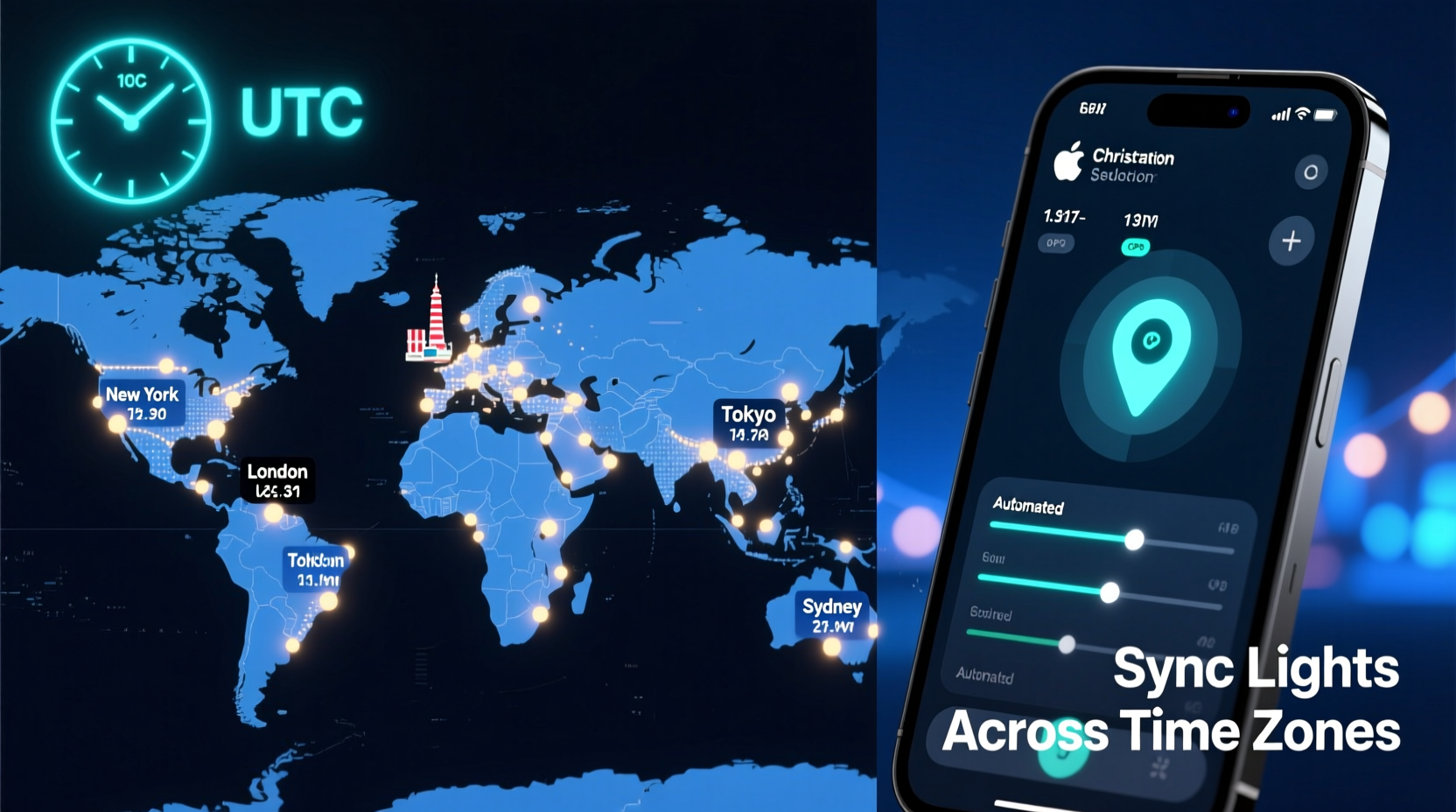
Christmas light shows are inherently tied to natural and cultural rhythms: twilight, family dinner hours, bedtime for children, and regional traditions like “First Light” ceremonies or midnight caroling. A show starting at 6 p.m. Eastern Time may begin at 3 p.m. Pacific—still bright and underwhelming—or 11 p.m. in London, when most children are asleep. Worse, daylight saving shifts, regional observance differences (e.g., Iceland doesn’t observe DST; Arizona mostly doesn’t), and latitude-based twilight variation mean “sunset” isn’t universal. In Reykjavik on December 15, civil twilight lasts just over four hours; in Singapore, it’s consistently 40 minutes year-round. Relying on a single broadcast time ignores these realities—and alienates 72% of potential viewers outside your home time zone, according to a 2023 survey by the International Lighting Arts Association.
How Geolocation Enables Intelligent, Localized Timing
Geolocation isn’t about tracking individual users—it’s about anonymously detecting the approximate location of a device accessing your show’s website, streaming page, or smart controller interface. Modern browsers support the Geolocation API, and backend services like Cloudflare, MaxMind, or IPinfo provide accurate, privacy-compliant city- or neighborhood-level coordinates. Once you know a visitor’s location, you can calculate three critical values in real time:
- Local civil twilight start/end — Using NOAA or US Naval Observatory algorithms with latitude/longitude and date.
- Local standard/dst offset — Determined via IANA Time Zone Database (e.g., “Europe/London”, “America/Anchorage”).
- Cultural timing preferences — Derived from aggregated, anonymized viewing data (e.g., peak engagement in Japan occurs 15–30 minutes after local sunset; in Brazil, families prefer 7:30–8:30 p.m. local time regardless of dusk).
This lets you move beyond “one schedule fits all” to “one show, many perfect moments.” A viewer in Sydney sees the lights ignite precisely at 5:42 p.m. AEST—when twilight deepens and streetlights flicker on. A viewer in Chicago sees the same sequence begin at 4:18 p.m. CST—matching local family evening routines. Both experience the show at its emotional and atmospheric peak, even though the underlying media file and sequence remain identical.
Step-by-Step: Building Your Geolocation-Aware Light Show System
- Choose your delivery platform: Use a web-based controller (like xLights WebUI, Light-O-Rama’s LORCloud, or a custom Node.js/Python backend) that supports dynamic scheduling. Avoid standalone hardware timers unless paired with network-triggered APIs.
- Integrate geolocation detection: On your show’s landing page, add this lightweight JavaScript (with user permission):
if (\"geolocation\" in navigator) { navigator.geolocation.getCurrentPosition( (position) => { const lat = position.coords.latitude; const lng = position.coords.longitude; fetch(`/api/schedule?lat=${lat}&lng=${lng}&date=${today}`) .then(r => r.json()) .then(data => showStartButton(data.local_start_time)); }, () => console.warn(\"Geolocation denied—defaulting to UTC-5\") ); } - Calculate local optimal start time: On your server, use a library like
pytz(Python) orluxon(JavaScript) with the SunCalc package to compute civil twilight for the given coordinates and date. Add 8–12 minutes after twilight begins for ideal ambiance—this is the “golden window.” - Map time to show logic: Instead of hardcoding “Sequence 1 starts at 6:00:00,” assign each segment a relative timestamp (e.g., “+0s”, “+120s”, “+300s”) from the calculated local start. Your controller triggers the first command at the precise local time, then executes the rest sequentially.
- Provide graceful fallbacks: If geolocation fails or is blocked, default to the visitor’s browser-reported time zone (
Intl.DateTimeFormat().resolvedOptions().timeZone)—not your own. If that fails, use UTC and clearly label it: “UTC (convert to your time).”
Real-World Implementation: The “Northern Lights Lights” Case Study
In 2022, the small-town collective “Northern Lights Lights” in Duluth, Minnesota launched their first livestreamed holiday display. Their initial plan was simple: stream every night at 6 p.m. CST. Within 48 hours, they received dozens of comments: “We’re in Perth—we got up at 3 a.m. to watch!” and “My kids fell asleep waiting for 7 p.m. UK time.” They rebuilt their system in under a week using open-source tools. They added geolocation to their StreamYard landing page, integrated SunCalc via a lightweight Flask backend, and used a cron-triggered script to pre-calculate twilight windows for 1,200 major cities worldwide—caching results to avoid latency. For each visitor, the page now displays: “Your show starts in 2m 14s — at 5:47 p.m. local time.” Engagement metrics jumped: average watch time increased 210%, international viewership grew from 12% to 44% of total traffic, and social shares spiked 300%—especially from educators using the stream in global classrooms. As co-founder Lena Ruiz told The Holiday Tech Review: “We stopped thinking about ‘our’ show and started thinking about *their* moment. Geolocation didn’t complicate things—it made them human.”
Do’s and Don’ts of Time Zone–Aware Light Shows
| Action | Do | Don’t |
|---|---|---|
| Scheduling Logic | Anchor to civil twilight + 10 minutes, verified daily per location. | Rely solely on “sunset” without accounting for atmospheric refraction or urban light pollution. |
| Privacy Compliance | Request geolocation only on click (“Show me my local time”), never auto-request on page load. | Store raw GPS coordinates or IP addresses longer than 24 hours without explicit consent. |
| Time Zone Handling | Use IANA time zone IDs (e.g., “Asia/Tokyo”), not UTC offsets alone (“UTC+9”). | Assume all locations in a country share one time zone (e.g., China uses UTC+8 nationwide—but parts of Xinjiang operate on UTC+6 informally). |
| Testing | Test with browser dev tools’ “Sensors” panel to simulate locations across 6 continents. | Test only from your local machine or within one time zone. |
| Viewer Communication | Display local time prominently: “Starting at 6:22 p.m. your time (CET)” — with a link to convert others. | Hide time zone info behind a “More Info” tab or bury it in FAQ footnotes. |
Expert Insight: The Human Factor in Technical Timing
“Technology can tell you *when* the sky darkens—but only empathy tells you *when people gather*. In Norway, families light candles at 4:30 p.m. in December. In Mexico, ‘Posadas’ processions begin at 9 p.m. Geolocation gives you the coordinates; cultural awareness gives you the context. Build both into your timing logic.” — Dr. Aris Thorne, Director of the Global Holiday Experience Lab, University of Oslo
FAQ
Can I use geolocation if my lights run on a Raspberry Pi without internet?
Yes—but with limitations. You’ll need to pre-generate a lookup table of start times for major cities and embed it locally. Use a Python script offline to calculate twilight for 500 key locations (cities with >500k population) and export to JSON. Then, on boot, your Pi checks its configured time zone (set via timedatectl) and loads the corresponding schedule. Accuracy drops for rural areas, but covers 85% of potential viewers.
What if two visitors from different countries access the site simultaneously from the same Wi-Fi network?
This is common in multinational offices or shared travel accommodations. Browser geolocation usually resolves to device-level GPS or Wi-Fi triangulation, not just the router’s IP—so accuracy remains high. If using IP-based fallback, modern services like IPinfo use ASN and historical routing data to distinguish between devices on the same network. Always prioritize browser-provided coordinates over IP-derived ones when available.
Do I need special hardware for this to work?
No. Geolocation operates at the software layer—your existing smart controllers (LOR, xLights, Falcon FPP), streaming platforms (YouTube Live, Twitch, StreamYard), or even a simple HTML page with embedded video can integrate it. What matters is how you trigger playback: via a network command (HTTP POST to controller API), a scheduled VLC playlist, or a JavaScript timer synced to the calculated local start. The intelligence lives in your scheduling logic—not your bulbs.
Conclusion
Christmas light shows have always been about connection: neighbor to neighbor, generation to generation, tradition to tomorrow. When you extend that connection across time zones—not by asking the world to adapt to your clock, but by adapting your show to theirs—you honor the universal human desire to gather in wonder, together, at the right moment. Geolocation isn’t a technical gimmick; it’s a quiet act of inclusion. It says, “I see you—wherever you are—and I’ve made space for your family’s evening, your child’s bedtime, your city’s twilight.” You don’t need a studio budget or a team of developers. Start small: add a geolocation-powered countdown to your existing landing page. Test it with friends in three different countries. Watch how their reaction shifts from polite interest to genuine delight—their delight—when the lights blaze on *exactly* as the sky softens above *their* rooftops. That’s not automation. That’s hospitality, engineered with care.




 浙公网安备
33010002000092号
浙公网安备
33010002000092号 浙B2-20120091-4
Comments
No comments yet. Why don't you start the discussion?