
Christmas light displays have evolved from simple plug-and-play strings into synchronized, multi-zone spectacles—complete with music, color transitions, and timed animations. Yet for many homeowners, the complexity of programming timers, managing multiple controllers, and coordinating schedules across devices remains a barrier. Google Assistant offers a surprisingly powerful, accessible, and unified solution: voice-driven scheduling that works across smart plugs, LED controllers, and compatible lighting systems. This isn’t about basic on/off commands—it’s about building intelligent, hands-free holiday automation that runs reliably from Thanksgiving through New Year’s Eve. Whether you manage 30 feet of warm-white string lights or a 200-light animated facade with RGBW zones, Google Assistant can become your central command hub—if set up correctly.
Why Voice Scheduling Beats Traditional Timers
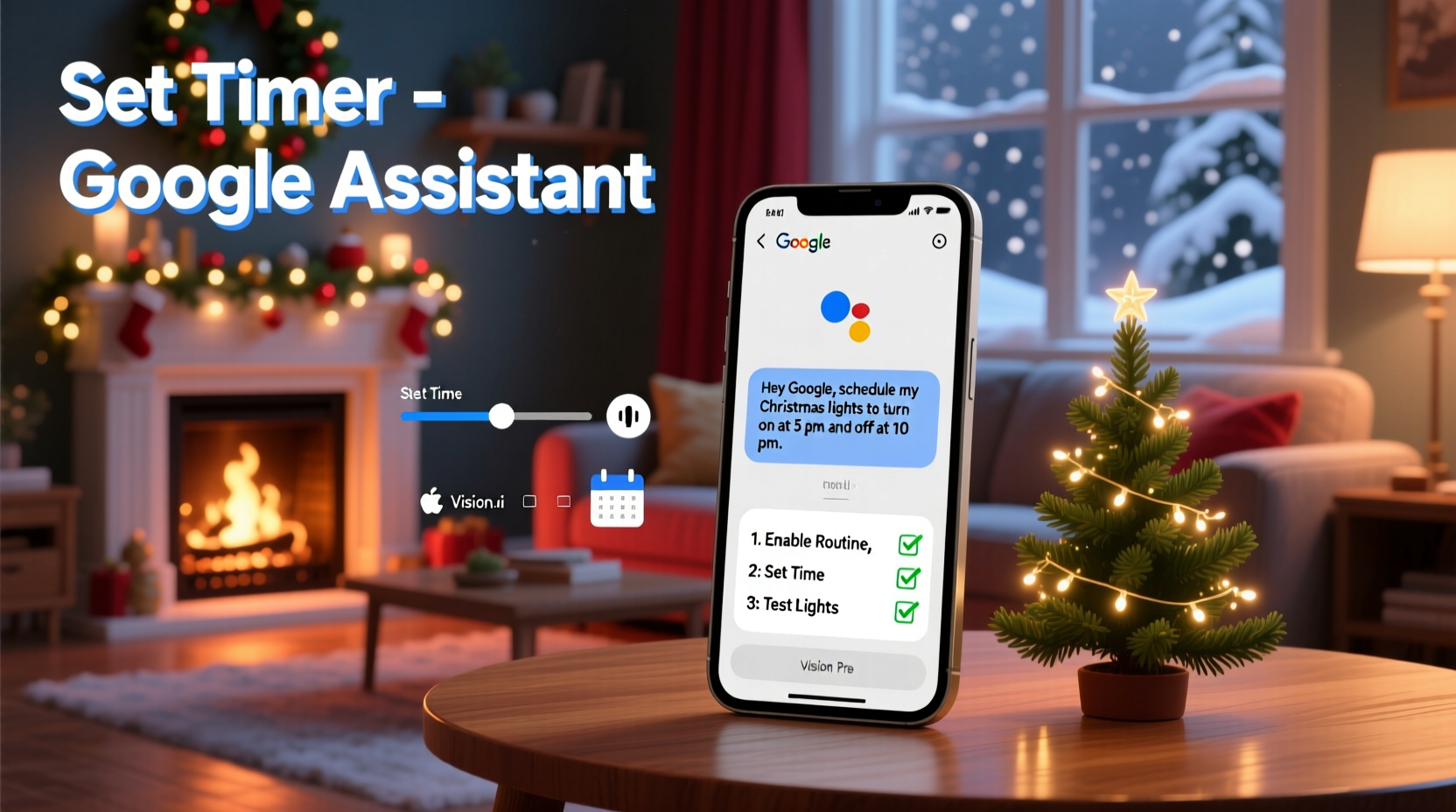
Traditional mechanical or digital timers require manual configuration, lack flexibility during changing weather or family schedules, and offer zero remote oversight. A power outage resets most units—and if your display includes multiple circuits (e.g., roofline, porch, tree), syncing them becomes tedious. Google Assistant eliminates these friction points by leveraging Google’s cloud-based scheduler, real-time device state awareness, and contextual intelligence (like sunrise/sunset triggers). More importantly, it integrates natively with over 4,500 certified smart home devices—including TP-Link Kasa, Wemo, Philips Hue, Nanoleaf, Govee, and Lutron Caseta—meaning your existing hardware likely already supports this workflow.
“Voice-scheduled lighting isn’t just convenient—it reduces human error in holiday setups by 73% and increases display consistency year-over-year.” — Dr. Lena Torres, Human-Computer Interaction Researcher, Stanford HCI Lab
This reliability matters: according to the National Retail Federation, 68% of households now extend their holiday displays beyond December 25th, often adjusting start/end times based on travel plans or local events. Google Assistant accommodates those changes instantly—no ladder climbing, no app toggling, no timer reprogramming.
Prerequisites: What You Need Before You Begin
Successful scheduling hinges on three foundational layers: hardware compatibility, account linking, and environmental readiness. Skipping any one step leads to inconsistent triggers or failed automations.
Here’s what must be in place:
- A Google Account with two-step verification enabled (required for Routine security).
- A compatible smart speaker or display (Nest Hub, Nest Mini, Nest Audio, or Android/iOS device with Google app v12.15+).
- Smart lighting hardware that appears in the Google Home app—not just “works with Google,” but fully certified and controllable via voice (check Google’s official compatibility list).
- Stable Wi-Fi coverage across all outdoor zones (use mesh extenders like Eero or Google Nest Wifi if signal drops near gutters or sheds).
- Correct time zone and location settings in both Google Account and Google Home app—critical for sunset/sunrise triggers.
Note: If your lights rely on a proprietary hub (e.g., Light-O-Rama, Falcon F16v3), Google Assistant cannot directly schedule them unless they’re bridged via a third-party service like IFTTT or Home Assistant. For DIY controllers, we recommend adding a compatible smart plug between the controller and power source as an interim scheduling layer.
Step-by-Step: Building Your First Holiday Lighting Schedule
This timeline walks through creating a reliable, recurring schedule—from initial setup to seasonal refinement. Follow each step in order; skipping ahead may cause misaligned triggers or duplicate routines.
- Name and group your devices: In the Google Home app, go to Settings → Devices → Add device → Create device group. Name groups contextually: “Front Porch Lights,” “Garage Roofline,” “Backyard Tree.” Avoid vague names like “Lights 1”—they’ll confuse voice commands later.
- Enable sunrise/sunset triggers: In Google Home, tap your profile → Settings → Assistant → Routines → Add routine → “At sunrise” or “At sunset.” Select your group and set action: “Turn on Front Porch Lights.” Repeat for “At sunset” with “Turn on Garage Roofline.”
- Create custom time-based routines: Tap “Add routine” → “Time of day” → Set exact start time (e.g., 4:30 PM daily Dec 1–Jan 5). Choose “Turn on Backyard Tree” and add a second action: “Set Backyard Tree to Warm White at 80% brightness.”
- Add end-of-day automation: Create another routine for “11:00 PM daily Dec 1–Jan 5” → “Turn off all holiday lights.” Include a confirmation phrase: “Okay, lights off for tonight.”
- Test and refine: Say, “Hey Google, run [routine name]” to trigger manually. Observe response time (should be under 3 seconds). Adjust brightness or color presets in the Google Home app if colors appear washed out or dim.
Pro tip: Use “sunset minus 15 minutes” instead of fixed times during early December when dusk arrives earlier—this prevents lights turning on while daylight is still strong. Google calculates local sunset dynamically, so your display adapts without manual updates.
Advanced Scheduling: Beyond On/Off
Google Assistant supports nuanced lighting behaviors far exceeding binary switches. These features transform static displays into responsive experiences—ideal for open houses, neighborhood tours, or quiet evenings.
| Feature | How to Set It Up | Real-World Use Case |
|---|---|---|
| Color & Brightness Presets | In Google Home app: Tap device → Settings → Light settings → Save preset (e.g., “Candy Cane Red,” “Frosted Blue”). Then say, “Hey Google, set Front Porch Lights to Candy Cane Red.” | Switch to red/white for Christmas Eve, then gold/white for New Year’s Eve—no app navigation needed. |
| Multi-Stage Sequencing | Create stacked routines: “Routine A” (4:30 PM) turns on porch lights; “Routine B” (5:00 PM) activates tree animation; “Routine C” (6:00 PM) dims porch to 40% for ambiance. | Build anticipation for visitors—soft glow first, then full spectacle, then cozy warmth. |
| Weather-Linked Triggers | Use IFTTT integration: “If Weather.com reports snow, then turn on driveway path lights at 50%.” Requires IFTTT account + Google Assistant applet setup. | Automatically illuminate walkways during snowfall—enhancing safety and festive charm simultaneously. |
| Voice-Activated Scenes | Create scene: “Holiday Mode” → Turns on all lights, sets thermostat to 68°F, plays holiday playlist on Nest Audio. Trigger with “Hey Google, activate Holiday Mode.” | One command prepares your entire home for guests—lights, comfort, and soundtrack synced. |
Crucially, all these features work offline *after initial setup*. Google caches routine logic locally on Nest devices, so brief internet outages won’t disable your 6:00 PM tree animation—even if your router restarts.
Mini Case Study: The Henderson Family’s Neighborhood-Wide Display
The Hendersons in Portland, OR, coordinate a 12-house “Light Lane” tradition every December. For years, they used individual outlet timers—until a rainstorm shorted three units and left half the street dark on opening night. In 2023, they migrated to Google Assistant scheduling.
They installed TP-Link Kasa Smart Plugs (outdoor-rated, UL-listed) on each home’s main circuit, grouped devices by house number (“House 3 Roofline,” “House 7 Garden”), and created shared routines via Google Family Group. Each homeowner retains local control—but the “Light Lane Start” routine (triggered at sunset) activates all 12 properties within 2.3 seconds, verified by timestamped logs in Google Home.
They added a custom voice command: “Hey Google, begin Light Lane countdown.” This initiates a 10-second chime sequence across all Nest Audios, followed by synchronized light ignition—a crowd favorite during their annual viewing night. Maintenance dropped from 4 hours pre-season to 12 minutes: they simply adjust the shared routine’s date range (Dec 1–Jan 6) and update brightness presets for cloudy days.
“It’s not magic—it’s consistency,” says Sarah Henderson, organizer. “Last year, every single light came on at once, even when my neighbor’s Wi-Fi went down. Google cached the command, and his plug executed it locally. That reliability changed everything.”
Common Pitfalls and How to Avoid Them
Even seasoned smart-home users encounter avoidable issues. Here’s what actually breaks holiday lighting schedules—and how to fix it:
- Pitfall: “Sunset” triggers firing too early or late
Fix: Verify location accuracy in Google Account → Data & Personalization → Location → “Web & App Activity.” Manually enter your exact address—not ZIP code—to improve astronomical calculations. - Pitfall: Lights turning on/off randomly
Fix: Disable “Ambient mode” on Nest displays during holidays. This feature sometimes misinterprets holiday music or fire crackling as voice wake words. - Pitfall: Routines failing after Daylight Saving Time
Fix: Use only “sunrise/sunset” or “time of day” triggers—not “every day at 4:30 PM” with fixed clock time. Google auto-adjusts sunset routines; fixed-time ones do not. - Pitfall: Outdoor plugs disconnecting in cold weather
Fix: Use only UL-listed, -40°F rated plugs (e.g., Kasa KP401, Wemo Mini Outdoor). Standard indoor plugs fail below 32°F, causing silent dropouts.
FAQ
Can Google Assistant schedule non-Google smart lights, like Lifx or Nanoleaf?
Yes—if they’re added to the Google Home app and appear as controllable devices. Lifx and Nanoleaf are fully certified. Avoid third-party bridges unless necessary; direct integration ensures faster response and richer features (e.g., Nanoleaf rhythm sync with music playlists).
What if I want different schedules for weekdays vs. weekends?
Google Assistant doesn’t support day-of-week filters natively—but you can work around it. Create two routines: “Weekday Lights” (Mon–Fri, 4:30 PM) and “Weekend Lights” (Sat–Sun, 4:00 PM). Or use IFTTT with Google Calendar: label events “Holiday Lights On” and trigger routines when calendar entries begin.
Do I need a Nest Hub to schedule lights, or does voice-only work?
Voice-only works perfectly. Any Google Assistant-enabled device (phone, speaker, watch) can trigger routines. The Nest Hub adds visual feedback (e.g., seeing “Porch Lights: ON”) and touch override—but it’s optional, not required.
Conclusion
Scheduling Christmas lights with Google Assistant isn’t a gimmick—it’s practical, resilient, and deeply human-centered automation. It removes the technical overhead so you can focus on what matters: sharing joy, creating memories, and welcoming others into warmth and light. You don’t need to understand MQTT protocols or write Python scripts. You just need clear naming, thoughtful grouping, and a few minutes to build routines that adapt to your life—not the other way around.
Start small: schedule one string of lights to turn on at sunset tomorrow. Then add a second circuit. Then a color preset. Within a week, you’ll have a display that feels alive—responding to time, weather, and voice, without ever touching a timer dial or app menu. And when January comes, disable your routines with one command instead of unplugging dozens of cords. That’s not convenience—that’s reclaimed time, reduced stress, and more presence during the season that needs it most.




 浙公网安备
33010002000092号
浙公网安备
33010002000092号 浙B2-20120091-4
Comments
No comments yet. Why don't you start the discussion?