
Clear glass or acrylic ornaments—those delicate, spherical vessels once reserved for traditional tinsel and glitter—are undergoing a quiet revolution. Driven by accessible electronics, evolving LED technology, and growing demand for personalized decor, they’ve become miniature light sculptures. When fitted with the right LED strip, powered thoughtfully, and diffused intentionally, a single ornament transforms into a self-contained ambient beacon: a floating moon in a winter vignette, a pulsing nebula on a mantel, or a synchronized node in a smart-lighting installation. This isn’t about stringing lights *around* objects—it’s about illuminating *from within*, where optics, electricity, and craftsmanship intersect. Done well, it delivers depth, dimension, and quiet sophistication. Done poorly, it yields glare, hotspots, flicker, or worse—safety hazards. This guide distills field-tested methods used by professional lighting designers, holiday artisans, and DIY educators into actionable, repeatable practice.
Why Clear Ornaments + LED Strips Work So Well (and Where They Don’t)
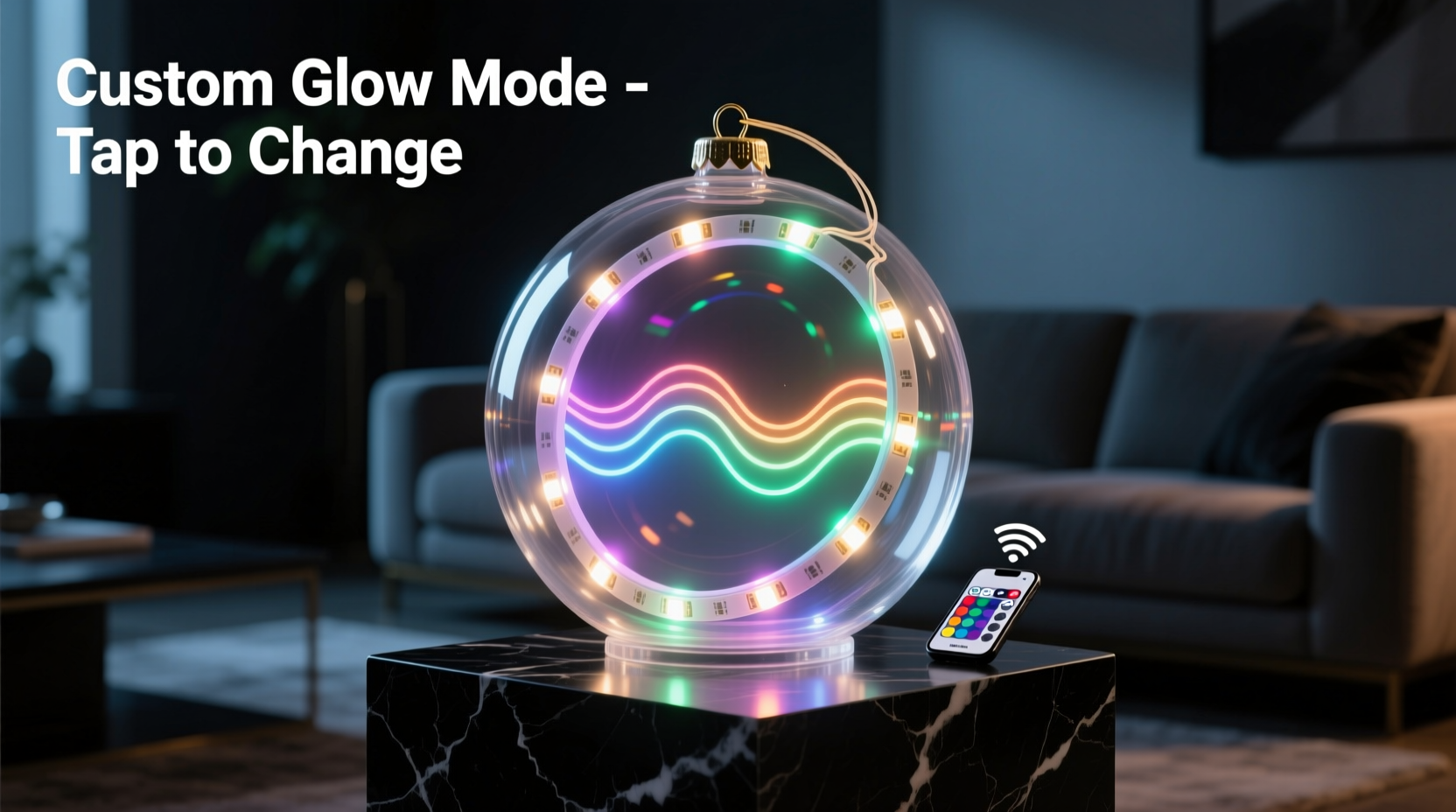
The synergy begins with physics. Clear ornaments act as optical waveguides and diffusers. Their smooth, curved surfaces refract and scatter light emitted from an internal source, softening harsh diodes into a gentle, even glow. Unlike frosted or mirrored ornaments—which absorb or reflect unpredictably—clear glass or high-clarity acrylic transmits >90% of visible light when clean and undamaged. That transmission efficiency is critical: it means minimal wattage is needed to achieve visual impact. A 3W, 12V strip segment can fully illuminate a 4-inch ornament without overheating or drawing excessive current.
But material matters profoundly. Not all “clear” ornaments are equal. Hand-blown glass often contains subtle imperfections that create organic light distortion—ideal for organic, artisanal effects. Machine-made acrylic ornaments offer higher consistency and lower breakage risk but may yellow over time under UV exposure. Avoid ornaments with internal paint, metallic linings, or textured interiors; these interfere with uniform diffusion and can trap heat near the strip.
Crucially, this technique excels in controlled environments—not high-traffic floor displays or outdoor installations exposed to rain or temperature swings. Heat buildup, condensation, and physical stress remain limiting factors. As lighting designer Lena Torres notes after outfitting over 200 custom ornaments for boutique retail displays:
“The magic happens at the intersection of restraint and precision. You’re not lighting a room—you’re curating a single point of luminous focus. Overpowering it defeats the purpose. Under-engineering it invites failure.”
Essential Materials & Smart Selection Criteria
Selecting components isn’t about grabbing the cheapest strip or largest battery—it’s about matching electrical behavior, thermal tolerance, and optical performance. Below is a vetted selection framework used by professionals:
| Component | Recommended Specification | Why It Matters | Avoid |
|---|---|---|---|
| LED Strip | 5050 or 2835 SMD, 60 LEDs/m, DC 12V, IP20 (indoor only), non-waterproof coating | Higher density ensures smoother light distribution; 12V minimizes voltage drop in short runs; non-waterproof strips dissipate heat better inside sealed enclosures | 220V AC strips (fire hazard), 5V strips (excessive current draw for same brightness), waterproof (silicone coating traps heat) |
| Ornament | 3–5 inch diameter, seamless opening (no screw threads), wall thickness ≥1.5mm, borosilicate glass or cast acrylic | Thicker walls resist thermal stress; seamless openings prevent strip snagging and allow clean insertion; borosilicate handles heat better than soda-lime glass | Thin-walled ornaments (<1mm), ornaments with interior seams or painted interiors, plastic ornaments labeled “for decorative use only” (often PVC, off-gasses under heat) |
| Power Source | Regulated 12V DC wall adapter (≥2A) OR lithium polymer battery pack (3.7V→12V boost converter, 2000mAh+) | Regulation prevents voltage spikes that shorten LED life; boost converters maintain stable output as battery drains | Unregulated wall warts, 9V alkaline batteries (voltage sag causes color shift), USB power banks without dedicated 12V output |
| Diffusion Aid | Matte-finish acrylic rod (3–4mm dia) OR ultra-thin white silicone sleeve (0.3mm thick) | Provides immediate, even surface contact; rods act as secondary light guides; sleeves add zero bulk while scattering light at the source | Aluminum foil (reflects but doesn’t diffuse), cotton balls (flammable, sheds fibers), glue-based diffusers (yellow over time) |
Step-by-Step Installation: From Strip to Sphere
This sequence prioritizes repeatability, thermal safety, and optical integrity. It assumes a standard 4-inch clear glass ornament with a 15mm circular opening.
- Prepare the strip: Cut the LED strip *only* at designated copper cut marks. For a 4-inch ornament, use a 12–15cm segment (≈5 inches). Solder 22AWG stranded wires (red/black) to the input pads. Seal solder joints with heat-shrink tubing—*never* electrical tape, which degrades under heat.
- Add diffusion: Slide a 4mm matte acrylic rod through the center of the strip’s adhesive backing, aligning it parallel to the LEDs. Alternatively, slip a 0.3mm white silicone sleeve over the entire active length. This step is non-negotiable for eliminating hotspots.
- Pre-test fit: Gently insert the prepared strip into the ornament using non-metallic tweezers or a bent paperclip. The strip should curl naturally into a loose spiral touching the inner equator—not forced against the top or bottom. If resistance occurs, trim 1cm from the strip end.
- Secure positioning: Apply one 3mm dot of acid-free, heat-resistant PVA glue (e.g., Jade 403) to the *back* of the strip’s center point. Insert again, rotating the ornament until the glued point contacts the inner surface at the desired orientation (e.g., 6 o’clock position). Hold for 45 seconds. Do *not* glue the entire strip—flexibility accommodates thermal expansion.
- Wire management: Route the input wires straight down through the opening. Use a small rubber grommet or silicone O-ring (3mm ID) pressed into the opening’s rim to protect wires from abrasion and seal minor gaps. Trim excess wire flush with the grommet exterior.
- Final power test: Connect to a regulated 12V source for 5 minutes. Monitor for warmth: the strip’s surface should be warm to touch (≤45°C), *not* hot. If hotter, reduce segment length or switch to lower-density (30 LEDs/m) strip.
Creative Control: Beyond On/Off
A static white glow is just the baseline. Real customization emerges through controllability and spectral tuning:
- Dimming: Use a PWM (pulse-width modulation) dimmer rated for 12V DC and your strip’s amperage. Avoid leading-edge TRIAC dimmers—they cause audible buzzing and LED flicker. A $12 inline PWM module offers smooth 0–100% control without color shift.
- Color Tuning: RGB or RGBW strips require a compatible controller. For true white balance, prioritize RGBW (dedicated white diodes) over RGB. Set correlated color temperature (CCT) between 2700K (warm candlelight) and 4000K (crisp daylight)—avoid 6500K, which appears sterile inside glass.
- Dynamic Effects: Simple controllers offer fade, strobe, or jump modes—but these often look jarring in isolated ornaments. Better: use a programmable controller (e.g., WLED with ESP32) to run slow, organic transitions—like a 90-second sunrise simulation or gentle cloud-like pulse. Sync multiple ornaments via WiFi for cohesive scenes.
- Optical Modifiers: Place a tiny piece of dichroic film (cut to 5mm square) between the strip and glass at the 12 o’clock position. It reflects specific wavelengths while transmitting others, creating a subtle halo effect. Or, insert a micro-prism sticker on the *outer* surface to cast geometric shadows on nearby walls.
Real-World Application: The Library Nook Project
In late 2023, interior architect David M. retrofitted 12 clear ornaments for a private library’s reading nook. The client requested “calm, focused light—not festive.” David selected 4.5-inch borosilicate glass orbs, each housing a 12cm segment of 2835 3000K warm-white strip with integrated acrylic rod diffusion. Power came from a single 12V/3A regulated supply, with individual inline PWM dimmers allowing per-orb adjustment. He mounted them at varying heights on aircraft cable, spaced 18 inches apart above the armchair.
The breakthrough was thermal validation: after 72 hours of continuous operation, infrared thermography showed maximum surface temperature of 42.3°C—well below the 55°C threshold for borosilicate stress cracking. More importantly, users reported the light felt “wrapped,” not directional—reducing eye strain during evening reading. One patron noted, “It’s like sitting under a cluster of captured fireflies.” No failures occurred over six months of daily use. Key takeaways: precise thermal management enabled longevity; human-centered dimming enabled comfort; and optical consistency across units created cohesion, not clutter.
FAQ
Can I use battery power for long-term display?
Yes—with caveats. A 2000mAh LiPo battery with a quality 3.7V→12V boost converter powers a single 15cm strip for ≈22 hours at full brightness. For multi-day operation, use a 5000mAh pack and set brightness to 60%. Always include low-voltage cutoff (≤3.0V) to prevent battery damage. Never leave charging batteries unattended inside ornaments.
Why does my ornament show a bright line instead of even glow?
This indicates insufficient diffusion or poor strip-to-glass contact. First, verify you’ve added a diffusion aid (rod or sleeve). Second, ensure the strip’s adhesive hasn’t failed—reapply heat-resistant glue if it’s detached. Third, check for dust or fingerprints on the inner glass surface; clean with 99% isopropyl alcohol and lint-free cloth before reinsertion.
Is it safe to hang lit ornaments near curtains or wood?
Yes—if thermal limits are respected. A properly installed 12V strip in a 4-inch ornament reaches ≤45°C surface temperature—below the autoignition point of cotton (210°C) or pine (250°C). Maintain ≥15cm clearance from flammable materials as a conservative buffer. Never use unregulated power supplies or enclose ornaments in tight, non-ventilated housings.
Conclusion: Light as Intentional Craft
Using LED strip lighting inside clear ornaments transcends seasonal decoration. It’s an exercise in disciplined design: honoring material limits, respecting electrical fundamentals, and prioritizing human perception over technical spectacle. Every decision—from the millimeter-thick acrylic rod to the regulated 12V supply—serves a singular goal: transforming fragile transparency into enduring, emotive light. There’s no shortcut around testing, no substitute for thermal awareness, and no replacement for observing how light behaves *in context*, not just on a bench. Start small: equip one ornament with a warm-white strip, diffuse it properly, and watch how it alters the space around it—not with volume, but with presence. Then scale deliberately. Share your iterations, document your thermal readings, refine your diffusion methods. The most compelling effects aren’t the brightest or most complex—they’re the ones that feel inevitable, as though the light had always belonged inside that sphere.




 浙公网安备
33010002000092号
浙公网安备
33010002000092号 浙B2-20120091-4
Comments
No comments yet. Why don't you start the discussion?