
Backlighting transforms a static shadowbox into a luminous vignette—a miniature winter wonderland glowing with depth, warmth, and quiet magic. Unlike front lighting, which flattens dimension and casts harsh shadows, well-executed backlighting creates silhouette definition, halo effects around delicate elements (think frosted pine boughs or glass ornaments), and an ethereal sense of atmosphere. LED strip lights are the ideal tool: low-voltage, cool-running, flexible, and available in precise color temperatures and brightness levels. But success isn’t about slapping strips behind glass. It’s about optical control, thermal management, power integrity, and intentional design. This guide distills field-tested techniques used by display artists, museum preparators, and holiday lighting specialists—applied specifically to the tight confines and layered composition of a shadowbox Christmas scene.
Why Backlighting Works—and Why Standard LED Strips Often Fail
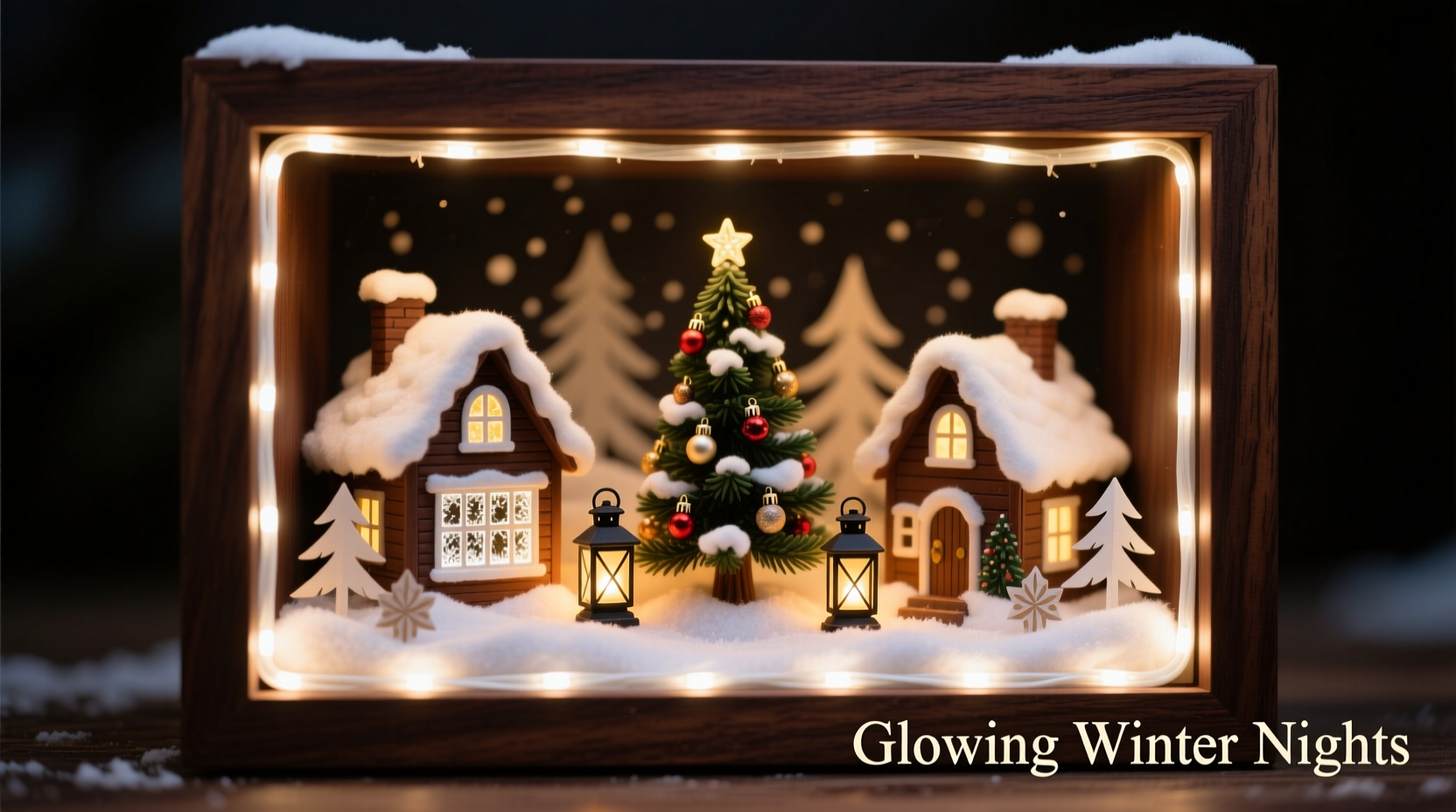
Backlighting leverages the principle of transmitted light: light passes *through* translucent or semi-opaque elements (like vellum snowscapes, frosted acrylic layers, or thin birch bark) while reflecting off denser ones (wooden houses, ceramic figures, metal bells). This contrast generates visual hierarchy and spatial separation. However, most DIY attempts fail because they overlook three critical constraints unique to shadowboxes:
- Depth limitation: Most shadowboxes are 2–4 inches deep. Standard 5050 or 3528 LED strips emit light at wide angles (120°+), causing spill onto side walls, glare on glass, and uneven washes instead of focused rear illumination.
- Heat accumulation: Enclosed spaces trap heat. Even “low-heat” LEDs can exceed safe operating temps when mounted directly against wood backing or sandwiched between foamcore and acrylic—degrading adhesive, warping substrates, and shortening diode life.
- Power drop-off: A 16-foot strip powered from one end may lose up to 30% brightness at the far end—creating a dim, unbalanced glow that undermines the scene’s cohesion.
These aren’t theoretical concerns. They’re why many well-intentioned setups result in washed-out silhouettes, yellowed glue lines, or flickering sections mid-season.
Choosing the Right LED Strip: Specs That Matter (Not Just Brightness)
“Warm white” and “300 LEDs per meter” are marketing labels—not specifications. What matters is spectral quality, beam control, and electrical behavior. Here’s how to decode the data sheet:
| Specification | What to Look For | Why It Matters for Shadowboxes |
|---|---|---|
| Color Rendering Index (CRI) | ≥90 (Ra90+) | Low-CRI strips distort reds (cardinals, berries) and blues (ice, sky backdrops), making scenes look artificial. Ra95 strips render wool textures, wood grain, and metallic finishes accurately. |
| Beam Angle | 60° or narrower (with optional diffuser channel) | A 120° strip floods side walls; a 60° strip focuses light toward the scene plane. Paired with a matte white acrylic diffuser, it delivers even, shadow-free backlighting without hotspots. |
| IP Rating | IP20 (indoor only) is sufficient—but avoid IP65 unless sealed in a channel | IP65 silicone coating traps heat and makes adhesion unreliable on vertical surfaces. IP20 strips run cooler and bond more securely to mounting tape. |
| PCB Thickness & Copper Weight | 2 oz copper, 1.6mm PCB | Thicker copper reduces resistance, minimizing voltage drop and heat buildup—critical in confined spaces where airflow is zero. |
| Dimming Compatibility | PWM dimmable (not just 0–10V) | PWM dimming maintains color temperature at low brightness. Non-PWM strips shift warm white to orange-yellow below 30%, ruining the crisp winter ambiance. |
One often-overlooked detail: cut points. Shadowboxes demand precise placement. Choose strips with cut points every 1–2 LEDs (not every 3–6), so you can trim exactly where needed—without sacrificing a diode or creating an open circuit.
Step-by-Step Installation: From Planning to Power-On
This sequence prioritizes longevity and optical precision over speed. Skipping any step risks uneven light, adhesive failure, or electrical hazards.
- Map Your Light Path: Sketch your shadowbox interior. Identify the deepest layer (e.g., a painted backdrop), then each successive layer (snow drift, house, tree, foreground figures). Backlighting should originate 0.5–1 inch behind the *deepest element*, not the back panel. Mark this plane with painter’s tape.
- Select & Cut Strips: Use a ruler and sharp utility knife to cut strips *only* at marked cut points. For a 24\" wide box, use two 12\" segments—one centered top, one centered bottom—to avoid center-darkening. Avoid single long runs.
- Prepare the Mounting Surface: Clean the back panel with isopropyl alcohol. Let dry. Apply high-bond double-sided tape (3M VHB 4950 recommended) in 0.75\" strips, spaced 2\" apart, along your mapped light plane. Press firmly for 30 seconds per section.
- Mount with Thermal Relief: Adhere strips to tape—but leave a 1/16\" air gap between the strip’s copper backing and the panel. Insert thin plastic shims (cut from credit card scraps) under the strip’s edges. This gap allows convection cooling and prevents heat transfer to wood or MDF.
- Add Diffusion (Non-Negotiable): Cut a piece of 1/8\" matte white acrylic (not frosted glass or vellum) to fit snugly behind the scene, 0.25\" smaller than the shadowbox interior. This diffuses light evenly, eliminates LED dots, and reflects stray light forward—not sideways.
- Wire Strategically: Solder 22 AWG stranded wire to strip endpoints. Route wires vertically down corners—not across the back—to avoid casting shadows. Use cable ties anchored to pre-drilled holes in the frame, not adhesive clips.
- Test Before Sealing: Power on at 50% brightness for 15 minutes. Check for hot spots with an infrared thermometer (surface temp should stay ≤35°C/95°F). Adjust diffusion or spacing if needed.
Real-World Example: The “Evergreen Hollow” Shadowbox
Marla, a prop stylist in Portland, built a 16\"x20\" shadowbox depicting a snowy forest glade: hand-carved cedar trees, a resin creek, miniature deer, and cotton “snow.” Her first attempt used a 24\" warm-white strip glued directly to plywood backing. Within 48 hours, the adhesive bubbled, the strip dimmed near the right edge, and glare on the glass made the deer invisible.
She revised using this approach:
- Switched to a 60° Ra95 strip with 2 oz copper PCB.
- Mounted two 8\" segments—top and bottom—with 1/16\" plastic shims.
- Added a 15.5\"x19.5\" matte white acrylic diffuser.
- Injected 12V power at both strip ends via a regulated Mean Well LPV-60-12 driver.
- Set brightness to 65% via PWM dimmer—bright enough to define silhouettes, soft enough to preserve the scene’s hushed stillness.
The result? A gallery-worthy display where light appears to emanate *from within* the snow itself. The creek glows with subtle refraction; the deer’s antlers cast delicate lace-like shadows on the backdrop. Marla now uses this method for all client holiday installations—and notes that her strips retain >98% output after 18 months of seasonal use.
“Backlighting isn’t about adding light—it’s about revealing what was already there, but unseen. The best shadowbox lighting doesn’t call attention to itself; it makes the viewer lean in, wondering how the magic is made.” — Elias Thorne, Exhibit Lighting Designer, The Museum of American Folk Art
Avoid These 5 Common Mistakes
Even experienced crafters fall into these traps. Each has a direct, measurable impact on performance and safety:
- Mistake 1: Using non-dimmable strips with wall dimmers. Standard leading-edge dimmers cause audible buzzing, inconsistent fading, and premature capacitor failure. Always pair with a compatible PWM dimmer (e.g., Lutron Caséta PD-6WCL) or constant-voltage driver with dimming input.
- Mistake 2: Gluing strips to painted or varnished surfaces. Paints and finishes contain plasticizers that degrade adhesive bonds over time. Sand lightly and clean with alcohol before mounting.
- Mistake 3: Overloading the power supply. Calculate total wattage: (LEDs per meter × length in meters × watts per LED). Add 20% headroom. A 5m strip rated at 14.4W/m needs ≥86W capacity—not a 60W “universal” adapter.
- Mistake 3: Skipping the diffuser. Without diffusion, individual LEDs create distracting “dotting”—breaking immersion and highlighting imperfections in materials. Matte acrylic is the only material that provides uniform scatter without light loss.
- Mistake 4: Ignoring polarity during soldering. Reversing + and − on a strip won’t damage it—but it will prevent operation. Label wires with red/black heat-shrink tubing *before* soldering. Test continuity with a multimeter.
FAQ: Troubleshooting Your Backlit Scene
My LEDs flicker only when the room lights are on—what’s wrong?
This indicates electromagnetic interference (EMI) from nearby AC wiring or dimmers. Separate low-voltage LED wiring from household AC cables by at least 6 inches. If routing parallel is unavoidable, use shielded 22 AWG twisted-pair wire for the LED run and ground the shield at the power supply end only.
Can I use battery-powered LED strips for a portable shadowbox?
Yes—but with caveats. AA/AAA battery packs cause rapid voltage sag, dimming LEDs within hours. Instead, use a rechargeable 12V lithium pack (e.g., 3S LiPo 11.1V 5000mAh) with a built-in low-voltage cutoff. Pair it with a constant-current DC-DC booster to maintain stable 12V output. Expect 8–12 hours runtime at 70% brightness.
How do I hide the power cord without drilling the frame?
Route the cord through the shadowbox’s existing hanging hardware. Loosen the D-ring screws, thread the cord behind the screw plate, then re-tighten. The cord emerges cleanly at the top edge, hidden by the frame’s lip. For wall-mounted boxes, use cord clips painted to match the frame color—never tape directly to wood, as residue damages finishes.
Conclusion: Light as Intentional Design
Backlighting a shadowbox Christmas scene isn’t decoration—it’s curation. Every decision, from the CRI rating of your LEDs to the millimeter gap beneath the strip, shapes how viewers experience stillness, nostalgia, and quiet reverence. When executed with technical rigor and aesthetic sensitivity, the result transcends seasonal display: it becomes a moment of pause in a hurried world. The glow isn’t just visible—it’s felt in the chest, remembered in the periphery of vision long after the box is closed. You don’t need expensive gear or studio space. You need precise choices, patient execution, and respect for light as a physical medium—not just a switch to flip. Start small: retrofit one 12\"x12\" box using the thermal shimming and dual-power technique outlined here. Observe how the cotton snow transforms from flat texture to volumetric mist. Notice how the silhouette of a tiny wooden sleigh gains weight and presence. Then scale up—not in size, but in intention.




 浙公网安备
33010002000092号
浙公网安备
33010002000092号 浙B2-20120091-4
Comments
No comments yet. Why don't you start the discussion?