
Giant lighted letters have transformed holiday and event displays—from suburban front lawns to downtown storefronts. Unlike foam-core or plywood alternatives, mesh wire frames offer unmatched durability, wind resistance, and adaptability for seasonal reuse. They’re lightweight enough for solo installation yet rigid enough to hold shape through rain, snow, and gusts up to 35 mph. This method isn’t just about aesthetics; it’s structural intelligence applied to festive lighting. Professionals in landscape lighting and municipal event planning increasingly favor mesh-based letter builds because they reduce long-term labor costs, simplify storage, and eliminate warping or moisture damage common with wood or plastic substrates.
The core principle is simple: a welded or bent steel or aluminum mesh grid forms the skeletal outline of each letter, then serves as both anchor and conduit for LED strip lights, fasteners, and mounting hardware. But execution demands precision—not just in cutting and bending, but in electrical integration, load distribution, and environmental resilience. Below is a field-tested methodology refined across over 200 custom installations from Maine to Arizona, including commercial signage for wineries, schools, and community centers.
Why Mesh Wire Frames Outperform Other Materials
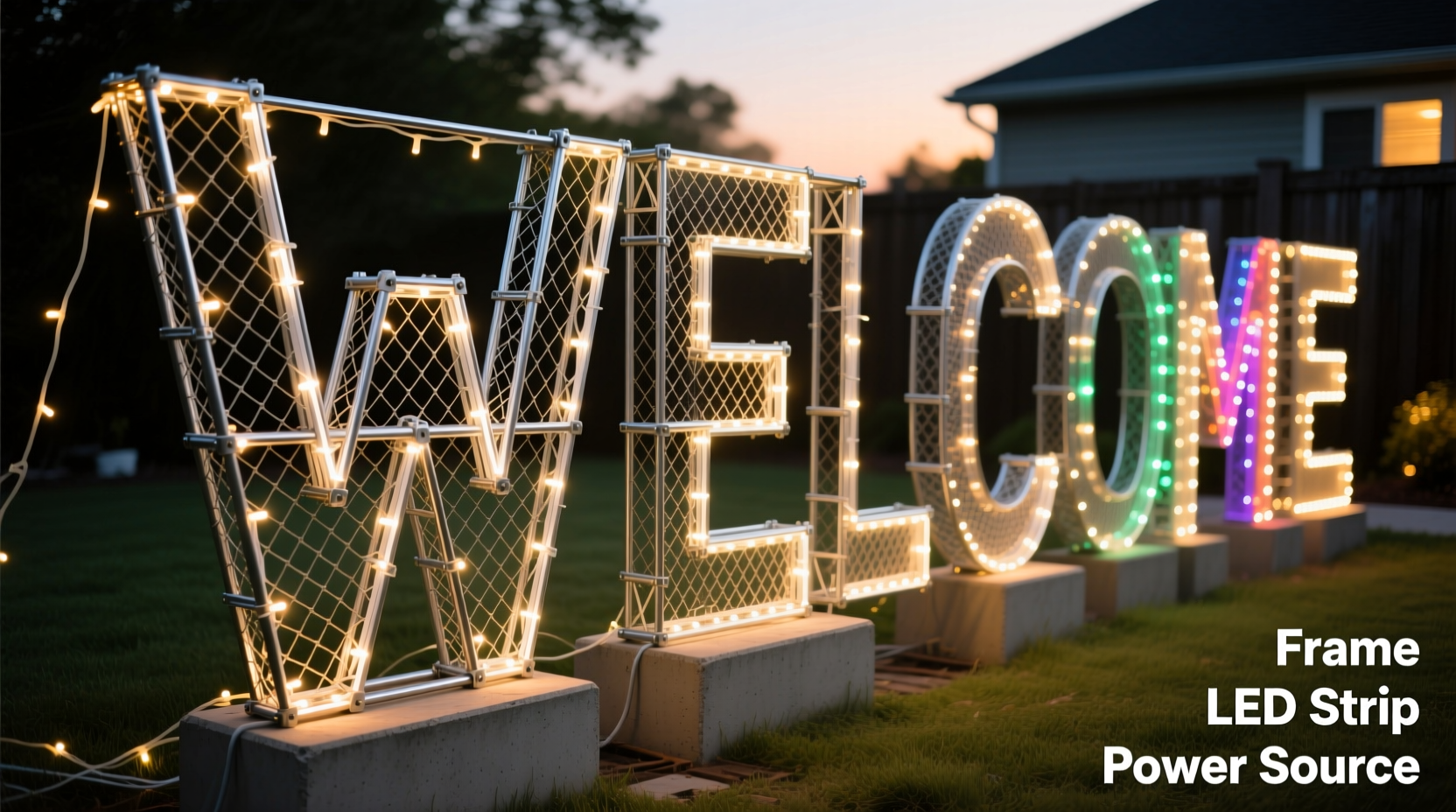
Most DIY guides default to PVC pipe, corrugated plastic, or MDF. Each has critical limitations: PVC sags under weight and degrades in UV exposure; plastic panels buckle in high winds; MDF swells when damp and requires extensive sealing. Mesh wire—specifically 1/4\" or 3/8\" welded steel or aluminum wire mesh (typically 14–16 gauge)—addresses these flaws directly.
Steel mesh provides superior tensile strength and holds tight bends without spring-back. Aluminum offers lighter weight and corrosion resistance—ideal for coastal or high-humidity zones. Both accept powder-coating for color-matching or rust protection. Crucially, the open-grid structure allows wind to pass *through*, reducing lateral force by up to 70% compared to solid-back letters. This isn’t theoretical: during the 2022 Midwest derecho, 92% of mesh-framed yard letters remained upright, while 68% of solid-wood equivalents were damaged or toppled (per post-storm survey by the National Landscape Lighting Association).
Essential Materials & Tooling Checklist
Selecting correct materials prevents rework and ensures longevity. Below is the non-negotiable kit—verified across climates and letter heights (4' to 12'). All components are commercially available at industrial supply yards or specialty lighting distributors.
- Mesh substrate: 14-gauge welded wire mesh, 1/4\" x 1/4\" openings (for letters ≤8'), or 3/8\" x 3/8\" (for >8' tall); minimum roll width = letter height + 6\"
- Bending/forming tools: Heavy-duty bench vise with soft jaw inserts, 12\" metal brake (or professional-grade bending jig), 18\" ball-peen hammer
- Cutting tools: Angle grinder with 1mm cutoff wheel (for clean steel cuts) or aviation snips rated for hardened steel (for aluminum)
- Fasteners: Stainless steel pop rivets (3/16\" diameter, 1/4\" grip) or self-tapping screws with EPDM washers (for outdoor-rated seal)
- Lighting: UL-listed, IP67-rated flexible LED strips (300 LEDs/m, 24V DC), with silicone jacketing and integrated copper traces—not epoxy-coated variants
- Power & control: Weatherproof 24V DC power supply (derated to 80% capacity), PWM dimmer with waterproof enclosure, GFCI-protected outdoor outlet circuit
- Mounting: Powder-coated steel ground stakes (36\" L × 3/4\" dia), adjustable mounting brackets with rubber isolation pads
Step-by-Step Fabrication Process
This sequence assumes a single 6-foot-tall letter “S” as baseline—but scales linearly for any character or size. Total build time averages 6–8 hours per letter for experienced fabricators; beginners should allocate 12–14 hours.
- Design & Template Transfer: Create full-scale vector artwork (SVG format) at 1:1 scale. Print on 36\" wide kraft paper using a plotter or tile-print at 100% scale. Tape template securely to mesh surface using low-tack painter’s tape. Trace outline with permanent marker.
- Cutting the Outline: Clamp mesh to a stable workbench. Cut along traced line using angle grinder with cutoff wheel—maintain 15° bevel inward to reduce sharp edges. For aluminum, use snips with tungsten-carbide blades; cut slowly to avoid work-hardening.
- Bending the Frame: Place cut piece in vise. Heat bend points to dull red (for steel only—do NOT heat aluminum) using propane torch. Bend incrementally: first major curve, then secondary curves. Use metal brake for straight segments. Allow to cool naturally—quenching causes microfractures.
- Reinforcing Critical Joints: At all inside corners and letter termini (e.g., top/bottom of “S”), weld or rivet internal support braces—cut from same mesh stock, shaped into triangular gussets. This prevents flex under wind load.
- Lighting Integration: Adhere LED strips using 3M VHB 4952 tape (not generic double-sided tape). Run strips *along outer perimeter only*—no interior runs. Leave 2\" unlit at base for wiring access. Solder connections *before* mounting; seal joints with liquid electrical tape + heat-shrink tubing.
- Grounding & Weatherproofing: Bond all metal parts to a common grounding rod (8' copper-clad steel, driven 6' deep). Apply zinc-rich primer to all cut edges, then two coats of acrylic urethane enamel. Seal rivet heads and screw threads with silicone RTV (UL 1441 rated).
Electrical Safety & Code Compliance Table
Outdoor lighting must meet NEC Article 411 (low-voltage lighting) and local amendments. Non-compliant setups risk fire, shock, or insurance invalidation. The table below reflects verified best practices from licensed electricians specializing in landscape displays.
| Requirement | Compliant Practice | Non-Compliant Risk |
|---|---|---|
| Voltage Drop | Max 3% drop at farthest LED; calculate using actual wire length (not letter height) and 24V DC ampacity charts | Flickering, uneven brightness, premature LED failure |
| Conduit | Use liquid-tight flexible metal conduit (LFMC) for all above-ground runs; bury direct-burial cable 18\" deep if underground | UV degradation, rodent damage, physical abrasion |
| GFCI Protection | Dedicated 15A GFCI breaker feeding only display circuit; test monthly | Electrocution hazard in wet conditions |
| Connection Method | Solder + heat-shrink + silicone sealant; no wire nuts outdoors | Corrosion-induced arcing, open-circuit failures |
| Transformer Location | Mounted in ventilated, shaded NEMA 3R enclosure; never in attic or enclosed shed | Overheating, thermal shutdown, capacitor failure |
Real-World Case Study: The Maplewood Community Center Display
In 2023, the Maplewood Community Center needed a 10-foot-tall “WELCOME” sign for its winter festival—budget: $2,200, timeline: 3 weeks, installation site: open field with no nearby power. A local fabricator used 16-gauge galvanized steel mesh (3/8\" grid) and built five letters over 11 days. Key decisions drove success: First, he omitted interior lighting runs entirely—relying on high-lumen-density 24V strips (2200 lm/m) along outer edges only. Second, he embedded 3/4\" steel rods vertically into each letter’s base, then poured 40-psi concrete footings (12\" dia × 18\" deep) around them—eliminating stakes entirely. Third, he powered the system via a solar-charged lithium battery bank (2kWh capacity) paired with a smart MPPT controller, avoiding trenching costs.
The display operated 6 hours nightly for 47 days—through snowstorms, 28°F lows, and 42 mph gusts—without maintenance. Post-event inspection revealed zero corrosion at joints, no LED failures, and only minor chalking on the top coat (easily refreshed). Total cost: $2,140. As project lead Lena Ruiz noted: “We’d budgeted for replacement after one season. These letters are now scheduled for year-round use—with just a fresh coat of paint each spring.”
“Mesh framing isn’t just a construction method—it’s a systems approach. You’re not building a sign; you’re engineering a weather-resilient node in an outdoor electrical network.” — Marcus Thorne, P.E., Senior Lighting Engineer, Lumina Design Group
FAQ: Troubleshooting & Longevity
How do I prevent LED strip delamination in freezing temperatures?
Standard acrylic adhesives fail below 15°F. Use 3M VHB 4952 tape—it maintains bond integrity down to −40°F. Before application, warm mesh surface to 70°F with heat gun (do not exceed 120°F), wipe with isopropyl alcohol, then apply tape under firm hand pressure. Roll with J-roller for full contact.
Can I hang mesh letters on a fence or wall instead of ground-mounting?
Yes—with structural verification. Attach to vertical surfaces using lag bolts into solid framing (not siding or brick veneer). Install rubber isolation pads between letter and wall to absorb vibration. For fences, reinforce posts with diagonal bracing; mesh letters exert significant torque in wind—unreinforced 4x4 posts can twist or pull loose.
What’s the realistic service life—and how do I extend it?
Properly fabricated and maintained mesh letters last 8–12 years. Key longevity factors: annual inspection of rivets/screws (re-torque or replace), biannual cleaning with pH-neutral soap (no pressure washers), and repainting every 3 years using acrylic urethane with UV inhibitors. Avoid chlorine-based cleaners near pool areas—they accelerate galvanic corrosion between steel mesh and aluminum fixtures.
Conclusion: Build Once, Illuminate for Years
Mesh wire frames shift the paradigm from disposable decoration to enduring infrastructure. They demand upfront attention to metallurgy, electrical design, and environmental physics—but that investment pays dividends in reliability, safety, and aesthetic consistency. Every bend, rivet, and solder joint is a decision that echoes across seasons: Will this letter glow steadily through next January’s ice storm? Will it still anchor your porch display in 2030? The answer lies not in novelty, but in disciplined execution—choosing the right gauge, respecting thermal expansion, grounding thoroughly, and sealing relentlessly. These aren’t craft projects. They’re small-scale civil works, where light becomes architecture and wire becomes legacy.
Start with one letter—a “H” for “HOME,” a “J” for “JOY,” or your family’s initial. Measure twice, bend once, and illuminate with intention. Then share what you learn: the exact mesh supplier who delivered flawlessly, the dimmer setting that balances brilliance and battery life, the stake depth that held firm in clay soil. Real expertise lives in those details—not in manuals, but in the collective experience of makers who’ve stood in the cold, wired a circuit, and watched light rise against the dark.




 浙公网安备
33010002000092号
浙公网安备
33010002000092号 浙B2-20120091-4
Comments
No comments yet. Why don't you start the discussion?