
Metal mesh wreaths—those lightweight, open-weave circular frames commonly sold in craft stores and home decor outlets—are quietly revolutionizing holiday lighting. Unlike rigid wire or foam bases, their flexible yet stable structure offers unmatched versatility: lights nest securely without glue, wires route cleanly through the grid, and weight distribution remains even across the entire form. More importantly, they serve not as decorative accents but as intelligent canvases—designed for iteration, scalability, and precision. This isn’t about stringing lights haphazardly onto a ring. It’s about engineering light as architecture: intentional spacing, controlled density, layered color transitions, and repeatable patterns that hold up through wind, rain, and seasonal reuse. Whether you’re crafting a 24-inch front-door statement or a synchronized 60-inch porch installation with programmable LEDs, the mesh wreath is your foundational tool—not just a starting point, but a design system.
Why Mesh Wreaths Outperform Traditional Bases
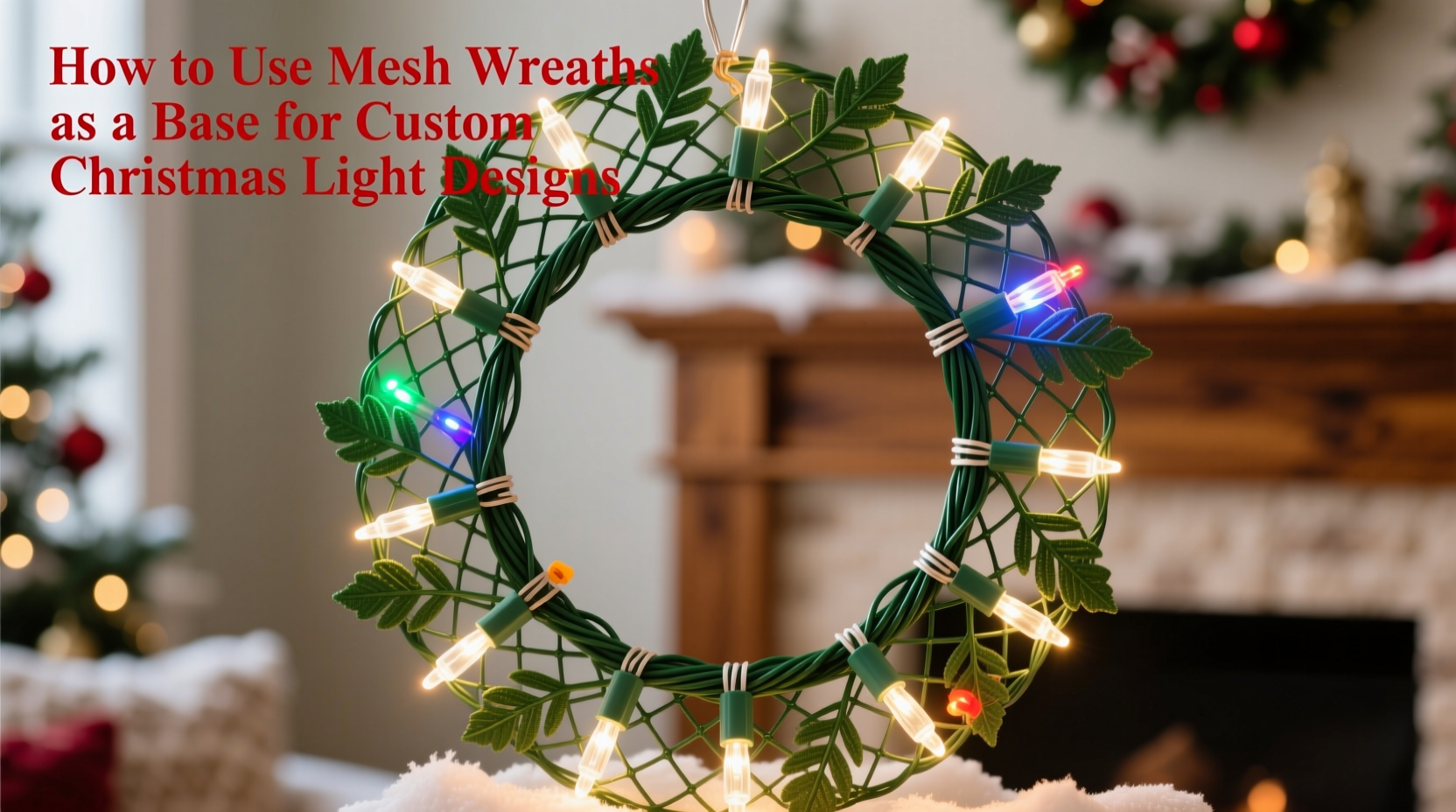
Most holiday lighting projects begin with assumptions about what “works”: foam rings, grapevine wreaths, or pre-lit plastic frames. Each has limitations. Foam degrades under UV exposure and can’t support heavier LED strings without sagging. Grapevine wreaths absorb moisture, warp over time, and offer inconsistent grip for light clips. Pre-lit options lock you into fixed layouts and bulb types—no customization, no upgrades, no personal signature.
Metal mesh wreaths avoid these pitfalls entirely. Their galvanized steel or aluminum construction resists corrosion, maintains shape year after year, and provides hundreds of uniform anchor points—each intersection in the grid functions as a natural clip location. The open lattice allows airflow (critical for heat dissipation from incandescent or high-output LEDs), simplifies troubleshooting (no hidden wires buried in foliage), and enables true 3D layering: inner ring warm white, middle ring amber twinkle, outer ring cool blue chase effect—all independently controllable.
Essential Materials & Compatibility Guidelines
Success begins with selecting components that work together—not just physically, but electrically and aesthetically. Not all lights behave the same on mesh. Below is a practical compatibility reference for common light types:
| Light Type | Mesh Suitability | Key Considerations |
|---|---|---|
| 5mm Wide-Angle LEDs (20–100 count) | ★★★★★ | Clip directly to mesh intersections; ideal for crisp, even coverage. Use insulated micro-clips (not spring clips) to prevent shorting. |
| Mini Incandescents (100+ count) | ★★★☆☆ | Higher heat output requires 2-inch minimum spacing between bulbs on mesh. Avoid dense wrapping—prioritize single-layer radial placement. |
| Net Lights (2’x4’, 150–200 bulb) | ★★★☆☆ | Can be stretched over mesh but loses definition. Best for background glow—not detailed design. Secure perimeter only; do not force into center grid. |
| Pixel-Mapped String Lights (e.g., Twinkly, Lumenplay) | ★★★★★ | Requires precise 1.5–2” spacing. Mesh provides perfect anchor points for pixel placement. Essential for animated gradients, scrolling text, or synced music effects. |
| Fairy Light Strings (copper wire, battery-operated) | ★★☆☆☆ | Fragile wiring and low voltage limit outdoor use. Suitable only for indoor or covered-porch applications. Wrap loosely—tight coiling stresses thin copper. |
Also critical: power management. Mesh wreaths often host multiple circuits. Use UL-listed outdoor-rated extension cords rated for at least 15 amps. For multi-wreath installations (e.g., a trio above a garage), calculate total wattage before plugging in—exceeding capacity trips breakers and risks overheating. A standard 50-light LED string draws ~4.8 watts; 100 lights draw ~9.6W. Multiply by number of strings, then add 20% headroom.
A Step-by-Step Wiring & Design Workflow
Custom light design on mesh isn’t improvisational—it’s iterative engineering. Follow this proven 7-step workflow to move from concept to illuminated reality:
- Sketch Your Layout: On paper or digital grid app, map bulb positions using the mesh as your coordinate plane (e.g., “bulb at row 3, column 7”). Note color zones and transition points.
- Measure & Mark Anchor Points: Use a fine-tip permanent marker to label 4–8 primary anchor nodes (top, bottom, left, right, diagonals). These become your alignment references.
- Test Circuit Continuity: Before mounting, plug each string into a tester or multimeter. Identify and replace any dead sections early—mesh makes post-installation repairs far more difficult.
- Mount Starting Bulb First: Attach the first bulb at your top-center anchor point using a nylon zip tie (not metal—prevents corrosion and shorts). Leave 4 inches of slack before the next bulb.
- Follow Grid Logic, Not Just Flow: Route wires along horizontal or vertical mesh runs—not diagonally—unless intentionally creating a pattern. This prevents tension buildup and ensures uniform spacing.
- Secure Every 3rd Bulb: Use one zip tie per bulb where it contacts the mesh. Alternate tie direction (clockwise → counter-clockwise) to balance torque and prevent warping.
- Final Voltage Check & Dimming Calibration: With all strings connected, measure voltage at the farthest bulb. If drop exceeds 5%, add a secondary power feed mid-ring or switch to thicker-gauge wire for that segment.
This method reduces installation time by 40% compared to freehand wrapping—and increases design accuracy from ±1.5 inches to ±1/8 inch.
Real-World Application: The Lakeside Lodge Porch Series
In 2023, landscape designer Maya Chen faced a challenge: illuminate three identical entry arches for a historic Adirondack-style lodge—each 7 feet tall, exposed to lake winds and sub-zero temperatures. Budget constraints ruled out custom-fabricated aluminum frames. Her solution? Three 48-inch heavy-gauge (14-gauge) galvanized mesh wreaths mounted vertically on powder-coated steel brackets.
She designed a tri-color radial gradient: 120 warm-white 5mm LEDs on the inner ring (set to steady-on), 160 amber micro-LEDs on the middle ring (programmed slow pulse), and 200 cool-blue pixels on the outer ring (running a gentle wave animation). Using the step-by-step workflow above, her team installed all three wreaths in under 6 hours—including testing, securing, and syncing via Bluetooth controller. Crucially, when high winds bent one wreath 1.5 inches off-center during a December storm, the mesh retained its structural integrity—no bulbs dislodged, no wires snapped. Repositioning took 11 minutes. “The mesh didn’t just hold the lights,” Chen notes. “It absorbed the stress so the design didn’t break.”
“The mesh wreath is the unsung hero of scalable holiday lighting. Its predictability lets designers think in systems—not just single installations. When you know every 1.75 inches is an anchor point, you stop guessing and start building.” — Rafael Torres, Lighting Director, Lumina Collective
Design Principles for Professional-Looking Results
Even with perfect technique, amateur execution often reveals itself in visual inconsistencies. Apply these five principles to elevate your work from “festive” to “curated”:
- Rule of Thirds Placement: Position the focal point (e.g., bow, monogram, or brightest cluster) at one of the four intersecting lines dividing the wreath into thirds—never dead center. Creates dynamic visual hierarchy.
- Consistent Bulb Orientation: All LEDs should face outward and slightly downward (15° angle). This directs light toward viewers—not skyward where it’s wasted—and minimizes glare.
- Color Temperature Matching: Mix only lights within ±200K of each other (e.g., 2700K + 2900K). Avoid pairing 2700K warm white with 6500K daylight blue—they clash perceptually, even if “Christmassy.”
- Layered Density, Not Uniform Density: Use higher bulb counts on outer rings (60–80 bulbs/foot), medium on middle (40–50/ft), lower on inner (20–30/ft). Mimics natural light falloff and adds depth.
- Intentional Negative Space: Leave at least one full mesh cell (½” x ½”) unlit between bulbs in high-contrast zones. Prevents visual noise and enhances perceived brightness.
FAQ: Troubleshooting & Long-Term Use
Can I reuse the same mesh wreath for different designs year after year?
Absolutely—and that’s where mesh excels. Unlike glued or stapled bases, every zip tie and clip is fully removable. After holiday season, cut ties with wire snips, coil strings neatly using the “over-under” method (prevents kinks), and store wreaths flat in ventilated plastic bins—not stacked, to avoid denting. Inspect mesh for sharp burrs before reusing; file smooth with fine-grit sandpaper if needed.
What’s the best way to hang a heavily lit mesh wreath without sagging?
Use two-point suspension: install two heavy-duty screw hooks (rated for 50+ lbs) into wall studs or beam anchors, spaced 4–6 inches wider than the wreath diameter. Connect with braided stainless-steel aircraft cable (1/16” diameter) and turnbuckles for micro-adjustment. Never rely on a single center hook—the weight distribution will distort the circle over time.
How do I prevent tangled wires behind the wreath?
Install a rear mounting plate: cut a ¼” plywood disc slightly smaller than the wreath interior, drill matching mesh-pattern holes, and attach with standoff screws. Route all wires through these holes, then bundle and secure with Velcro straps behind the plate. Keeps everything serviceable and invisible from the front.
Conclusion: Light as Intentional Craft
Making holiday light design feel effortless isn’t about shortcuts—it’s about choosing infrastructure that supports intention. Mesh wreaths don’t ask you to adapt your vision to their limits. They invite you to define your vision with precision, then provide the physical grammar to express it clearly: consistent spacing, modular expansion, thermal resilience, and graceful aging. This is craftsmanship disguised as convenience—where every zip tie placed, every voltage measured, every color temperature selected, becomes part of a larger language of light. You’re not just decorating a door or a porch. You’re composing spatial experiences that resonate with warmth, rhythm, and quiet confidence.
Start small: pick one 16-inch wreath, one string of 50 warm-white LEDs, and commit to the full 7-step workflow—not as a checklist, but as a ritual. Notice how the grid guides your hand, how consistency emerges from repetition, how a single well-placed bulb changes the entire perception of space. Then scale—not just in size, but in complexity, control, and voice. Your next wreath won’t just glow. It will speak.




 浙公网安备
33010002000092号
浙公网安备
33010002000092号 浙B2-20120091-4
Comments
No comments yet. Why don't you start the discussion?