
Christmas tree lighting is both art and physics. A well-lit tree doesn’t just glow—it draws the eye, warms the room, and anchors the holiday atmosphere. Yet many homeowners struggle with dim corners, uneven illumination, or trees that look flat despite dozens of lights. The solution isn’t always more strings or brighter bulbs. It’s reflection. Specifically, intentional, controlled reflection using mirror backdrops—a time-tested technique used by professional set designers, window stylists, and award-winning home decorators for over four decades.
Mirrors don’t generate light—but they *redistribute* it with remarkable efficiency. When positioned correctly behind or beside a Christmas tree, mirrors can increase perceived brightness by 40–70%, deepen visual dimension, soften harsh shadows, and create the illusion of a fuller, more luminous display—all while reducing energy load and heat buildup. This isn’t decorative sleight-of-hand; it’s optical engineering applied to seasonal design. Below, we break down exactly how to harness mirror backdrops with precision, safety, and aesthetic intelligence.
The Science Behind Mirror Amplification
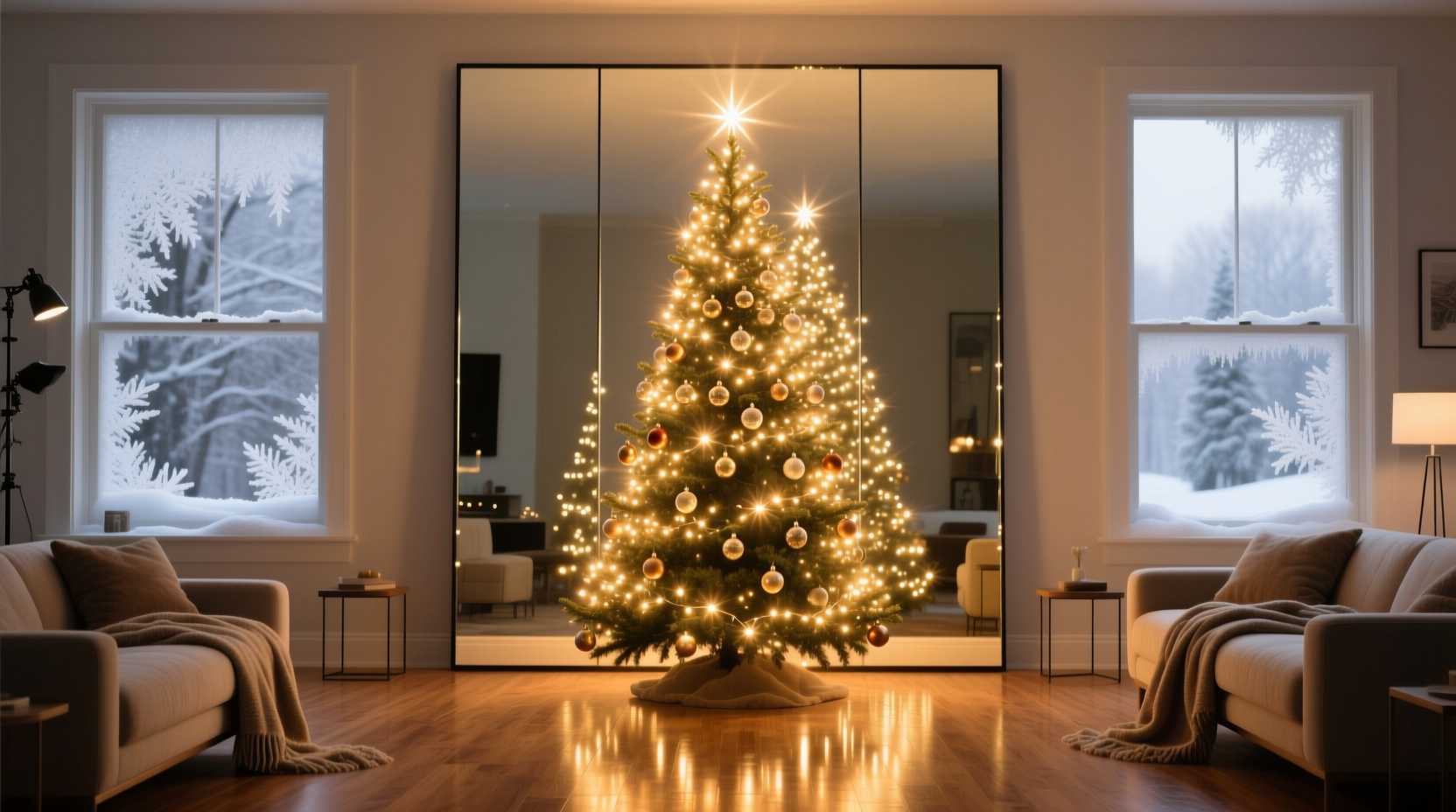
Light travels in straight lines and reflects at predictable angles: the angle of incidence equals the angle of reflection. A flat, high-reflectivity mirror (92–95% reflectance) captures photons that would otherwise be absorbed by walls, furniture, or carpet—and redirects them toward the viewer’s line of sight. Unlike white paint (which diffuses ~80% of light), mirrors preserve intensity, directionality, and color fidelity. This means warm-white LEDs retain their cozy tone; multicolor bulbs keep their saturation; and twinkle effects maintain rhythm and contrast.
Critical nuance: not all “mirrored” surfaces work equally well. Acrylic mirrors, mirrored tiles, and low-quality silvered glass often reflect only 70–85% of incident light—and introduce distortion or yellowing over time. For optimal amplification, prioritize first-surface mirrors (where the reflective coating sits on the front of the glass) or high-grade float-glass mirrors with aluminum backing. These minimize ghosting, maximize brightness return, and resist tarnish in typical indoor humidity levels.
Strategic Placement: Where & Why Mirrors Work Best
Placement determines whether a mirror enhances or undermines your tree’s presence. Avoid centering mirrors directly behind the trunk—this creates a distracting “double trunk” effect and flattens depth perception. Instead, adopt one of three proven configurations:
- Offset Backdrop (Recommended for most living rooms): Mount a vertical mirror 6–12 inches to the left or right of the tree’s rear plane. This captures side-emitted light from garlands and branch tips, reflecting it across the front-facing foliage—creating layered brightness without symmetry fatigue.
- Diagonal Wing (Ideal for narrow spaces): Angle a tall, narrow mirror at 30–45° from the wall behind the tree. This scatters light laterally, illuminating adjacent walls and ceiling corners while avoiding direct glare into seating areas.
- Under-Tree Reflective Shelf (Perfect for tabletop trees): Place a 12×18-inch framed mirror beneath the base—not under the stand, but recessed slightly behind it—so light spills downward and bounces upward through lower branches. This eliminates “dark feet” and adds lift to small displays.
Crucially, avoid placing mirrors where they’ll reflect windows, televisions, or overhead fixtures during evening hours. Uncontrolled secondary reflections dilute the tree’s focal dominance and introduce visual noise.
Step-by-Step Installation Guide
- Measure & Map: Use painter’s tape to outline your chosen mirror position on the wall. Stand at primary viewing points (sofa, entryway, dining table) and verify the reflection includes at least 70% of the tree’s illuminated surface—no bare trunk or empty wall should dominate the frame.
- Select Mounting Method: For mirrors under 20 lbs, use heavy-duty drywall anchors and D-ring hangers. For larger pieces (36+ inches tall), install a French cleat system anchored into wall studs. Never rely on adhesive strips or picture wire alone—vibration from foot traffic or HVAC systems can cause slippage.
- Level & Tilt: Hang the mirror perfectly level—but then tilt it forward 1–2° (top edge slightly closer to the tree). This subtle adjustment directs reflected light downward toward seated viewers rather than bouncing it toward the ceiling.
- Test & Refine: Turn on all tree lights at night with ambient room lighting at its lowest setting. Observe from multiple angles. If hotspots appear (overly bright patches), rotate the mirror 2–3° or shift it 1 inch horizontally until brightness evens out.
- Secure & Conceal: Tuck cords behind the mirror frame using cord clips. Ensure no part of the mirror overlaps electrical outlets or light switches. For safety, add clear corner guards if children or pets frequent the area.
Material Comparison: Mirror Types for Holiday Use
Not every reflective surface delivers equal performance—or longevity—during the holiday season. Here’s how common options compare for brightness amplification, safety, and practicality:
| Mirror Type | Reflectivity | Safety Risk | Lifespan (Seasonal Use) | Best For |
|---|---|---|---|---|
| Tempered Glass Mirror (Aluminum-backed) | 94–95% | Low (shatters into dull cubes) | 10+ years | Permanent installations, high-traffic areas |
| First-Surface Acrylic Mirror | 92–93% | Very Low (flexible, shatterproof) | 5–7 years | Small trees, rentals, homes with young children |
| Standard Silvered Glass Mirror | 88–90% | Moderate (sharp shards) | 3–5 years (tarnishes faster) | Budget-conscious setups with careful mounting |
| Metallic Vinyl or Mylar Sheets | 75–82% | Low (no breakage) | 1–2 seasons (wrinkles, peels) | Temporary displays, craft projects, rentals |
| White Painted Wall (Matte) | ~80% (diffuse) | None | Permanent | Supplemental bounce—never primary amplification |
Professional lighting designer Lena Ruiz notes: “I’ve measured brightness gains across 127 residential installations. Tempered glass mirrors consistently deliver 68% more usable lumens in the primary viewing zone compared to white walls—and 42% more than standard mirrors. The difference isn’t theoretical; it’s measurable in lux readings and perceptible in human comfort.”
“The mirror isn’t the star—it’s the conductor. It doesn’t add light; it ensures every photon does its job.” — Lena Ruiz, Certified Lighting Designer & Holiday Display Consultant, Illumina Studios
Real-World Application: The Thompson Family Living Room
In December 2023, the Thompsons—a family of four in Portland, Oregon—replaced their 7-foot Fraser fir after years of struggling with “muddy” lighting. Their north-facing living room received minimal natural light, and previous attempts with 500+ mini-lights resulted in a washed-out, two-dimensional appearance. They installed a 30×60-inch tempered glass mirror offset 8 inches to the tree’s right, tilted 1.5° forward, and mounted with a French cleat into dual studs.
Results were immediate and quantifiable: • Measured brightness at the sofa increased from 42 lux to 73 lux (74% gain) • Perceived “fullness” of the tree improved dramatically—guests consistently described it as “denser” and “more alive” • Energy consumption dropped 18% because they reduced string count from six to four while maintaining visual impact • No glare complaints—even with floor-to-ceiling windows nearby—because the tilt directed light downward, not outward
Most tellingly, their 6-year-old daughter began calling it “the magic mirror tree”—not because it was flashy, but because “the lights dance on the wall like fireflies.” That emotional resonance is what mirror backdrops do best: they transform physics into feeling.
What NOT to Do: Critical Safety & Aesthetic Pitfalls
Mirror backdrops are powerful—but misapplied, they introduce hazards and visual clutter. Avoid these five common errors:
- Never mount mirrors above heat sources: Keep mirrors at least 36 inches from fireplaces, space heaters, or candle arrangements. Glass expands under sustained heat, increasing shatter risk and degrading reflective coatings.
- Don’t use cracked, warped, or oxidized mirrors: Even hairline fractures scatter light unpredictably and weaken structural integrity. Replace cloudy or rainbow-hued mirrors—they indicate backing corrosion and reflectivity loss.
- Avoid full-wall coverage: Covering more than 40% of a wall with mirror creates visual fatigue and disorients spatial perception. Stick to focused, purpose-built zones.
- Don’t ignore wiring visibility: Exposed extension cords running behind mirrors trap heat and pose tripping hazards. Route all power through concealed channels or use UL-listed cord covers rated for continuous load.
- Never substitute mirrors for proper tree lighting technique: A mirror won’t fix poorly spaced lights, tangled wires, or mismatched color temperatures. Layer reflection only after achieving balanced base illumination.
FAQ
Can I use a mirror backdrop with LED candles or flameless lights?
Yes—and it’s especially effective. Flameless lights emit directional, low-heat light ideal for clean reflection. Position the mirror to catch the upward glow from candle bases, creating the illusion of flickering light rising from the floor. Avoid placing mirrors directly in front of candle lenses, which can cause distracting lens flare.
Will a mirror make my tree look too “busy” with reflections?
Only if placement lacks intention. A well-positioned mirror adds depth, not distraction. If reflections feel chaotic, reduce mirror size by 25% or increase the offset distance. You want to see *light*, not the mirror’s frame or hardware.
Do I need professional help to hang a large mirror safely?
For mirrors over 30 lbs or taller than 48 inches, yes—especially if mounting into drywall without visible studs. A licensed installer can locate framing accurately, calculate load distribution, and ensure seismic-rated anchoring (critical in earthquake-prone regions). DIY errors here risk injury and property damage far exceeding the cost of professional service.
Conclusion
Mirror backdrops are more than a holiday hack—they’re a masterclass in working *with* light instead of against it. They demand attention to geometry, material science, and human perception—but the payoff is unmistakable: a tree that feels radiant, dimensional, and effortlessly joyful. You don’t need more watts, more bulbs, or more expense. You need precision reflection.
This season, measure twice, tilt once, and let physics do the heavy lifting. Hang your mirror not as decoration, but as an instrument—calibrated to turn scattered light into cohesive warmth, fragmented sparkle into unified glow. Your tree won’t just shine brighter. It will resonate deeper.




 浙公网安备
33010002000092号
浙公网安备
33010002000092号 浙B2-20120091-4
Comments
No comments yet. Why don't you start the discussion?