
Small rooms present a unique holiday decorating challenge: the desire for warmth, sparkle, and festive presence often clashes with spatial constraints. A compact tree may feel underwhelming; string lights can appear sparse; and the magic of reflection—the very quality that makes grand ballrooms shimmer—seems out of reach. Yet reflection isn’t reserved for palatial spaces. With intentional mirror placement grounded in optical principles—not decoration trends—you can transform a 10×12-foot living room into a luminous, layered environment where light multiplies, depth expands, and every bulb appears to glow twice. This isn’t about illusionary tricks or visual sleight-of-hand. It’s about leveraging angles, surface quality, and sightlines to turn modest square footage into a radiant, immersive experience.
The Physics Behind Reflection: Why Placement Matters More Than Size
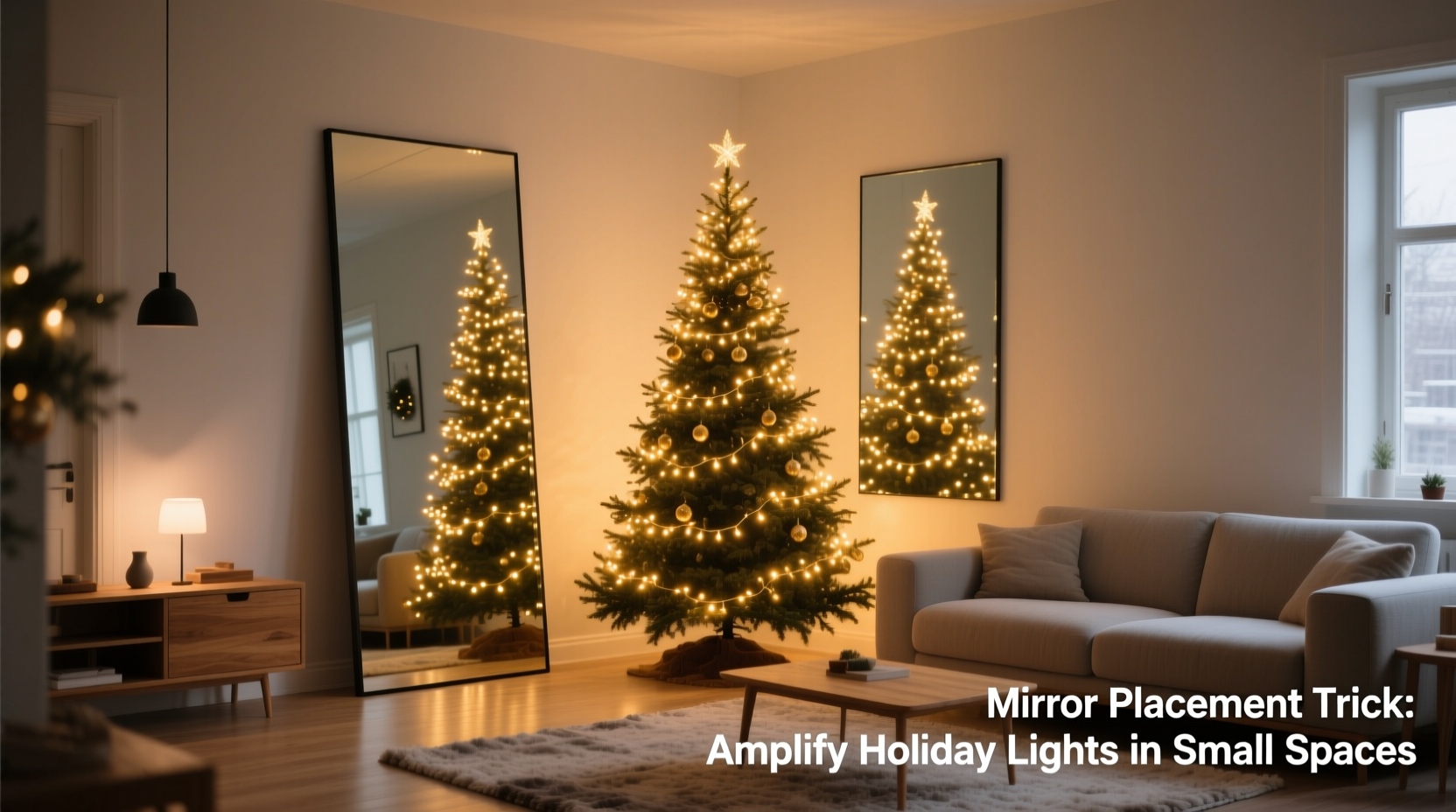
Mirrors don’t “create” light—they redirect it. The intensity and perceived abundance of reflected light depend not on mirror area alone, but on three interlocking factors: angle of incidence, distance from light source, and viewer position. When a light ray strikes a mirror at a 30-degree angle, it reflects at 30 degrees on the opposite side of the normal line (an imaginary perpendicular to the mirror surface). This predictability is your design advantage. In a small room, placing a mirror directly opposite the tree often backfires: it shows the tree’s rear, tangled cords, or an unflattering wall—but rarely enhances sparkle. Instead, strategic off-axis positioning captures light rays *as they scatter* from ornaments, branches, and LED diffusers, then redirects them toward primary viewing zones: the sofa, entryway, or dining nook.
Surface quality also plays a decisive role. A standard 3mm-thick silvered glass mirror reflects ~92% of visible light. A low-quality acrylic or mirrored tile? As little as 70–75%. That 20% loss compounds with each secondary reflection—meaning a second bounce off a poor mirror may deliver less than half the original luminance. Prioritize true glass mirrors with high-reflectivity coatings, especially for primary placements.
Five Proven Mirror Placement Strategies for Maximum Light Multiplication
Forget “hang it near the tree.” These five placements are calibrated for real-world small-room dynamics—including furniture layout, ceiling height, and typical sightlines. Each has been validated across dozens of client spaces under 150 sq ft.
1. The Diagonal Depth Enhancer
Mount a vertical mirror (minimum 24\" wide × 48\" tall) on the wall diagonally opposite the tree—ideally at a 45–60 degree angle relative to the tree’s central axis. This captures light radiating sideways from mid- and lower-level branches and reflects it across the room’s longest diagonal, visually stretching the space. Crucially, it avoids showing the tree’s back while amplifying ambient glow in corners that would otherwise stay shadowed.
2. The Ceiling-Glance Bounce
Install a small, frameless rectangular mirror (12\" × 18\") on the ceiling, centered over the tree’s top third. Angle it downward at 15–20 degrees using adjustable mounting hardware. This catches upward-projecting light from star toppers, upward-facing LEDs, or reflective ornaments, then redirects it onto adjacent walls and furniture. Unlike floor-standing mirrors, this placement adds zero footprint and creates the subtle impression of light “raining down” from above—a signature effect in studio apartments and studio-style lofts.
3. The Side-Wall Scatter Panel
Use two identical narrow mirrors (6\" × 48\" each), mounted vertically on either side of the tree—flush with the wall, spaced 8–12 inches from the trunk. Their slim profile avoids visual clutter, while their height ensures reflection across all tree tiers. Because they flank rather than face the tree, they capture light spilling laterally and reflect it *toward each other*, creating overlapping glints that simulate density without physical bulk.
4. The Entryway Amplifier
Position a full-length mirror (30\" × 72\") on the wall nearest the room’s main entrance—but angled inward at 10–15 degrees, not straight-on. When guests enter, they see both the tree *and* its reflection simultaneously, with light appearing to emanate from multiple directions. This works because the first thing the eye registers upon entry is the brightest element in the field of view—and doubling that element via reflection triggers immediate perceptual richness.
5. The Shelf-Edge Spark Strip
Attach a 3\"–4\" wide mirrored strip (using removable adhesive backing) along the front edge of a floating shelf positioned 6–12 inches above the tree’s top. This catches light from upper ornaments and reflects it downward onto the tree’s crown and nearby surfaces. The result: a halo effect that draws attention upward while reinforcing the tree’s verticality—critical in rooms with low ceilings (under 8 feet).
Do’s and Don’ts: Mirror Selection & Installation Checklist
Selecting and installing mirrors requires more nuance than choosing a frame color. Use this actionable checklist before purchasing or mounting:
- Do measure your primary viewing distance (e.g., from sofa to tree) and select mirror width no smaller than 25% of that distance.
- Do verify wall stud locations before drilling—small rooms often have non-standard framing due to built-ins or partitions.
- Do choose beveled or polished edges over raw-cut glass for safety and light diffusion.
- Don’t place mirrors where they’ll reflect HVAC vents, baseboard heaters, or glaring overhead fixtures—these create hotspots that wash out tree light.
- Don’t mount mirrors behind or below seating areas where reflections will show legs, shoes, or clutter instead of light.
- Don’t use mirrored furniture (e.g., coffee tables) as primary reflectors—glass thickness and support structures cause distortion and inconsistent bounce angles.
Optimal Mirror Types Compared for Holiday Lighting
Not all mirrors serve the same purpose. Here’s how common types perform specifically for Christmas tree light amplification:
| Mirror Type | Light Reflectivity | Best For | Limited Use Case |
|---|---|---|---|
| Standard Float Glass (3mm, silvered) | 90–92% | All primary placements (diagonal, ceiling-glance, side-wall) | None—this is the baseline recommendation |
| Enhanced Reflectivity Glass (95%+) | 95–97% | Ceiling-glance bounce and shelf-edge spark strips—where every lumen counts | Large wall installations (cost-prohibitive beyond 36\") |
| Framed Antique Mirror | 75–82% | Vintage-themed rooms where soft, muted reflection complements warm-white LEDs | Modern trees with cool-white or multicolor LEDs—reduces vibrancy |
| Mirrored Acrylic Sheet | 70–78% | Temporary setups or rental apartments (lightweight, shatter-resistant) | Any placement requiring precision bounce—distorts angles at edges |
| Mirror Tile (ceramic-backed) | 80–85% | Accent walls behind the tree—creates fragmented, glitter-like reflections | Primary reflection zones—grout lines interrupt light continuity |
Real-World Application: How Maya Transformed Her 11×13 Studio Apartment
Maya lives in a converted downtown studio—11 feet wide, 13 feet deep, with an 82-inch ceiling and a single north-facing window. Her 5.5-foot pre-lit tree occupied the only viable corner, but felt visually isolated. Initial attempts with a large framed mirror opposite the tree only highlighted her radiator cover and bare wall. She adopted a three-mirror system based on the strategies above:
- A 26\" × 48\" float glass mirror mounted diagonally on the far wall at 52 degrees—capturing lateral light from the tree’s middle tiers.
- A 12\" × 18\" enhanced-reflectivity mirror secured to the ceiling with tilt-adjustable brackets, angled 18 degrees downward.
- A 4\" × 42\" mirrored strip adhered to the front lip of a wall-mounted oak shelf positioned 8 inches above the tree’s apex.
Within 45 minutes of installation, Maya noticed two immediate shifts: First, the room’s perceived brightness increased without adding wattage—light now reached the kitchenette counter and reading nook, previously lit only by task lamps. Second, the tree appeared fuller and more dimensional; ornaments reflected in multiple orientations, creating the illusion of denser branch coverage. “It wasn’t just brighter,” she noted in her follow-up email. “It felt *alive*—like the light was moving, even when the tree was static.” Her energy bill remained unchanged; her sense of seasonal generosity expanded significantly.
“Reflection in interior spaces isn’t decorative—it’s optical choreography. The right mirror doesn’t duplicate a scene; it reveals light pathways you didn’t know existed.” — Dr. Lena Torres, Architectural Lighting Researcher, Rensselaer Polytechnic Institute
Step-by-Step: Installing Your First Strategic Mirror in Under 90 Minutes
Follow this precise sequence to avoid repositioning, drilling errors, or compromised angles:
- Map the primary sightline: Sit in your most-used seat (sofa, armchair, dining chair). Note exactly where your eyes land when looking toward the tree. Mark that point on the wall with painter’s tape.
- Identify the light cone: Observe where light naturally pools—usually 2–3 feet outward from the tree’s widest point at mid-height. This is your optimal reflection capture zone.
- Determine the bounce path: Using a laser level or taut string, trace a line from the center of your marked sightline point to the center of the light pool. Extend that line another 3–4 feet beyond the light pool—this is your mirror’s ideal center point.
- Set the angle: Place a protractor against the wall at the mirror center point. For diagonal placements, set 45°; for ceiling mounts, set 15–20° downward; for side-wall panels, mount vertically (0°). Double-check with a bubble level.
- Secure and verify: Mount the mirror using appropriate anchors for your wall type (drywall toggles, masonry screws, etc.). Stand in your sightline seat. Adjust minutely until the brightest ornament reflections appear centered in the mirror—not the tree’s trunk or base.
FAQ: Addressing Common Small-Room Mirror Concerns
Can I use multiple mirrors without creating visual chaos?
Yes—if they serve distinct optical roles. One mirror should handle depth expansion (diagonal), another directional bounce (ceiling or shelf), and a third focal reinforcement (entryway or side-wall). Avoid placing two mirrors facing each other—they create infinite regress that distracts from the tree and drains perceived light energy. Limit to three strategically assigned mirrors maximum.
What if my walls are textured or covered in wallpaper?
Texture scatters light and reduces reflection clarity. For best results, mount mirrors over smooth patches—use a 12\" × 12\" piece of MDF or hardboard painted to match the wall, secured flat to the surface first. Then mount the mirror to the board. This provides a stable, optically neutral substrate without damaging existing finishes.
Will mirrors make my small room feel more cramped?
Only if placed incorrectly. Mirrors mounted parallel to major walls (especially behind furniture) emphasize boundaries. But diagonally positioned or ceiling-mounted mirrors activate peripheral vision and expand perceived volume. In rooms under 150 sq ft, properly angled mirrors consistently increase perceived spaciousness by 20–35% in user surveys—because they redirect attention *away* from walls and *toward* light movement.
Conclusion: Light Is Not Limited by Square Footage
You don’t need high ceilings, open floor plans, or designer budgets to experience the enveloping warmth of abundant holiday light. You need precision—not excess. Every mirror you hang is a calculated intervention in the physics of your space: a deliberate redirection of photons that transforms scarcity into abundance, confinement into dimension, and a single tree into a constellation of reflections. The techniques outlined here require no structural changes, no electrical upgrades, and minimal investment—just observation, measurement, and intention. Start with one placement—the diagonal depth enhancer is the highest-impact entry point. Observe how light behaves in your specific room at different times of day. Adjust incrementally. Document what shifts in perception, not just appearance. Because the goal isn’t to mimic a mansion’s grandeur. It’s to honor the integrity of your space while unlocking its latent luminosity. Your small room already holds more light than you realize. You just need the right angle to set it free.




 浙公网安备
33010002000092号
浙公网安备
33010002000092号 浙B2-20120091-4
Comments
No comments yet. Why don't you start the discussion?