
Christmas lights transform homes into festive sanctuaries, but their impact doesn’t have to rely solely on wattage or quantity. One of the most underutilized yet powerful tools in holiday lighting design is the mirror. By strategically placing mirrors, you can multiply the visual presence of your lights, deepen spatial perception, and elevate even modest displays into something extraordinary. Unlike adding more strands or upgrading bulbs, using mirror reflections is a low-cost, high-return technique that leverages physics and design to create brilliance beyond what’s physically installed.
Mirrors don’t generate light, but they manipulate its path—bouncing, scattering, and multiplying the glow across rooms and outdoor spaces. When applied thoughtfully, this principle turns walls, corners, and dark areas into dynamic contributors to your holiday ambiance. Whether you're decorating a small apartment, a grand living room, or an exterior façade, integrating mirrors into your lighting plan adds dimension, movement, and magic.
The Science Behind Light Reflection and Holiday Displays
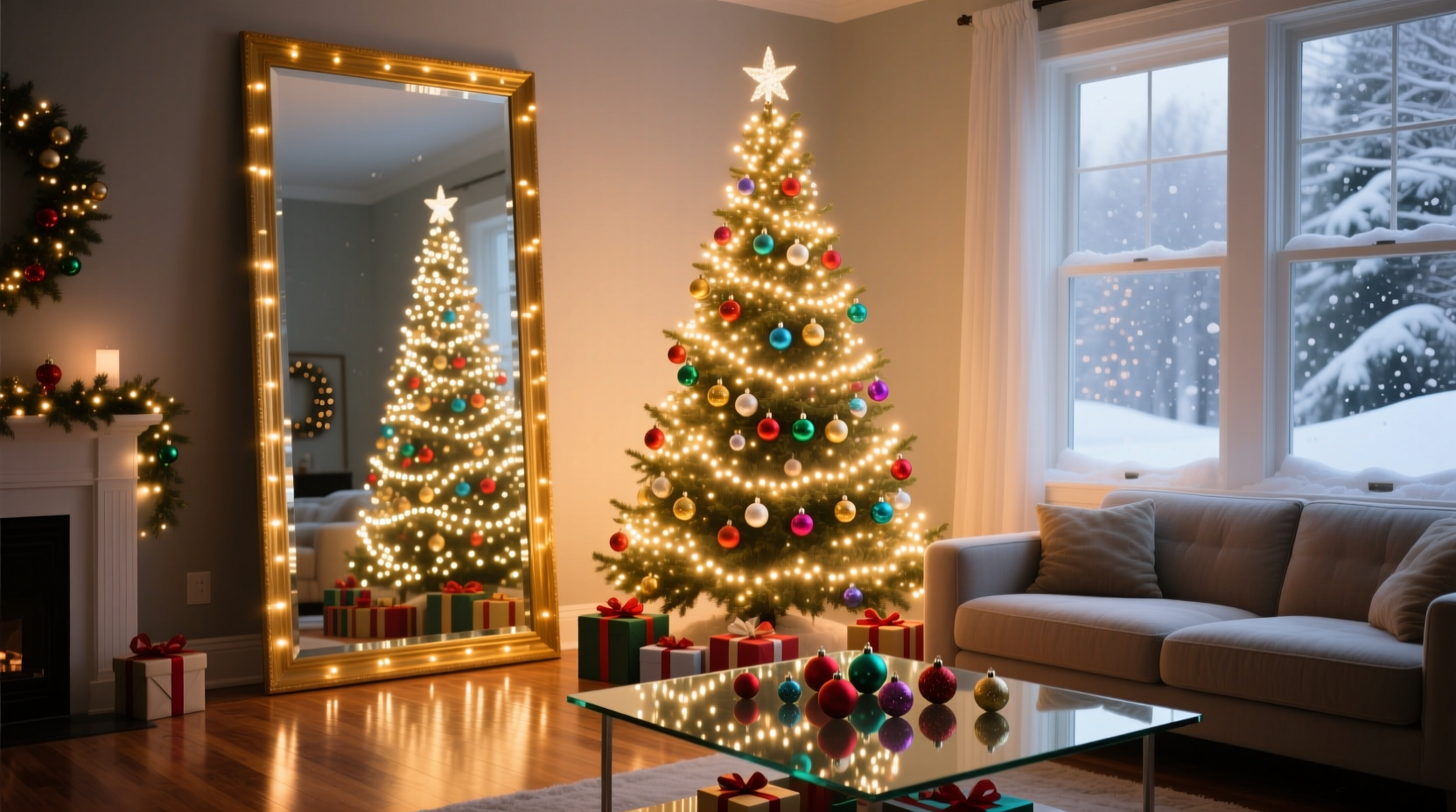
Light behaves predictably: when it strikes a smooth, reflective surface like glass coated with silver or aluminum, it bounces off at an angle equal to its incoming trajectory. This is known as the law of reflection. In practical terms, a string of lights aimed toward a mirror will appear duplicated on the opposite side of the reflective plane. The brain interprets this reflected image as real, creating the illusion of additional lights where none exist.
This effect becomes especially potent with Christmas lights because of their clustered, twinkling nature. Unlike a single beam, multiple small points of light generate a complex pattern upon reflection. If the mirror is large enough or positioned correctly, these patterns can fill entire walls or ceilings, giving the impression of a fully lit environment—even if only one section is actually wired.
Moreover, LED lights—now standard for most holiday setups—emit directional, bright illumination ideal for reflection. Their cool operation also means they won’t damage nearby surfaces, including mirrored frames or backing materials, making them safe to place close to reflective installations.
“Reflection isn’t just decoration—it’s optical engineering. A well-placed mirror can double your perceived light coverage without doubling energy use.” — Dr. Lena Pruitt, Lighting Design Specialist, Rhode Island School of Design
Strategic Mirror Placement Techniques
The effectiveness of mirror-based amplification depends almost entirely on positioning. Poorly placed mirrors may reflect unlit corners, furniture, or obstructed views, diminishing the desired effect. Optimal placement aligns the mirror’s field of view with the primary light source while ensuring the reflection enhances rather than distracts from the space.
Indoor Applications
Inside the home, focus on high-impact zones such as living rooms, entryways, and dining areas where holiday gatherings occur. Consider these placements:
- Opposite the Christmas tree: Position a full-length or large wall mirror directly across from the tree. This doubles the visual weight of the tree’s lights and ornaments, making the centerpiece appear larger and more radiant.
- Behind mantle displays: Mount a mirror above or behind electric candles, figurines, or garlands on the fireplace mantel. The reflection creates depth, suggesting a tunnel or infinite repetition of lights.
- Ceiling-mounted mirrors: Use angled ceiling mirrors (such as those found in vintage chandeliers or decorative medallions) to bounce upward-facing lights across the room. This works especially well with stairwell railings wrapped in lights.
Outdoor Applications
Exterior use requires weather-resistant materials, but the payoff is dramatic. Place shatterproof, UV-protected acrylic mirrors (often called \"safety mirrors\") along fence lines, beside doors, or near window displays. These reflect porch lights, wreaths, and roofline strings back into the yard, increasing visibility from the street and enhancing curb appeal.
For driveways or walkways, position convex security mirrors at corners to bounce light around obstructions. Though primarily designed for visibility, their curved surface diffuses light widely, scattering sparkle across snow-covered paths or shrubbery.
Step-by-Step Guide: Creating a Mirror-Amplified Light Display
Follow this sequence to integrate mirrors effectively into your Christmas lighting setup:
- Assess your current lighting layout. Identify primary light sources—the tree, window strands, porch fixtures—and note their direction and brightness.
- Select mirror types based on location. Indoors, use standard glass mirrors; outdoors, opt for acrylic or polycarbonate versions resistant to breakage and weathering.
- Determine optimal angles. Stand where viewers will be (e.g., front door, sofa) and adjust the mirror until the maximum amount of light appears reflected.
- Secure installation. Use appropriate hardware—mirror clips indoors, rust-proof brackets outdoors—to prevent shifting during wind or foot traffic.
- Test at night. Turn off ambient lights and evaluate the reflection after dark. Adjust tilt or position for even distribution and minimal glare.
- Incorporate motion or flicker. Pair reflected static lights with flickering LEDs or rotating projectors to create dynamic interplay between real and mirrored images.
Choosing the Right Mirrors for Maximum Impact
Not all mirrors work equally well for light amplification. Size, shape, frame style, and surface quality all influence performance. The following table compares common mirror types for holiday use:
| Mirror Type | Best For | Pros | Cons |
|---|---|---|---|
| Full-Length Wall Mirror | Living rooms, hallways | Large reflective area, elegant appearance | Heavy, requires secure mounting |
| Decorative Ornamental Mirror | Focal points near trees or windows | Adds festive style, available in seasonal shapes (stars, snowflakes) | Smaller surface limits reflection scope |
| Acrylic Safety Mirror | Outdoor installations, children's areas | Shatterproof, lightweight, weather-resistant | Slightly less clarity than glass |
| Convex Security Mirror | Driveways, tight corners | Wide-angle reflection, improves safety | Distorts image slightly |
Avoid mirrors with tinted glass or anti-glare coatings, as these reduce reflectivity and mute light color. Clear, high-silver-content mirrors offer the brightest return.
Mini Case Study: Transforming a Small Apartment Balcony
Sophie Chen, a graphic designer in Chicago, lives in a studio apartment with a narrow balcony facing north—receiving little natural light in winter. Last year, she wanted to create a visible holiday display but was limited by outlet access and space. She installed a single strand of warm-white micro-LEDs along the railing and mounted two 18-inch acrylic mirrors on either end of the balcony wall, angled inward.
The result exceeded expectations. Passersby reported seeing “a glowing cove” from the sidewalk, mistaking the reflections for additional lighting. Inside, the living area benefited from bounced light spilling through the sliding glass door. Sophie later added a small rotating projector that cast animated snowflakes, which the mirrors multiplied into a swirling canopy.
Her total cost: $38. Total runtime: under two hours. The display became a neighborhood favorite, proving that strategic reflection can overcome spatial limitations.
Checklist: Preparing Your Mirror & Light Setup
Use this checklist before finalizing your holiday lighting and mirror arrangement:
- ☐ Identify primary light sources to be reflected
- ☐ Choose mirror type based on indoor/outdoor use
- ☐ Measure viewing angles from key vantage points
- ☐ Clean mirror surface thoroughly before installation
- ☐ Secure mirrors with appropriate fasteners
- ☐ Test reflection after dark and adjust positioning
- ☐ Avoid pointing mirrors directly at bright bulbs to prevent glare
- ☐ Combine with other reflective surfaces (glass tables, metallic décor) for layered effects
Common Mistakes to Avoid
Even experienced decorators can misjudge reflection dynamics. Common pitfalls include:
- Overcrowding: Placing too many mirrors causes chaotic, overlapping reflections that dilute the intended effect.
- Incorrect height: Mirrors mounted too high reflect ceilings instead of lights; too low, and they capture legs and furniture.
- Ignoring ambient light: During dusk or dawn, external light can wash out reflections. Reserve mirror-heavy designs for full nighttime viewing.
- Using damaged or foggy mirrors: Pitting, tarnishing, or moisture behind the glass scatters light unevenly, reducing clarity.
FAQ
Can I use regular household mirrors outdoors?
No. Standard glass mirrors are not weather-sealed and can crack from freeze-thaw cycles or moisture infiltration. Use acrylic or polycarbonate mirrors rated for outdoor use instead.
Will mirrors increase my electricity usage?
No. Mirrors only reflect existing light—they do not consume power or require wiring. The energy savings come from achieving greater visual impact without adding more bulbs.
Are there fire risks when using mirrors near Christmas lights?
Modern LED lights produce minimal heat, so the risk is negligible. However, avoid placing any mirror in direct contact with incandescent bulbs, which can reach high temperatures and potentially crack glass.
Conclusion: Let Light Multiply Itself
Amplifying Christmas lights with mirrors is more than a clever trick—it’s a thoughtful fusion of aesthetics and physics. With careful planning, a single string of lights can appear as dozens, transforming confined spaces into luminous wonderlands. The beauty lies not in excess, but in intentionality: every reflection is a calculated enhancement, a silent echo of joy extended.
This holiday season, look beyond the plug and socket. Study your room’s angles, anticipate sightlines, and let mirrors do the heavy lifting. You’ll spend less time untangling wires and more time enjoying the glow. Whether you’re crafting intimacy in a cozy nook or dazzling neighbors from afar, reflection offers a smarter, brighter way to celebrate.




 浙公网安备
33010002000092号
浙公网安备
33010002000092号 浙B2-20120091-4
Comments
No comments yet. Why don't you start the discussion?