
Christmas tree lights shimmer most vividly not when they’re brightest—but when their light is multiplied, redirected, and layered through reflection. Mirror surfaces, often overlooked as mere decorative accents, function as optical amplifiers: they capture photons that would otherwise dissipate into shadow and return them to the viewer’s eye with directional precision. This isn’t about adding more wattage—it’s about maximizing what you already have. Professional lighting designers for holiday displays, museum exhibit curators, and even theatrical set stylists rely on reflective geometry to create depth, rhythm, and perceived luminosity. In homes, a single strategically placed mirror can double the visual impact of a modest string of 100 LED micro-bulbs. This article details how to harness reflection intentionally—not as an afterthought, but as a core element of your tree’s lighting architecture.
The Physics Behind the Sparkle: Why Mirrors Work Better Than White Surfaces
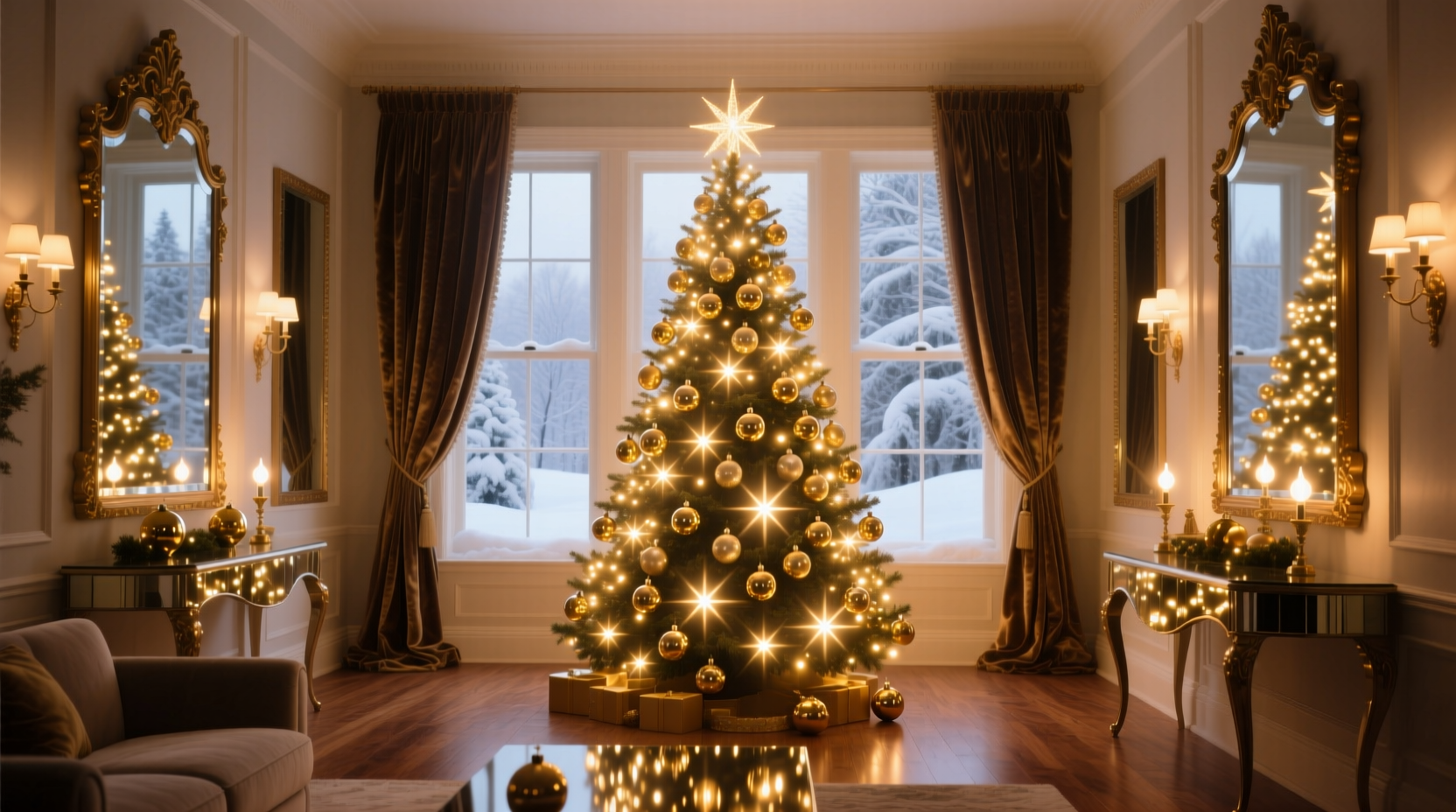
Not all reflective materials perform equally. A matte white wall reflects approximately 85–90% of visible light—but diffusely, scattering photons in all directions. That softens contrast and blurs sparkle. A high-quality mirror, by contrast, reflects over 95% of incident light with specular (angle-matched) precision: light hitting at 30° bounces off at 30°. This preserves the pinpoint intensity of each bulb, maintaining sharp highlights and crisp twinkle patterns. Crucially, mirrors also extend the *perceived volume* of light. When positioned to reflect both the front and side profiles of the tree, they simulate additional layers of branches and ornamentation—tricking the brain into registering greater density and movement.
This effect compounds geometrically. One mirror adds one reflected image. Two mirrors angled toward each other generate infinite reflections—a cascade known as a “mirror tunnel.” While full infinite recursion isn’t practical or desirable on a tree (it creates visual noise), controlled dual-mirror setups—such as a rear wall mirror paired with mirrored ornaments—produce layered, dimensional sparkle that feels alive, not static.
Five Strategic Mirror Placement Zones (With Real-World Rationale)
Effective mirror integration follows spatial logic—not symmetry. Each placement zone serves a distinct optical purpose. Avoid centering mirrors solely for “balance”; prioritize sightlines, ambient light sources, and natural movement paths through the room.
- Rear Wall Mirror (Primary Amplifier): Mount a vertical mirror 6–12 inches behind the tree trunk, centered horizontally. Its height should match or slightly exceed the tree’s. This captures the entire back profile—branches, garlands, and hidden lights—and projects them forward, effectively doubling the tree’s frontal presence. Ideal for narrow rooms where space limits viewing angles.
- Side Table or Mantel Mirror (Dynamic Accent): Place a small, tilted mirror (15–30° angle) on a surface adjacent to the tree—e.g., a side table to the left. It reflects the tree’s right flank, introducing asymmetrical sparkle that shifts as viewers walk past. Tilting prevents direct glare into eyes while enhancing dimensionality.
- Mirror-Backed Ornament Cluster (Micro-Amplification): Group 3–5 mirrored baubles (preferably varying diameters: 2\", 3\", and 4\") on lower-to-mid branches. Position them so their curved surfaces face outward and slightly upward. Each acts as a miniature lens, catching and redirecting light from multiple bulbs simultaneously—creating localized “hotspots” of intensified glitter.
- Floor Mirror (Ground-Level Lift): A low-profile, beveled-edge mirror laid flat on the floor beneath the tree stand reflects upward into the lowest tier of branches. This illuminates often-shadowed areas (especially under dense firs or spruces), revealing hidden lights and metallic garlands that would otherwise vanish into darkness.
- Ceiling-Mounted Reflective Panel (Overhead Dimension): A 12\" × 12\" square of rigid acrylic mirror mounted flush to the ceiling directly above the tree’s apex reflects downward. It doesn’t show the tree’s top—it shows the *undersides* of upper branches and ornaments, adding a subtle, ethereal halo effect that enhances vertical continuity.
Do’s and Don’ts: Mirror Material, Size, and Safety Guidelines
Mirror selection impacts safety, longevity, and optical fidelity. The wrong choice introduces distortion, glare, or hazard—especially around children or pets. Below is a distilled comparison of common reflective options for holiday use:
| Mirror Type | Best For | Key Advantages | Risks & Limitations |
|---|---|---|---|
| Tempered Glass Mirror (3mm+) | Rear wall, floor, mantel | Shatter-resistant, optically precise, durable finish | Heavy; requires secure mounting hardware; avoid if mounting on plaster walls without stud anchors |
| Acrylic Mirror Sheet | Ceiling panel, ornament backs, DIY frames | Lightweight, shatterproof, easy to cut and mount with adhesive | Slightly lower reflectivity (~92%); scratches easily—handle with microfiber only |
| Metallic Mylar Film (on rigid board) | Temporary installations, kids’ rooms | Ultra-light, inexpensive, highly flexible | Distorts reflection at angles >15°; degrades with humidity; not suitable for permanent placement near heat sources |
| Antique/Textured Mirror | Decorative accent only (not primary reflection) | Softens glare, adds vintage charm, hides minor imperfections | Reduces sparkle clarity—avoid for primary amplification zones |
Avoid placing mirrors within 18 inches of heat-emitting incandescent bulbs or halogen spotlights. While modern LEDs run cool, older string lights can reach 60°C+—enough to warp acrylic or delaminate adhesive-backed films. Always secure wall-mounted mirrors with closed-hook picture hangers rated for 2× the mirror’s weight, not nails alone.
Step-by-Step: Setting Up Your Mirror-Enhanced Tree Lighting System
Follow this sequence to calibrate reflections before final decorating. Rushing placement leads to hotspots, dead zones, or unintended glare.
- Install bare tree and lights first. Use warm-white or multi-color LEDs with a high CRI (Color Rendering Index >90) for truer color reflection. Ensure lights are evenly distributed—no gaps in lower third.
- Position rear wall mirror. Stand at your primary viewing point (e.g., sofa). Adjust mirror height until the full tree—including base and top—is cleanly framed. Mark mounting points.
- Add floor mirror. Center it under the stand. Verify it reflects at least two tiers of lower branches. If obscured by skirt fabric, trim skirt hem or use a smaller mirror (10\" × 10\").
- Test side-angle mirror. Place on adjacent surface. Tilt gradually while observing the tree’s reflection. Stop when you see clear, undistorted branches—not just a blur of light. Secure with museum putty if temporary.
- Hang mirror ornaments. Start with largest (4\") on bottom-heavy branches facing outward. Add medium (3\") mid-level, angled 45° upward. Finish with smallest (2\") near tips—these catch ambient ceiling light for subtle secondary sparkle.
- Final calibration. Turn off all room lights except tree. Walk slowly in a 360° circle. Note where reflections converge (ideal) or disappear (reposition needed). Adjust tilt or position in 2° increments until sparkle feels immersive, not fragmented.
Mini Case Study: The Apartment Living Room Transformation
Sarah, a graphic designer in Chicago, faced a challenge: her 7-foot Nordmann fir occupied nearly the full width of her 12-foot-wide living room. With only one unobstructed 8-foot wall behind the sofa—and no space for a traditional tree stand against it—she’d always placed the tree in the corner, resulting in a flat, one-dimensional appearance. Lights looked dull from the main seating area, and ornaments on the far side vanished into shadow. She implemented a minimal mirror system: a 30\" × 48\" tempered glass mirror mounted vertically on the wall *opposite* the tree (not behind it), angled 10° inward using adjustable French cleats; a 14\" circular acrylic mirror on the coffee table, tilted 25°; and six 3\" mercury-glass ornaments clustered on the tree’s most visible quadrant. The result? The wall mirror captured the tree’s full front and left profile, projecting it across the room like a stage backdrop. The coffee table mirror bounced light upward into the middle branches, making garlands appear to float. Within 48 hours, three neighbors asked how she’d “added so many more lights.” No new strings were purchased—only 1.2 seconds of reflection time were added to every photon’s path.
“Mirrors don’t create light—they orchestrate it. The best holiday lighting isn’t about quantity; it’s about choreography. Every reflective surface is a conductor’s baton directing where attention lands.” — Rafael Mendez, Lighting Director, Rockefeller Center Christmas Tree Team (2018–2023)
FAQ
Can I use aluminum foil or chrome gift wrap as a mirror substitute?
No. These materials produce diffuse, low-fidelity reflection—scattering light rather than focusing it. Foil crinkles create chaotic hotspots; chrome wrap lacks optical flatness, distorting branch shapes and turning bulbs into smears. They may add *glint*, but not controlled *sparkle*. Reserve them for craft projects—not primary amplification.
How do I clean mirror surfaces without streaking or damaging coatings?
Use distilled water and a 100% cotton microfiber cloth—never paper towels or ammonia-based cleaners. For stubborn fingerprints, dampen the cloth with 70% isopropyl alcohol (not rubbing alcohol with additives), then wipe *once* in straight lines—not circles—to avoid micro-scratches. Dry immediately with a second dry microfiber cloth. Store cloths in sealed bags to prevent dust accumulation.
Will mirrored surfaces make my tree look too “busy” or overwhelming?
Only if reflections lack intention. Busy visuals arise from uncontrolled multiplicity—e.g., four mirrors competing for attention. Stick to the five-zone framework: one primary (rear wall), one dynamic (side table), and three micro (ornaments, floor, ceiling). Eliminate any mirror that reflects another mirror directly—that triggers visual fatigue. Test by closing one eye: if the scene feels cohesive, not fractured, you’ve achieved balance.
Conclusion
Amplifying Christmas tree sparkle with mirrors isn’t decoration—it’s illumination design. It transforms passive light emission into active light storytelling, where every reflection deepens the sense of warmth, abundance, and quiet wonder. You don’t need expensive gear or electrician-level expertise. What you need is understanding: how angles govern direction, how material quality governs fidelity, and how restraint governs elegance. Start small—add just the rear wall mirror and three well-placed ornaments this season. Observe how light lingers longer on your guests’ faces, how children pause to watch reflections dance across the ceiling, how the tree seems to breathe with its own quiet rhythm. Then next year, refine. Adjust the tilt. Swap an ornament. Notice the difference a 2° change makes. Because true magic lies not in excess, but in the precise, thoughtful multiplication of what already shines.




 浙公网安备
33010002000092号
浙公网安备
33010002000092号 浙B2-20120091-4
Comments
No comments yet. Why don't you start the discussion?