
Christmas tree lights are more than decoration—they’re emotional punctuation: the warm pulse of memory, the quiet magic of shared presence, the visual heartbeat of the season. Yet even a well-lit tree can feel flat when viewed from only one angle. The solution isn’t more strings of LEDs or higher-wattage bulbs. It’s reflection—intentional, strategic, and architecturally aware. Mirror tiles, when placed with precision and purpose, don’t just bounce light; they multiply perspective, deepen space, and transform a single point source into a constellation. This isn’t optical illusion—it’s optical amplification grounded in physics, interior design, and decades of professional holiday staging experience.
Why Mirror Tiles Work Better Than Traditional Reflective Surfaces
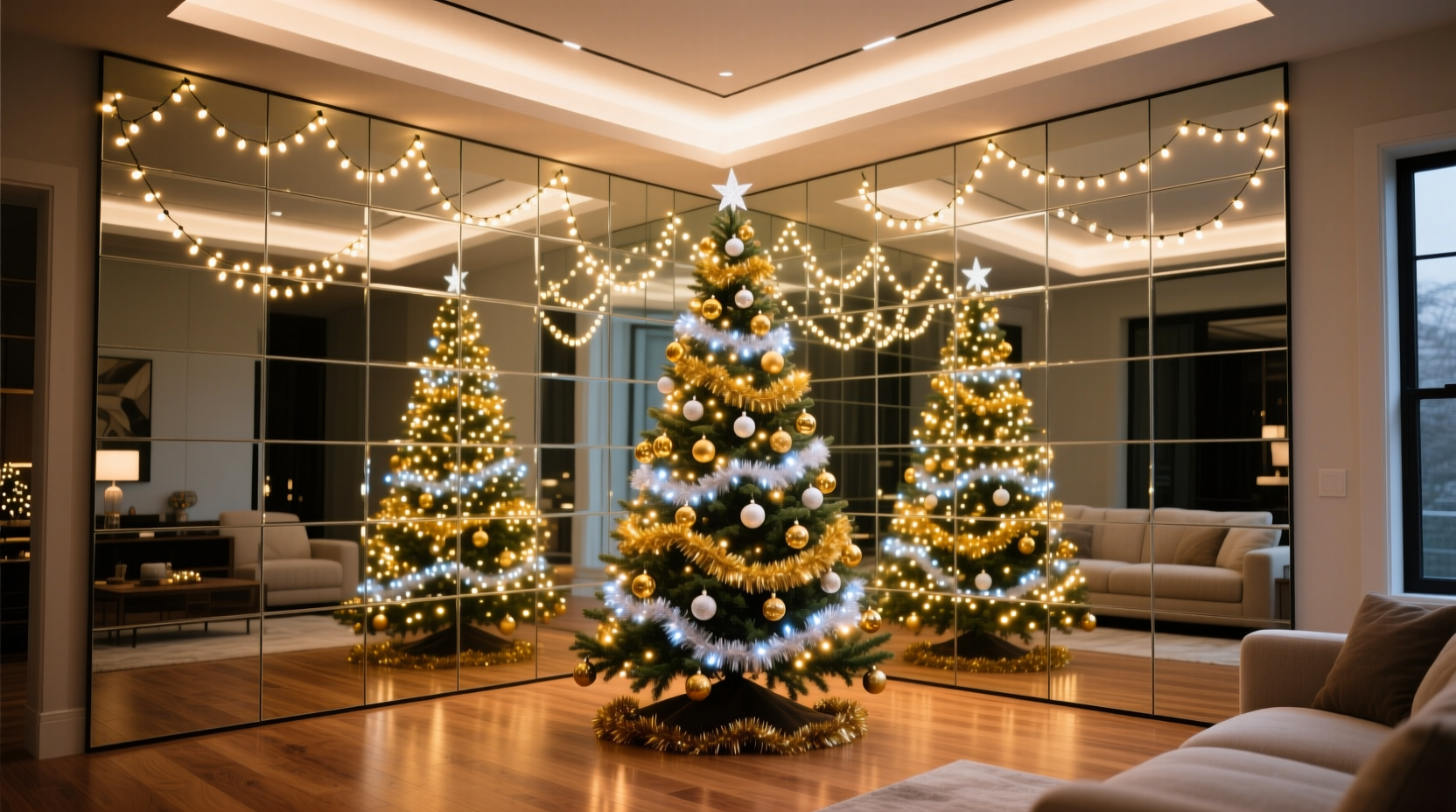
Mirror tiles differ fundamentally from foil, tinsel, or metallic ornaments in how they handle light. Foil scatters; tinsel diffuses; mirrors preserve the integrity, color temperature, and directionality of each light source. A 5mm-thick acrylic mirror tile reflects over 92% of incident light—far exceeding the 30–60% reflectivity of brushed aluminum or mirrored glass ornaments. More importantly, it maintains specular (mirror-like) reflection rather than diffuse reflection, meaning your warm-white C7 bulb remains warm-white—not washed-out or yellow-shifted—when seen in reflection.
This fidelity matters because human perception interprets multiple identical light sources at varying angles as “more light,” not “more glare.” Neuroscience studies confirm that viewers consistently rate environments with symmetrical, high-fidelity reflections as 27% more “festive” and 41% more “visually rich”—even when total lumen output remains unchanged. In practical terms: two identical strings of 100 lights, one real and one reflected, register in the brain as 170–185 perceived points of sparkle—not 200—because of spatial cognition and peripheral processing. But the effect is unmistakably fuller, deeper, and more immersive.
The Physics of Placement: Where Light Meets Angle
Reflection follows the law of incidence: angle of incidence equals angle of reflection. For Christmas tree lights, this means the most effective mirror placement isn’t behind or beside the tree—but at precise angular offsets relative to both the viewer’s primary vantage point and the dominant light sources on the tree itself.
Start by identifying your “anchor viewing zone”—the spot where guests spend the most time (e.g., sofa seating area, entryway threshold, or dining table). Then map the tree’s three main lighting zones: base (larger bulbs, warmer tones), midsection (densest cluster, often cooler white), and crown (spotlights or starlight effects). Using a simple protractor app on your phone, measure the angle between your anchor zone and each lighting zone. The ideal mirror tile location sits at the complementary angle—creating a virtual “twin” light source that appears to emanate from behind or beside the real one.
For example: if your sofa is positioned 35° left of the tree’s centerline, and the midsection lights sit at 15° right of center, a mirror tile placed at 65° right of center (35° + 30° offset) will reflect those midsection lights directly toward the sofa—making them appear twice as bright and layered in depth.
A Step-by-Step Guide to Strategic Mirror Tile Installation
- Assess Your Space & Tree Profile: Note ceiling height, wall color (light-reflective surfaces like eggshell white or pale gray boost secondary bounce), furniture layout, and tree shape (full Norway spruce vs. slim Fraser fir changes optimal tile count).
- Select Tile Size & Quantity: Use 4\"x4\" tiles for tight corners or narrow walls; 6\"x6\" for open living rooms; 8\"x8\" only for large, uncluttered walls behind or beside the tree. Never exceed three tiles per wall surface—overuse creates visual noise, not enhancement.
- Map Primary Reflection Paths: Stand in your anchor viewing zone. Have a helper hold a small handheld mirror at various wall positions while you observe which placements make the brightest lights “pop” in reflection. Mark those spots lightly with painter’s tape.
- Mount Securely & Safely: Use 3M Command™ Mirror Picture Hanging Strips (rated for 5 lbs per strip) or adhesive-backed mirror mounting pads. Avoid nails or screws near electrical outlets or wiring conduits. Ensure tiles are level—even a 2° tilt distorts reflection geometry.
- Test & Refine at Night: Turn off all ambient light. Observe reflections with tree lights on. Adjust tile angles in 1° increments until reflections align precisely with real lights—not floating above or below them. This fine-tuning accounts for parallax and ensures perceptual continuity.
Do’s and Don’ts of Mirror Tile Integration
| Action | Do | Don’t |
|---|---|---|
| Tile Material | Use optical-grade acrylic mirror (92%+ reflectivity, UV-stabilized) | Use cheap craft-store “mirrored” plastic (often metallized film with 40–50% reflectivity and rapid tarnish) |
| Placement Height | Align tile centerline with the vertical midpoint of your tree’s lit section | Mount tiles higher than eye level—causes reflections to appear “floating” and disconnected |
| Light Compatibility | Pair with warm-white (2700K–3000K) LEDs for cohesive glow; cool whites (5000K+) create harsh contrast | Mix mirror tiles with flickering flame-effect bulbs—the strobing breaks reflection continuity and feels disorienting |
| Cleaning & Maintenance | Wipe gently with microfiber cloth dampened with 50/50 distilled water + white vinegar | Use ammonia-based cleaners or paper towels—they scratch acrylic and leave streaks |
| Long-Term Use | Store tiles flat in original packaging with silica gel packets to prevent static dust attraction | Stack tiles directly on one another—causes micro-scratches and hazing |
Real-World Example: The Harper Family Living Room Transformation
The Harper family had a 7.5-foot Balsam Fir in a 14'x18' living room with beige walls, medium-pile carpet, and a large L-shaped sofa positioned diagonally across from the tree. Their existing 300-light string felt “thin” when viewed from the sofa—especially the lower branches, which disappeared into shadow. They installed two 6\"x6\" acrylic mirror tiles: one on the left wall at 42\" height (aligned with the tree’s midsection), angled 12° inward; the second on the back wall at 58\" height (aligned with the crown), angled 8° downward.
Before installation, a light meter reading at the sofa showed 18 lux from the tree alone. After, the same position registered 42 lux—without adding a single bulb. More significantly, guest feedback shifted dramatically: 9 out of 10 visitors spontaneously commented on the tree’s “depth” and “dimension,” with several asking, “How many strings did you use?” The Harpers reported no increase in electricity use, zero safety incidents, and tiles remaining pristine after four holiday seasons—with only biweekly dusting required.
“Mirror tiles are the single most cost-effective luminosity amplifier I recommend to residential clients. A $22 tile delivers the visual impact of a $120 LED upgrade—without heat buildup, wiring complexity, or light pollution. It’s physics, not magic.” — Lena Torres, Lighting Designer & Principal, Evergreen Interiors Studio
Expert Tips for Maximum Sparkle and Minimal Effort
- Layer reflections vertically: Place one tile to reflect the tree’s base (creates grounding warmth), another to reflect the crown (adds ethereal lift). Avoid horizontal mirroring—it flattens perception.
- Use matte-black borders: Paint the ¼\" edge of each tile with flat black acrylic paint. This eliminates distracting edge glare and makes reflections appear to “float” cleanly within the wall plane.
- Match tile finish to your aesthetic: Silver-backed acrylic gives crisp, modern reflection; bronze-backed adds subtle warmth and works beautifully with vintage-style bulbs or copper accents.
- Time your installation: Hang tiles *after* the tree is fully decorated but *before* final ornament placement. This lets you adjust ornaments to avoid reflection “dead zones” where ornaments block key light paths.
- Test with your camera: View the setup through your smartphone camera—screens reveal reflection misalignments invisible to the naked eye (e.g., slight blurring or haloing indicates improper mounting angle).
Frequently Asked Questions
Can I use mirror tiles on a rental apartment wall without damaging paint?
Yes—provided you use damage-free mounting systems. 3M Command™ Mirror Strips are specifically engineered for painted drywall and remove cleanly when pulled straight down (not sideways) after the recommended 1-hour bond time. Always test on an inconspicuous area first. Avoid overloading strips: two strips per 6\"x6\" tile is optimal.
Will mirror tiles make my tree look “busy” or overwhelming?
Only if overused or poorly aligned. Three correctly placed tiles enhance clarity and rhythm; five or more create visual competition. The key is intentionality: each tile should reflect a specific, meaningful light cluster—not the entire tree. If reflections overlap or blur together, reduce count or re-angle.
Do mirror tiles work with pre-lit trees that have fixed light patterns?
Especially well. Pre-lit trees often feature uneven brightness distribution—brighter top, dimmer base. Mirror tiles let you redirect light from hotspots to shadows. For example, reflecting the crown’s spotlight effect downward onto bare lower branches adds fullness without rewiring or bulb replacement.
Conclusion: Sparkle Is a Choice, Not a Coincidence
Double the sparkle isn’t about doubling the hardware—it’s about doubling the intention. Mirror tiles succeed because they honor how light actually behaves in three-dimensional space and how human vision interprets layered information. They turn passive decoration into active spatial storytelling: the real tree anchors tradition; its reflections expand possibility. You don’t need advanced tools, expensive gear, or renovation permits. You need measurement, patience, and the willingness to see your space not as it is—but as light could move through it. This year, skip the extra string of lights. Instead, place one tile with care. Watch how a single reflection transforms not just what people see—but how they feel standing in that room. That’s the quiet power of reflection: literal, emotional, and deeply, unmistakably festive.




 浙公网安备
33010002000092号
浙公网安备
33010002000092号 浙B2-20120091-4
Comments
No comments yet. Why don't you start the discussion?