
Outdoor lighting plays a crucial role in both the functionality and visual appeal of residential landscapes. Among the most innovative and practical solutions available today are motion-activated lights. When strategically installed around trees, these lights not only enhance security but also draw attention to architectural features of your yard. Trees, especially mature or uniquely shaped ones, serve as natural focal points. By integrating motion-sensing technology into your outdoor lighting plan, you can illuminate these living sculptures on demand—saving energy while creating dramatic nighttime effects.
The goal isn’t just visibility; it’s intelligent illumination. Motion-activated lights turn on only when movement is detected, reducing light pollution and electricity consumption. More importantly, they offer an element of surprise and elegance—activating softly as someone approaches, casting dynamic shadows through branches, or guiding footsteps along garden paths. This article explores how to effectively use motion-activated lighting to accentuate trees and their surrounding zones with precision, style, and purpose.
Why Focus Lighting Around Trees?
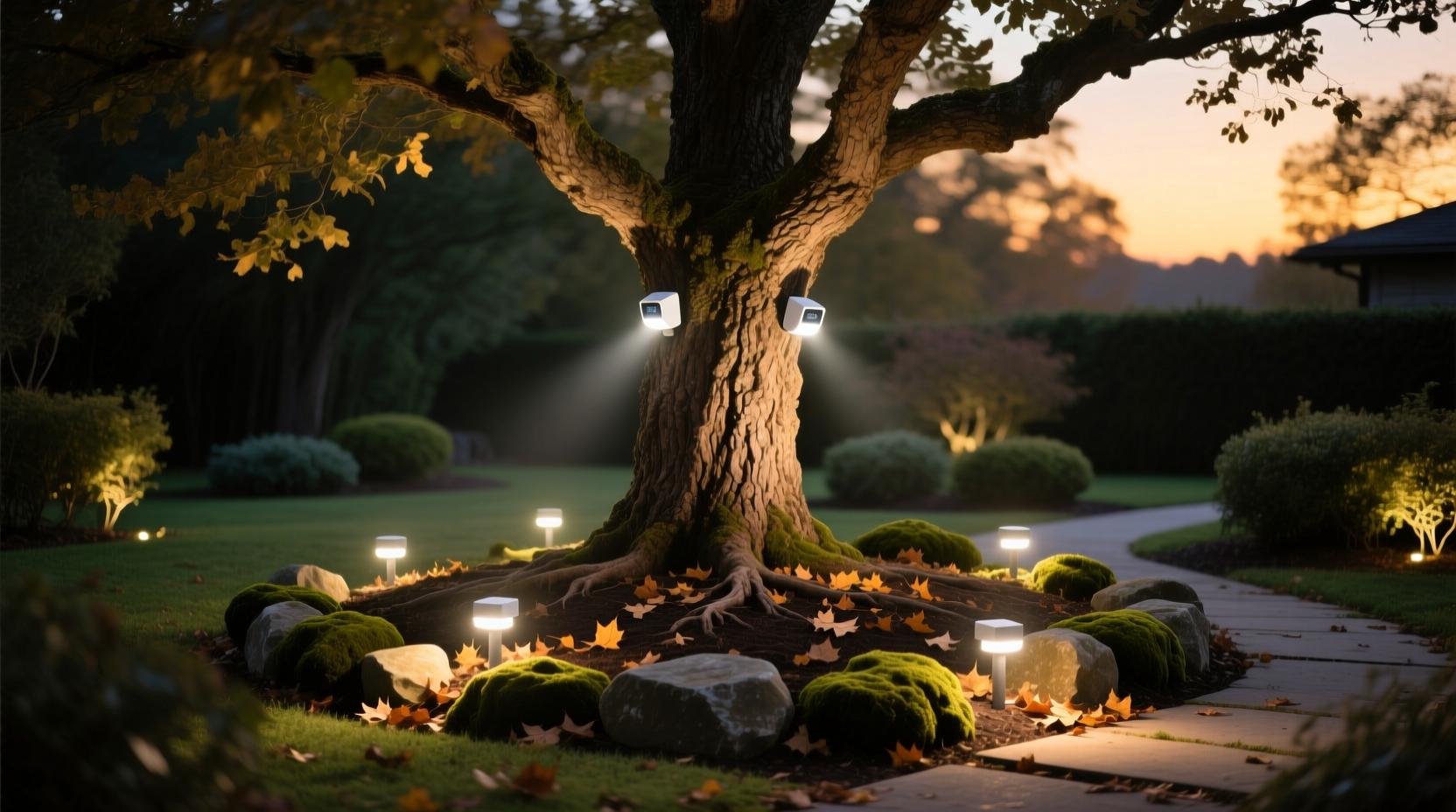
Trees contribute significantly to a property’s curb appeal, shade, and ecological balance. At night, however, their presence often fades into darkness unless deliberately highlighted. Strategic lighting transforms them from background elements into centerpieces. Uplighting a tree from its base, for example, emphasizes texture, height, and form. Downlighting mimics moonlight, creating soft pools beneath the canopy. But adding motion activation introduces interactivity—making the experience of walking through your garden more immersive and secure.
Beyond aesthetics, trees are often positioned near driveways, walkways, or corners of the house where shadows can conceal hazards or intruders. A motion-triggered spotlight near such a tree doesn’t just create ambiance—it alerts homeowners to movement, deters trespassers, and improves navigational safety without flooding the entire yard with constant light.
Selecting the Right Motion-Activated Lights
Not all motion sensors are created equal. The effectiveness of your installation depends heavily on choosing fixtures suited to your environment and goals. Consider the following factors when selecting lights:
- Sensor range: Most models detect motion within 15–30 feet. For larger yards or taller trees, opt for wider detection angles (up to 180 degrees).
- Activation delay: Adjustable timers let you control how long the light stays on after detecting motion—anywhere from 10 seconds to 10 minutes.
- Light temperature: Warm white (2700K–3000K) blends naturally with landscape tones, while cool white (4000K+) offers higher visibility for security purposes.
- Power source: Solar-powered units are eco-friendly and easy to install but may lack brightness in shaded areas. Hardwired or plug-in options provide consistent output.
- Weather resistance: Ensure fixtures are rated at least IP44 for outdoor durability.
For highlighting trees specifically, consider low-voltage LED path lights or stake-mounted spotlights with narrow beam spreads. These allow focused projection onto trunks or lower branches without excessive spill light. Brands like Philips Hue Outdoor, LITOM, and Kichler offer reliable smart and non-smart motion lights tailored for landscape use.
“Properly placed motion lighting turns passive landscaping into active defense and artistry.” — Marcus Tran, Landscape Lighting Designer & Certified Lighting Consultant (LC)
Step-by-Step Guide: Installing Lights to Highlight Key Areas
Effective placement ensures both aesthetic impact and functional performance. Follow this sequence to install motion-activated lights around a tree with optimal results:
- Assess the tree’s structure and surroundings. Identify which side faces foot traffic, pathways, or entry points. Determine if the trunk, canopy, or root zone needs emphasis.
- Mark potential fixture locations. Use small flags or stones to indicate where lights will go. Ideal spots include 2–4 feet from the trunk, angled slightly upward.
- Check for obstructions. Trim low-hanging branches or foliage that might block sensor views or reflect false triggers (e.g., swaying leaves).
- Test sensor alignment. Temporarily place each light and walk through expected approach paths to confirm detection coverage.
- Install securely. For solar models, ensure panels face south (in the Northern Hemisphere) and receive direct sunlight. Secure stake lights firmly into soil; hardwired units should be connected by a licensed electrician.
- Adjust sensitivity and duration settings. Set lower sensitivity to ignore small animals, and choose a runtime of 60–90 seconds for balance between usability and efficiency.
- Evaluate at night. Observe how light interacts with bark patterns, casts shadows, and activates during movement. Fine-tune positioning as needed.
Strategic Zones to Illuminate Around the Tree
A single tree can anchor multiple functional zones. Targeted lighting should address both beauty and utility across these areas:
| Area | Purpose | Recommended Fixture Type | Motion Setting Tips |
|---|---|---|---|
| Base of Trunk | Highlight bark texture and girth; add drama | Low-profile LED uplight or well light | Short duration (30 sec), medium sensitivity |
| Near Walkway/Path | Improve nighttime navigation | Stake-mounted path light with motion | Longer duration (2+ min), high detection angle |
| Canopy Edge (over seating area) | Provide ambient glow when occupied | Hanging motion lantern or tree-mounted spotlight | Delayed fade-out feature preferred |
| Behind Tree (blind corner) | Security monitoring for hidden zones | Wall-mounted floodlight with wide sensor | High sensitivity, loud alert optional |
| Root Zone / Mulch Bed | Prevent tripping hazards | Ground-recessed step light | Quick trigger, low brightness to preserve night vision |
By segmenting the space around the tree into functional zones, you create layered lighting that responds intelligently to human activity. This approach avoids over-illumination while maximizing usefulness.
Mini Case Study: Transforming a Backyard Oak with Smart Lighting
The Hernandez family owns a large backyard dominated by a century-old live oak near their patio entrance. While beautiful during the day, the tree created a dark, intimidating shadow at night, discouraging evening use of the outdoor space. They installed four solar-powered motion lights: two at the base of the trunk, one aimed at the adjacent stepping-stone path, and a fourth mounted on a nearby pergola post to downlight the outer canopy.
After setup, movement toward the patio triggered a gradual brightening sequence. As someone approached, the base lights revealed the textured bark, while the path light guided steps safely. Once seated, minimal residual movement kept the overhead light active for about 90 seconds before dimming—a perfect balance of function and atmosphere.
Within weeks, the family reported increased comfort using the backyard after sunset. Neighbors complimented the “theatrical” effect, and local wildlife cameras showed fewer nocturnal intrusions. The system required no wiring, used zero grid power, and paid for itself in reduced porch light usage.
Common Mistakes to Avoid
Even well-intentioned installations can backfire without proper planning. Watch out for these frequent errors:
- Over-lighting the tree: Too many fixtures or overly bright bulbs wash out details and create glare.
- Poor sensor placement: Mounting lights where wind-blown branches cause constant triggering leads to frustration and shortened bulb life.
- Ignoring seasonal changes: Foliage growth in summer may obstruct sensors or alter light patterns established in spring.
- Using mismatched color temperatures: Mixing warm and cool LEDs around the same tree creates visual discord.
- Forgetting maintenance: Dust, dirt, and spider webs accumulate on lenses and sensors, reducing efficiency.
Checklist: Preparing Your Tree Lighting Project
Before purchasing or installing any lights, run through this checklist to ensure success:
- ✅ Identify the primary purpose: security, aesthetics, pathway guidance, or a combination.
- ✅ Choose between solar, plug-in, or hardwired power based on location and reliability needs.
- ✅ Measure distance from power sources and proximity to walking routes.
- ✅ Sketch a simple layout showing tree position, fixture placements, and target zones.
- ✅ Select fixtures with appropriate beam angles (narrow for accent, wide for area coverage).
- ✅ Verify local regulations on outdoor lighting, especially in homeowner associations.
- ✅ Test one unit before full deployment to assess brightness, trigger speed, and runtime.
- ✅ Schedule seasonal reviews to adjust for plant growth or shifting sun exposure (for solar units).
Frequently Asked Questions
Can motion-activated lights damage trees?
No, LED-based motion lights produce negligible heat and do not emit harmful UV radiation. As long as fixtures are installed without drilling into the trunk or damaging roots, they pose no risk to tree health.
Will animals set off the sensors frequently?
Yes, pets and wildlife can trigger basic sensors. To reduce false alarms, look for models with pet immunity (ignores animals under 40 lbs) or adjustable sensitivity controls. Positioning lights higher or shielding the sensor downward also helps.
How do I make the lighting look natural rather than harsh?
Use warmer color temperatures (2700K–3000K), limit brightness to 200–400 lumens per fixture, and aim lights upward at subtle angles. Avoid direct line-of-sight to bulbs—bury fixtures slightly or tuck them behind rocks or mulch.
Final Thoughts: Light With Purpose
Integrating motion-activated lights around trees is more than a convenience—it's a thoughtful blend of design, safety, and sustainability. When done right, these systems remain unobtrusive until needed, then respond with quiet brilliance. Whether illuminating a majestic maple in your front yard or a fruit tree beside a garden gate, targeted lighting brings depth, dimension, and awareness to your outdoor world.
The best installations go unnoticed until they’re needed. That moment—when a soft glow rises from the darkness as you step outside, revealing the familiar silhouette of a beloved tree—is when technology fades into poetry. Let your landscape speak after sunset, not with constant noise, but with intentional, responsive light.




 浙公网安备
33010002000092号
浙公网安备
33010002000092号 浙B2-20120091-4
Comments
No comments yet. Why don't you start the discussion?