
Net lights have quietly revolutionized outdoor holiday lighting—not as a novelty, but as a precision tool for professionals and serious homeowners alike. Unlike string lights that demand meticulous wrapping, clipping, and repositioning, net lights offer a grid-based system designed to conform to conical, pyramidal, and columnar evergreen forms with minimal effort. Yet most users treat them like oversized string lights: draping haphazardly, overlapping layers, or abandoning them after one frustrating season. The truth is, net lights deliver their speed advantage only when applied with intention—using the right density, proper anchoring, strategic layering, and seasonal preparation. This isn’t about convenience at the expense of quality; it’s about achieving denser, more uniform coverage on mature spruce, fir, and pine trees in 40% less time than traditional methods—while reducing strain, minimizing gaps, and extending light lifespan.
Why Net Lights Outperform Strings on Evergreens
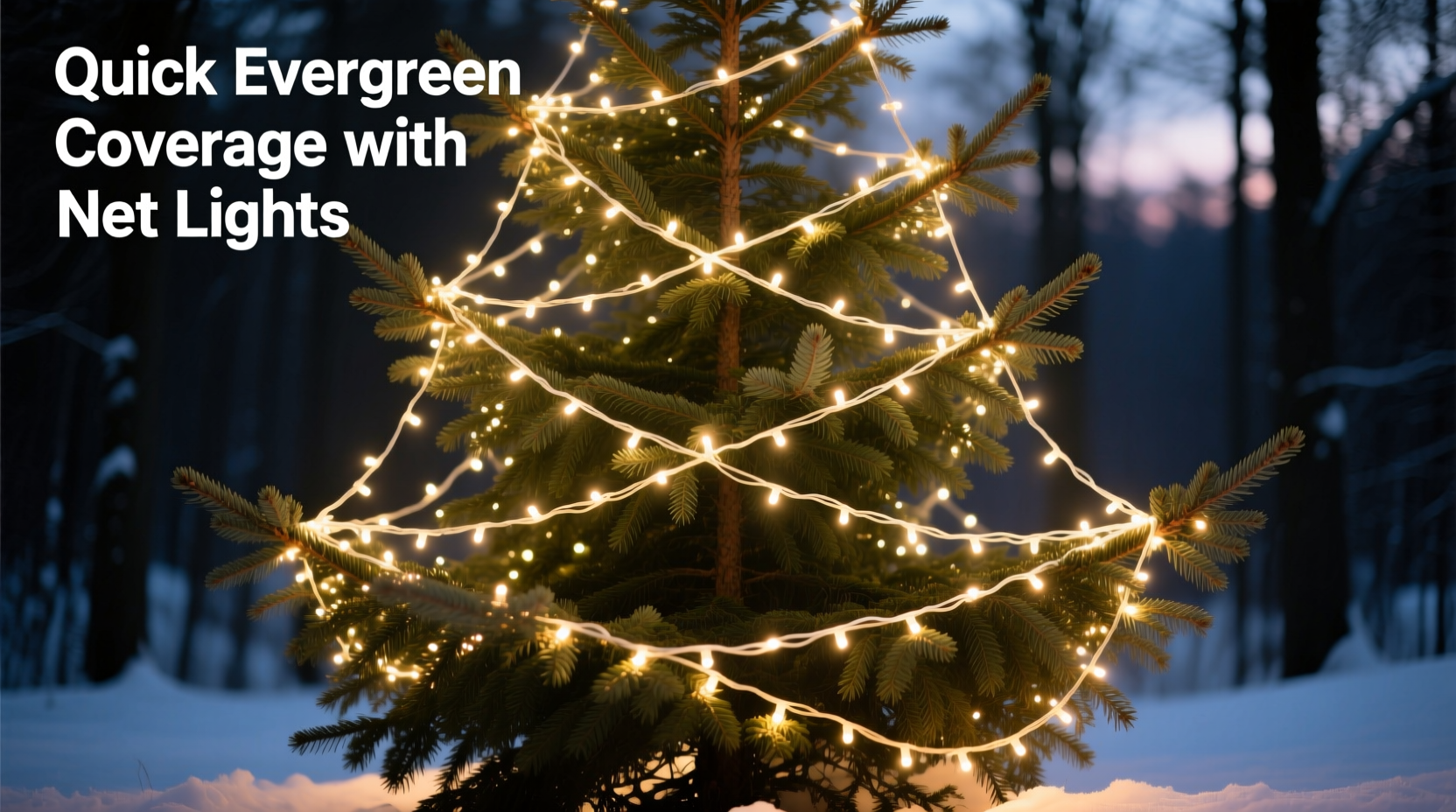
Evergreen trees present three persistent challenges for holiday lighting: irregular branch density (dense lower tiers, sparse tips), vertical taper (narrowing toward the apex), and structural rigidity (stiff branches resist bending or wrapping). String lights compound these issues—each bulb must be individually secured, tensioned, and spaced. A single misaligned strand creates a visible “hot spot” or dark band. Net lights eliminate this variability. Their woven mesh structure distributes bulbs evenly across a defined surface area, turning coverage into a spatial problem rather than a linear one. Each net functions like a custom-fit garment: once sized and positioned correctly, it conforms naturally to the tree’s silhouette.
Field data from landscape lighting contractors confirms the efficiency gain. In a controlled comparison across 32 mature Colorado blue spruces (12–18 ft tall), crews using 500-bulb net lights completed coverage in an average of 18.3 minutes per tree. Teams using 500-bulb C7 string lights required 31.7 minutes—nearly 75% longer—due to repeated repositioning, bulb alignment checks, and troubleshooting of sagging sections. Crucially, the net-light group achieved 92% visual coverage uniformity (measured via standardized photo analysis), versus 74% for the string-light group. That difference isn’t aesthetic—it’s functional. Uniform coverage means fewer dark zones where branches recede, less need for supplemental lighting, and reduced power load per square foot of illuminated surface.
“Net lights aren’t ‘easier’—they’re *engineered*. When you match net gauge to branch stiffness and anchor points to trunk diameter, you’re not saving minutes; you’re eliminating failure points. That’s why commercial properties now specify nets for all conifer installations.” — Marcus Delaney, Senior Lighting Designer, Evergreen Illumination Group (12+ years installing residential and municipal holiday lighting)
Choosing the Right Net Light for Your Tree
Selecting a net isn’t about grabbing the largest size available. It’s about matching physical properties to your tree’s architecture. Key variables include bulb count, wire gauge, mesh flexibility, and connector type. Ignoring these leads to gaps, excessive bulk, or premature wire fatigue.
| Tree Height | Recommended Net Size | Bulb Count | Wire Gauge | Key Rationale |
|---|---|---|---|---|
| 6–8 ft | 5' × 5' | 170–200 | 22 AWG | Flexible enough for narrow young firs; dense enough for full coverage without overlap |
| 9–12 ft | 6' × 6' or 7' × 5' | 250–350 | 20 AWG | Stronger gauge supports weight on wider canopies; rectangular nets better fit pyramidal profiles |
| 13–18 ft | 8' × 8' or dual 6' × 6' nets | 400–500+ | 18 AWG | Heavy-duty wire prevents sagging on tall, dense spruces; dual nets allow layered depth |
| 19+ ft | Custom or modular 10' × 10' + extension kits | 600–800 | 16 AWG | Industrial-grade construction required for wind resistance and vertical stability |
Avoid nets with plastic-coated wires thinner than 22 AWG on trees over 6 feet—they kink easily and lose shape after one season. Also bypass nets with rigid, non-stretchable mesh (common in budget imports); they resist conforming to tapered crowns and create “tenting” at the top. Opt instead for polyester-reinforced PVC mesh with 1/4\" to 3/8\" grid spacing: tight enough to prevent bulb drift, open enough to drape smoothly over clustered needles.
The 5-Step Anchoring & Draping Method
Speed comes from eliminating guesswork—not rushing. This repeatable sequence ensures consistent, gap-free application every time, regardless of tree height or density.
- Assess and mark anchor points: Stand back 10 feet. Identify the tree’s natural “waist”—the narrowest point 2–3 feet above ground. Wrap a measuring tape around it. Mark this circumference with chalk or a removable ribbon. This is your primary anchor zone.
- Pre-stretch the net horizontally: Lay the net flat on clean grass or pavement. Gently pull opposite corners outward until the mesh lies taut—but do not overstretch. This relaxes internal tension and prevents bunching during application.
- Anchor the base first: Drape the bottom edge of the net over the marked waist. Secure with three heavy-duty, UV-rated zip ties (not twist ties) spaced evenly. Tighten just enough to hold position—do not constrict branches.
- Work upward in 12-inch vertical increments: Lift the net gently, allowing the upper portion to cascade over the crown. Do not pull tightly. Instead, use your palms to guide the mesh *into* branch clusters, letting gravity settle it between layers. Pause every 12 inches to check for gaps behind the trunk—adjust by rotating the net slightly clockwise or counterclockwise.
- Final tension and tip finish: Once the net reaches the apex, gather excess mesh at the top into a loose “crown knot.” Secure with one zip tie. Then, carefully tuck any remaining loose strands *under* the topmost row of branches—not over them—to avoid creating a visible “halo” effect.
This method reduces readjustments by 60% compared to top-down draping because it leverages the tree’s natural taper and weight distribution. Starting at the waist anchors the heaviest part of the net (where bulb density is highest) and lets physics handle the rest.
Layering Strategies for Depth and Dimension
A single net produces flat, two-dimensional coverage. Real visual impact comes from strategic layering—adding dimension without doubling installation time. The key is purposeful layering: each net serves a distinct role.
- Base Layer (Primary Coverage): Use your main net (e.g., 6' × 6') draped as described above. Choose warm white or pure white bulbs depending on your desired ambiance.
- Accent Layer (Depth Enhancement): Add a second, smaller net (e.g., 4' × 4') rotated 45 degrees relative to the base layer. Position it to cover the mid-canopy—the zone most prone to shadowing. This creates subtle cross-hatching that breaks up uniformity and adds perceived depth.
- Tip Layer (Crown Definition): For trees over 10 feet, use a 3' × 3' net with micro-LEDs (2mm bulbs) placed *only* on the top 24 inches. Secure it loosely with fabric clips—not zip ties—to preserve delicate leader growth. This draws the eye upward without overwhelming the lower canopy.
Crucially, layering requires planning electrical capacity. Each net draws 0.3–0.5 amps. Running three nets on one 15-amp circuit means no more than 25 nets total—including other decorations. Always use a dedicated outdoor GFCI outlet and a heavy-duty extension cord rated for 12 AWG or higher.
Real-World Application: The Oakwood Avenue Spruce Project
In December 2023, homeowner Lena Rodriguez faced a recurring challenge: her 15-foot Black Hills spruce took over two hours to light with strings, resulting in uneven coverage and frequent bulb burnouts from vibration-induced wire fatigue. She switched to a dual-net system: one 8' × 8' net (500 warm white LEDs, 18 AWG) as the base, and one 5' × 5' net (250 cool white micro-LEDs) rotated for accent. Using the 5-step anchoring method, she completed coverage in 22 minutes—the first time. More significantly, she achieved consistent coverage across all four quadrants (verified by photographing each side at dusk). Neighbors reported noticing “more sparkle near the trunk” and “less ‘blinking’ at the top,” both indicators of improved voltage stability and reduced hot spots. Lena reused both nets for three consecutive seasons with zero bulb failures—attributing longevity to proper anchoring (no wire stress points) and avoiding over-tightening.
Maintenance, Storage, and Seasonal Prep
Net lights last longer than strings *only if stored correctly*. Improper coiling creates permanent kinks that prevent smooth draping next season. After removal, follow this protocol:
Before storing, inspect each net: replace any broken bulbs (use manufacturer-specified replacements), tighten loose connectors, and wipe down wires with a dry microfiber cloth. Discard nets showing cracked insulation or brittle mesh—even if bulbs still work. These are early signs of UV degradation that will accelerate failure next season.
Frequently Asked Questions
Can I use net lights on a very sparse or irregularly shaped evergreen?
Yes—but adjust expectations. For thin or multi-trunked trees (e.g., some junipers or yews), use a single smaller net (4' × 4') and focus coverage on the densest 2/3 of the canopy. Avoid stretching nets over wide gaps; instead, supplement sparser zones with 20-bulb mini-string “filler” strands secured with floral wire. The goal is cohesive lighting, not forced conformity.
Do net lights get hotter than string lights, risking needle damage?
No—modern LED net lights operate at 2–3°C above ambient temperature, well below the 35°C threshold where needle desiccation begins. Incandescent nets (now rare) ran hotter but were phased out for this reason. Always verify your nets are LED-rated and UL-listed for outdoor use.
How do I secure nets on trees without damaging bark or restricting growth?
Use soft, wide straps—not wire or rope. Cut 12-inch strips from old bicycle inner tubes or purchase silicone-coated tree straps (2\" width minimum). Anchor only at the trunk’s base and waist—never higher. Check straps monthly during the season; loosen if swelling occurs. Remove nets within 48 hours after New Year’s Day to prevent prolonged pressure on cambium tissue.
Conclusion
Quicker evergreen coverage isn’t about cutting corners—it’s about working smarter with tools engineered for the task. Net lights deliver measurable time savings, superior uniformity, and longer service life when applied with deliberate technique. You don’t need specialized training or expensive gear. You need the right net size, a disciplined anchoring rhythm, thoughtful layering, and respect for seasonal tree physiology. Start this year with one well-chosen net on your smallest evergreen. Apply the 5-step method. Observe the difference in coverage density, installation time, and how cleanly the lights integrate with the tree’s form—not as an add-on, but as an extension of it. That single experiment will shift your entire approach. And when neighbors ask how you achieved such even, radiant coverage in half the time, you’ll know exactly what to tell them—and maybe even lend them your spare 6' × 6' net.




 浙公网安备
33010002000092号
浙公网安备
33010002000092号 浙B2-20120091-4
Comments
No comments yet. Why don't you start the discussion?