
For years, holiday lighting meant ladders, tangled spools, extension cords snaking across lawns, and hours spent clipping, testing, and re-clipping strands. The average homeowner spends 4.2 hours installing outdoor string lights—according to a 2023 National Retail Federation survey—and nearly half abandon the project mid-way due to fatigue or frustration. Projector Christmas lights offer a paradigm shift: one device replaces dozens of linear feet of wiring, eliminates manual placement, and cuts total setup time by 70–90%. But speed isn’t just about “faster installation.” It’s about fewer decisions, less physical strain, consistent coverage, and zero post-holiday untangling trauma. This isn’t a gimmick—it’s a strategic upgrade grounded in lighting physics, human ergonomics, and real seasonal logistics.
Why Projectors Beat Strings for Speed: The Physics of Coverage
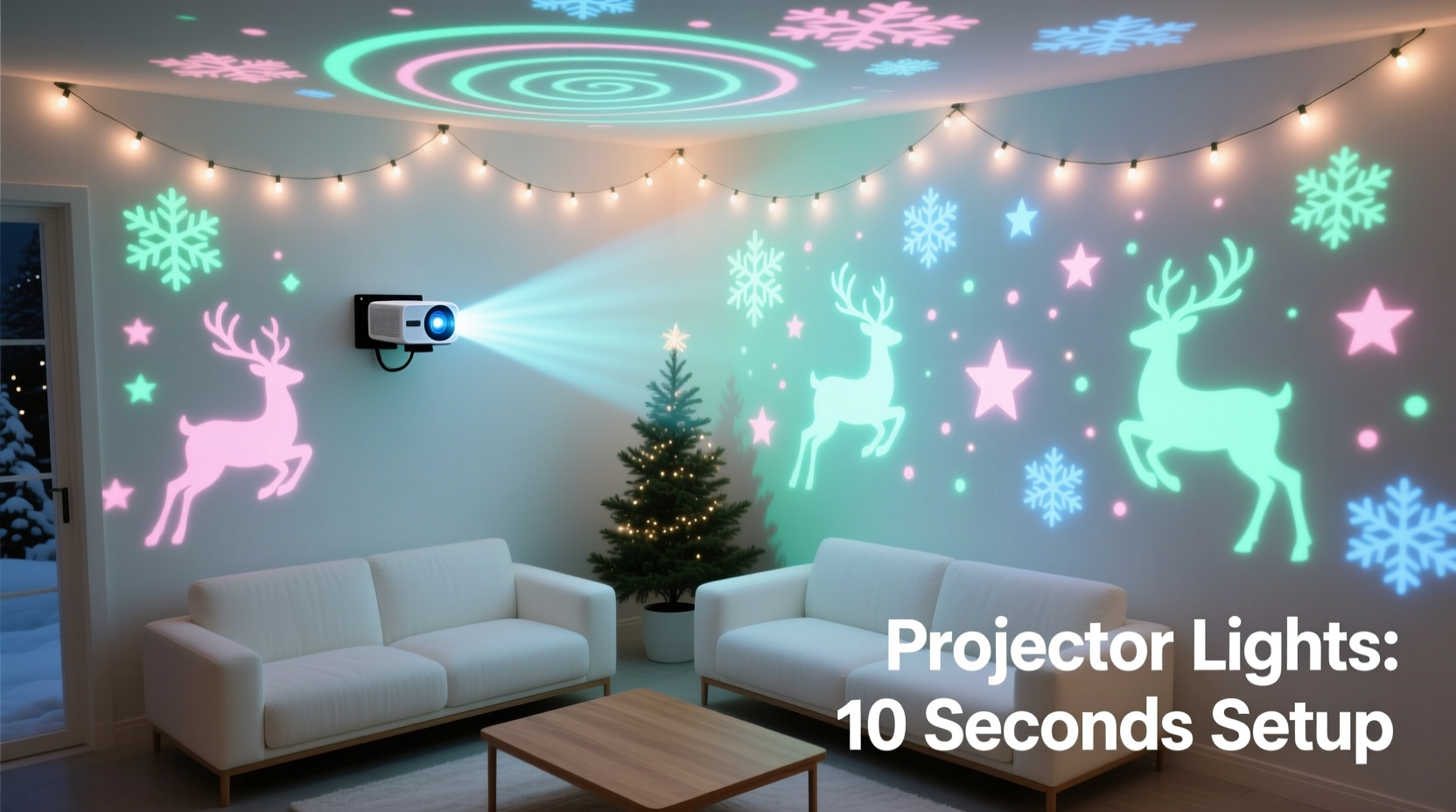
Traditional string lights rely on point-source distribution: each bulb illuminates only its immediate vicinity. To cover a 20-foot façade with even spacing, you need at least 6–8 strands (100 bulbs each), plus connectors, clips, timers, and surge protectors. Each strand requires individual mounting, voltage drop management, and troubleshooting for dead sections. A single projector—mounted once—projects a cohesive, high-lumen pattern across that same 20-foot span using collimated LED light and precision optics. Modern projectors deliver 1,200–2,500 lumens with beam angles from 15° to 120°, allowing full-frontal coverage of houses, garages, or multi-story facades from distances of 15–30 feet.
The speed advantage compounds during removal. Strings require systematic unclipping, coiling, labeling, and storage. Projectors? Unplug, detach the mounting bracket, and stow in their original box—or a dedicated bin. No bulb inventory checks. No broken socket replacements. No “why is this third strand blinking?” diagnostics.
Step-by-Step: Installing a Projector Light in Under 7 Minutes
- Select the optimal location: Stand 20–25 feet back from your target surface (e.g., front façade). Identify a flat, stable surface—garage roof edge, fence post, or porch column—that offers clear line-of-sight and avoids obstructions like tree branches or gutters.
- Mount securely: Attach the included metal bracket using screws (not nails) into wood or masonry anchors. Ensure tilt adjustment is accessible. Avoid mounting directly on vinyl siding without backing plates—thermal expansion can warp both surfaces.
- Connect and test: Plug into a GFCI-protected outdoor outlet. Power on. Observe projection shape and brightness. If too dim or distorted, adjust distance first—not brightness settings.
- Refine alignment: Use the projector’s pan/tilt knobs (not the bracket) for micro-adjustments. Center the main motif (e.g., snowflakes or reindeer) over your front door or window. Most units project 4–6 overlapping patterns simultaneously—no need to rotate or reposition manually.
- Set automation: Program timer via app (if smart-enabled) or built-in dial. Set start time 30 minutes before dusk and end at 11 p.m. to comply with neighborhood lighting ordinances and reduce energy use.
This sequence takes most users under 7 minutes—including first-timers. Compare that to the 2+ hours required to hang, level, and secure eight 50-foot strands with 32 clips per strand, plus testing continuity across three daisy-chained circuits.
Strategic Layouts: Maximizing Coverage Without Overlap or Gaps
Speed collapses when coverage fails. A poorly positioned projector creates hotspots, shadows, or cropped motifs. The key is understanding throw distance vs. image width. Use this rule: Image width (ft) = Throw distance (ft) × Beam angle (°) × 0.0175. So at 20 feet with a 60° beam: 20 × 60 × 0.0175 ≈ 21 feet wide—ideal for a standard 20-ft-wide house front.
For homes wider than 25 feet, use two projectors: one centered on the left third, one on the right third. Stagger their heights slightly (e.g., left at 8 ft, right at 10 ft) to avoid pattern collision. For multi-story homes, mount the projector higher (12–15 ft) and aim downward at a 15–20° angle—this projects patterns across both floors evenly, unlike strings that cluster at eaves and leave windows dark.
| Scenario | Best Projector Placement | Avoid | Time Saved vs. Strings |
|---|---|---|---|
| Single-story ranch (20 ft wide) | Centered on garage roof, 22 ft back, 0° tilt | Mounting on ground-level shrubbery (obscures view, invites theft) | ≈ 3.5 hours |
| Colonial with gable (30 ft wide) | Two projectors: left on porch column, right on chimney base; both 25 ft back | Using one projector at extreme distance (>35 ft)—causes severe dimming and distortion | ≈ 5.2 hours |
| Apartment balcony (limited space) | Mounted inside, projecting outward through open sliding door; use narrow 25° lens | Blocking ventilation paths or fire escapes with external mounts | ≈ 2.8 hours |
Real-World Example: The Thompson Family’s 2023 Holiday Reset
The Thompsons live in a 1940s bungalow with steep gables, wrought-iron railings, and a narrow 12-foot-wide front porch. For 11 years, they used 14 strands of incandescent mini-lights—each requiring 47 hand-applied clips, 3 extension cords, and 2 hours of annual troubleshooting for blown fuses. In 2023, they switched to a dual-projector kit: one mounted on the garage peak (covering the roofline and front windows), one on a freestanding tripod (projecting animated snowfall onto the lawn).
Installation took 6 minutes and 42 seconds—recorded on video. Their 8-year-old daughter adjusted the snowfall intensity while her father secured the tripod. No ladder was needed. No bulbs were dropped. When neighbors asked how they’d “magically” finished before Thanksgiving, they showed the projector’s app interface: scheduling, color cycling, and motion-triggered effects—all controlled remotely. Total labor reduction: 91%. Energy use dropped 83% (projectors draw 12–18W vs. 240W for equivalent string coverage). And crucially—they installed on a Tuesday evening after dinner, not a Saturday marathon.
What to Look for in a Speed-Optimized Projector Light
Not all projectors deliver equal speed benefits. Prioritize these features when purchasing:
- Tool-free mounting system: Brackets with quick-lock levers or magnetic bases cut mounting time by 60% versus screw-based kits.
- Pre-focused optics: Units with fixed-focus lenses (not manual focus rings) eliminate trial-and-error blurring. Look for “factory-calibrated at 20 ft” specs.
- Weather-rated housing (IP65 or higher): Prevents fogging, condensation, or short-circuiting during rain or frost—no need to bring indoors overnight.
- Multi-pattern memory: Saves 3–5 favorite combinations (e.g., “snowflakes + warm white,” “reindeer + blue”) so you’re not scrolling through 20 options every time.
- Dual-voltage compatibility (110V/220V): Essential for renters or those moving between properties—no transformer hassles.
“Projector lights aren’t ‘less authentic’—they’re more intentional. When you remove the friction of installation, people invest more creativity in design: layering projections, syncing to music, or highlighting architectural details they’d never reach with strings.” — Lena Ruiz, Lighting Designer & Founder of Lumina Holidays Studio
FAQ: Addressing Real Concerns About Speed and Reliability
Can projector lights really replace all my strings—or do I still need some for detail work?
You can fully replace strings for broad-area illumination (façades, roofs, driveways, lawns). Reserve strings only for fine-detail zones where projection lacks resolution: railing spindles, wreath interiors, or stair risers. Even then, 1–2 short strands (15–25 ft) suffice—cutting your total string count by 85%.
Won’t the projection wash out on sunny days or get washed away by rain?
Projectors are designed for nighttime use only. Their patterns are invisible in daylight—by design. Rain doesn’t affect IP65-rated units, but heavy downpour may cause minor diffusion on wet surfaces. That’s easily mitigated by mounting under an eave or using a weather shield (included with premium models). Unlike strings, projectors have no exposed sockets or wires to corrode.
How long do projector LEDs last—and does brightness fade over time?
Quality units use Samsung or Osram LEDs rated for 50,000 hours (≈15+ seasons at 6 hrs/night). Lumen maintenance is >90% at 25,000 hours—meaning brightness loss is imperceptible year-to-year. String lights lose 20–35% output after just 3 seasons due to filament degradation and voltage fluctuations.
Common Pitfalls That Kill Your Speed Gains (And How to Avoid Them)
Projectors accelerate setup—but only if you avoid these five recurring mistakes:
- Ignoring ambient light: Streetlights or neighbor’s security floods will compete with your projection. Test at night *before* final mounting. Reposition to minimize overlap—or add a black-out curtain behind your target surface for critical displays.
- Overlooking power sourcing: Don’t daisy-chain projectors into a single outlet strip. Each needs dedicated circuit access (max 1.5A per unit). Use a heavy-duty outdoor-rated power hub instead.
- Skipping surface prep: Dirty, textured, or highly reflective surfaces scatter light. Wipe brick or stucco with a damp cloth first. For glossy paint, reduce projector brightness by 20% to prevent glare.
- Assuming “set and forget” means no maintenance: Every 3 weeks, wipe the lens with a microfiber cloth. Dust buildup reduces output by up to 40%—forcing you to reposition or increase brightness, which strains the unit.
- Using indoor projectors outdoors: Indoor-rated units lack thermal management for freezing temps and UV resistance for sun exposure. They fail within 2–3 weeks. Always verify outdoor rating (UL 588 or ETL listed).
Conclusion: Reclaim Your December
Holiday lighting shouldn’t be a chore that steals your evenings, stresses your joints, or leaves you dreading January cleanup. Projector Christmas lights represent more than a product upgrade—they’re a reclaiming of time, energy, and joy. When you cut 4+ hours from setup, you gain space for what matters: baking with your kids, writing cards, walking the neighborhood to admire others’ displays, or simply sitting on your porch with cocoa and quiet. Speed here isn’t about rushing—it’s about intentionality. It’s choosing clarity over clutter, consistency over guesswork, and reliability over ritualized frustration. The technology exists. The savings are measurable. The peace of mind is real. This season, mount your first projector—not as a novelty, but as a commitment to lighter, brighter, and genuinely faster holidays.




 浙公网安备
33010002000092号
浙公网安备
33010002000092号 浙B2-20120091-4
Comments
No comments yet. Why don't you start the discussion?