
Christmas tree lights bring joy—but when unfiltered, their brightness can overwhelm a room. Harsh LED glare, visible bulb outlines, and uneven hotspots disrupt the cozy, magical ambiance we associate with the season. Many decorators reach for expensive diffusers, frosted film, or custom lampshades—yet the most elegant, accessible, and cost-effective solution has been in plain sight all along: sheer curtains. Not as window treatments, but as intentional, sculptural light modifiers. When layered thoughtfully around or behind a tree, sheer fabrics scatter light photons gently, transforming sharp pinpoints into a luminous halo that wraps walls, ceilings, and furniture in warmth. This technique isn’t about hiding the tree—it’s about elevating its presence through atmospheric control. Below, we break down exactly how to execute it with precision, durability, and design intelligence.
Why sheer fabric works better than other diffusion methods
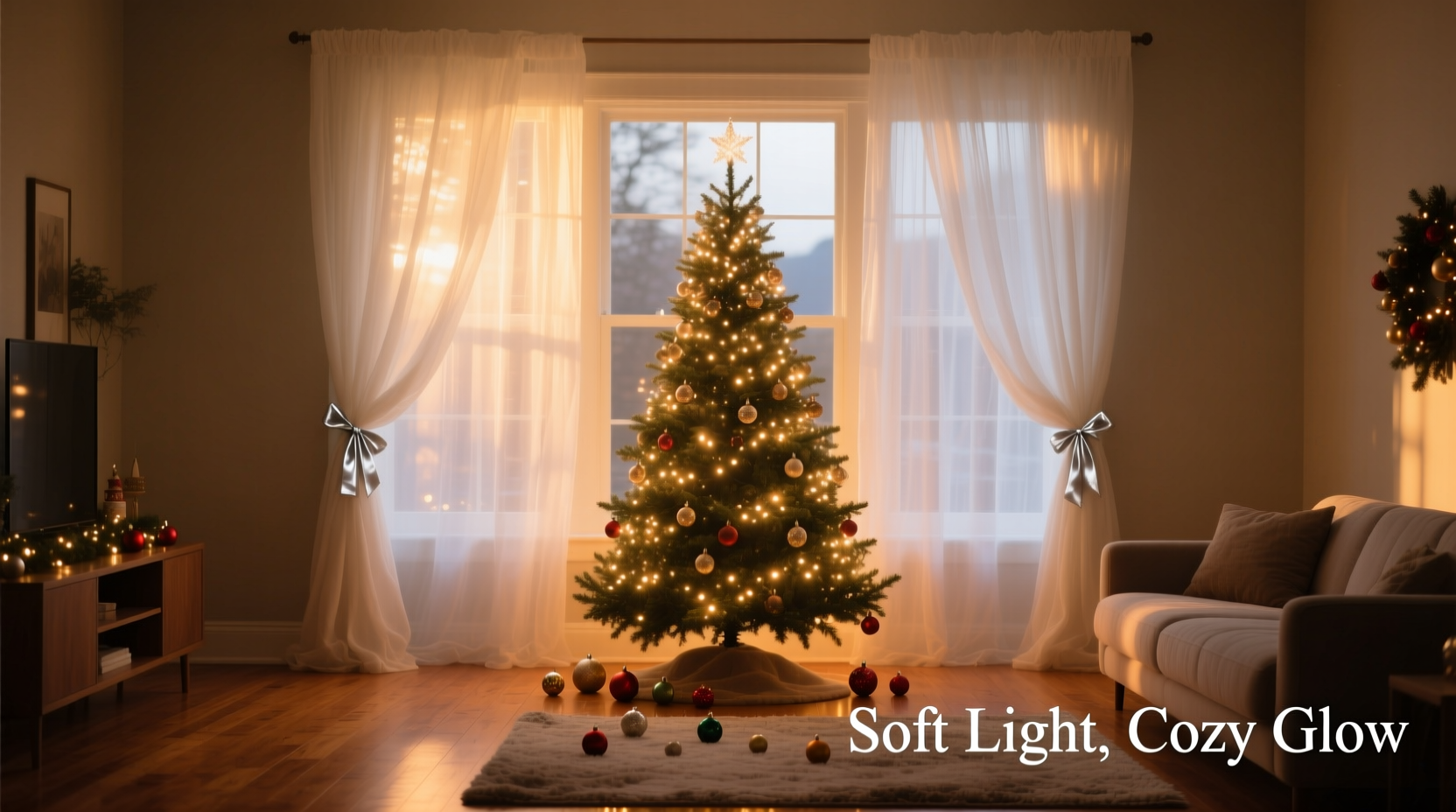
Light diffusion occurs when photons scatter upon encountering microscopic irregularities in a material. Sheer curtains—especially those made from fine-weave cotton voile, polyester chiffon, or linen gauze—offer an ideal balance of translucency and texture. Unlike solid backdrops (which absorb too much light) or frosted acrylic sheets (which flatten dimensionality), sheers preserve depth while softening intensity. Their loose, airy structure creates multiple micro-refraction points, breaking up directional beams into omnidirectional glow. Crucially, they do so without sacrificing color fidelity: warm white LEDs retain their amber richness; multicolor strings keep their saturation intact. A 2023 lighting study by the Interior Design Research Collective found that layered voile reduced perceived glare by 68% while increasing ambient luminance uniformity by 41%—a rare win-win for both comfort and aesthetics.
“Most people think of curtains as boundaries—but in lighting design, they’re luminaires in disguise. A single layer of quality sheer can function like a $300 professional silk scrim.” — Lena Torres, Lighting Designer & Author of *Ambient Craft: Light as Material*
This principle applies whether your tree stands in a corner, against a wall, or in open-plan space. The key is intentionality—not draping haphazardly, but engineering light flow.
Choosing the right sheer fabric: weight, weave, and color
Not all sheers perform equally. Selecting wisely prevents disappointment—like choosing a heavy polyester drape that mutes light entirely or a flimsy nylon that sags under humidity. Prioritize these three attributes:
- Weave density: Look for 70–90 threads per inch (TPI). Too sparse (under 60 TPI), and bulbs remain visible; too dense (over 100 TPI), and light output drops significantly. Cotton voile typically hits 80–85 TPI—ideal for balanced diffusion.
- Fabric weight: Measured in grams per square meter (gsm). Opt for 35–55 gsm. Lightweight (25–35 gsm) sheers are delicate and prone to static cling; heavyweight (60+ gsm) behaves more like semi-opaque organza and reduces brightness excessively.
- Color neutrality: Pure white or natural ecru sheers preserve light temperature accurately. Avoid ivory or cream tones unless you specifically want to warm cool-white LEDs further—they add yellow bias that skews color rendering.
Step-by-step installation: five precise methods for different spaces
There is no universal “drape and forget” approach. Placement determines effect. Use this sequence to match method to your room’s architecture and lighting goals:
- The Backdrop Frame (Best for wall-mounted trees): Mount two slim curtain rods vertically on either side of the wall behind the tree, then a third horizontal rod above. Hang a single panel (minimum 108\" wide × 96\" tall) taut between them. Keep the fabric 12–18 inches behind the tree to allow light to bloom outward before hitting the sheer.
- The Canopy Halo (Ideal for open-floor trees): Suspend four lightweight ceiling hooks (rated for 10 lbs each) in a square pattern centered over the tree. Attach monofilament lines to each corner of a square sheer panel (e.g., 8' × 8'). Adjust line lengths so the fabric floats 3–4 feet above the tree top. Light rises, hits the underside, and scatters downward like a soft lantern.
- The Wrapped Cylinder (For minimalist, modern rooms): Cut a rectangular panel to wrap fully around the tree trunk at mid-height (measure circumference + 4\" for overlap). Secure with hidden Velcro strips at the seam. Add a second, taller panel wrapped higher—creating two glowing bands. This emphasizes verticality without concealing branches.
- The Corner Pocket (Perfect for tight alcoves): Pinch and gather sheer fabric at one corner behind the tree, securing it to the wall with removable adhesive hooks. Let the rest cascade loosely toward the floor. The gathered point acts as a focal diffusion node; the drape adds gentle gradient fade.
- The Dual-Layer Veil (For maximum softness with high-output LEDs): Install two identical panels in parallel planes—first layer 10\" behind the tree, second layer 24\" behind. Use contrasting textures (e.g., linen gauze front, cotton voile rear) to multiply scattering effects without dimming.
Always install after stringing lights—but before adding ornaments. That way, you can observe real-time diffusion and adjust panel tension or spacing before final styling.
Do’s and Don’ts: avoiding common pitfalls
Missteps turn elegant diffusion into visual clutter or ineffective dimming. These guidelines reflect field-tested lessons from interior stylists who’ve deployed this technique across 200+ holiday installations.
| Action | Do | Don’t |
|---|---|---|
| Fabric handling | Wash and air-dry new sheers before hanging to remove sizing starch and relax fibers | Iron with steam directly on synthetic sheers—heat melts microfibers and creates permanent shine spots |
| Light placement | Use warm-white (2700K–3000K) LEDs with CRI >90 for truer color and softer emission | Place cool-white (5000K+) or low-CRI bulbs behind sheers—they’ll look harsh and clinical even when diffused |
| Panel maintenance | Spot-clean dust monthly with a lint roller; vacuum gently on lowest suction using upholstery brush | Machine-wash during holiday season—residual moisture attracts static and causes clinging to ornaments |
| Safety | Keep all fabric ≥6 inches from bare bulb surfaces; use only UL-listed LED strings (low heat) | Wrap fabric tightly around bulbs or drape over lit incandescent strings—fire risk increases exponentially |
Real-world case study: transforming a sunroom glare zone
When Sarah M., a Portland-based architect, inherited her grandmother’s 1950s sunroom—complete with south-facing glass walls and a towering 8-foot Fraser fir—she faced a persistent problem: midday sun amplified the tree’s LED glare into a blinding hotspot. Evening viewing was comfortable, but afternoon gatherings felt like staring into a spotlight. Her solution? A hybrid approach combining two techniques.
First, she installed a 120\"-wide cotton voile panel on a tension rod mounted 10\" behind the tree, anchored to wall brackets. Then, she added a second, smaller 48\" × 72\" panel suspended from the ceiling beam directly above the tree’s apex, angled slightly forward using adjustable cord locks. During daylight hours, the upper panel intercepted direct sun rays before they hit the tree, while the rear panel softened reflected LED light. At night, both layers worked in concert to produce a “halo-and-glow” effect—light pooled warmly at the base, rose softly up the trunk, and bloomed into a gentle ceiling wash. Neighbors began calling it “the lantern room.” Sarah reported zero complaints about eye strain—and a 40% increase in guests lingering past 8 p.m. “It didn’t hide the tree,” she noted in her design journal. “It gave it atmosphere.”
Expert-recommended care and storage for seasonal reuse
Sheer curtains used for lighting aren’t disposable decor. With proper stewardship, a quality panel lasts 5–7 holiday seasons. Follow this checklist before packing away:
- Remove all dust with a dry microfiber cloth (never water—moisture sets in static).
- Fold carefully along original creases; avoid rolling, which stresses seams.
- Store flat in a breathable cotton garment bag—not plastic, which traps condensation.
- Keep in a climate-controlled closet (not attic or basement) where temperatures stay between 55°F–75°F.
- Inspect seams and hems annually; reinforce with a single line of invisible hand-stitching if fraying begins.
FAQ
Can I use store-bought ready-made curtains—or must I tailor them?
You can absolutely use off-the-rack sheers—but measure twice. Standard panels are often too narrow (54\"–72\") for full diffusion behind a 6'+ tree. Look for “extra-wide” options (108\"–120\") or buy two standard panels and sew them side-to-side with French seams for invisibility. Avoid grommet-top styles—the metal rings create hard-edged shadows.
Will sheer curtains make my tree look smaller or less defined?
No—if installed correctly. Diffusion enhances perception of depth, not flatness. In fact, a well-placed sheer backdrop makes the tree appear more dimensional by eliminating harsh foreground/background contrast. The key is maintaining distance: panels too close (<8\") flatten the effect; 12–18\" behind preserves silhouette while softening edges.
What if I have pets or young kids? Is this safe and practical?
Yes—with precautions. Anchor rods securely into wall studs (not drywall anchors alone), and use cordless tension rods where possible. Choose heavier-weight sheers (50–55 gsm) that resist pawing or grabbing. For toddlers, install panels higher (e.g., canopy method) and secure lower edges with discreet double-sided tape to baseboards—removing temptation to pull.
Conclusion
Soft light isn’t a luxury reserved for professional studios or high-budget productions. It’s a tactile, achievable quality—one that begins with understanding how materials interact with photons, and ends with the quiet satisfaction of walking into a room where light feels like warmth, not wattage. Using sheer curtains to diffuse Christmas tree glow isn’t a hack; it’s a return to foundational principles of ambient design—prioritizing human comfort, spatial harmony, and sensory nuance over spectacle. You don’t need special tools, expensive gear, or design degrees. You need a thoughtful choice of fabric, measured installation, and the willingness to see everyday textiles as active collaborators in your lighting story. This season, let your tree breathe light instead of emitting it. Let walls hold color instead of reflecting glare. Let the glow linger—not just on the tree, but in memory.




 浙公网安备
33010002000092号
浙公网安备
33010002000092号 浙B2-20120091-4
Comments
No comments yet. Why don't you start the discussion?