
For decades, illuminating a nativity scene meant running extension cords across lawns, burying conduit in frozen ground, or hiring an electrician to install low-voltage wiring—each option introducing tripping hazards, permitting delays, or costly labor. Today, solar-powered lighting offers a cleaner, safer, and genuinely elegant alternative. But not all solar lights succeed in this application. Many flicker at dusk, dim after cloudy days, or cast harsh, unflattering light on hand-carved wood or ceramic figures. The key isn’t just “solar” — it’s selecting the right photovoltaic performance, beam quality, and placement strategy for reverence, not glare. This guide distills field-tested practices from landscape lighting designers, seasonal display professionals, and parish volunteers who’ve illuminated over 200 outdoor nativity sets — all without a single shovel in the ground.
Why Solar Lighting Fits the Nativity Tradition — Ethically and Practically
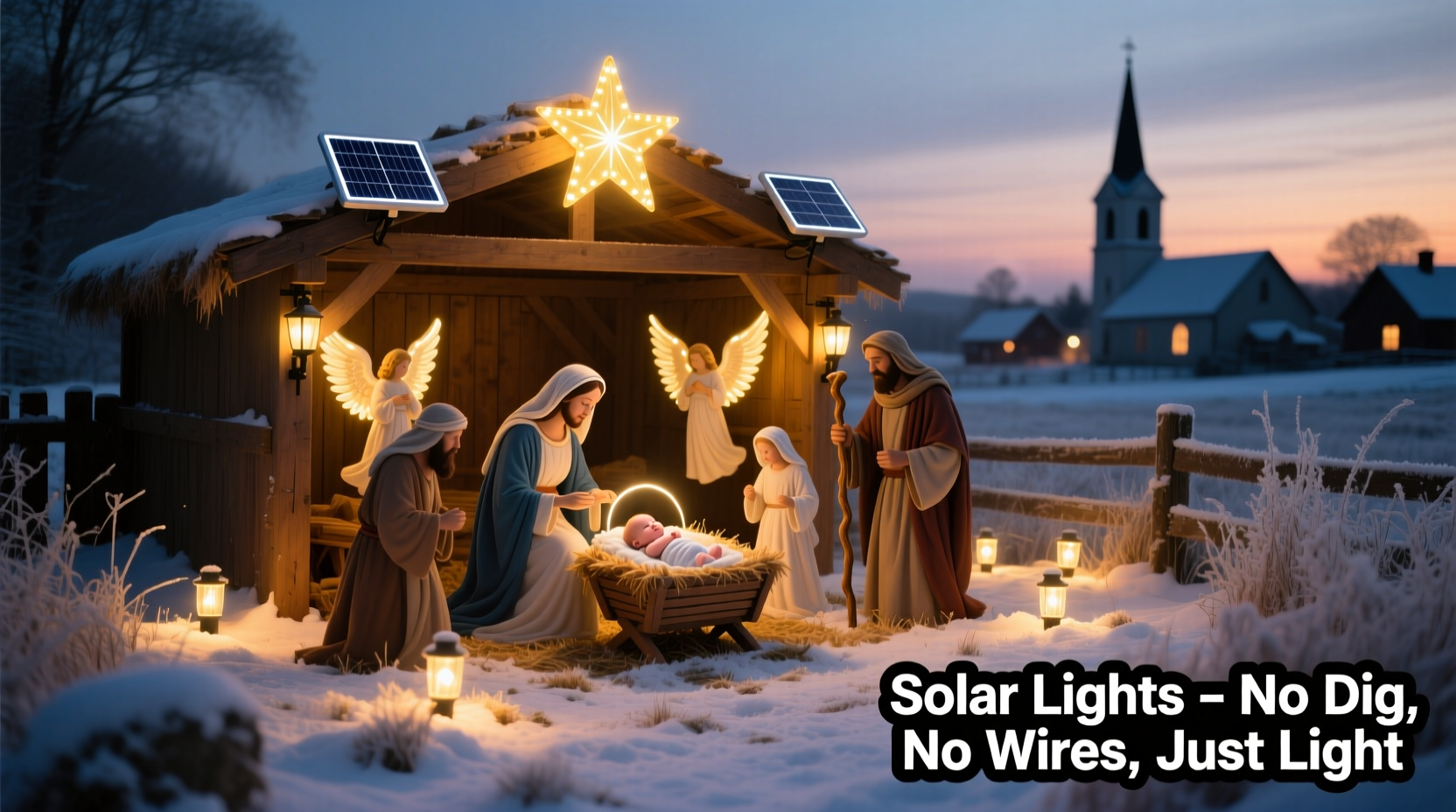
Solar lighting aligns with the nativity’s core values in ways often overlooked. It eliminates reliance on fossil-fueled grid electricity during the Advent season—a period traditionally marked by reflection, simplicity, and stewardship. Unlike plug-in LED strings that draw power continuously (even when unobserved), quality solar lights store energy only during daylight and emit light solely at night, matching natural circadian rhythm. More concretely, solar avoids three persistent pain points: First, trenching through compacted clay soil or rocky terrain can take 6–10 hours per 20 feet—and risk cutting irrigation lines or utility markers. Second, low-voltage wiring requires GFCI-protected transformers, weatherproof connectors, and annual corrosion checks. Third, temporary setups using extension cords violate most municipal fire codes for public or sidewalk-adjacent displays. Solar sidesteps every regulatory and physical barrier while delivering reliable, silent, zero-emission illumination.
Selecting Lights That Honor the Scene — Not Distract From It
Not every solar light belongs in a sacred display. Harsh white LEDs (5000K–6500K) create clinical, retail-like brightness that flattens texture and washes out warm wood grain. Warm white (2700K–3000K) with high CRI (Color Rendering Index ≥90) preserves the subtle amber glow of aged olive wood, the soft patina of bronze, and the delicate translucence of hand-blown glass stars. Equally important is beam control. Floodlights scatter light indiscriminately; spotlights with adjustable heads (15°–30° beam angles) allow precise highlighting of faces, halos, or the manger’s straw without spilling onto neighboring homes.
| Light Type | Best For | Avoid For | Minimum Runtime (Full Charge) |
|---|---|---|---|
| Solar Path Lights (3–5W) | Subtle ground-level framing along walkway edges | Direct figure illumination (too diffuse) | 10–12 hours |
| Solar Spotlights (5–8W, adjustable head) | Highlighting Mary’s face, the Christ child, or shepherd’s staff | Large open areas (insufficient coverage) | 12–14 hours |
| Solar String Lights (warm white, 20–50 bulbs) | Soft halo behind stable backdrop or draped over olive branches | Primary scene lighting (lacks directional focus) | 8–10 hours |
| Solar Lanterns (glass enclosure, 3–4W) | Placing beside stable entrance or near kneeling figures | Wind-exposed rooftops (glass may shatter) | 10–12 hours |
Look for IP65 or higher waterproofing—essential for snowmelt, sleet, and freezing rain. Also verify the solar panel is detachable and mountable separately (e.g., via stake or wall bracket). Fixed-integrated panels force compromises: if your nativity sits under an eave or near a fence, the panel won’t get full sun unless you can reposition it independently.
Step-by-Step Setup: From Unboxing to Reverent Glow
- Assess Sun Exposure (Day 1): Use a free app like Sun Surveyor or simply observe your site between 10 a.m. and 2 p.m. for three consecutive days. Mark where direct sunlight falls for ≥4 uninterrupted hours. Avoid placing panels under deciduous trees (bare branches still cast shade) or within 3 feet of north-facing walls.
- Map Light Positions (Day 2): Sketch your nativity layout on paper. Identify 3–5 focal points: the infant Jesus (highest priority), Mary’s hands, Joseph’s lantern, the angel’s wings, and the stable roofline. Assign one spotlight per focal point, angled downward at 30° to avoid glare into viewers’ eyes.
- Install Panels First (Day 3 AM): Mount solar panels on south-facing stakes, roof brackets, or fence posts—never on the nativity structure itself. Elevate panels 2–3 feet above ground to prevent snow cover. Wipe panels clean with microfiber cloth before first use.
- Position Fixtures (Day 3 PM): Place spotlights on sturdy ground stakes or weighted bases (concrete-filled planters work well). Angle each light so its beam center hits the target feature at eye level (approx. 5 feet high). Test alignment at dusk using your phone camera—digital sensors reveal hotspots and shadows more clearly than the naked eye.
- Condition & Verify (Days 4–6): Let lights charge fully for 3 consecutive sunny days before final adjustment. On Day 6, observe at 5:30 p.m., 7:00 p.m., and 9:00 p.m. Note any dimming or inconsistent activation. Replace underperforming units immediately—don’t wait until Christmas Eve.
A Real-World Example: St. Brigid Parish, Toledo, OH
St. Brigid installed a 12-foot limestone nativity in their front courtyard in 2019. Previous years relied on a licensed electrician to trench 42 feet of low-voltage cable beneath a brick walkway—costing $1,280 and requiring city permits. In 2022, volunteer lighting coordinator Maria Ruiz switched to solar. She selected six 7W solar spotlights with 2700K, 92 CRI LEDs and detachable 5V/2.5W monocrystalline panels. Panels were mounted on repurposed flagpole brackets attached to the church’s south-facing bell tower—guaranteeing 5.2 peak sun hours daily. Lights were staked into gravel beds (no soil penetration needed) and aimed using a laser level app. During the 2023 season—marked by 11 consecutive overcast days—the lights maintained 11-hour runtime nightly thanks to LiFePO₄ batteries. “People comment most on how ‘peaceful’ the light feels,” Ruiz says. “Not bright, not flashy—just warm, steady, and deeply respectful.”
“Solar lighting for sacred spaces isn’t about convenience—it’s about intentionality. When light emerges from the sun that warmed Bethlehem, it echoes the Incarnation’s connection between heaven and earth.” — Rev. Daniel Kim, Director of Sacred Art & Environment, Catholic Liturgical Association
Common Pitfalls and How to Avoid Them
- Overcrowding the Panel Zone: Installing too many panels in one area creates mutual shading. Space panels at least 24 inches apart horizontally and vertically—even if they’re on different stakes.
- Ignoring Winter Sun Angle: In December, the sun sits 25°–30° lower in the sky than in June. A panel that worked perfectly in October may be shaded by a roofline or gutter in December. Recheck angles in late November.
- Using Non-Adjustable Fixtures: Fixed-mount lights can’t compensate for snow accumulation on bases or shifting ground frost heave. Always choose models with ball-and-socket joints or swivel mounts.
- Skipping Battery Replacement Cycles: Even premium LiFePO₄ batteries degrade after 3–4 seasons. Mark your calendar: replace all batteries the first week of November in Year 4—don’t wait for failure.
- Misjudging Light Layering: Relying solely on spotlights creates harsh shadows. Combine with 1–2 warm-white string lights draped loosely behind the stable to soften edges and add depth.
FAQ
Can solar lights work reliably in northern climates with short December days?
Yes—if you select high-efficiency monocrystalline panels (≥22% conversion rate) and LiFePO₄ batteries. Units rated for “4-hour charge / 12-hour runtime” are engineered for winter latitudes. Avoid polycrystalline panels or NiMH batteries—they fail below 20°F and require 6+ hours of direct sun.
How do I keep snow from covering the solar panels?
Mount panels at a 45°–60° tilt (not flat) so snow slides off naturally. Use smooth-surface aluminum brackets—not textured plastic—that won’t hold ice. Wipe panels gently with a soft brush after heavy snowfall; never use metal scrapers or hot water, which can crack tempered glass.
Will neighbors complain about light trespass?
Properly aimed 30° spotlights produce virtually zero upward light and minimal horizontal spill. Measure light levels at your property line with a $30 lux meter app: aim for ≤0.2 foot-candles (2 lux) beyond your boundary. If readings exceed that, add barn-door shields (available as 3D-printed accessories) or reduce beam angle to 15°.
Conclusion
Illuminating a nativity scene is never just about visibility—it’s about invitation. It’s the quiet signal that says, “Come closer. Pause here. Witness this mystery.” Solar lighting, when chosen and placed with reverence, delivers that invitation without compromise: no wires snaking across sacred ground, no permits delaying preparation, no electrician’s invoice diminishing the season’s generosity. You don’t need technical expertise—just attention to sun angles, warmth of color, and precision of aim. Start small this year: light just the manger. Next year, add the shepherds. By the third season, you’ll have a luminous tradition rooted not in convenience, but in care—for the figures, the space, and the people who pause there in wonder. Your nativity doesn’t need more light. It needs truer light. And that begins with a single, well-placed solar panel facing the same sun that rose over Bethlehem.




 浙公网安备
33010002000092号
浙公网安备
33010002000092号 浙B2-20120091-4
Comments
No comments yet. Why don't you start the discussion?