
Remote work has become a cornerstone of modern professional life. While many companies now offer formal hybrid or fully remote arrangements, others remain hesitant. In such environments, knowing how to justify working from home—without raising suspicion or compromising trust—is a subtle but valuable skill. The key isn’t deception; it’s strategic communication that aligns personal needs with workplace priorities like productivity, focus, and efficiency.
The most effective \"excuses\" aren't fabrications—they’re real-life situations framed in a way that emphasizes benefits to both employee and employer. When used appropriately, these justifications can open doors to greater flexibility, improved concentration, and better work-life integration.
Choose Excuses That Align With Productivity
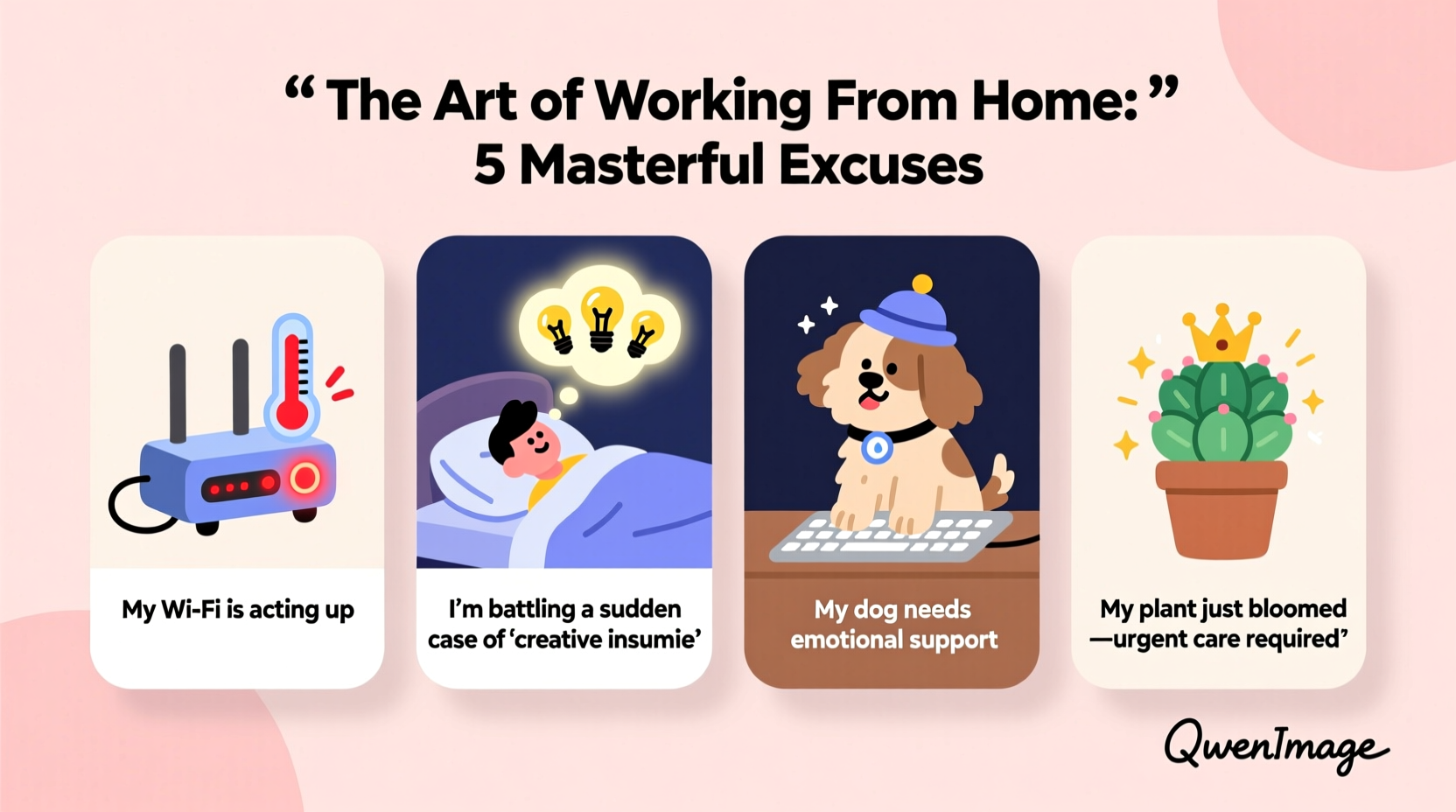
Not all reasons for working remotely are equally convincing. The strongest ones tie directly to job performance. Employers care less about convenience and more about results. Framing your request around enhanced output makes approval far more likely.
- Deep Work Days: “I have a critical project deadline and need uninterrupted focus. Working from home will let me complete it efficiently.”
- Reduced Office Distractions: “The open office layout is making it hard to concentrate on complex tasks. A quiet home environment would help me deliver higher-quality work.”
- Sick Recovery (Non-Contagious): “I’m recovering from a minor illness and not contagious, but still need rest. I can work remotely without impacting my output.”
Realistic Scenarios That Justify Remote Work
Sometimes, life throws curveballs. The trick is turning them into credible, low-drama opportunities to work from home. Below are five realistic situations—some planned, some spontaneous—that professionals commonly use to transition temporarily to remote setups.
- Home Maintenance or Repairs: Plumbers, electricians, or internet technicians often require someone to be present. Use this as a legitimate reason to stay home while remaining productive.
- Caring for a Family Member: Whether it’s an elderly parent needing a medical appointment or a child home sick from school, caregiving is a universally accepted justification.
- Weather Conditions: Snowstorms, flooding, or extreme heat can make commuting dangerous. These are high-credibility excuses, especially when local authorities issue advisories.
- Personal Errands with Time Constraints: Need to sign legal documents, receive a delivery, or attend a property viewing? Bundle it with work: “I’ll be available all day and can log off briefly if needed.”
- Mental Health Reset: Increasingly accepted, this reason works best in supportive cultures. Phrase it as proactive self-management: “I’m taking a focused day to recharge and ensure peak performance this week.”
Mini Case Study: Turning a Plumbing Emergency into a Productive Day
Sarah, a marketing analyst at a mid-sized firm, had been trying to secure more remote days but faced resistance due to company policy. One morning, her landlord called: a pipe burst required immediate repair between 10 a.m. and 2 p.m. She emailed her manager: “There’s an urgent plumbing issue at my apartment. I need to be onsite for the repair, but I’ll be fully available to work before, during, and after. All deadlines will be met.”
She delivered her report early, responded promptly to Slack messages, and even hosted a scheduled client call from her home office. Her manager noted her professionalism and later approved two regular remote days per week. The excuse was real—but her performance made the difference.
Do’s and Don’ts: Navigating Remote Requests Professionally
| Do’s | Don’ts |
|---|---|
| Provide advance notice when possible | Wait until the last minute without explanation |
| Emphasize continuity of work | Make it sound like you’re taking a day off |
| Offer to join meetings via video | Disappear from communication channels |
| Use company-approved tools and security protocols | Breach data policies or use unsecured networks |
| Follow up with a summary of completed tasks | Fail to demonstrate accountability |
“Employees who communicate proactively and deliver results remotely build trust faster than those who demand flexibility without proof of reliability.” — Mark Tran, HR Director at NexaFlow Solutions
Step-by-Step Guide to Requesting a Remote Work Day
Even the best excuse falls flat without proper execution. Follow this timeline to increase your chances of approval and long-term flexibility.
- Assess the Situation (Day Before): Identify a valid reason—planned or emergent—and confirm it’s believable and non-repetitive.
- Draft a Concise Message (Morning of Request): State the reason, duration, and assurance of availability. Keep it professional and brief.
- Submit Through Proper Channels: Use email or internal messaging systems. Avoid casual platforms like text unless culturally accepted.
- Prepare Your Workspace: Ensure your laptop, Wi-Fi, and software are ready. Test video conferencing tools if meetings are scheduled.
- Work Transparently: Check in regularly, update task boards, and respond promptly. Visibility builds credibility.
- Follow Up (End of Day): Send a quick recap: “Completed X, submitted Y, ready for Z tomorrow.” This reinforces responsibility.
Frequently Asked Questions
Is it ethical to use “excuses” to work from home?
Yes, as long as the reason is truthful and you maintain or exceed your usual productivity. Calling it an “excuse” doesn’t mean lying—it means selecting a compelling, acceptable justification from real-life circumstances. Transparency and performance are what matter most.
How often can I reasonably work from home using situational excuses?
Depends on your workplace culture. In rigid offices, limit it to once every few weeks. In flexible environments, monthly use of varied reasons is sustainable. Avoid repeating the same excuse frequently, as patterns raise skepticism.
What if my manager asks for proof, like a doctor’s note?
Only provide documentation if required by policy. For non-medical reasons (e.g., repairs, errands), a simple statement is usually sufficient. If pressed, offer to reschedule or compromise: “I can come in after noon if needed.”
Build Flexibility Through Consistency
The ultimate goal isn’t to master excuses—it’s to earn the right to work remotely without needing one. Each time you work from home successfully, you’re building a track record. Deliver on promises, stay visible, and overcommunicate. Over time, your reliability becomes the justification.
Companies don’t resist remote work because employees lack reasons—they resist because they fear lost productivity. Every focused hour you log from home chips away at that fear. The best excuse is a completed project delivered ahead of schedule, from a quiet desk miles away from the office noise.
“The future of work isn’t about where you sit—it’s about what you deliver. Prove your value anywhere, and location becomes irrelevant.” — Lena Patel, Organizational Psychologist and Remote Work Consultant




 浙公网安备
33010002000092号
浙公网安备
33010002000092号 浙B2-20120091-4
Comments
No comments yet. Why don't you start the discussion?