
Beginning October 1, 2025, U.S. travelers will need a REAL ID-compliant driver’s license or identification card to board domestic flights and enter certain federal facilities. With this deadline approaching, millions of Americans are checking whether their current ID meets the updated federal requirements. This guide provides a clear, actionable roadmap to verify your ID’s compliance, avoid last-minute surprises, and ensure smooth travel and access in the coming years.
Understanding REAL ID: What It Is and Why It Matters
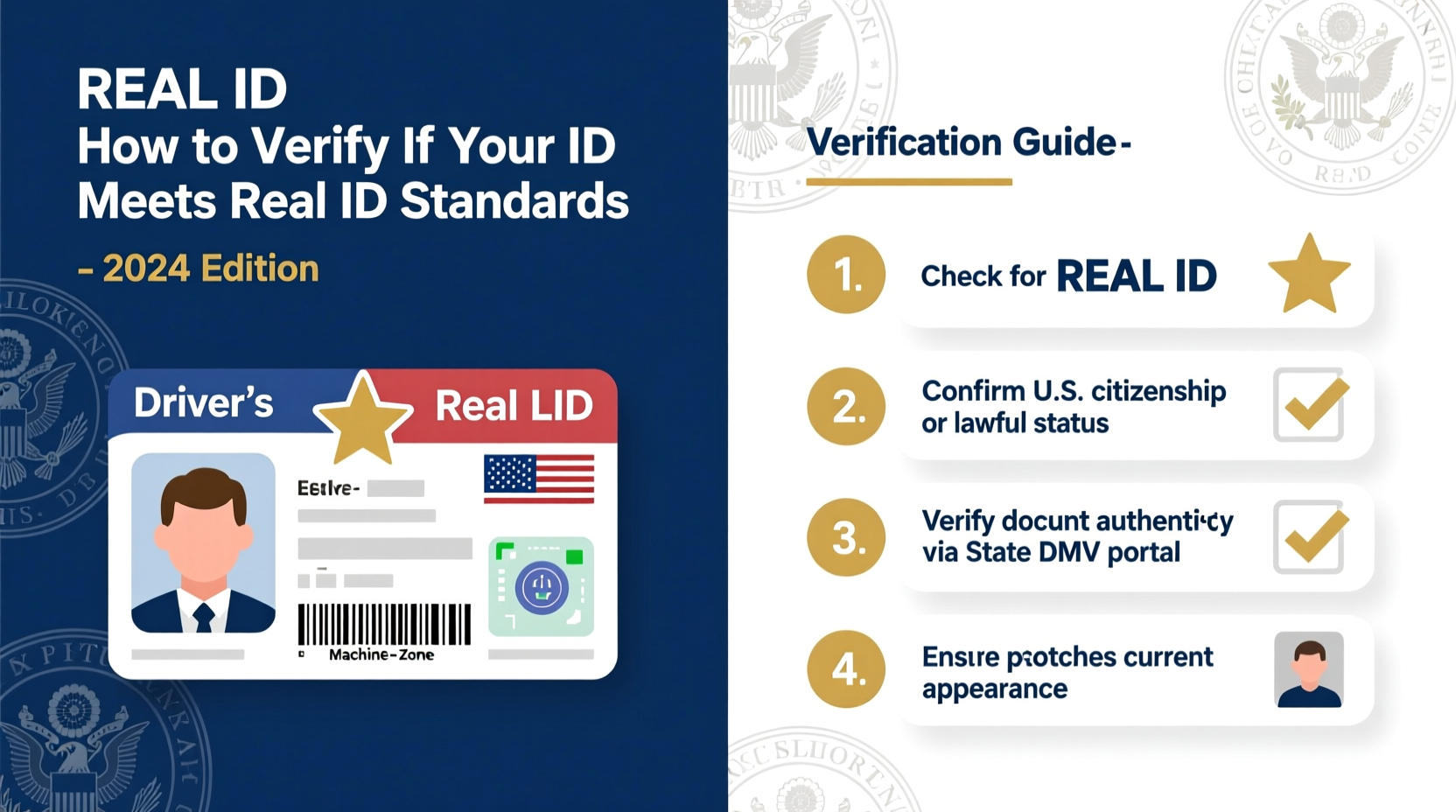
The REAL ID Act was passed by Congress in 2005 following recommendations from the 9/11 Commission. Its purpose is to set consistent federal standards for state-issued driver’s licenses and identification cards. The Department of Homeland Security (DHS) oversees enforcement, requiring IDs used for federal purposes—like boarding planes or entering secure government buildings—to meet minimum security criteria.
A compliant REAL ID includes enhanced security features such as holograms, machine-readable technology, and verification of identity documents during issuance. Not all states issue only REAL ID cards; many offer both standard and compliant versions, clearly marked to distinguish them.
“REAL ID strengthens national security by ensuring that individuals presenting identification at federal checkpoints have undergone verified identity checks.” — U.S. Department of Homeland Security
How to Check If Your Current ID Is REAL ID Compliant
The easiest way to determine compliance is by examining the physical card. A compliant REAL ID is typically marked with a star in the upper right corner. The symbol may appear in one of several forms:
- A gold or black star within a circle
- A star cutout (for some newer designs)
- A star inside a parallelogram (used in select states)
If you see any of these symbols, your ID is likely compliant. If there's no star—or if it's labeled “Not for Federal Identification”—it does not meet REAL ID standards.
Step-by-Step Verification Process
- Inspect your ID for the star symbol. Look carefully at the top right corner.
- Check the expiration date. An expired ID is not valid for travel or federal access, even if compliant.
- Visit your state’s official DMV or BMV website. Most provide an online tool to verify REAL ID status using your license number or personal details.
- Contact your local DMV office directly. Ask whether your current ID type (standard vs. enhanced vs. REAL ID) qualifies.
- Cross-reference with TSA guidelines. The TSA maintains a list of acceptable identification types on its website.
What Documents Are Needed to Upgrade to a REAL ID?
If your current ID isn’t compliant, upgrading requires submitting specific documentation to prove identity, Social Security number, and residency. Requirements vary slightly by state but generally include the following:
| Document Type | Purpose | Examples |
|---|---|---|
| Proof of Identity | Verify legal name and date of birth | U.S. passport, certified birth certificate, permanent resident card |
| Social Security Proof | Confirm SSN | SSN card, W-2 form, SSA-1099 |
| Proof of Residency | Show two documents proving address | Utility bill, bank statement, lease agreement, mortgage statement |
All documents must be original or certified copies—photocopies are not accepted. Some states allow digital uploads for appointments, but in-person visits are typically required for first-time applicants.
Common Mistakes That Delay REAL ID Processing
- Bringing photocopies instead of originals
- Using outdated proof of address (older than 90 days)
- Failing to bring all three categories of documents
- Assuming a renewal automatically upgrades to REAL ID (it doesn’t)
Mini Case Study: Sarah’s Last-Minute Airport Hurdle
Sarah, a frequent traveler from Ohio, assumed her standard driver’s license would suffice for her May 2024 flight to Washington, D.C. She arrived at the airport confident—only to be stopped at the TSA checkpoint. Her license lacked the star symbol and was labeled “Not for Federal Identification.” Though she had a passport, she hadn’t brought it, assuming her license would work.
TSA agents allowed her to proceed after secondary screening, but she missed her flight due to delays. Embarrassed and stressed, Sarah visited her local BMV the next day. She learned she needed her birth certificate, Social Security card, and two utility bills to upgrade. Because she didn’t have all documents on hand, the process took three separate visits over two weeks.
Her experience highlights the importance of early verification and preparation. “I thought I had plenty of time,” Sarah said later. “Now I know better—don’t wait until the week before your trip.”
Checklist: Verify and Upgrade Your REAL ID Status
Use this checklist to ensure you’re prepared well before October 1, 2025:
- ☐ Examine your current ID for the star symbol
- ☐ Confirm your ID is not expired
- ☐ Visit your state’s DMV website to verify REAL ID eligibility
- ☐ Gather original documents: proof of identity, SSN, and two proofs of residency
- ☐ Schedule an in-person appointment at your local DMV
- ☐ Request a REAL ID specifically during renewal—do not assume it’s automatic
- ☐ Keep a copy of your application confirmation and new card photo for records
Frequently Asked Questions
Can I fly without a REAL ID after October 1, 2025?
Yes, but only if you present an alternative federally accepted form of identification. Acceptable options include a valid U.S. passport, passport card, military ID, or trusted traveler cards (Global Entry, NEXUS, SENTRI). Without one of these, you will not be allowed through TSA checkpoints.
Is a REAL ID required for international travel?
No. International travel always requires a valid U.S. passport book. A REAL ID cannot be used in place of a passport for crossing borders.
Do children need a REAL ID to fly domestically?
Children under 18 do not need identification when traveling domestically with a companion. However, the accompanying adult must present valid ID—either a REAL ID or another acceptable form.
Conclusion: Take Action Now to Avoid Travel Disruptions
The transition to mandatory REAL ID compliance is not a distant policy—it’s a near-future reality. Waiting until the final months before the October 2025 deadline could mean long lines, document shortages, and unnecessary stress. By verifying your ID today, gathering necessary paperwork, and scheduling upgrades proactively, you protect your ability to travel freely and access secure facilities without interruption.




 浙公网安备
33010002000092号
浙公网安备
33010002000092号 浙B2-20120091-4
Comments
No comments yet. Why don't you start the discussion?