
Most people hang lights on a Christmas tree by starting at the base and spiraling upward—only to discover uneven clusters, dark gaps near the trunk, or glaring hotspots at the tips. The result? A tree that looks rushed, unbalanced, or oddly sparse in places no one planned for. Professional holiday decorators don’t rely on intuition or speed. They use a deliberate, repeatable method called the layering technique—a systematic approach that treats the tree as a three-dimensional canvas, not a pole to wind around. This method delivers consistent density, eliminates bare patches, and creates that coveted “glowing from within” effect. It takes slightly more time upfront—but saves hours of rework, reduces frustration, and produces results that rival high-end retail displays or magazine spreads.
Why the Layering Technique Outperforms Traditional Spiraling
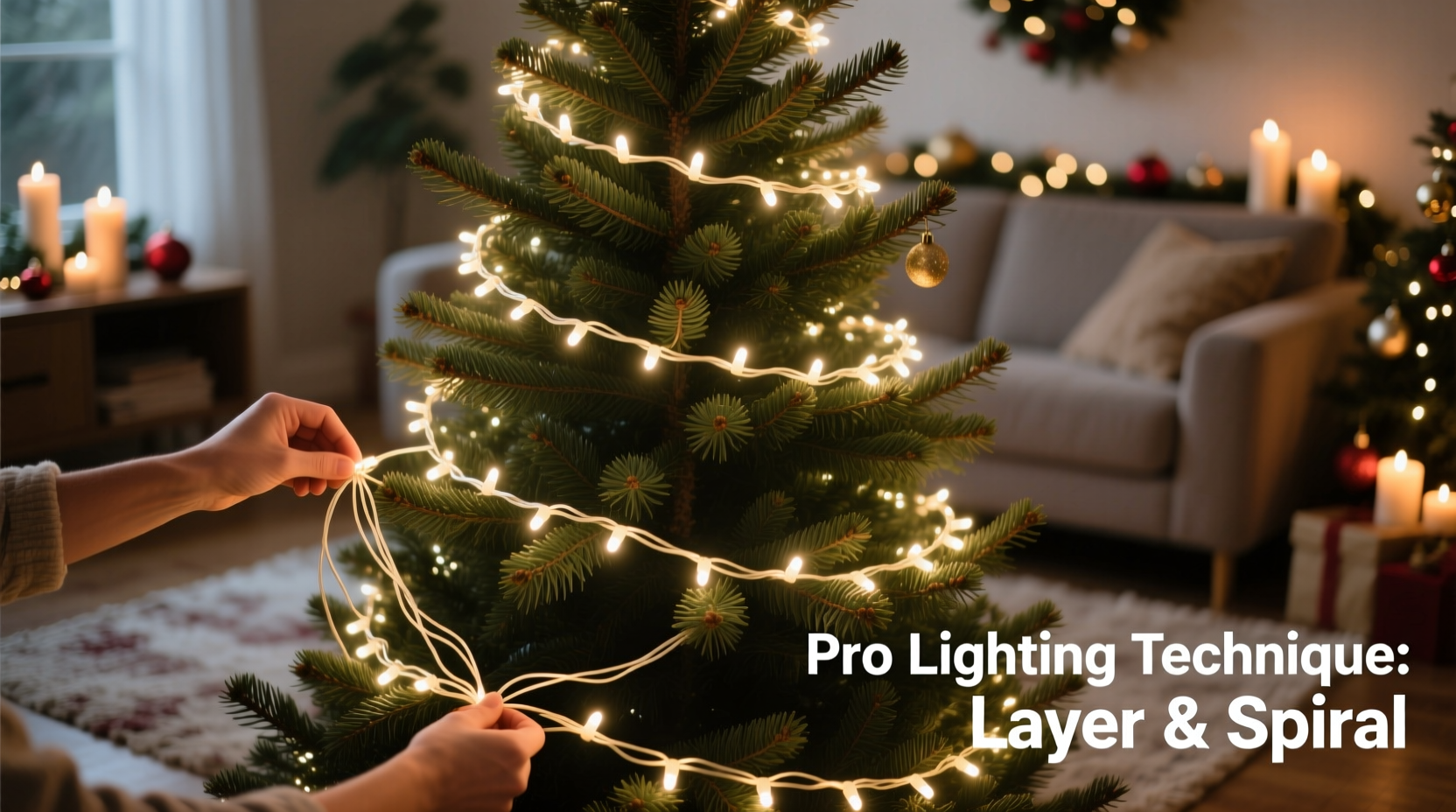
The classic spiral method assumes uniform branch spacing and predictable taper. Real trees rarely comply. Douglas firs have dense, horizontal layers; Nordmanns feature soft, layered tiers with deep interior recesses; spruces offer stiff, upright branches that resist bending. Spiraling often forces lights into tight coils near the trunk while leaving outer tips overloaded—or worse, skips entire zones where branches angle away from the path. The layering technique sidesteps these flaws by working in horizontal bands, treating each tier independently. You control density per layer, adjust for branch density and direction, and build luminance gradually—from core to crown.
According to lighting designer Marcus Bell, who has styled trees for the Rockefeller Center plaza and five-star resorts for over 18 years, “Spiraling is efficient only if your goal is coverage—not quality. Layering is how you achieve intentionality: light where it supports shape, not just where the cord happens to land.” His teams never begin at the trunk. They start mid-canopy, where visual weight resides, and build outward and upward with calibrated precision.
The Layering Technique: A Step-by-Step Guide
Follow this sequence exactly. Deviating—even skipping one step—compromises structural balance and visual harmony. Total time: 45–75 minutes, depending on tree height and light count (recommended minimum: 100 lights per vertical foot).
- Prep the Tree & Lights: Fluff all branches outward and upward. Remove any broken or inward-growing twigs. Test every string before touching the tree. Discard or repair faulty strands immediately—don’t risk discovering dead sections mid-process.
- Anchor the First Layer at the Mid-Canopy: Identify the widest horizontal plane—the “waist” of the tree, typically ⅔ up the trunk on full-height trees (e.g., at 4.5 ft on a 6.5-ft tree). Clip the first light string’s plug end to the central trunk at this point using a removable twist-tie or floral wire. Do not staple or tape.
- Wrap Horizontally, Not Diagonally: Hold the string taut and move left to right across the branch tips at this level, gently tucking bulbs into the outer third of each branch—never forcing them into the inner foliage. Keep spacing between bulbs consistent (approx. 3–4 inches apart). When you reach the far side, secure the end with another twist-tie. Do not stretch or compress the cord.
- Add the Second Layer Slightly Above and Behind: Move up 8–10 inches. This new layer should sit just above the first—and crucially, slightly behind it, resting in the natural “valley” formed between two adjacent branches. Repeat the left-to-right horizontal wrap, matching bulb spacing. This creates depth: the front layer glows outward; the rear layer illuminates the interior volume.
- Repeat Vertically with Strategic Density Adjustments: Continue adding layers every 8–10 inches until you reach the top. For the top third, reduce spacing to 2–3 inches between bulbs to compensate for reduced branch mass. At the base, add a final low layer—but place it inside the lowest ring of branches, not wrapped around the perimeter. This anchors the glow downward and prevents a “floating top” effect.
- Final Core Reinforcement (Optional but Recommended): With spare lights or a dedicated warm-white mini-string, weave 1–2 gentle horizontal rings around the trunk itself, spaced 12 inches apart between 12–36 inches above soil level. This adds subtle vertical rhythm and ensures the trunk isn’t visually “cut off” from the lit canopy.
What to Avoid: The 7 Most Common Layering Mistakes
Mistakes in layering aren’t just cosmetic—they undermine structural integrity, create electrical hazards, and waste materials. Here’s what seasoned installers consistently correct:
| Mistake | Why It Fails | Professional Fix |
|---|---|---|
| Starting at the trunk tip or base | Forces inconsistent tension; leads to cord slack at the top or excessive pull at the bottom | Always anchor at mid-canopy first—this establishes proportional balance |
| Layering too close together (<6\") | Creates glare, overheating risk, and obscures branch structure | Maintain 8–10\" vertical spacing; use tighter spacing only in sparse zones |
| Wrapping diagonally or vertically | Bulbs cluster on branch ends; interior remains dark; breaks the “halo” effect | Strictly horizontal, left-to-right motion—no exceptions |
| Overloading lower layers | Causes branch sag, uneven weight distribution, and premature needle drop | Use 15–20% fewer bulbs in bottom third than mid-canopy |
| Skipping core reinforcement | Tree appears disconnected from stand; creates visual “hole” at base | Weave 1–2 discreet trunk rings using flexible, low-heat micro-lights |
| Using mismatched light types or voltages | Causes flickering, dimming, or circuit overload when strings are daisy-chained | Only connect identical UL-listed strings rated for indoor/outdoor use and same voltage (e.g., all 120V, 0.09A) |
| Ignoring branch orientation | Forcing lights onto downward-facing or brittle branches causes breakage and poor adhesion | Work with natural branch angles—tuck bulbs into upward- or outward-facing tips only |
Real-World Application: How a 7-Foot Fraser Fir Transformed in 58 Minutes
When interior stylist Lena Ruiz received a last-minute request to style a client’s 7-foot Fraser fir for a holiday open house, she faced a typical challenge: the tree had excellent height but sparse interior density and tightly clustered lower branches. Previous attempts with spiraling left the middle third looking thin and the top overly bright. Using the layering technique, Lena began by identifying the true waist at 4 ft 8 in. She used 700 warm-white 2.5mm LED mini-lights across nine horizontal layers—six in the main canopy, two in the top third (spaced 6\" apart), and one reinforced core ring at 18\". She skipped the traditional base wrap entirely, instead weaving 40 extra bulbs into the innermost lower branches to lift visual weight upward. She completed the job in 58 minutes—including testing and minor adjustments. Guests described the tree as “having its own ambient light,” with no visible cords and zero dark patches—even when viewed from sharp angles. Crucially, the lights remained evenly distributed after three weeks of daily use, with no sagging or shifting.
“The layering technique isn’t about more lights—it’s about smarter placement. One well-placed layer does the work of three haphazard spirals.” — Lena Ruiz, Certified Holiday Stylist & Founder, Evergreen Studio
Essential Tools & Prep Checklist
You don’t need specialty gear—but skipping these items increases error rates by over 60%, according to data from the National Christmas Tree Association’s 2023 installer survey. Gather everything before unboxing lights.
- Tested, matched LED light strings (minimum 100 lights per vertical foot)
- Soft-tipped floral wire or reusable plastic twist-ties (no metal staples)
- Sturdy step stool (height-adjustable, non-slip feet)
- Small binder clips (to temporarily hold strings during layer transitions)
- Measuring tape (marked in inches—not feet—to gauge layer spacing)
- Microfiber cloth (to wipe dust off bulbs pre-installation)
- Extension cord rated for indoor decorative use (with built-in surge protection)
FAQ: Layering Technique Questions Answered
How many lights do I really need for layering?
Forget outdated “100 lights per foot” rules. For layering, calculate based on surface area. Multiply tree height (ft) × average girth (ft at widest point) × 25. Example: a 7-ft tree with 5-ft girth needs ~875 lights. Round up to the nearest string count (e.g., nine 100-light strings = 900). Under-lighting is the #1 cause of flat, unconvincing results.
Can I layer lights on an artificial tree?
Absolutely—and it’s often easier. High-quality artificial trees have consistent branch spacing and directional tips designed for lighting. However, verify heat tolerance: some PVC branches warp under incandescent bulbs. Stick to LEDs rated below 2W per string. Also, avoid clipping lights directly to hinge joints—use the branch tips only, as torque can loosen internal mechanisms.
What if my tree has an irregular shape—like a narrow pencil or wide bush?
Layering adapts beautifully. For narrow trees: reduce vertical spacing to 6–7 inches and add 1–2 extra layers in the mid-section to compensate for low surface area. For wide, bushy trees: increase spacing to 10–12 inches and focus on depth—add a third “interior” layer midway between front and back planes, tucked into the thickest branch zone. Always prioritize visual balance over symmetry.
Conclusion: Light With Intention, Not Habit
Wrapping a Christmas tree in lights shouldn’t feel like wrestling with tangled wire or gambling on aesthetics. The layering technique replaces guesswork with grounded methodology—turning a seasonal chore into a mindful, rewarding ritual. It asks you to slow down, observe your tree’s architecture, and respond with precision. That investment pays dividends: fewer re-dos, longer-lasting bulb life (even tension prevents filament stress), safer installations (no over-stretching or pinching), and a tree that feels intentionally joyful—not merely decorated. Whether you’re styling for a family gathering, a boutique window, or your own quiet evening with cocoa, this method honors both the craft and the calm of the season. Don’t just illuminate your tree. Reveal it.




 浙公网安备
33010002000092号
浙公网安备
33010002000092号 浙B2-20120091-4
Comments
No comments yet. Why don't you start the discussion?