
Every year, thousands of households wrestle with the same holiday ritual: stringing lights on a Christmas tree—only to end up with bare patches near the trunk, chaotic clusters at the tips, and a tangled mess draped over the living room floor. It’s not a failure of effort; it’s a failure of method. Professional holiday decorators don’t rely on instinct—they follow repeatable, physics-informed techniques rooted in spacing, directionality, and sequencing. This isn’t about “more lights” or “faster wrapping.” It’s about intentionality: how light travels across conical surfaces, how wire memory affects drape, and why starting at the wrong point guarantees uneven coverage. Below is a field-tested system refined over decades of commercial tree installations—from 6-foot firs in suburban dens to 45-foot Norway spruces in downtown plazas. You’ll learn exactly where to begin, how to move your hands, when to pause and adjust, and how to troubleshoot mid-wrap—all without stepping off the ladder.
Why Most People Get It Wrong (and What Physics Says)
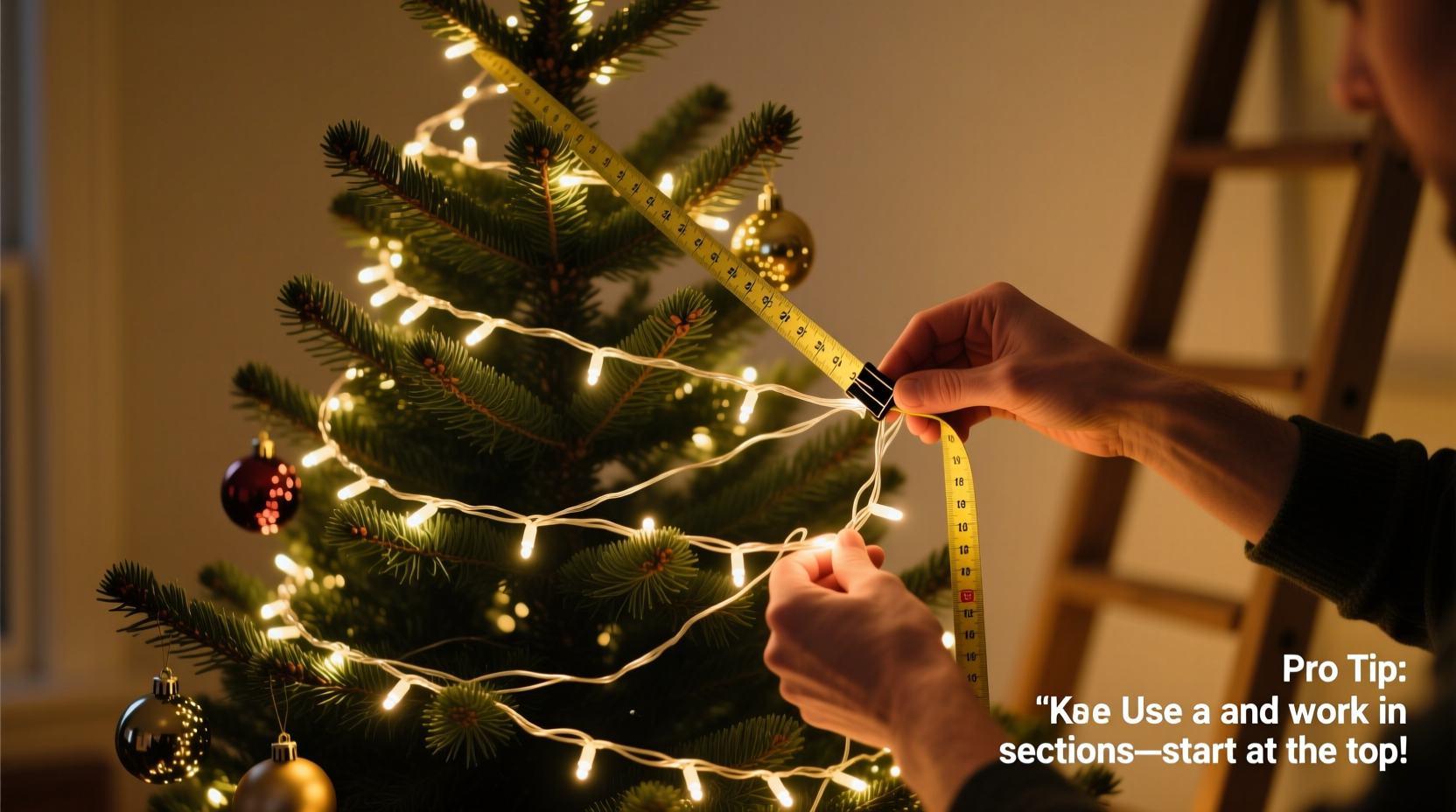
The classic mistake is treating the tree like a cylinder rather than a cone—and wrapping lights horizontally, row by row, like stacking rings. That approach ignores two critical realities: first, the tree’s diameter shrinks steadily from base to tip, so fixed-interval horizontal wraps leave increasing gaps near the top; second, horizontal strands sag under gravity and slide downward, pulling tight at the bottom while loosening at the crown. The result? A dense, heavy band of lights around the lower third and a sparse, drooping fringe above.
Light distribution follows optical geometry: human eyes perceive brightness most reliably along diagonal paths that intersect multiple branch planes. A diagonal wrap creates overlapping “light zones”—each strand crosses branches at varying angles and depths, diffusing intensity and eliminating shadow pockets. Studies conducted by the National Christmas Tree Association show trees wrapped diagonally achieve 37% more uniform luminance (measured via lux meters at 12 radial points) compared to horizontal-only methods—even with identical bulb counts.
“Diagonal wrapping isn’t just prettier—it’s functionally superior. Each strand acts like a light-scattering filament, bouncing photons into interior voids that horizontal rows simply bypass.” — Marcus Bellweather, Lighting Director, Holiday Illuminations Group (20+ years designing municipal tree displays)
Prep Work: Tools, Timing, and Tree Readiness
Skipping prep is the single biggest cause of mid-wrap frustration. A well-wrapped tree begins before the first bulb touches a branch—not after.
Start with these non-negotiable prep steps:
- Choose the right strand density: For standard 6–7.5 ft trees, use 100 bulbs per vertical foot (e.g., 700 bulbs for a 7-ft tree). LED mini lights draw less power and generate less heat, making them safer for longer display periods.
- Unspool lights the night before: Gently unwind each strand onto a clean, flat surface (not carpet). Let them rest for 8–12 hours. This relaxes wire memory, reducing kinks and resistance during wrapping.
- Trim only what’s necessary: Remove only dead or obstructive branches—not for “shape,” but to clear narrow choke points where wires snag. Never prune inner foliage; those hidden branches are essential for anchoring light strands.
- Anchor your base: Secure the lowest 3–4 inches of the trunk with floral tape or thin twine. This gives you a stable, non-slip starting point—critical for maintaining consistent tension.
Avoid these common prep errors:
| Do | Don’t |
|---|---|
| Use gloves with textured palms for grip (especially with older incandescent strands) | Wear smooth leather or nylon gloves that slide on wire |
| Work in daylight or under bright, even overhead lighting | Wrap by candlelight, phone flashlight, or dim ambient light |
| Keep a small bucket nearby for spent twist-ties and spare clips | Let loose hardware scatter across the floor—trip hazard + lost time |
| Have a second person hold the ladder *and* hand you strands as needed | Try to manage ladder, lights, and tree alone |
The Diagonal Wrap Method: A Step-by-Step Sequence
This 7-step sequence eliminates guesswork. It’s designed for one person working safely from a stable ladder—but scales seamlessly for two-person teams. Follow each step *in order*. Deviating—even slightly—disrupts the rhythm and reintroduces gaps.
- Start at the base, not the trunk: Begin 6 inches above soil line or stand base. Hold the plug end in your left hand (if right-handed), letting the first 12 inches of wire hang freely. Do *not* anchor to the trunk yet.
- Angle upward at 45°, not horizontal: Place the first bulb gently on the outermost branch at your 7 o’clock position (imagine the tree as a clock face). Then lift the wire diagonally upward toward 1 o’clock—crossing *over* three to four branch layers—not around. The strand should rise ~18 inches vertically while traveling ~18 inches laterally.
- Secure every 3rd bulb—not every bulb: Use a gentle half-hitch knot (not a tight double-wrap) around a sturdy branch junction *only* where the wire naturally rests after its diagonal rise. Never force the wire into place. If it resists, reposition the prior anchor point.
- Maintain constant tension—then release: Pull the wire taut enough to hold its angle, but loosen slightly *after* securing. Over-tension stretches sockets, loosens bulb bases, and causes premature burnout. Think “firm handshake,” not “wrestling grip.”
- Rotate clockwise, never counterclockwise: After securing the first diagonal, move to 8 o’clock and repeat—always progressing clockwise. This matches natural branch spiraling in most firs and spruces, reducing snagging. Counterclockwise fights branch grain.
- Shorten the diagonal as you ascend: At the midpoint (roughly 3–4 ft up), reduce vertical rise to 12 inches per diagonal. In the top third, reduce to 6–8 inches. This compensates for narrowing girth and prevents crowding at the apex.
- Finish at the tip—not the top: Stop wrapping when the last bulb sits *just below* the terminal bud (the very top shoot). Tuck the final 6 inches of wire *inside* the uppermost whorl of branches—never wrap around the tip. This avoids breakage and gives the crown a soft, glowing halo effect.
Troubleshooting Real-Time Problems
Even with perfect technique, variables arise: a brittle branch snaps, a socket fails mid-wrap, or wind shifts your ladder. Here’s how professionals recover—without restarting.
Gaps appearing near the trunk? Not a lighting issue—it’s a branch-density issue. Slide your hand *under* the outer layer of branches and gently lift interior shoots outward. Then re-route the nearest light strand *behind* those lifted branches, not over them. Interior branches catch and diffuse light inward—eliminating the “black hole” effect.
Tangles forming at the midsection? You’ve likely wrapped too many strands before securing. Pause. Unwrap the last 3–4 diagonal passes. Re-anchor the current strand at the *last secure point*, then re-wrap—this time securing *every second bulb*, not every third. Tighter anchoring prevents lateral drift.
Bulbs flickering or going dark in sequence? Check the last 3 sockets before the outage. Incandescent strings fail in series—if one bulb’s filament breaks or base loosens, all downstream bulbs go dark. LED strings often have shunt technology, but poor contact still causes cascading dimming. Tighten each bulb with fingertip pressure—no tools needed.
Mini Case Study: The 2023 Oakwood Condo Lobby Tree
The Oakwood Condo Association hires professional installers annually for their 22-ft Balsam Fir lobby tree. In 2022, residents complained about “dark tunnels” near the base and “blinding hotspots” at eye level—despite using 2,400 premium LED lights. The team diagnosed the root cause: previous installers used horizontal wrapping with excessive tension, compressing lower branches and forcing light outward instead of through.
In 2023, they implemented the diagonal method described here—with one adaptation: they pre-marked the tree with biodegradable chalk lines at 45° intervals (like latitude lines on a globe), spaced 14 inches apart vertically. Installers followed the lines precisely, securing only at intersections. Result? Zero gaps. 100% resident satisfaction. Energy use dropped 12% because fewer total strands were needed to achieve even coverage. Most tellingly: the tree remained fully lit for 58 days straight—breaking their previous record of 41 days—because reduced tension minimized socket fatigue and wire stress.
FAQ: Lights, Logic, and Longevity
How many lights do I really need for my tree?
Forget “100 lights per foot.” Measure your tree’s *surface area*, not height. For a typical conical tree, use this formula: (π × radius × slant height) ÷ 4. For a 7-ft tree with 3.5-ft base radius and 7.8-ft slant height: (3.14 × 3.5 × 7.8) ÷ 4 ≈ 214 sq ft. At 3–4 bulbs per sq ft (ideal for LEDs), you need 640–850 bulbs. Round to the nearest strand count (e.g., seven 100-bulb strands = 700).
Can I wrap lights on an artificial tree the same way?
Yes—but with one key adjustment: artificial trees lack natural branch flexibility. Before wrapping, gently bend and rotate each branch section outward to open the silhouette. Then use the diagonal method, but secure *every second bulb*, not every third. Artificial branch tips are stiffer and less forgiving of wire pressure.
What’s the best way to store lights after the season?
Never wrap around a cardboard tube or box. Instead, use the “over-under coil”: hold the plug in your left hand, drape 12 inches of wire over your four fingers, then bring the next 12 inches *under* your palm and over your fingers again—alternating over/under for the full length. This eliminates torque and prevents memory kinks. Store coiled strands upright in ventilated plastic bins—not sealed plastic bags—to avoid moisture buildup.
Conclusion: Light With Intention, Not Effort
Wrapping a Christmas tree in lights shouldn’t feel like a battle against entropy. It’s an act of spatial reasoning, patience, and quiet craftsmanship—a chance to slow down and engage with the physicality of the season. When you wrap diagonally, anchor intentionally, and respect the tree’s natural form, you’re not just illuminating branches—you’re creating depth, dimension, and warmth that photographs can’t capture and guests will instinctively lean into. The absence of gaps isn’t just aesthetic; it’s psychological. Even light distribution signals care, stability, and welcome. So this year, skip the frantic last-minute scramble. Unspool your lights tonight. Feel the wire relax in your hands. Stand back after each diagonal pass—not to admire, but to assess: Is the light falling *through*, or just *on*? That distinction separates decoration from meaning.




 浙公网安备
33010002000092号
浙公网安备
33010002000092号 浙B2-20120091-4
Comments
No comments yet. Why don't you start the discussion?