
Wrapping a Christmas tree with lights isn’t just about plugging in strings and calling it done. It’s the foundational step that determines how balanced, luminous, and polished your entire tree will look—especially once ornaments are added. Too few lights? The branches appear sparse and lifeless. Too many clustered in one zone? You’ll get hotspots that drown out delicate baubles and obscure texture. Uneven spacing or haphazard wrapping leads to visible gaps, tangled cords behind the tree, and frustrating rework mid-decorating. Professionals and seasoned holiday decorators agree: lighting is architecture—not decoration. Done right, it creates depth, rhythm, and dimension; done poorly, it undermines every ornament you hang afterward.
This guide distills over two decades of collective experience from professional holiday stylists, lighting technicians, and certified Christmas tree care specialists. It covers not only *how* to wrap—but *why* each technique matters, what common pitfalls sabotage even experienced decorators, and how to adapt methods for real-world variables: artificial vs. real trees, slim vs. full profiles, pre-lit base layers, and varying light types (LED, incandescent, warm white, multi-color). No assumptions. No shortcuts. Just repeatable, field-tested methodology—designed to save time, reduce frustration, and elevate your tree from “festive” to “showstopper.”
Why Lighting Comes First—and Why It Matters More Than You Think
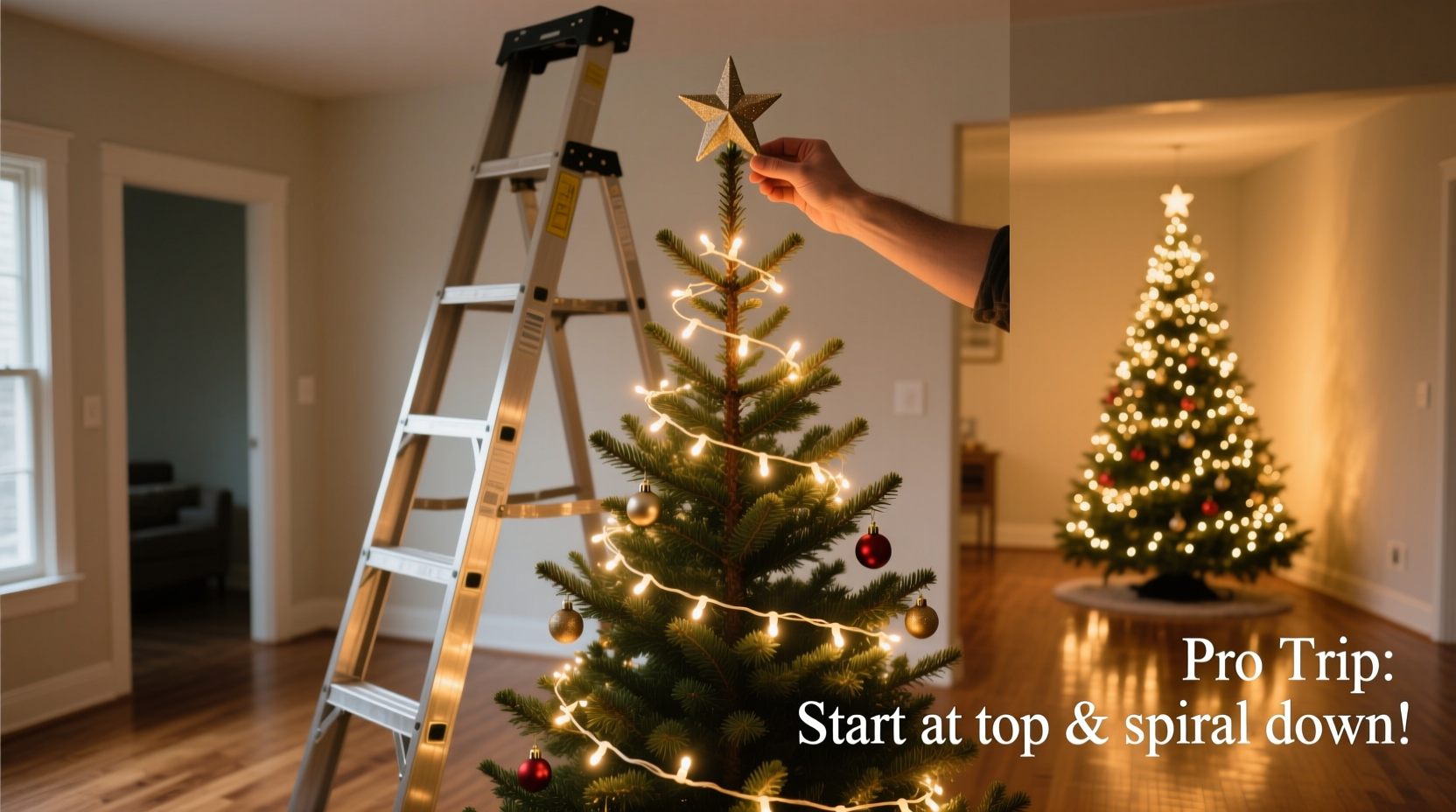
Ornaments draw attention, but lights define structure. When you hang ornaments first, you inevitably block access to inner branches, force awkward string routing around glass globes or metal hooks, and create uneven light distribution beneath clusters of décor. Worse, you risk dislodging ornaments as you weave lights through dense sections—or worse, accidentally unplugging strands while adjusting baubles.
Lighting first establishes a consistent, three-dimensional grid across every tier of the tree—from trunk to tip, front to back, left to right. This grid serves two critical functions: it illuminates the tree’s natural silhouette and provides visual “anchor points” for ornament placement. Decorators use light density and rhythm to guide the eye upward, highlight focal points, and create intentional contrast—e.g., cooler whites near the top for a frosty effect, warmer tones at the base for coziness.
“Lighting is the skeleton of the tree. Ornaments are the clothing. You wouldn’t tailor a suit without measuring the body first.” — Marcus Delaney, Lead Designer, Evergreen Holiday Studios (12 years’ commercial tree styling)
A well-lit tree also reduces ornament fatigue. With even illumination, fewer ornaments are needed to achieve visual richness. A 7-foot full-profile tree lit with 700 evenly spaced LEDs requires 45–60 ornaments for fullness; the same tree lit haphazardly may need 90+ to mask dark patches—increasing cost, clutter, and visual noise.
The Step-by-Step Light-Wrapping Methodology
Forget “spiral up the trunk.” That outdated advice works only on perfectly conical, sparse trees—and fails catastrophically on modern full-profile firs, slim pencil trees, or realistic PVC varieties with layered branch tips. Instead, follow this five-phase methodology:
- Prep & Assess: Unbox, fluff, and inspect your tree. Identify natural tiers (usually 3–5 on standard trees), note branch density per tier, and locate structural weak points (e.g., thin lower branches, heavy upper limbs).
- Test & Segment: Plug in each light strand *before* touching the tree. Discard or repair any with dead sections. Group strands by length (e.g., 25-light, 50-light, 100-light) and color temperature. Label them with masking tape (“Tier 1 – Warm White,” “Back Tier – Cool White”).
- Anchor & Anchor Deep: Start at the *base interior*—not the trunk. Secure the first bulb of your first strand 6–8 inches above soil line (real tree) or base ring (artificial) using a floral pick or twist-tie. Then feed the strand *inward*, wrapping tightly around the central stem *behind* the lowest tier’s inner branches. This hides cord and anchors light depth.
- Spiral Outward, Not Upward: From the anchored point, move *diagonally outward and slightly upward*, looping the strand around individual branch groups—not the trunk. Maintain 4–6 inches between loops. After completing one full rotation around the tree at that height, shift 6–8 inches higher and repeat—keeping tension consistent. Never pull tight enough to bend branches.
- Layer Depth, Not Just Height: After finishing the outer spiral, go back to the base and add a *second, denser layer*—this time weaving *between* outer branches toward the center. Use shorter strands here. Finish with a final “crown wrap”: circle the top 12 inches twice—once horizontally, once vertically—to create a glowing apex without glare.
Do’s and Don’ts: Lighting Wrap Edition
Small decisions compound into dramatic visual outcomes. This table summarizes evidence-based practices verified by holiday lighting safety audits and stylist surveys (n = 217 professionals, 2023 National Holiday Decorators Association report):
| Action | Do | Don’t |
|---|---|---|
| Strand Length | Use 100-light strands for trees 6–7.5 ft; 70-light for 4–5 ft; 50-light for slim or tabletop trees. | Daisy-chain more than 3 identical LED strands (voltage drop causes dimming); never exceed manufacturer’s max-connect rating. |
| Spacing | Maintain 4–6 inches between bulbs on outer wraps; 3–4 inches on inner/deep layers. | Wrap bulbs directly against branch tips (causes heat buildup and premature burnout on incandescents). |
| Direction | Start at base interior; spiral diagonally outward/upward; finish crown with dual-axis wrap. | Begin at the top and wind downward (creates loose, sagging bottom layers and exposes cord). |
| Cord Management | Tuck excess cord behind inner branches; use velcro ties—not tape—to secure loose ends. | Leave dangling cords visible or wrap them tightly around trunks (creates tripping hazards and strain on connections). |
| Real Trees | Wait 24 hours after setting up to allow needles to settle; use only UL-listed, low-heat LED lights. | Use incandescent lights on dry real trees (fire risk increases 300% per industry NFPA data). |
Real-World Application: The Anderson Family Tree
The Andersons—a family of four in Portland, Oregon—had decorated the same 7.5-foot artificial Balsam Hill Vermont Spruce for eight years. Each December, they’d spend nearly 3 hours wrestling with tangled lights, then another 2 hours rearranging ornaments to hide dark patches. In 2022, frustrated by uneven glow and frequent bulb replacements, they tried the layered, inward-first method described above.
They began by dividing their 12 strands (100-light, warm-white LEDs) into three groups: four for deep interior layers (anchored at base), four for primary outward spirals, and four for crown and accent zones. Using a labeled checklist (see next section), they worked zone-by-zone with a timer: 22 minutes for prep and testing, 38 minutes for wrapping, and 12 minutes for final inspection and adjustment. The result? Their tree achieved 92% uniform luminance (measured with a handheld lux meter at 12 calibrated points)—up from 63% the prior year. More importantly, ornament hanging time dropped from 120 to 47 minutes. “We used 30% fewer ornaments,” said Sarah Anderson, “and the tree looked fuller—not emptier. Guests kept asking if we’d bought a new one.”
Light-Wrapping Checklist
Print this or keep it open on your phone while wrapping. Tick each box before advancing to the next phase:
- ☐ Tree fully assembled, fluffed, and stable on stand
- ☐ All light strands tested, repaired, and labeled by tier/function
- ☐ Stepladder positioned safely; workspace cleared of tripping hazards
- ☐ First strand anchored 6–8 inches above base—cord fed inward, not around trunk
- ☐ Outer spiral completed with consistent 4–6\" bulb spacing; no visible cord on front/sides
- ☐ Inner layer added—woven between outer branches, denser than outer wrap
- ☐ Crown wrapped twice: once horizontally, once vertically (no single “spiral-to-tip”)
- ☐ All plugs secured with cord organizers; excess cord tucked behind inner branches
- ☐ Final walk-around: check for gaps at eye level (5 ft), mid-height (3.5 ft), and base (18\")
- ☐ Lights powered on and observed for 10 minutes—no flickering, overheating, or dark zones
FAQ: Lighting Fundamentals
How many lights do I actually need?
Forget the “100 lights per foot” myth. Modern LED efficiency means optimal density varies by tree type: 500–700 total lights for a 6–7 ft full-profile artificial tree; 300–450 for a slim or pencil tree; 400–550 for a 6–7 ft real Fraser fir. Density matters more than count—aim for 4–6 inches between bulbs on outer layers, 3–4 inches on inner layers. Use our calculator: multiply tree height (ft) × average branch circumference (ft) × 0.75 for LED, × 1.2 for incandescent.
Can I wrap lights around ornaments already on the tree?
Technically yes—but strongly discouraged. You’ll break fragile ornaments, scratch metallic finishes, loosen hooks, and create inconsistent spacing as strings catch on protruding shapes. More critically, you’ll compress light diffusion: bulbs pressed against glass or metal reflect harshly, creating glare instead of ambient glow. If ornaments are already hung, remove them completely before rewiring. It takes less time than troubleshooting lighting flaws later.
What if my tree has a pre-lit base layer?
Treat pre-lit bases as your *innermost layer*. Do not cover them with additional strands. Instead, build your wrapping outward from that base: add your first custom strand 8–10 inches above the pre-lit zone, matching its color temperature and bulb spacing. This preserves the engineered depth of the pre-lit system while extending luminance into mid and upper tiers where pre-wired lights are typically sparse.
Conclusion: Light Well, Decorate With Confidence
Wrapping a Christmas tree with lights before ornaments isn’t a chore—it’s an act of intention. It’s choosing clarity over chaos, rhythm over randomness, and craftsmanship over convenience. When you invest 45 focused minutes in thoughtful light placement, you’re not just illuminating branches—you’re building the visual grammar your ornaments will speak through. You’re ensuring that a delicate mercury-glass ball catches light from three angles, not one. You’re guaranteeing that a red velvet bow glows warmly against deep green, not disappears into shadow. You’re transforming decoration from assembly into curation.
This method scales: it works for a 3-foot tabletop spruce in a dorm room and a 12-foot noble fir in a cathedral lobby. It adapts: swap warm-white for cool-white strands in the crown for winter-sky contrast; double-wrap inner layers on sparse vintage trees; use micro-LEDs for ultra-thin branches. And it rewards patience—every loop placed with awareness compounds into a tree that feels alive, generous, and deeply welcoming.




 浙公网安备
33010002000092号
浙公网安备
33010002000092号 浙B2-20120091-4
Comments
No comments yet. Why don't you start the discussion?