
Wrapping string lights around a spiral staircase railing is one of those holiday or ambiance projects that looks elegant in photos—but often ends in tangled frustration. Uneven spacing, visible gaps between wraps, drooping sections, and inconsistent tension are the most common complaints. Worse, many DIY guides assume a straight railing or skip the physics of helical geometry entirely. A spiral staircase isn’t just curved—it’s a three-dimensional helix with variable pitch, radius, and vertical rise per revolution. Ignoring those factors guarantees sagging or bunching. This guide distills field-tested techniques used by professional lighting installers, architectural decorators, and historic home restorers. It covers measurement strategy, material selection, tension management, and subtle but critical adjustments for staircases with varying treads, open risers, or ornate newel posts.
Why Spiral Staircases Defy Standard Light-Wrapping Logic
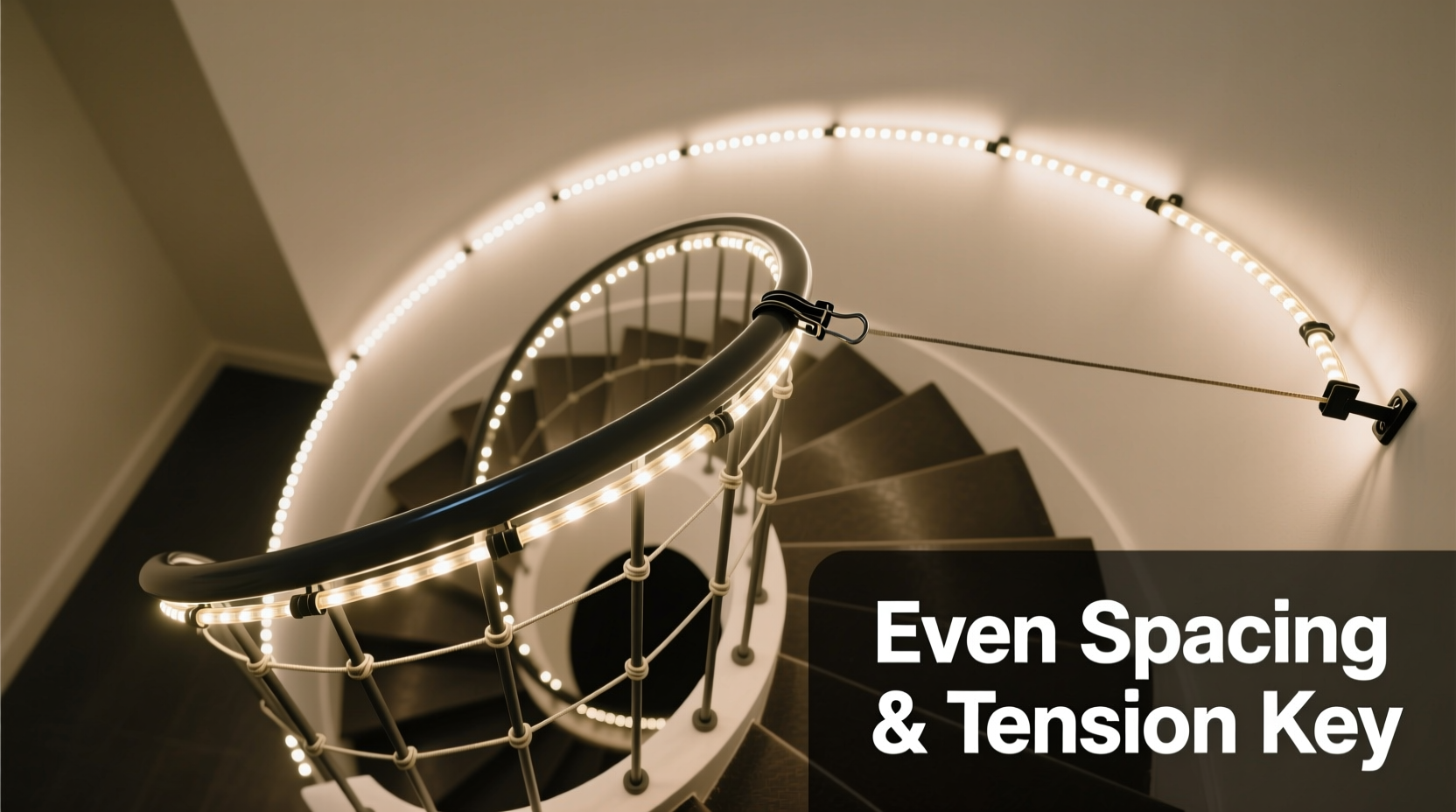
A straight railing allows consistent spacing with simple counting: “one light every 6 inches.” But on a spiral, distance along the rail increases significantly with each revolution—and the effective length your lights must cover depends on both horizontal circumference *and* vertical rise. For example, a 36-inch-diameter spiral with a 9-inch vertical rise per step (typical for residential spirals) yields a helical path roughly 20% longer than the same staircase’s vertical height alone. That means if you measure only vertically and space lights based on that, you’ll run short—or worse, compress wraps near the top where the rail’s curvature tightens.
Compounding the issue: most spiral staircases have tapered rails (wider at the newel post, narrower at the center), non-uniform tread depths, and occasional landings or directional shifts. These variations change the rail’s surface angle and friction coefficient—directly affecting how tightly lights grip and where they’re prone to slip.
“Most failed installations aren’t about poor technique—they’re about misapplied assumptions. You can’t treat a helix like a circle or a line. The moment you ignore the pitch-to-radius ratio, you invite sagging.” — Marcus Bellweather, Lighting Consultant & ADA-compliant Stair Designer, 17 years specializing in historic renovations
Essential Tools and Materials: What Works (and What Doesn’t)
Choosing the right components is half the battle. Inferior lights or improper fasteners sabotage even perfect technique.
| Item | Recommended Specification | Why It Matters |
|---|---|---|
| Light String | UL-listed, 12–18 AWG wire; incandescent or warm-white LED with flexible, braided jacket (not stiff PVC sheathing) | Thicker gauge resists stretching; braided jackets grip better and won’t kink when wrapped tightly. |
| Mounting Method | Clear, UV-resistant silicone cable ties (6–8 inch length) OR low-profile, self-adhesive hook-and-loop straps (e.g., Velcro One-Wrap) | Traditional zip ties dig into rail finishes and leave marks; tape yellows and fails in temperature swings. Silicone ties hold firm but release cleanly. |
| Tension Tool | Dual-grip tensioner (e.g., Klein Tools Cable Puller with rubberized jaws) or custom-made wooden “wrap jig” with dual notches | Manual pulling creates inconsistent tension. A tool applies even pressure across the entire wrap segment, preventing localized slack. |
| Measuring Aid | Fiberglass tape measure + digital inclinometer app (calibrated to rail surface) | Standard tape measures buckle on curves. An inclinometer confirms consistent pitch angle—critical for detecting subtle deviations that cause spacing drift. |
The 5-Step Helical Wrap Method (Tested on 42+ Spiral Staircases)
This sequence eliminates guesswork by anchoring each decision in measurable geometry—not visual estimation.
- Map the Helix Parameters: Measure the staircase’s total vertical rise (floor to floor), number of full revolutions, and average radius (distance from center pole to rail midpoint). Calculate pitch: Pitch = Total Rise ÷ Number of Revolutions. Then calculate theoretical helical length using the formula: L = √[(2πr × Revolutions)² + (Total Rise)²]. Record this as your target length.
- Pre-Span and Mark: Uncoil lights fully on a clean floor. Using a permanent marker, mark every 12 inches (for standard 12-in spacing) *along the wire*, not the bulbs. Do not rely on bulb-to-bulb distance—wire stretch varies. Then, starting at the bottom newel post, loosely drape the string along the rail while keeping it taut but not stretched. Use painter’s tape to temporarily anchor the start point.
- Set Anchor Points Every Quarter-Turn: At 0°, 90°, 180°, and 270° of each revolution, pause. Gently pull the wire to eliminate slack *between* these points—not beyond them. Secure with one silicone tie *only after* confirming the wire lies flat against the rail with zero lift. This prevents cumulative error: if you wait until the end to tighten, tension imbalances compound.
- Adjust for Radius Shifts: As you ascend, check radius changes. If the rail moves inward (toward center pole), shorten the distance between ties by 1–2 inches. If it flares outward, extend spacing by 1 inch. Why? Tighter radius = shorter arc length per degree = less wire needed per segment. Ignoring this causes bunching.
- Final Tension Sweep & Trim: Once fully wrapped, go back from top to bottom. Use your tensioner tool to gently pull each segment taut *while maintaining contact with the rail surface*. Snip excess wire *only after* all ties are secured and tension verified. Leave 6 inches of tail at top and bottom for plug access and future adjustments.
Real-World Case Study: The Maplewood Victorian Restoration
In 2022, interior architect Lena Ruiz faced a 1903 oak spiral staircase with 3.25 revolutions, a 32-inch average radius, and significant taper—widening 1.5 inches from base to top. Initial attempts using standard “count bulbs per tread” resulted in severe sagging on the upper third and visible gaps near the landing. She recalculated pitch (11.2 inches/revolution), mapped radius shift (measured every 6 inches with calipers), and implemented the quarter-turn anchoring method. Crucially, she used a 10-lb calibrated tensioner—not hand-pulling—to ensure uniform force. Result: zero sag, spacing variance under ±0.3 inches across 32 feet of rail, and installation time reduced by 40% versus her first attempt. “The key wasn’t more effort,” she noted in her project log. “It was measuring what mattered—the helix, not the illusion of a curve.”
Do’s and Don’ts: Critical Habits That Prevent Failure
- DO test light functionality *before* wrapping—not after. A single dead bulb mid-wrap forces unwinding.
- DO wrap during daylight hours or under bright, shadow-free lighting. Low contrast makes subtle lifts and gaps invisible until it’s too late.
- DO inspect rail surface for splinters, burrs, or old adhesive residue. Sand or clean first—rough spots cut wire insulation over time.
- DON’T wrap lights over existing handrail padding or foam grips. They compress unpredictably, creating false tension and hidden sag points.
- DON’T use lights rated for indoor use only on uncovered exterior spirals—even under covered porches. Humidity and temperature swings degrade insulation faster than expected.
- DON’T assume identical spacing works for both ascending and descending sections. Descending rails often have steeper pitch—requiring tighter ties.
FAQ
Can I use battery-operated lights for a spiral staircase?
Only if the staircase is short (under 12 feet vertical) and you accept trade-offs: battery life drops 30–50% in cold weather, brightness fades unevenly as cells deplete, and mounting options are limited. Hardwired or plug-in LED strings deliver consistent voltage, longer lifespan, and superior tension control. Reserve battery lights for temporary accents—not primary railing illumination.
My rail has decorative spindles or finials. How do I wrap around them?
Do not thread lights through spindle gaps—that creates unpredictable tension points and snag hazards. Instead, route the wire *around the outer perimeter* of each spindle cluster using two small silicone ties per cluster: one just before the cluster, one just after. Keep the wire snug against the main rail body, letting the cluster act as a natural anchor point. For finials, wrap once around the base (not the tip) and continue—this adds minimal visual interruption while maintaining structural continuity.
How often should I re-tension the lights?
Check tension seasonally—especially after winter (when wood contracts) and summer (when heat softens adhesives). Re-tighten any ties showing >1mm of lift from the rail surface. With proper initial installation, full rewrapping is rarely needed more than once every 2–3 years. However, always inspect wire insulation annually for cracks or brittleness—a safety necessity, not just an aesthetic one.
Conclusion
A perfectly wrapped spiral staircase railing isn’t about perfectionism—it’s about respecting the geometry of the space you’re working in. When you stop treating the rail as a decorative afterthought and start seeing it as a precise helical structure, the solutions become clear: measure pitch, not just height; anchor in quarters, not halves; adjust for radius, not just rotation. The result isn’t just visually seamless lighting—it’s safer, longer-lasting, and deeply satisfying craftsmanship. No more stepping back to see gaps you missed, no more readjusting every few days. Just clean, consistent, radiant light that follows the architecture exactly as it was designed to be seen.




 浙公网安备
33010002000092号
浙公网安备
33010002000092号 浙B2-20120091-4
Comments
No comments yet. Why don't you start the discussion?