
When stepping into the world of PC-based virtual reality, two headsets frequently rise to the top: the HTC Vive (specifically the original Vive or Vive Pro) and the Samsung Odyssey+. Both deliver immersive experiences, but they cater to different needs and budgets. The HTC Vive typically commands a higher price—so the critical question isn't just about features, but whether that premium translates into meaningful value. For consumers weighing options, understanding the real-world differences in tracking, display, audio, ecosystem, and long-term usability is essential.
Tracking Systems: Room-Scale vs Inside-Out
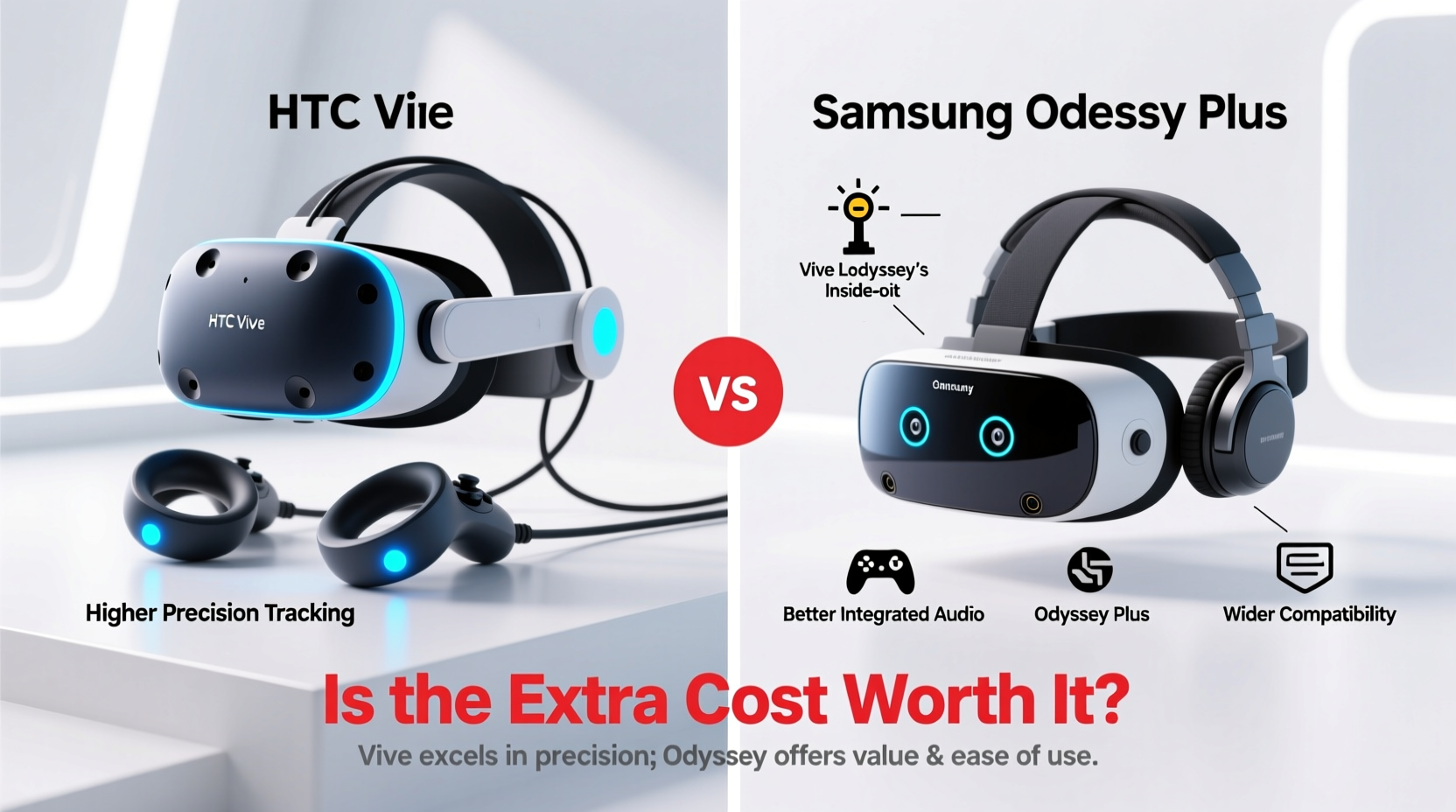
The most fundamental distinction between the HTC Vive and the Samsung Odyssey+ lies in their tracking technology. The Vive uses external Lighthouse base stations for room-scale tracking, enabling precise 360-degree positional awareness. This setup allows users to walk freely within a defined space, making it ideal for immersive gaming, architectural walkthroughs, and training simulations.
In contrast, the Odyssey+ relies on inside-out tracking using built-in cameras. While this eliminates the need for external sensors and simplifies setup, it sacrifices some precision and spatial range. Users may experience minor drift or occlusion issues when moving too quickly or stepping out of optimal camera view.
“Room-scale tracking with Lighthouse remains the gold standard for positional accuracy in consumer VR.” — David Limp, former SVP of Devices at Amazon and VR advisor
Display and Visual Fidelity
Visual quality plays a major role in presence—the feeling of “being there” in a virtual environment. The HTC Vive features dual OLED displays with a resolution of 1080x1200 per eye, delivering deep blacks and vibrant colors. However, it does exhibit noticeable screen door effect (SDE) due to its lower pixel density compared to newer headsets.
The Samsung Odyssey+, on the other hand, uses dual AMOLED panels with a higher resolution of 1440x1600 per eye. This results in sharper visuals, reduced SDE, and better overall clarity. It also supports HDR, enhancing contrast and color depth in compatible applications.
That said, the Vive Pro (a step above the base Vive) matches the Odyssey+ in resolution and improves on brightness and clarity, though at an even higher cost. For users focused on visual fidelity without breaking the bank, the Odyssey+ holds a clear edge over the base Vive.
Comfort and Ergonomics
Long VR sessions demand comfort, and here, design philosophy diverges. The HTC Vive uses a circumferential head strap that can place pressure on the front of the face, especially during extended use. While aftermarket straps are available, the default fit may cause discomfort for some users.
The Odyssey+ adopts a halo-style headband similar to the Oculus Rift, distributing weight more evenly across the crown of the head. Combined with its slightly lighter build, this makes the Odyssey+ feel less fatiguing during multi-hour sessions. Additionally, the flip-up visor is a small but practical feature, allowing quick disengagement from VR without removing the headset entirely.
Air-tight sealing around the eyes also varies. The Vive’s facial interface creates a strong seal, minimizing light bleed, while the Odyssey+ tends to allow more ambient light in, potentially disrupting immersion in bright rooms.
Audio Integration and Immersion
Both headsets include built-in headphones, but their implementation differs. The Vive ships with integrated earbuds that sit close to the ears but don’t fully block external noise. Many users replace them with third-party solutions for better sound quality and isolation.
The Odyssey+ features AKG-tuned headphones mounted on the headband, offering richer bass and clearer mids. They’re removable and support 3D audio passthrough via Windows Mixed Reality’s spatial sound engine. In practice, this means directional cues in games—like footsteps or gunfire—are more accurately rendered, enhancing competitive gameplay and cinematic experiences.
Ecosystem and Software Compatibility
This is where the HTC Vive gains significant ground. While both headsets can access SteamVR—which hosts the largest library of VR content—the Vive is natively optimized for Valve’s platform. This ensures smoother integration, broader peripheral support (like Vive Trackers), and early access to experimental features such as Knuckles controllers or finger-tracking gloves.
The Odyssey+ operates within the Windows Mixed Reality ecosystem, which historically has had fewer exclusive titles and slower updates. Although it can run most SteamVR games through compatibility layers, performance tweaks, controller mapping, and loading times may not be as seamless.
Additionally, enterprise and professional users often prefer the Vive due to its support for OpenVR, enabling custom integrations in healthcare, engineering, and education environments. The Odyssey+ lacks comparable developer tools and third-party hardware expansion options.
Price-to-Performance Breakdown
| Feature | HTC Vive (Base) | Samsung Odyssey+ |
|---|---|---|
| Resolution (per eye) | 1080x1200 | 1440x1600 |
| Display Type | OLED | AMOLED + HDR |
| Tracking System | Lighthouse (external) | Inside-out (cameras) |
| Field of View | ~110° | ~95° |
| Audio | Integrated earbuds | AKG on-ear, spatial audio |
| Controllers | Vive wands (high precision) | Mixed Reality motion controllers |
| Setup Complexity | High (base stations required) | Low (plug-and-play) |
| Ecosystem Access | SteamVR + Viveport | Windows MR + SteamVR (via bridge) |
| Typical Price (USD) | $599–$799 (Vive Pro) | $499 |
Real-World User Scenario: The Home Enthusiast's Dilemma
Consider Mark, a software developer and VR hobbyist with a mid-range gaming PC and a small home office he’s converted into a play area. He wants to enjoy both casual games like *Beat Saber* and immersive simulations like *Microsoft Flight Simulator*. Initially drawn to the Odyssey+ for its plug-and-play ease and vivid display, he finds himself frustrated by tracking inconsistencies when turning rapidly or leaning forward.
After six months, he upgrades to a used HTC Vive. Despite the steeper setup curve—mounting base stations, calibrating zones—he immediately notices improved responsiveness and freedom of movement. Games that previously felt jittery now feel fluid. He also begins experimenting with Vive Trackers to add full-body tracking, something unavailable on his previous system. Though the visuals aren’t quite as sharp, the enhanced interactivity and ecosystem flexibility make the investment worthwhile.
Mark’s experience reflects a common trajectory: initial appeal of convenience gives way to demand for precision and expandability.
Checklist: Choosing Between Vive and Odyssey+
- ✅ Do you have space for base stations and room-scale movement? → Lean toward Vive
- ✅ Is visual sharpness your top priority? → Odyssey+ excels here
- ✅ Do you plan to use SteamVR heavily? → Vive offers native optimization
- ✅ Are you sensitive to setup complexity? → Odyssey+ wins on simplicity
- ✅ Do you want future-proof expandability (trackers, accessories)? → Vive is superior
- ✅ Is budget under $500? → Odyssey+ fits better
Frequently Asked Questions
Can the Samsung Odyssey+ run SteamVR games?
Yes, through the SteamVR plugin for Windows Mixed Reality. Most titles work, but some require manual configuration, and performance may vary due to translation layer overhead.
Is the HTC Vive obsolete given newer models like the Vive Pro 2 or Focus 3?
Not entirely. The original Vive remains functional and widely supported. While newer models offer higher specs, the base Vive still delivers a robust room-scale experience at a lower entry point, especially on the used market.
Which headset is better for fitness apps?
The HTC Vive, due to its superior tracking stability and lower latency, provides more accurate motion capture—critical for apps like *Supernatural* or *FitXR*, where scoring depends on movement precision.
Final Verdict: Is the Extra Cost Worth It?
The answer hinges on how you define value. If your priorities are visual clarity, ease of setup, and a lower upfront cost, the Samsung Odyssey+ delivers excellent performance for media consumption and casual gaming. Its AMOLED screens and built-in audio create a polished out-of-box experience.
However, if you seek true immersion, expansive room-scale interaction, and deeper integration with the broader VR ecosystem, the HTC Vive justifies its higher price. The precision of Lighthouse tracking, combined with SteamVR’s vast content library and accessory support, offers a level of engagement the Odyssey+ simply can’t match—despite its technical advantages in resolution.
In essence, the extra cost of the Vive pays for capability, not just quality. For serious enthusiasts, developers, or those planning long-term VR use, that investment yields tangible returns in flexibility and performance.




 浙公网安备
33010002000092号
浙公网安备
33010002000092号 浙B2-20120091-4
Comments
No comments yet. Why don't you start the discussion?