
When the Huawei P30 Pro launched in 2019, it sent shockwaves through the smartphone photography world. With its groundbreaking periscope zoom lens and revolutionary low-light capabilities, it challenged Apple’s dominance in mobile imaging. The iPhone XS Max, representing Apple’s flagship at the time, was already praised for its natural color science and reliable performance. But could it stand up to Huawei’s new powerhouse?
The debate over which phone has the superior camera isn’t just about megapixels or marketing claims—it comes down to real-world usability, dynamic range, consistency, and personal preference. This article dives deep into how these two phones perform across key photographic scenarios, backed by technical insights and practical experience.
Camera Hardware: Specs Tell Only Part of the Story
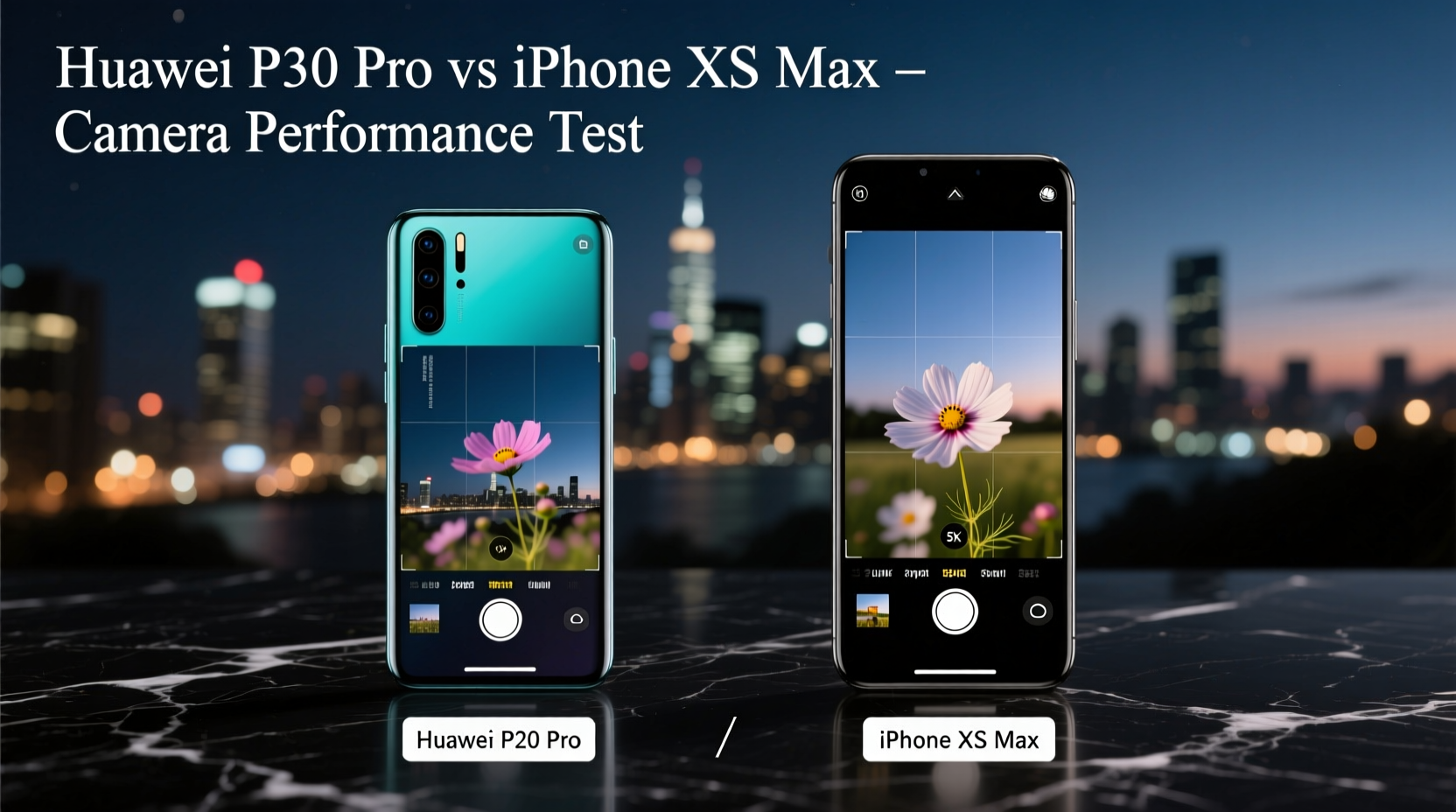
On paper, both devices pack impressive hardware, but they take different approaches to image capture.
| Feature | Huawei P30 Pro | iPhone XS Max |
|---|---|---|
| Main Sensor | 40MP RYYB (f/1.6) | 12MP (f/1.8) |
| Ultra-Wide | No | 12MP (f/2.4) |
| Telephoto | 8MP periscope (f/3.4), 5x optical zoom | 12MP (f/2.4), 2x optical zoom |
| ToF Sensor | Yes | No |
| Low-Light Tech | SuperSpectrum sensor, Night Mode | Smart HDR, larger pixels |
The P30 Pro’s RYYB (Red-Yellow-Yellow-Blue) sensor replaces green with yellow to capture 40% more light than traditional RGB sensors. This gives it a distinct advantage in dim environments. Meanwhile, the iPhone relies on computational photography—Smart HDR, advanced tone mapping, and consistent software tuning—to deliver balanced results.
Low-Light Photography: Where the P30 Pro Shines
No discussion of the P30 Pro is complete without addressing its legendary night photography. Its dedicated Night Mode uses multi-frame stacking and AI stabilization to produce bright, detailed images even in near-darkness. Street scenes under moonlight, indoor restaurant shots, and cityscapes at dusk reveal textures and colors that were previously unthinkable on a smartphone.
In contrast, the iPhone XS Max handles low light competently but conservatively. It avoids excessive noise by capping brightness, often resulting in darker exposures compared to the P30 Pro. While this preserves shadow detail, it can make nighttime photos appear flat or underexposed unless manually adjusted.
“Huawei redefined what we expect from mobile cameras in darkness. The P30 Pro didn’t just improve night shots—it created a new category.” — David Evans, Mobile Imaging Analyst at DXOMARK
However, aggressive brightening in Night Mode can sometimes introduce halos around lights or unnatural color tints, particularly in mixed lighting. The iPhone, while less dramatic, maintains more accurate white balance and smoother gradients.
Zoom Performance: Optical vs Digital Realities
The P30 Pro introduced a periscope-style telephoto lens enabling 5x optical zoom—an industry first. Combined with hybrid zoom up to 10x and digital zoom up to 50x, it allows users to capture distant subjects like concert stages, wildlife, or architecture with surprising clarity.
The iPhone XS Max maxes out at 2x optical zoom. Beyond that, digital cropping reduces quality rapidly. At 5x magnification, the difference is stark: the P30 Pro retains recognizable facial features and texture, while the iPhone delivers a soft, pixelated result.
- P30 Pro at 5x: Clear details, usable for social sharing or prints.
- P30 Pro at 10x: Slight softness but still structured; great for casual use.
- XS Max at 5x: Heavy reliance on digital enhancement; fine details lost.
This makes the P30 Pro a standout choice for travel photographers or anyone who frequently shoots distant subjects without carrying extra gear.
Color Science and Image Consistency
If the P30 Pro wins on versatility, the iPhone excels in consistency. Apple’s approach prioritizes true-to-life color reproduction, minimal processing artifacts, and seamless transitions between lenses. Skin tones remain natural, skies retain subtle gradients, and whites stay neutral—even under challenging lighting.
Huawei, meanwhile, leans toward vivid saturation and enhanced contrast. While pleasing for social media, this can lead to oversaturated greens in foliage or exaggerated reds in clothing. Some users appreciate the “pop,” while others find it artificial.
In dynamic range—the ability to preserve detail in shadows and highlights—the iPhone generally holds an edge. Highlights in bright skies are less likely to blow out, and dark areas retain more recoverable data during editing. The P30 Pro occasionally clips extreme highlights, particularly in daylight portraits with backlighting.
Real-World Example: Concert Photo Challenge
Sophia, a music blogger in Berlin, attended a dimly lit indie show where flash photography was banned. She brought both phones to test them side-by-side. Using the P30 Pro’s Night Mode, she captured sharp images of the band with visible facial expressions and stage lighting effects. The same scene on the iPhone appeared grainy and too dark, despite Smart HDR trying to lift shadows. However, when reviewing backstage candid shots in normal lighting, she preferred the iPhone’s skin tone rendering and lack of color cast.
Her takeaway? The P30 Pro delivered usable content where none should exist—ideal for unpredictable environments. But for everyday moments, the iPhone felt more trustworthy.
Video Capabilities: Stability vs Flexibility
Both phones support 4K recording at 60fps, but differences emerge in stabilization and dynamic range.
The iPhone XS Max offers cinematic video quality with excellent audio sync, smooth electronic and optical stabilization, and precise exposure control. It remains one of the best handheld video tools for vloggers and content creators who value reliability.
The P30 Pro supports OIS on all rear cameras and includes AI-powered stabilization, but footage can exhibit slight warping during fast pans due to aggressive digital correction. Audio pickup is also less refined, picking up more ambient noise.
For filmmakers or YouTubers, the iPhone still sets the benchmark. For casual users who prioritize photo flexibility over video polish, the trade-off may be acceptable.
Actionable Tips for Choosing Between Them
- If you shoot often in low light, the P30 Pro’s Night Mode is unmatched.
- If you value accurate colors and seamless switching between lenses, go with the iPhone.
- Need long-range zoom? The P30 Pro is the only real option here.
- Prefer one-tap reliability without tweaking settings? The iPhone delivers consistency.
- Editing photos later? The iPhone’s HEIF format and wider software support offer advantages.
Frequently Asked Questions
Is the Huawei P30 Pro better than the iPhone XS Max overall?
It depends on priorities. The P30 Pro surpasses the iPhone in zoom and low-light photography, but the iPhone offers superior color accuracy, video quality, and ecosystem integration. Neither is universally “better”—they excel in different areas.
Can the iPhone compete in night mode photography?
Not directly. The iPhone XS Max lacks a dedicated night mode (introduced later with iOS 11). While Smart HDR helps in twilight, it cannot match the P30 Pro’s ability to illuminate pitch-black scenes. Third-party apps can help, but native performance lags behind.
Does the lack of ultra-wide on the P30 Pro matter?
Yes, for some users. The iPhone’s ultra-wide lens enables creative framing for landscapes, architecture, and group shots. The P30 Pro forces cropping or stepping back, limiting compositional flexibility.
Final Verdict: Is the Camera Really Better on the Huawei?
In specific disciplines—especially low-light and optical zoom—the Huawei P30 Pro objectively outperforms the iPhone XS Max. Its hardware innovations pushed boundaries and forced competitors to catch up. If those capabilities align with your needs, the answer is clearly yes.
But “better” isn’t absolute. The iPhone offers a more balanced, predictable, and versatile experience across lighting conditions and media types. Its strength lies not in headline-grabbing features but in day-in, day-out dependability.
Ultimately, the P30 Pro expanded what we thought possible from a smartphone camera. Whether it's “better” depends on how you define success: raw capability or consistent excellence.




 浙公网安备
33010002000092号
浙公网安备
33010002000092号 浙B2-20120091-4
Comments
No comments yet. Why don't you start the discussion?