
In an era where personal data is constantly at risk, smartphone manufacturers have responded with built-in privacy tools designed to shield sensitive information. Two of the most prominent solutions are Huawei’s Private Space and Samsung’s Secure Folder. Both promise to isolate private apps, files, and data from the main system, but they work in fundamentally different ways. Understanding their architecture, security models, and real-world usability is essential for deciding which one actually keeps your secrets safe.
How Huawei Private Space Works
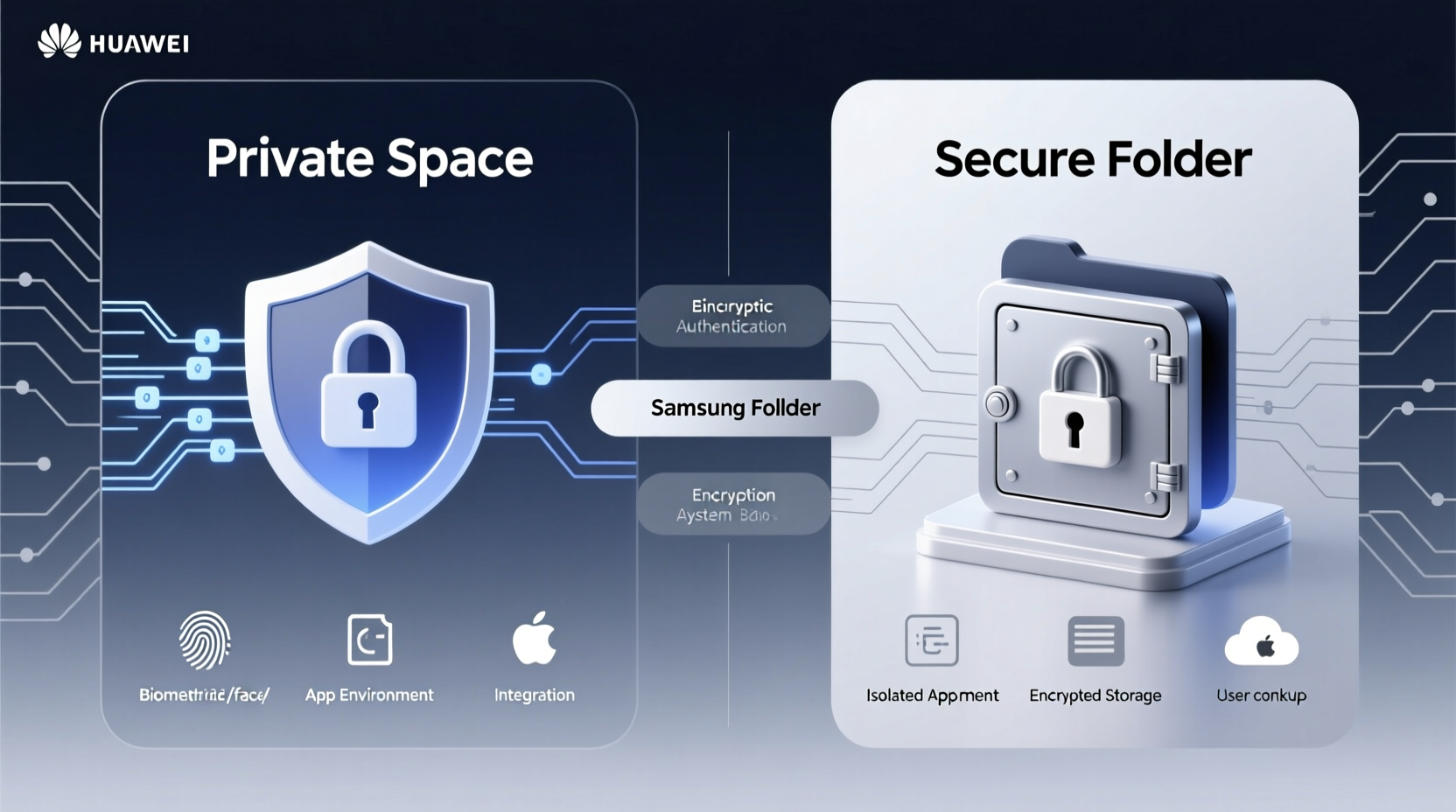
Huawei’s Private Space is a system-level feature available on EMUI (now HarmonyOS), allowing users to create a separate environment within the same device. It doesn’t rely on containerization or virtualization but instead uses partitioned storage and dual-user logic similar to Android’s multi-user framework. When enabled, you can store separate sets of apps, photos, documents, and even settings—accessible only after authenticating with a password, PIN, pattern, or biometrics.
The key advantage of Private Space is that it’s deeply integrated into the OS, making it lightweight and fast. However, because it shares the same kernel and system processes as the main user profile, its isolation is not as strong as hardware-backed containers.
Samsung Secure Folder: A Knox-Powered Vault
Samsung’s Secure Folder takes a more robust approach by leveraging the company’s defense-grade Knox platform. Unlike Huawei’s solution, Secure Folder runs in a hardware-isolated container secured by the Trusted Execution Environment (TEE) and protected by the hardware-backed keystore. This means encrypted data is tied directly to the device’s secure chip, making it nearly impossible to extract without physical tampering detection triggering automatic wipe protocols.
You can install duplicate versions of apps (like WhatsApp, Gallery, or banking apps) inside Secure Folder, each operating independently with isolated data. Files stored here cannot be accessed by the main system, even through file managers or cloud sync unless explicitly shared.
“Secure Folder is one of the few consumer-facing implementations of true hardware-enforced app sandboxing.” — Dr. Lena Park, Mobile Security Researcher at CyberSec Asia
Key Differences: Architecture and Security Model
The core distinction lies in how each system isolates data. Huawei’s Private Space operates more like a hidden user profile with restricted access, while Samsung’s Secure Folder functions as a cryptographically sealed vault.
| Feature | Huawei Private Space | Samsung Secure Folder |
|---|---|---|
| Isolation Type | Software-based (multi-user profile) | Hardware-backed container (Knox TEE) |
| Encryption Level | Standard file-based encryption | FIPS 140-2 compliant AES-256 |
| App Cloning Support | Limited (depends on app compatibility) | Full support for cloned apps |
| Biometric Authentication | Yes (uses standard sensor) | Yes (hardware-isolated verification) |
| Data Recovery Risk | Moderate (potential forensic recovery) | Very low (auto-wipe on tamper detection) |
| Cloud Sync Integration | No native sync for private files | Optional Samsung Cloud backup (encrypted) |
Real-World Example: Protecting Sensitive Work Documents
Consider Maria, a freelance consultant who handles confidential client contracts. She uses her personal phone for both business and private communication. On her Huawei P40 Pro, she stores PDFs in Private Space, believing they’re hidden. However, during a routine repair, a technician accesses her main account and discovers traces of cached files still accessible via recovery tools due to incomplete deletion protocols.
In contrast, when she switches to a Galaxy S23 and uses Secure Folder, all contracts are stored within the Knox-protected environment. Even if the device is factory reset without unlocking Secure Folder first, the encrypted container remains inaccessible. The hardware tether ensures that brute-force attacks trigger irreversible data destruction.
This scenario illustrates why architectural depth matters—not just concealment, but cryptographic enforcement.
Step-by-Step Setup Comparison
Setting Up Huawei Private Space
- Navigate to Settings > Privacy > Private Space.
- Select authentication method (PIN, password, or pattern).
- Create credentials different from your main lock screen.
- Switch between spaces using the login screen toggle.
- Manually transfer apps and files into the space.
Enabling Samsung Secure Folder
- Go to Settings > Biometrics and Security > Secure Folder.
- Sign in with your Samsung account (required).
- Choose lock type (PIN, pattern, password, or biometrics).
- Confirm setup; the folder initializes using Knox security services.
- Download or move apps directly into the folder from Google Play.
Security Limitations and User Responsibilities
Even the strongest technology has vulnerabilities when misused. Neither Private Space nor Secure Folder can protect against phishing, malware installed with user permission, or weak passwords. Additionally:
- Huawei’s solution may leave metadata traces in system logs or backups, especially if third-party apps cache data outside the private partition.
- Samsung requires a Samsung account, which introduces a potential single point of compromise if the account is breached.
- Both features depend on timely OS updates—outdated firmware may contain exploitable flaws in the underlying security stack.
“No mobile security feature is impenetrable, but hardware-rooted trust chains significantly raise the cost of attack.” — Alex Rivera, Senior Analyst at Mobile Threat Defense Lab
Checklist: Choosing the Right Privacy Feature for You
- ✅ Do you need military-grade encryption? → Choose Secure Folder
- ✅ Are you using a non-Samsung device? → Private Space may be your best option
- ✅ Concerned about account dependency? → Avoid Secure Folder if you don’t want a Samsung ID
- ✅ Need seamless app cloning? → Secure Folder offers broader compatibility
- ✅ Prioritize speed over absolute security? → Private Space loads faster due to lighter overhead
- ✅ Handling highly sensitive data (legal, medical, financial)? → Only use Secure Folder with updated firmware
Frequently Asked Questions
Can someone bypass Huawei Private Space with root access?
If the device is rooted and physical access is obtained, advanced forensic tools may recover some unencrypted data remnants. However, full access to the private space remains blocked without authentication. Rooting also voids warranty and disables certain security features.
Does Samsung Secure Folder use extra battery?
No significant battery impact. The container runs only when opened, and background processes are tightly controlled. Any performance hit is negligible under normal use.
Can I transfer my Secure Folder data to a new phone?
Yes, provided you're signed into the same Samsung account and the receiving device supports Knox. Data migrates securely via encrypted cloud transfer or Smart Switch.
Final Verdict: Which One Keeps Your Secrets Safer?
While Huawei Private Space offers convenience and decent obfuscation for casual privacy needs—like hiding personal photos or social media accounts—it falls short in high-threat scenarios. Its software-only model lacks the cryptographic rigor needed for true data protection.
Samsung Secure Folder, powered by Knox and hardware-backed encryption, provides a far stronger guarantee. It meets enterprise standards for data isolation and resists both logical and physical attacks. For anyone serious about safeguarding private information—whether it's intimate conversations, financial records, or professional documents—Secure Folder is the superior choice.
Ultimately, the decision depends on your threat model. If you value peace of mind backed by verifiable security engineering, Samsung’s implementation sets the benchmark. But if you’re simply looking to hide everyday content from prying eyes at home, Huawei’s Private Space remains functional and user-friendly.




 浙公网安备
33010002000092号
浙公网安备
33010002000092号 浙B2-20120091-4
Comments
No comments yet. Why don't you start the discussion?