
Side sleepers face a unique challenge when choosing a mattress: they need enough softness to cushion their shoulders and hips, yet sufficient support to keep their spine aligned. This delicate balance makes the decision between hybrid and memory foam mattresses particularly critical. While both types offer distinct advantages, understanding how each performs under real-world conditions can help you avoid discomfort, back pain, and restless nights.
Memory foam has long been praised for its body-contouring properties, while hybrid models combine that comfort with responsive coil support. But which one truly delivers superior performance for side sleepers? Let’s examine the key differences in construction, pressure relief, motion isolation, temperature regulation, and longevity to determine the best fit based on your sleeping habits and body type.
Understanding the Needs of Side Sleepers
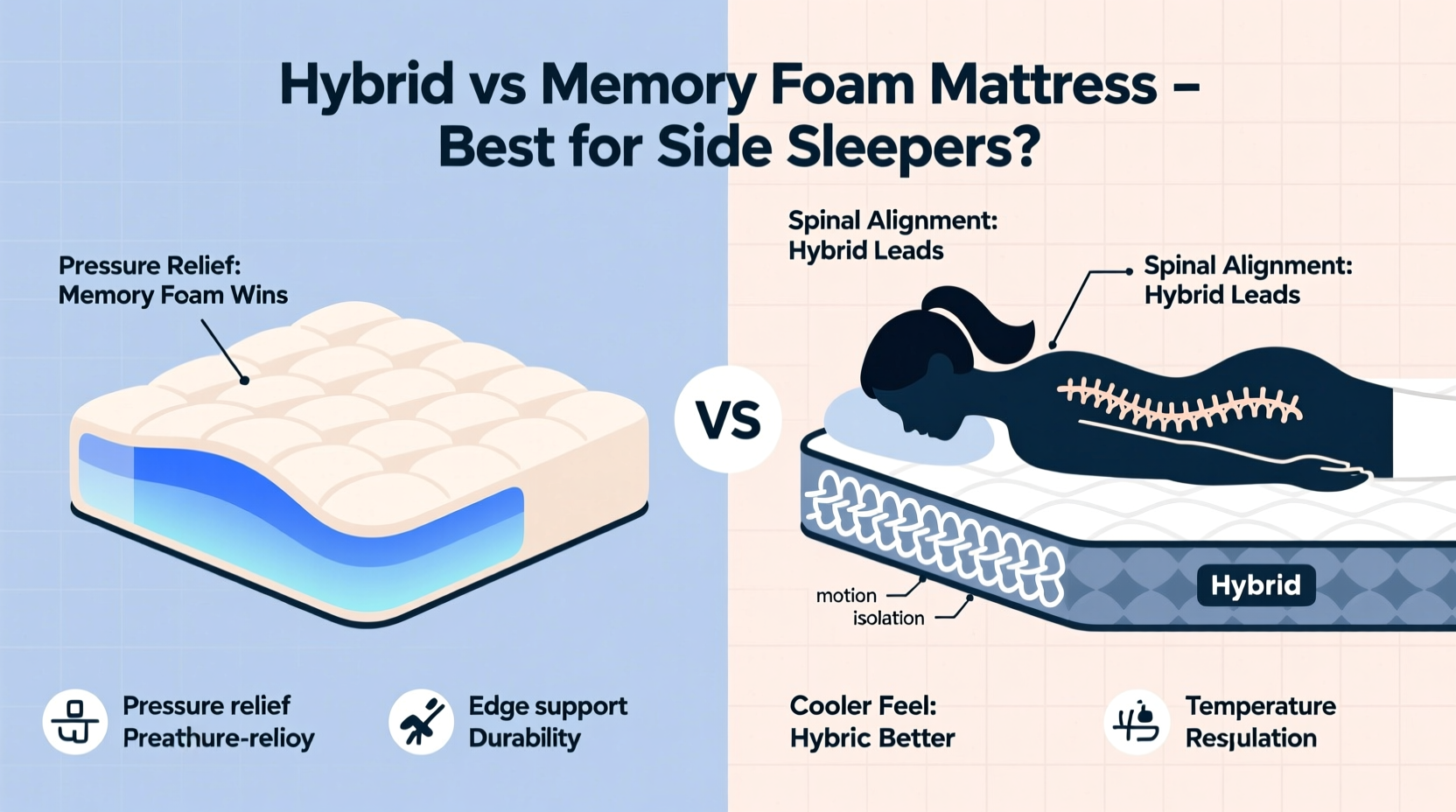
When you sleep on your side, your heaviest points—shoulders and hips—bear most of your body weight. If a mattress is too firm, these areas won’t sink in enough, creating misalignment in the spine. Conversely, if it's too soft, your midsection may sag, leading to lower back strain.
The ideal mattress for side sleepers should:
- Allow 2–3 inches of sinkage at the hips and shoulders
- Maintain neutral spinal alignment from neck to pelvis
- Provide targeted pressure relief without sacrificing support
- Minimize motion transfer if sharing the bed
- Breathe well enough to prevent overheating
Body weight further influences this equation. Lighter individuals (under 130 lbs) often require softer surfaces to achieve proper contouring, while heavier side sleepers (over 230 lbs) benefit from firmer bases to prevent excessive sinking.
How Memory Foam Mattresses Work for Side Sleepers
Traditional memory foam mattresses are made from viscoelastic polyurethane layers that respond to heat and pressure by conforming closely to the body. This creates a “hugged” sensation that many side sleepers find comforting.
The deep contouring helps distribute pressure evenly across the shoulder and hip joints, reducing the risk of numbness or soreness upon waking. High-density foams (1.8 lb/ft³ or higher) offer better durability and support than cheaper alternatives.
However, older memory foam models were notorious for trapping heat due to their dense cellular structure. Modern advancements have mitigated this issue through:
- Gel infusions that draw heat away from the body
- Open-cell foam technology for improved airflow
- Phase-change cover materials that regulate surface temperature
Despite improvements, some all-foam beds still retain more heat than hybrids, especially in warmer climates or for people who naturally run hot.
“Memory foam remains one of the top choices for side sleepers because of its ability to relieve joint pressure. The key is selecting a medium-soft to medium firmness level—usually between 4 and 6 on the firmness scale.” — Dr. Lena Torres, Chiropractor & Sleep Posture Specialist
The Hybrid Advantage: Combining Comfort and Support
Hybrid mattresses integrate memory foam or latex comfort layers with an internal system of individually wrapped coils. This design aims to deliver the best of both worlds: plush surface feel with dynamic underlying support.
For side sleepers, the pocketed coils provide zoned support—softer under the hips and firmer along the lumbar region—which enhances spinal alignment. The coils also improve responsiveness, making it easier to shift positions during the night without feeling stuck.
Additionally, the open space between coils promotes consistent airflow, significantly improving breathability over all-foam models. Many hybrids feature breathable covers, gel-infused foams, and convoluted foam layers (egg-crate style) to further enhance cooling.
Because hybrids typically use fewer foam layers than all-foam beds, there’s less risk of developing permanent body impressions over time. However, coil quality varies widely; look for gauges between 12 and 15 (lower number = thicker wire) and at least 800 coils in queen size for optimal durability.
Real Example: Sarah’s Transition from Foam to Hybrid
Sarah, a 34-year-old nurse and lifelong side sleeper, had used a classic memory foam mattress for five years. While she initially loved the way it cradled her hips, she began waking up with lower back pain after rotating shifts. She also noticed increased night sweats, likely due to her high-stress job and irregular schedule.
After consulting a physical therapist, she switched to a medium-firm hybrid with zoned coils and a gel-infused memory foam top. Within two weeks, her morning stiffness decreased, and she reported deeper, cooler sleep. “I don’t feel like I’m sinking into quicksand anymore,” she said. “The support under my waist keeps everything lined up, but the top layer still cushions my shoulders.”
Comparative Analysis: Hybrid vs Memory Foam for Side Sleepers
| Feature | Memory Foam Mattress | Hybrid Mattress |
|---|---|---|
| Pressure Relief | Excellent – conforms closely to curves | Very Good – enhanced by foam layer + zoned coils |
| Spinal Alignment | Good – depends on thickness and density | Excellent – adaptive coil support prevents sagging |
| Cooling Performance | Fair to Good – prone to heat retention unless ventilated | Very Good – natural airflow through coils |
| Motion Isolation | Excellent – minimal disturbance from partner movement | Good – coils transmit slight vibrations |
| Edge Support | Fair – edges may compress easily | Excellent – reinforced perimeter coils |
| Durability | 7–10 years (depends on foam density) | 8–12 years (with quality coils) |
| Best For | Light to average-weight side sleepers, couples needing motion isolation | Heavier side sleepers, hot sleepers, combo sleepers |
Choosing Based on Body Type and Preferences
Your ideal mattress depends heavily on your build, sleeping habits, and personal comfort preferences.
Lightweight Side Sleepers (Under 130 lbs)
These individuals benefit most from softer surfaces that allow adequate sinkage. All-foam memory mattresses with a medium-soft feel (around 4–5 firmness) often work best, as they enable proper shoulder and hip immersion without requiring excessive body weight to activate the foam.
Average-Weight Side Sleepers (130–230 lbs)
This group enjoys the widest range of options. A medium-firm hybrid (firmness 5–6.5) usually provides the perfect balance of cushioning and support. Memory foam beds with transitional polyfoam bases can also perform well, provided they include cooling features.
Heavy Side Sleepers (Over 230 lbs)
Higher body weight increases the risk of inadequate support and premature sagging. Hybrids with thick, high-gauge coils and dense base foams are generally recommended. Avoid all-foam models under 10 inches tall or with low-density support cores.
Hot Sleepers or Those in Warm Climates
If you frequently wake up sweating, prioritize breathability. Hybrid mattresses inherently outperform traditional memory foam here. Choose models with copper or graphite infusions, phase-change fabric covers, and breathable coil systems.
Couples Sharing the Bed
Consider motion isolation and edge stability. While memory foam excels at minimizing disturbances, modern hybrids with individually wrapped coils come close. If one partner moves frequently, opt for a model with at least 1,000 independently encased coils in queen size.
Step-by-Step Guide to Selecting Your Ideal Mattress
- Assess your primary sleeping position. Confirm you're primarily a side sleeper using sleep tracking apps or partner observation.
- Determine your body weight. Use this to narrow down firmness recommendations.
- Evaluate temperature sensitivity. Do you sleep hot? Prioritize cooling technologies and airflow.
- Decide on motion isolation needs. If sharing the bed, test motion transfer in person or check verified reviews.
- Set a budget. Quality hybrids typically start around $1,200 for queen; premium memory foam beds begin at $900.
- Read third-party lab tests. Look for certifications like CertiPUR-US, OEKO-TEX, or foam density specs.
- Test during trial period. Most online brands offer 100+ night trials—use them fully before deciding.
Frequently Asked Questions
Can memory foam cause back pain for side sleepers?
Yes—if the mattress is too firm or too soft. A mattress that doesn’t allow proper hip and shoulder sinkage will misalign the spine, leading to chronic discomfort. Always choose a medium to medium-soft option with adequate thickness (10–14 inches).
Do hybrid mattresses last longer than memory foam?
Generally, yes. The combination of durable coils and high-resilience foams often results in a longer lifespan, especially for heavier users. Well-made hybrids resist sagging better than all-foam models over time.
Is a hybrid mattress worth the extra cost?
For most side sleepers, especially those over 180 pounds or who sleep hot, the added investment pays off in comfort, support, and longevity. The improved airflow and responsiveness justify the price difference for many users.
Final Recommendations and Action Plan
There is no universal “best” mattress type for side sleepers—but data and user feedback point to strong trends. Lightweight individuals seeking maximum pressure relief may prefer high-quality memory foam. However, for most side sleepers—especially those with average to heavy builds, temperature concerns, or active sleep habits—a hybrid mattress offers superior overall performance.
The integration of responsive coil support with advanced foam layers delivers balanced cushioning, better spinal alignment, and enhanced durability. When shopping, focus on construction quality rather than brand names. Check foam densities, coil count and gauge, and cooling features. Take full advantage of sleep trials to test real-world comfort.




 浙公网安备
33010002000092号
浙公网安备
33010002000092号 浙B2-20120091-4
Comments
No comments yet. Why don't you start the discussion?