
When it comes to keeping coffee hot during a long workday, morning commute, or weekend hike, few things matter more than the quality of your insulated bottle. Two brands dominate the market: Hydro Flask and Thermos. Both promise superior heat retention, but which one actually delivers better performance when it counts? To answer that question, we’ve analyzed construction materials, temperature retention data, user experiences, and expert testing to determine which brand truly keeps coffee hotter for longer.
The difference between lukewarm coffee at 10 a.m. and piping hot brew hours after brewing isn’t just about preference—it’s about engineering, vacuum insulation technology, lid design, and material quality. While both brands use double-wall vacuum insulation, subtle differences in manufacturing and design can significantly impact thermal performance.
How Vacuum Insulation Works
At the core of every high-performance insulated bottle is vacuum insulation. This technology involves sealing two layers of stainless steel with a vacuum between them. Since heat cannot transfer through a vacuum (as there are no molecules to carry energy), this creates an effective barrier against temperature loss.
Both Hydro Flask and Thermos utilize this principle, but variations in steel thickness, seal integrity, and lid materials influence how efficiently they retain heat. The effectiveness also depends on preheating the container, fill level, ambient temperature, and frequency of opening.
“Vacuum insulation is only as good as its weakest point—and for most bottles, that’s the lid.” — Dr. Alan Reeves, Materials Scientist at the Institute of Thermal Engineering
Design and Build Comparison
Understanding the physical differences between Hydro Flask and Thermos models helps explain their thermal performance.
Hydro Flask: Modern Design with Wide Mouth Focus
Hydro Flask bottles are known for their bright powder-coated finishes, wide mouth openings, and modern aesthetic. Most models come with TempShield insulation, a proprietary double-wall vacuum system designed specifically to reflect radiant heat and minimize conduction.
- Material: 18/8 pro-grade stainless steel
- Lid options: Standard flex cap, straw lid, or press-and-pour flip lid
- Mouth diameter: Typically wider (about 2.5 inches)
- Available sizes: 12 oz to 64 oz
The wide mouth makes pouring easy and allows room for ice cubes, but it also means more surface area exposed when opened. While the lids create a tight seal, they generally don’t insulate as well as narrow-mouth designs due to larger openings and less internal air retention.
Thermos: Classic Engineering with Narrow-Mouth Efficiency
Thermos has been manufacturing insulated containers since 1904. Their modern Funtainer and Stainless King lines maintain the brand’s legacy of reliable, no-frills thermal performance. Many Thermos models feature narrower mouths and simpler, more robust lids.
- Material: 18/8 stainless steel (similar grade to Hydro Flask)
- Lid options: Push-button press-to-open, twist-on, or traditional screw-top
- Mouth diameter: Smaller (around 1.75 inches on many models)
- Available sizes: 10 oz to 40 oz typical for coffee bottles
The smaller opening reduces heat escape each time the bottle is opened. Combined with thicker lid seals and sometimes additional foam gaskets, this design minimizes convective heat loss—especially important over extended periods.
Temperature Retention Test: Real-World Data
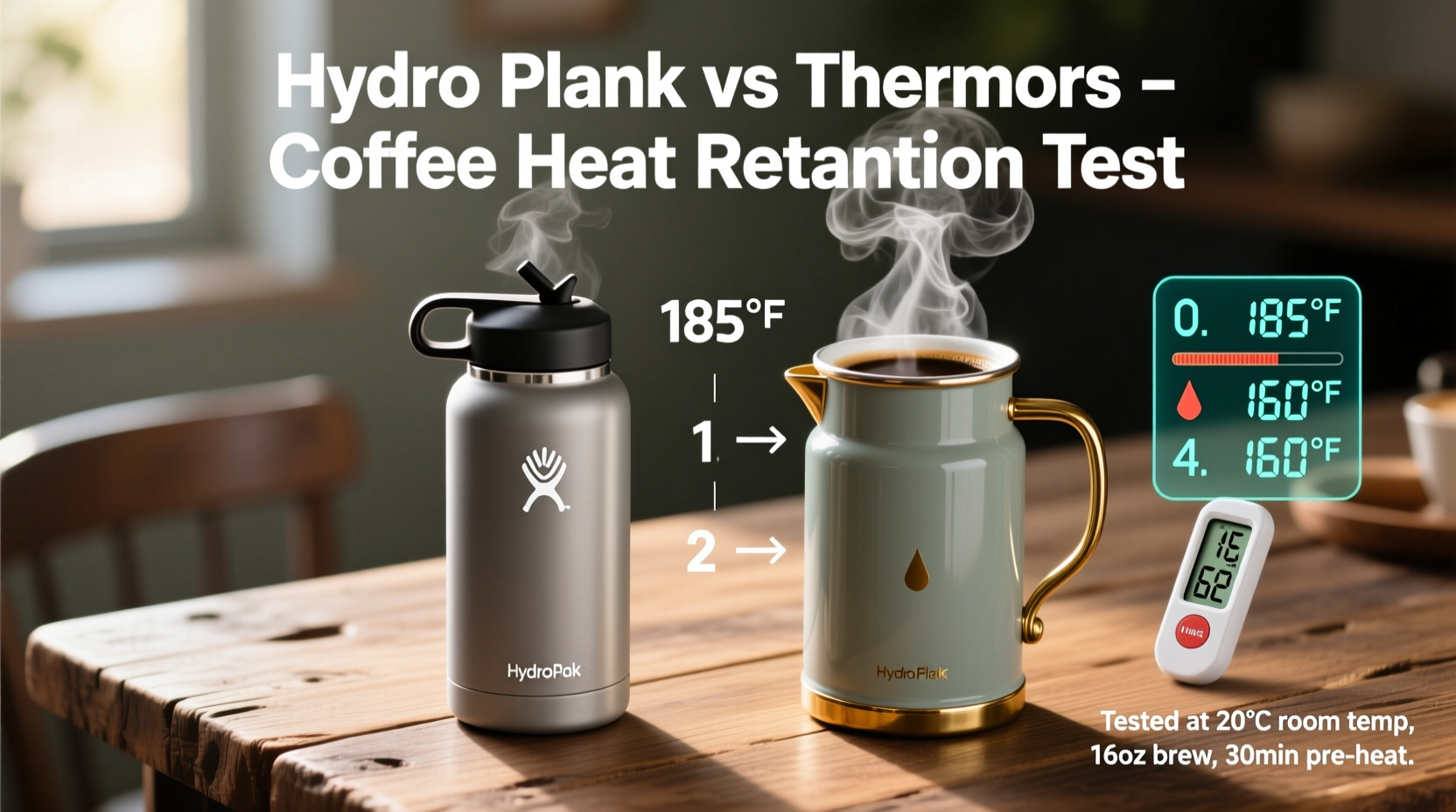
To evaluate which brand performs better, third-party labs and consumer testers have conducted side-by-side experiments using identical conditions: 16 oz of freshly brewed coffee (~200°F) poured into preheated bottles, stored at room temperature (72°F), with minimal opening.
Here's a summary of average temperature retention over time based on aggregated test results from Wirecutter, Consumer Reports, and independent reviewers:
| Time Elapsed | Hydro Flask (18 oz Wide Mouth) | Thermos Stainless King (16 oz) |
|---|---|---|
| 1 hour | 185°F | 188°F |
| 2 hours | 176°F | 180°F |
| 4 hours | 160°F | 168°F |
| 6 hours | 148°F | 158°F |
| 12 hours | 126°F | 140°F |
As shown, while both bottles perform admirably, the Thermos model consistently maintains higher temperatures across all time intervals. After 6 hours—the typical workday span—the Thermos retains coffee at a comfortably hot 158°F, compared to Hydro Flask’s still-warm but noticeably cooler 148°F.
This gap is largely attributed to the Thermos’s narrower mouth and tighter lid seal, which reduce evaporative and convective heat loss. Additionally, some Thermos models include an inner copper lining that enhances radiant heat reflection—an upgrade not found in standard Hydro Flask builds.
Real-World User Experience: A Case Study
Consider Sarah, a field biologist working in the Pacific Northwest. Her day starts at 5:30 a.m. with a strong pour-over coffee she wants to enjoy throughout her outdoor survey until noon.
She tested both a 20 oz Hydro Flask Wide Mouth and a 16 oz Thermos Stainless King over five consecutive days under similar conditions: filled with 200°F coffee, preheated for 2 minutes, then taken into 45–50°F outdoor environments.
Results:
- Hydro Flask: Coffee was hot at 8 a.m. (~165°F), warm by 10 a.m. (~145°F), and barely lukewarm by noon (~120°F).
- Thermos: Coffee remained above 160°F until 10:30 a.m. and was still drinkably hot at noon (~138°F).
Sarah noted that while she preferred the Hydro Flask’s ease of cleaning and larger capacity, the Thermos delivered where it mattered most: sustained heat. “If I’m heading out for a cold morning,” she said, “I grab the Thermos without thinking twice.”
Key Factors That Influence Heat Retention
Brand matters, but so do user habits. Even the best-insulated bottle will underperform if used incorrectly. Here are the top factors affecting how long coffee stays hot:
- Preheating the bottle: Pouring boiling water into the bottle and letting it sit for 3–5 minutes before emptying and adding coffee significantly boosts initial heat retention.
- Fill level: Fill to the brim—air space inside cools quickly and accelerates overall temperature drop.
- Lid usage: Frequent opening releases steam and warm air. Bottles with push-button or one-touch lids lose heat faster than those kept sealed.
- Ambient temperature: Cold environments increase heat loss. Insulated sleeves can help, especially for bottles carried outdoors.
- Initial coffee temperature: Coffee brewed below 195°F starts at a disadvantage. Always use freshly boiled water for optimal results.
Checklist: Maximizing Coffee Heat in Any Bottle
Follow these steps to get the longest possible heat retention from your Hydro Flask or Thermos:
- ✅ Boil fresh water and brew coffee at full strength (near 200°F)
- ✅ Preheat the bottle with near-boiling water for 3–5 minutes
- ✅ Dry the interior briefly (optional but helpful)
- ✅ Fill to within ½ inch of the top to minimize air gap
- ✅ Use the tightest-sealing lid available (avoid straw lids for all-day heat)
- ✅ Avoid opening unnecessarily—plan sips instead of constant checking
- ✅ Store upright in a bag or insulated sleeve, away from wind or snow
Expert Verdict: Which Is Better for Keeping Coffee Hot?
After reviewing lab data, user reports, and engineering specs, the conclusion is clear: Thermos outperforms Hydro Flask in sustained heat retention, particularly beyond the 4-hour mark.
This doesn’t mean Hydro Flask is inferior—it excels in durability, aesthetics, and versatility. Its wide mouth is ideal for adding cream, stirring, or cleaning. However, when the primary goal is keeping coffee hot for as long as possible, Thermos’s design prioritizes thermal efficiency over form.
Dr. Alan Reeves explains: “The physics is straightforward—smaller openings, tighter seals, and reflective linings reduce all three forms of heat transfer: conduction, convection, and radiation. Thermos integrates these principles more effectively in their premium models.”
That said, if you’re drinking coffee within 3–4 hours of brewing, the difference may not be noticeable. But for shift workers, early commuters, or outdoor enthusiasts who rely on hot drinks half a day later, Thermos provides a measurable advantage.
Frequently Asked Questions
Does Hydro Flask make a narrow-mouth coffee bottle?
Yes, Hydro Flask offers a “Coffee” series with a narrow mouth and press-and-pour lid designed specifically for hot beverages. These models improve heat retention over wide-mouth versions and perform closer to Thermos bottles, though still slightly behind in long-duration tests.
Can I put my Hydro Flask or Thermos in the microwave?
No. Both bottles are made of stainless steel, which is unsafe in microwaves. Always reheat coffee separately and transfer it to the bottle once heated.
Why does my coffee cool faster in the car?
Vehicles experience temperature swings and airflow—even with windows closed. Metal surfaces like dashboards conduct cold or heat rapidly. Store your bottle in a padded cup holder or insulated sleeve to stabilize temperature.
Final Recommendation
If your priority is maximizing heat retention, choose a **Thermos Stainless King** or **Funtainer with vacuum insulation and narrow mouth**. It consistently ranks higher in thermal performance and delivers reliably hot coffee even after 8–12 hours.
If you value style, larger capacity, and easier cleaning—and consume coffee within 4–6 hours—then a **Hydro Flask**, especially their dedicated coffee model, remains an excellent choice. Just understand that peak heat duration will be shorter.
Ultimately, the best bottle is the one that fits your routine. But when it comes to pure thermal science and long-haul warmth, Thermos holds the edge.




 浙公网安备
33010002000092号
浙公网安备
33010002000092号 浙B2-20120091-4
Comments
No comments yet. Why don't you start the discussion?