
When choosing a gaming headset, balancing performance, comfort, and price is essential. HyperX offers two popular models—the Cloud Stinger and the CloudX—that occupy adjacent spaces in the budget-to-mid-tier range. While both deliver solid audio and reliable build quality, the CloudX comes at a higher price point. The real question isn't just about specs—it's whether that added cost translates into meaningful improvements for your gaming experience.
This breakdown dives deep into design, audio fidelity, microphone quality, compatibility, and long-term usability to determine if upgrading from the Cloud Stinger to the CloudX is justified—or if you're better off saving your cash.
Design and Build Quality
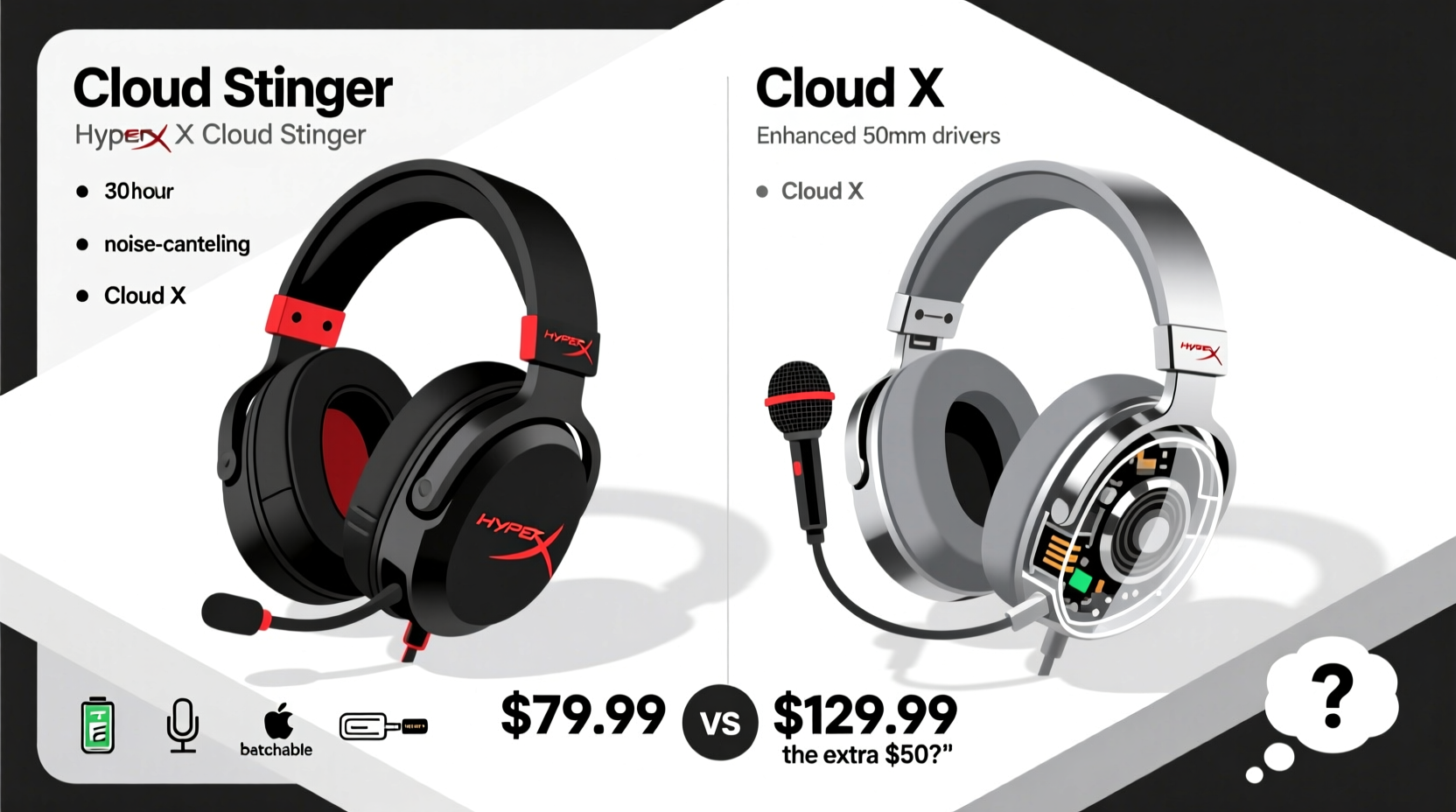
The first noticeable difference between the HyperX Cloud Stinger and the CloudX lies in their construction. The Cloud Stinger uses a durable steel-reinforced headband with plastic hinges and ear cup frames. It’s lightweight and comfortable for extended sessions, but some users report creaking over time, especially around the swivel joints.
In contrast, the CloudX features a more robust aluminum frame across the headband and yokes. This not only enhances structural integrity but also gives the headset a premium feel often missing in sub-$100 models. The ear cushions are slightly thicker memory foam on the CloudX, wrapped in finer leatherette that resists peeling longer than the Stinger’s coating.
Both models feature 90-degree swiveling ear cups and a foldable design, though the CloudX’s hinges feel tighter and less prone to wobble. For desk-bound use, either will suffice—but if longevity is a priority, the CloudX pulls ahead.
Comfort Comparison Over Long Sessions
Extended wear testing reveals subtle but important differences. The Cloud Stinger applies slightly more clamping force, which can cause mild fatigue after two hours. Its ear cups are shallower, making them less ideal for larger ears. The CloudX, with deeper ear cups and a more balanced clamp, distributes pressure more evenly. Gamers with glasses report significantly less discomfort with the CloudX due to improved seal and padding depth.
Audio Performance: Clarity, Bass, and Spatial Awareness
Both headsets use 50mm neodymium drivers, but tuning and driver alignment differ. The Cloud Stinger emphasizes mid-bass, giving music and explosions a punchy character. However, this comes at the expense of vocal clarity and high-frequency detail—important in competitive shooters where footsteps and reload cues matter.
The CloudX benefits from HyperX’s newer driver calibration process, delivering a flatter frequency response. Treble is crisper without being harsh, mids are more defined, and bass remains impactful but controlled. In games like *Valorant* or *CS2*, directional audio cues are noticeably clearer, allowing players to pinpoint enemy movement with greater accuracy.
“Even small improvements in audio staging can give players a measurable edge in fast-paced multiplayer environments.” — Daniel Ruiz, Audio Engineer & Competitive Gaming Consultant
For multimedia use, the CloudX handles dynamic range better. Movies with layered soundtracks (e.g., *Dune* or *Mad Max: Fury Road*) reveal background textures and ambient effects that the Stinger tends to compress or blur.
Surround Sound: Virtual 7.1 Implementation
The Cloud Stinger includes virtual 7.1 surround via a USB sound card dongle. While functional, it often creates an artificial sense of space, with sounds appearing “inside the head” rather than externalized. The processing can also introduce slight latency during cutscenes or voice chat.
The CloudX integrates advanced spatial processing through its dedicated USB-C adapter (backward compatible via included cable), offering smoother panning and better distance estimation. More importantly, the CloudX supports third-party software like Dolby Atmos and Windows Sonic when used on PC, giving users flexibility beyond the built-in mode.
Microphone and Communication Quality
Both headsets come with noise-canceling cardioid mics, but there’s a clear gap in performance. The Cloud Stinger’s mic captures breath noises and has a narrow pickup pattern, requiring precise positioning. On voice platforms like Discord, users often need post-processing or boosting to sound clear.
The CloudX uses an upgraded omnidirectional mic with better sensitivity and reduced wind noise. It picks up voice naturally across a wider range, minimizing the need for shouting or mic adjustments. Background keyboard clicks and room echo are suppressed more effectively, resulting in cleaner comms out-of-the-box.
| Feature | Cloud Stinger | CloudX |
|---|---|---|
| Driver Size | 50mm | 50mm (tuned) |
| Frame Material | Steel + Plastic | Aluminum |
| Ear Cushion Depth | Shallow | Deep |
| Surround Sound | Virtual 7.1 (USB-A) | Enhanced 7.1 + Software Support |
| Microphone Type | Noise-canceling Cardioid | Omnidirectional w/ Noise Suppression |
| Connection | 3.5mm or USB | USB-C (w/ adapter) |
| Price Range (MSRP) | $50–$60 | $90–$100 |
Compatibility and Platform Flexibility
The Cloud Stinger shines in versatility. Its dual-input design (3.5mm analog and USB) allows plug-and-play use across PC, PS4/PS5, Xbox (with adapter), Nintendo Switch, and even mobile devices. This makes it a solid choice for hybrid users who switch between consoles and computers.
The CloudX, while primarily designed for modern PCs and next-gen consoles, requires USB connectivity. It lacks a direct 3.5mm option, meaning you’re dependent on the USB-C cable and adapter. However, it supports multi-platform use through USB hubs or console-specific adapters. On Xbox Series X|S, it works natively with full surround support. On PlayStation, it functions seamlessly with no additional setup.
Real-World Example: A Streamer’s Dilemma
Consider Alex, a part-time streamer who plays on both PC and Switch. Initially using the Cloud Stinger, he found the mic required constant EQ tweaking and the audio lacked depth during live commentary. After upgrading to the CloudX, his viewers noted improved voice clarity and richer game audio. However, he now needs a separate audio splitter when switching to handheld Switch mode—a minor trade-off for overall quality gains.
His experience reflects a common pattern: casual users may never notice the Stinger’s limitations, but those broadcasting or playing competitively benefit from the CloudX’s refinement.
Is the CloudX Worth the Extra Money?
The $40–$50 price gap between the two models represents a 70–100% increase over the Stinger’s base cost. So, does the upgrade justify that jump?
- Better build? Yes. Aluminum frame and deeper ear cups improve longevity and comfort.
- Better sound? Noticeably. Flatter response curve and superior imaging enhance immersion and competitive advantage.
- Better mic? Absolutely. Natural vocal reproduction reduces reliance on software fixes.
- More convenient? Not always. Loss of 3.5mm analog means less plug-and-play flexibility.
If you play casually, use multiple older platforms, or are on a tight budget, the Cloud Stinger remains an excellent value. But if you prioritize audio precision, voice clarity, and long-term durability—and primarily use modern systems—the CloudX delivers tangible returns on that investment.
Checklist: Should You Upgrade?
- Do you play competitive multiplayer games where audio cues are critical? → CloudX
- Do you stream or record voice content without post-processing? → CloudX
- Do you wear glasses or play for more than 2 hours at a time? → CloudX
- Do you use older consoles or mobile devices without USB-C? → Stick with Stinger
- Is your budget under $70? → Stinger is the smarter buy
Frequently Asked Questions
Can I use the CloudX on my PS4 or Xbox One?
Yes. The CloudX works on both systems via USB. On Xbox, it supports full 7.1 surround. On PS4, it functions as a standard USB headset with stereo audio unless you enable optional 3D audio settings.
Does the CloudX have battery life concerns?
No. Like the Stinger, the CloudX is wired and powered entirely through USB. There’s no battery to degrade or recharge.
Is the microphone detachable on either model?
Neither headset has a fully detachable mic. Both feature flexible, permanently attached booms that can be rotated up to mute, but not removed.
Final Verdict
The HyperX Cloud Stinger continues to be one of the best entry-level gaming headsets on the market—reliable, versatile, and affordable. But the CloudX isn’t just a rebrand; it’s a meaningful evolution. From its reinforced frame to refined acoustics and superior microphone, every upgrade serves a purpose.
The extra cost pays for quieter materials, smarter audio processing, and a listening experience that stays comfortable and immersive for hours. For serious gamers, streamers, or anyone tired of compromising on sound and build, the CloudX earns its premium tag—not because it’s flashy, but because it performs.
If your usage aligns with modern platforms and you value quality over sheer compatibility, the HyperX CloudX isn’t just worth the extra money—it might be the last budget-to-midrange headset you’ll ever need to buy.




 浙公网安备
33010002000092号
浙公网安备
33010002000092号 浙B2-20120091-4
Comments
No comments yet. Why don't you start the discussion?