
Dogs are social animals, deeply attuned to their human companions. When left alone, some exhibit destructive or disruptive behaviors—but not all of these actions stem from the same cause. Separation anxiety and boredom are two common reasons behind a dog’s misbehavior when unattended, yet they require vastly different approaches. Misdiagnosing one for the other can lead to ineffective training, prolonged stress for both pet and owner, and even worsening behavior. Understanding the nuances between these conditions is essential for providing appropriate care and creating a healthier, happier environment for your dog.
Understanding the Core Differences
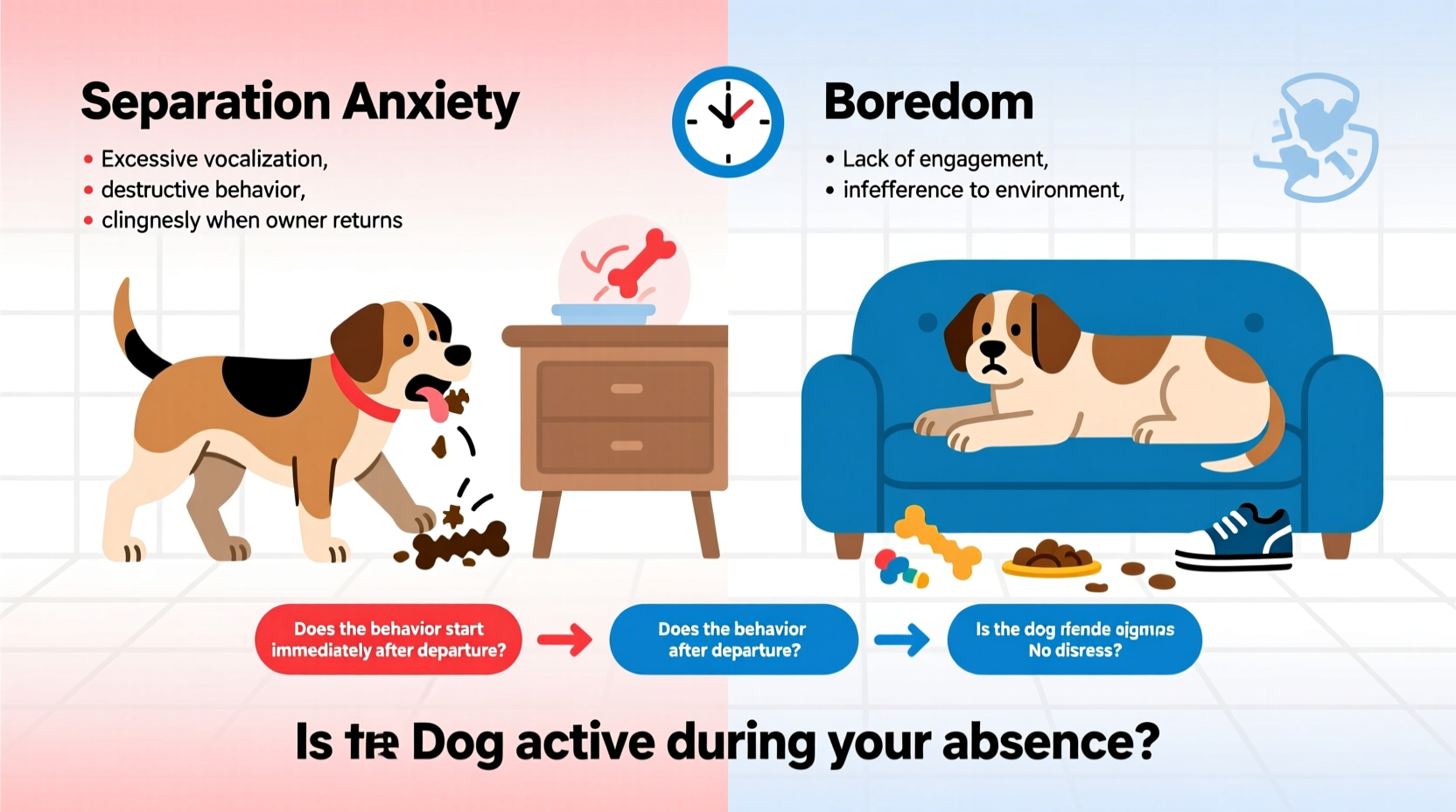
At first glance, a chewed-up shoe or a scratched door may seem like clear evidence of misbehavior. However, the motivation behind such actions reveals whether the dog is suffering from emotional distress or simply seeking stimulation. Separation anxiety is a clinical condition rooted in fear and panic—your dog genuinely believes they are in danger when separated from you. Boredom, on the other hand, arises from under-stimulation. The dog isn’t distressed but lacks mental or physical engagement, leading to self-entertainment that often crosses into destructiveness.
The key lies in context: When does the behavior occur? How intense is it? Does it happen immediately upon departure or after a delay? These details help determine whether the root cause is emotional or environmental.
Behavioral Signs: Separation Anxiety vs Boredom
To differentiate between the two, observe specific behavioral markers. While there may be overlap in outcomes—like chewing or barking—the triggers and timing differ significantly.
| Behavior | Separation Anxiety | Boredom |
|---|---|---|
| Onset of Behavior | Immediate or within minutes of departure | May begin after 30+ minutes; delayed onset |
| Type of Destructiveness | Chewing near exits (doors, windows), clawing at frames | Random chewing—shoes, furniture, remote controls |
| Vocalization | Persistent whining, howling, barking shortly after you leave | Occasional barking, may stop and resume later |
| House Soiling | Urination/defecation despite being house-trained, especially near doors | Rare unless routine is disrupted; usually holds bladder |
| Pacing & Restlessness | Constant pacing along a set route, inability to settle | Intermittent movement, may nap between activities |
| Escape Attempts | Frequent, intense attempts to break out; may injure self | Minimal or none; no urgency to exit |
| Greeting You | Over-the-top excitement, difficulty calming down | Happy but manageable greeting; settles quickly |
This comparison highlights that separation anxiety manifests as a panic response, while boredom reflects a lack of engagement. A dog with separation anxiety doesn’t calm down over time; their distress escalates. A bored dog, however, may tire, nap, and then resume activity later.
Real-Life Example: Max the Rescue Terrier
Max, a three-year-old mixed terrier adopted six months prior, began chewing shoes and scratching the back door whenever his owner left for work. Initially assumed to be separation anxiety, the owner tried confining Max to a crate, which only worsened the behavior—he howled for hours and injured his paws trying to escape.
A professional trainer suggested filming Max’s behavior. The footage revealed Max was quiet for the first 45 minutes, then began exploring, eventually finding an old sneaker to chew. He napped twice during the four-hour absence. There was no pacing, no vocalization at departure, and he greeted his owner calmly after initial tail wagging.
The diagnosis shifted: Max wasn’t anxious—he was bored. His rescue background meant he hadn’t learned independent play skills. With structured enrichment—long-lasting chews, puzzle toys, and short solo practice sessions—his chewing decreased by 90% within three weeks. Crate use was phased out in favor of a dog-proofed room with rotating toys.
This case underscores the importance of observation over assumption. Treating boredom as anxiety would have led to unnecessary medication or counterproductive confinement strategies.
Step-by-Step Guide to Accurate Diagnosis
Follow this methodical approach to determine whether your dog’s behavior stems from separation anxiety or boredom:
- Observe Timing and Triggers: Note exactly when problematic behaviors start after you leave. Use a camera to record at least three separate absences.
- Assess Departure Reactions: Does your dog follow you anxiously before you go? Pant, drool, or tremble? These are pre-departure anxiety signs.
- Check Destructive Patterns: Is damage focused on exit points? That suggests escape-driven anxiety. Random destruction points to exploration or play.
- Evaluate Calming Ability: Does the dog ever lie down, sleep, or engage in non-destructive activity? If yes, anxiety is less likely.
- Test with Short Absences: Leave for 5 minutes, gradually increasing duration. Dogs with true anxiety react strongly even to brief separations.
- Introduce Mental Stimulation: Offer high-value puzzles or stuffed Kongs. If the dog engages and remains calm, boredom was likely the issue.
- Consult a Professional: If uncertainty remains, seek a veterinary behaviorist or certified dog trainer for formal assessment.
This process eliminates guesswork and ensures interventions match the actual problem.
Expert Insight: What Professionals Say
Dr. Karen Overall, a board-certified veterinary behaviorist, emphasizes precision in diagnosis:
“Mislabeling boredom as separation anxiety leads to inappropriate treatment. We see dogs medicated unnecessarily because owners mistake normal canine curiosity for panic. True separation anxiety involves autonomic nervous system activation—increased heart rate, panting, trembling—not just chewing a slipper.” — Dr. Karen Overall, DACVB
Likewise, renowned dog trainer Victoria Stilwell warns against quick fixes:
“You can’t puzzle-toy your way out of real anxiety. But you also can’t scold a bored dog into compliance. The solution depends entirely on accurate identification.” — Victoria Stilwell, Animal Behavior Expert
These experts highlight that effective intervention begins with correct labeling. Treatment paths diverge sharply based on diagnosis.
Action Plan: Tailored Solutions for Each Condition
Once you’ve identified the root cause, apply targeted strategies.
Solutions for Separation Anxiety
- Gradual Desensitization: Practice leaving for seconds, then slowly increase time. Reward calm behavior.
- Counter-Conditioning: Pair departures with positive experiences (e.g., a special treat given only when leaving).
- Environmental Management: Use white noise, pheromone diffusers (Adaptil), or covered crates to reduce arousal.
- Professional Support: In severe cases, veterinarians may prescribe anti-anxiety medication alongside behavior modification.
Solutions for Boredom
- Enrichment Rotation: Rotate toys weekly to maintain novelty and interest.
- Interactive Feeding: Use food puzzles, snuffle mats, or frozen broth cubes to extend mealtime engagement.
- Pre-Departure Exercise: A brisk walk or fetch session before leaving burns energy and promotes relaxation.
- Background Stimuli: Leave on a dog-friendly TV channel or soft music to provide auditory engagement.
Common Mistakes to Avoid
Even well-meaning owners make errors that exacerbate the problem:
- Punishing the Dog After Returning: Dogs don’t connect punishment with past actions. This increases anxiety and damages trust.
- Over-Reliance on Crates: For anxious dogs, crating can feel like imprisonment. For bored dogs, it removes all stimulation, worsening frustration.
- Ignoring Pre-Departure Cues: If your dog shadows you, whines, or hides when you pick up keys, address this ritualistic behavior early.
- Assuming All Chewing is Bad: Chewing is natural. Provide acceptable outlets rather than expecting complete abstinence.
FAQ: Frequently Asked Questions
Can a dog have both separation anxiety and boredom?
Yes, though they typically don’t coexist as primary issues. A dog may initially be bored, but repeated failed attempts to cope could lead to learned helplessness or secondary anxiety. More commonly, owners confuse the two. A thorough assessment is needed to isolate the dominant factor.
How long does it take to resolve separation anxiety?
With consistent training, mild cases may improve in 4–6 weeks. Moderate to severe cases often require 3–6 months or longer. Progress is rarely linear—setbacks are normal. Patience and consistency are critical.
Are certain breeds more prone to separation anxiety?
Breeds bred for close human collaboration—such as Border Collies, German Shepherds, and Cavalier King Charles Spaniels—are statistically more susceptible due to their attachment tendencies. However, any dog, regardless of breed, can develop separation anxiety based on upbringing, trauma, or routine changes.
Final Checklist: Confirming Your Dog’s Needs
Use this checklist to validate your assessment:
- ✅ Recorded behavior during absence? (No assumptions)
- ✅ Noted exact timing of destructive/vocal behaviors?
- ✅ Checked for physical signs of stress (drooling, trembling, dilated pupils)?
- ✅ Tried enrichment (puzzle toys, chews) to test for boredom response?
- ✅ Practiced short departures to gauge reaction?
- ✅ Consulted a professional if behavior persists or escalates?
If most answers are “yes,” you’re on track to making informed decisions. If not, revisit the diagnostic steps before implementing long-term solutions.
Conclusion: Empathy and Evidence Lead to Better Care
Distinguishing between separation anxiety and boredom isn’t just about fixing bad behavior—it’s about understanding your dog’s inner world. One condition demands compassion and systematic retraining; the other calls for creativity and engagement. Applying the right solution starts with asking the right questions and observing without judgment.
Your dog isn’t misbehaving to spite you. They’re responding to their environment in the only way they know how. By taking the time to accurately diagnose the issue, you honor their needs and strengthen your bond. Start today: set up a camera, review the signs, and choose a path grounded in empathy and evidence.




 浙公网安备
33010002000092号
浙公网安备
33010002000092号 浙B2-20120091-4
Comments
No comments yet. Why don't you start the discussion?