
As the holiday season approaches, one of the most common dilemmas homeowners face is how to decorate their indoor spaces with festive lighting. Traditional physical string lights have long been a staple, but in recent years, indoor projection Christmas lights have emerged as a modern alternative. Both options offer charm and ambiance, but when it comes to ease of use—installation, maintenance, storage, and overall convenience—one clearly stands out depending on your priorities.
This guide dives deep into the practical differences between indoor projection Christmas lights and physical string lights, helping you decide which option fits your lifestyle, space, and decorating goals without unnecessary hassle.
Installation Process: Speed and Simplicity
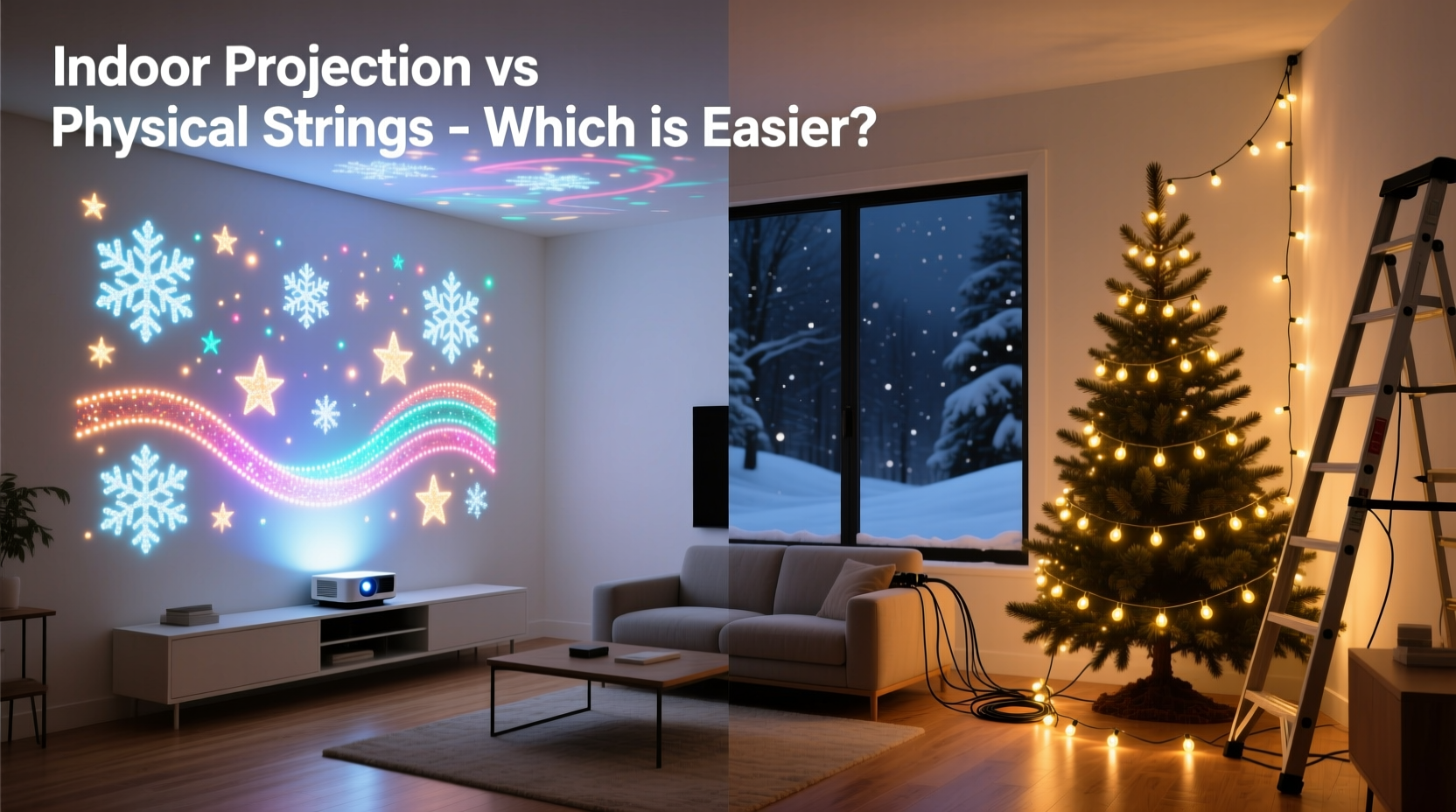
The first major factor in determining which lighting solution is “easier” lies in setup time and complexity.
Physical string lights require careful placement. You’ll need to drape them along mantels, around windows, across ceilings, or through garlands. This often involves measuring lengths, using clips, tape, or hooks, and untangling knots—a process that can take anywhere from 30 minutes to several hours, especially if covering multiple rooms.
In contrast, indoor projection lights are plug-and-play. Most models come with a base unit that projects LED patterns onto walls or ceilings. Simply place the projector on a shelf, table, or mount it slightly elevated, aim it at the desired surface, and turn it on. Setup typically takes under five minutes, with no climbing, no wires across floors, and no risk of damaging paint or wallpaper.
While projection systems eliminate manual draping, they do require some attention to angle and distance. Most projectors work optimally between 6 to 10 feet from the target surface. Too close, and the image distorts; too far, and brightness diminishes. But even with minor adjustments, the total effort remains drastically lower than handling multiple strands of physical lights.
Maintenance and Daily Use
Once installed, ongoing maintenance separates truly low-effort solutions from those that demand attention.
Physical string lights may flicker, develop dead bulbs, or short-circuit over time. Even with modern LED sets, issues like loose connections or frayed wires can arise—especially after months in storage. Checking each strand before and during the season is often necessary. Dust accumulation also means occasional cleaning, particularly if stored in less-than-ideal conditions.
Projection lights, being solid-state electronics with no external wiring beyond the power cord, require almost zero maintenance. There are no individual bulbs to replace, no points of failure along a string, and no exposed circuits vulnerable to pets or foot traffic. Most units include built-in timers, remote controls, and multiple light modes (like snowfall, twinkling stars, or rotating colors), allowing dynamic changes without touching the device.
However, projector lenses can gather dust over time. A quick wipe with a microfiber cloth every few weeks keeps the image sharp. Beyond that, these devices run reliably throughout the season with minimal oversight.
“Projection lighting has revolutionized seasonal decor for renters and busy families. It’s not just about aesthetics—it’s about reclaiming time and reducing stress.” — Laura Nguyen, Home Automation Consultant
Storage and Longevity
After the holidays end, storing decorations becomes its own chore. Physical string lights are notorious for tangling, even when carefully coiled. Over time, repeated winding and unwinding lead to wire fatigue, broken sockets, or damaged plugs. Many households end up replacing entire sets every few years due to wear and tear.
Projection units, meanwhile, pack down neatly into a single box. No fragile filaments, no delicate arrangements. Just unplug, cover the lens, and store upright in a dry place. With fewer moving parts and no extended wiring, projectors generally last longer—often five to seven seasons or more with proper care.
Still, both types benefit from organized storage. Using labeled bins and avoiding extreme temperatures helps preserve performance regardless of format.
Storage Comparison Table
| Feature | Physical String Lights | Projection Lights |
|---|---|---|
| Setup Time | 20–90 minutes | 3–7 minutes |
| Tangle Risk | High | None |
| Bulb Replacement Needed? | Yes (over time) | No |
| Storage Space | Moderate to large (multiple reels/bins) | Compact (single unit) |
| Lifespan (Average) | 3–5 years | 5–8 years |
| Durability Around Pets/Kids | Low (wires accessible) | High (no dangling cords) |
Safety and Accessibility Considerations
Safety plays a crucial role in determining ease of use—especially in homes with children, pets, or elderly residents.
Traditional string lights involve numerous electrical connections and long stretches of wiring. These pose tripping hazards, chewing risks for pets, and potential fire dangers if overloaded or damaged. While LED versions run cooler than incandescent bulbs, any exposed circuit increases liability.
Projection lights eliminate nearly all of these concerns. The only cord is a short power cable from the base unit to an outlet. There are no hanging wires, no hot surfaces, and no components within reach of curious hands or paws. This makes them ideal for apartments, nurseries, staircases, or shared living spaces where safety and simplicity go hand-in-hand.
Additionally, projection systems are excellent for individuals with limited mobility. Seniors or those with back problems won’t need to climb ladders or stretch to reach high corners. One strategic placement delivers wide coverage, transforming entire rooms with ambient light.
Mini Case Study: The Martinez Family Apartment
The Martinez family lives in a two-bedroom city apartment with hardwood floors, two cats, and twin toddlers. Every year, setting up traditional lights became a source of frustration—tangled wires, fallen clips, and constant readjustments. Last season, they switched to an indoor Christmas light projector.
They placed the unit on a bookshelf in the living room, aimed it toward the ceiling, and activated a gentle snowfall pattern with soft white lights. Within minutes, the entire space felt festive. Their cats couldn’t unravel anything, the kids didn’t trip, and cleanup took seconds. Mrs. Martinez noted: “It’s the first year I didn’t dread taking down decorations.”
They now use a second projector in the dining area for dinner gatherings, creating a cozy atmosphere without clutter. Total investment: $70 for two units. Time saved: approximately four hours over the season.
Customization and Aesthetic Flexibility
While physical lights win in terms of tactile authenticity—the warm glow of real bulbs strung by hand—projection systems offer unmatched versatility.
A single projector can display multiple effects: steady glows, pulsing waves, falling snow, animated reindeer, or even music-synchronized patterns. Some advanced models connect via Bluetooth or apps, letting users schedule scenes, adjust brightness, or switch themes remotely.
Physical strings, once hung, remain static unless manually changed. Adding variety means purchasing additional sets in different colors or styles—increasing cost, complexity, and storage needs.
That said, projections lack depth. They create flat images on surfaces rather than three-dimensional sparkle throughout a space. If you value texture, layering, and realism—such as lights woven through a real tree or draped over a banister—physical strings still deliver a richer sensory experience.
Step-by-Step Guide: Setting Up Indoor Projection Lights
- Choose your location: Pick a stable surface 6–10 feet from the target wall or ceiling.
- Clear the path: Ensure furniture or objects don’t block the projection beam.
- Plug in the unit: Connect to a nearby outlet. Avoid extension cords if possible.
- Adjust the angle: Tilt or rotate the projector head until the pattern fills your desired area evenly.
- Select mode: Use the remote or button panel to choose color, animation, and speed.
- Set timer (optional): Program auto-on/off times to match your routine.
- Test overnight: Run a full cycle to ensure stability and brightness.
Checklist: Choosing the Right Option for Your Home
- ✅ Do you want fast setup and takedown? → Lean toward projection
- ✅ Are you decorating rental property or can’t drill holes? → Projection wins
- ✅ Do you have pets or small children? → Safer with projection
- ✅ Is storage space limited? → Projectors save room
- ✅ Do you love authentic, layered lighting? → Stick with physical strings
- ✅ Want dynamic effects without extra gear? → Choose projector
- ✅ Planning to decorate outdoors later? → Note: most indoor projectors aren’t weatherproof
FAQ
Can indoor projection lights work on dark walls?
They can, but effectiveness drops significantly. Dark paint absorbs light, making patterns faint or invisible. For best results, use on light-colored or white surfaces. If your walls are dark, consider projecting onto lighter curtains or temporary backdrop panels.
Do physical string lights use more energy than projectors?
Modern LED string lights are energy-efficient, but longer runs (e.g., 100+ bulbs) consume more wattage than a typical projector (usually 5–12W). A single projector uses roughly the same energy as one short strand of LEDs. So yes, projectors generally use less electricity.
Can I leave projection lights on all night?
Most models are designed for extended use and include overheating protection. However, using the built-in timer (e.g., 4–8 hour auto-off) extends lifespan and saves energy. Never cover the ventilation slots while operating.
Conclusion: Which Is Easier?
When evaluating purely on ease—installation speed, daily management, storage, safety, and long-term reliability—indoor projection Christmas lights are the clear winner for most households.
They require minimal effort to deploy, pose fewer risks, last longer, and adapt easily to changing preferences. For renters, busy parents, seniors, or anyone prioritizing convenience, projection lighting offers a smart upgrade over traditional methods.
That said, physical string lights retain emotional and aesthetic value. Their three-dimensional presence adds warmth and craftsmanship that projections can’t fully replicate. For those who enjoy the ritual of decorating or seek a classic look, physical strings remain meaningful—even if they demand more work.
The future of holiday lighting likely lies in hybrid setups: using projections for broad, effortless ambiance and supplementing with small, targeted string lights where dimension and detail matter most.




 浙公网安备
33010002000092号
浙公网安备
33010002000092号 浙B2-20120091-4
Comments
No comments yet. Why don't you start the discussion?