
As the holiday season approaches, one of the most anticipated traditions is decorating the home with festive lighting. In recent years, a new contender has emerged alongside classic string lights: indoor projector Christmas lights. While both aim to create a magical ambiance, they differ significantly in terms of setup, maintenance, versatility, and long-term convenience. For homeowners weighing their options, understanding these differences—especially when it comes to ease of installation—is essential for making an informed choice that aligns with their lifestyle and expectations.
This article breaks down the practical realities of using indoor projector lights versus traditional physical string lights, focusing on setup simplicity, adaptability, safety, cost, and overall user experience. Whether you're a seasoned decorator or someone who dreads untangling wires every December, this comparison will help clarify which option truly delivers on convenience.
Understanding the Two Options
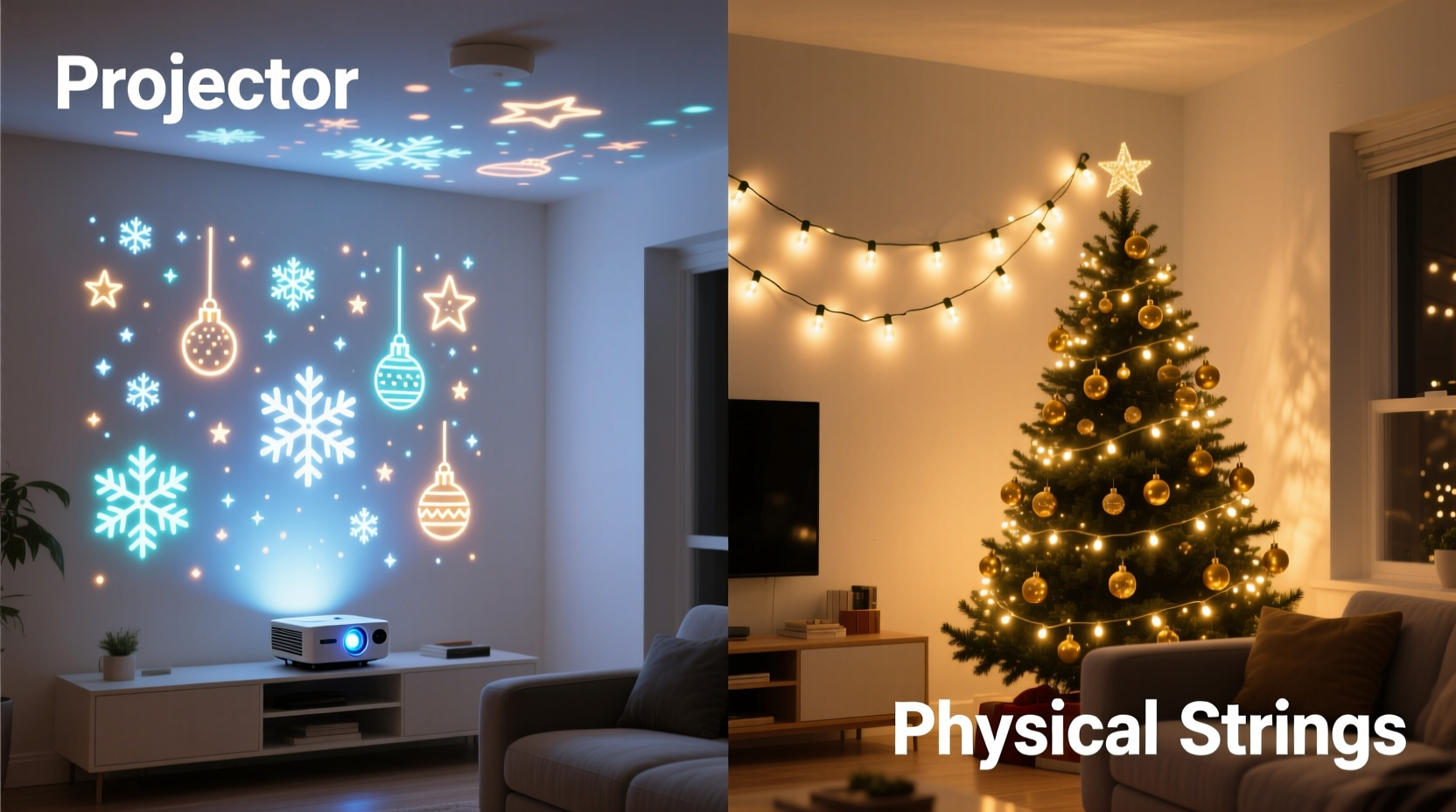
Before diving into the setup process, it’s important to understand what each lighting solution entails.
Physical string lights are the traditional choice—wired strands of LED or incandescent bulbs designed to be draped, wrapped, or hung around windows, mantles, staircases, and furniture. They come in various lengths, colors, and bulb styles and require physical placement throughout the desired space.
Indoor projector Christmas lights, on the other hand, use small devices that project animated light patterns onto walls and ceilings. These units plug into a standard outlet and cast moving images such as snowflakes, twinkling stars, or falling snow. No strings, no clips—just plug and play illumination.
The core difference lies in physicality: one requires manual arrangement across surfaces; the other creates visual effects from a single point. This fundamental contrast shapes everything from setup time to storage needs.
Setup Process: Time, Tools, and Effort Compared
When comparing ease of setup, several factors come into play: time required, tools needed, physical access, and repeatability year after year.
String lights typically demand more hands-on effort. The process begins with retrieving tangled cords from storage—a common frustration for many. Untangling can take anywhere from 5 to 30 minutes depending on how well they were stored the previous year. Once free of knots, the next step involves measuring spaces, securing clips or tape, and carefully draping lights along edges. Windows, door frames, and shelves must be accessible, and ladders may be necessary for high placements. Each run needs to be tested before final positioning, adding further time.
In contrast, setting up a projector light takes under five minutes. Most models are compact (about the size of a coffee mug) and simply need to be plugged in and angled toward a wall or ceiling. Some offer remote controls or app connectivity to adjust brightness, speed, or animation type. There's no climbing, no clipping, and no risk of dropping bulbs. One unit can cover multiple rooms if placed strategically near a central hallway or open living area.
Comparison Table: Setup & Maintenance Factors
| Factor | Projector Lights | Physical String Lights |
|---|---|---|
| Average Setup Time | 3–5 minutes | 30–90 minutes |
| Tools Required | None | Clips, tape, ladder, tester |
| Storage Space Needed | Minimal (single box) | Large (multiple reels/bins) |
| Risk of Damage During Setup | Very low | Moderate to high (bulbs, wires) |
| Year-Round Reusability | High (same spot, same setup) | Variable (re-tangle likely) |
| Child/Pet Safety | High (no cords) | Low to moderate (choking, tripping) |
Real-World Example: A Busy Family’s Holiday Dilemma
The Thompson family lives in a two-story suburban home with large bay windows, a staircase railing, and an open-concept living room. Every year, Mr. Thompson spends a full Saturday untangling lights, testing broken strands, and installing them safely while his wife manages their two young children. Last year, one of the kids pulled down a section from the fireplace mantle, causing half the display to go dark.
This year, they decided to try projector lights. They purchased two indoor units—one for the living room and one for the dining area—and placed them on side tables. Within ten minutes, the entire downstairs was bathed in gentle, rotating snowflake patterns. The kids loved watching the moving lights without being able to touch or disrupt them. Mrs. Thompson noted that cleanup was just as fast: unplug and store. No more dusty bulbs or damaged wires.
While they missed the tactile charm of real lights, the dramatic reduction in stress and time investment made the switch worthwhile. They now use projectors as their primary indoor lighting and reserve physical strings for outdoor trees only.
“Families with limited time or mobility should seriously consider projection lighting—it reduces setup barriers and increases seasonal enjoyment.” — Laura Mendez, Home Automation Consultant
Step-by-Step Guide: Setting Up Each Option
Projector Christmas Lights – 5-Minute Setup
- Choose a central location with power access and clear line-of-sight to walls/ceiling.
- Place the projector on a stable surface like a table or shelf.
- Plug in the device and turn it on.
- Adjust the angle and focus dial (if available) to spread the pattern evenly.
- Use the remote or button panel to select desired effect (e.g., slow snowfall, blinking stars).
- Test visibility from different parts of the room and reposition if needed.
Physical String Lights – 60+ Minute Process
- Retrieve stored lights and inspect for damage or missing bulbs.
- Untangle cords carefully to avoid wire strain.
- Test each strand using a power source before installation.
- Measure areas to decorate (windows, railings, shelves) and estimate length needed.
- Attach adhesive clips or hooks along mounting surfaces.
- Drape lights evenly, avoiding sagging or loose sections.
- Connect multiple strands only if rated for series use.
- Plug into outlet and test final appearance.
- Secure excess cord and hide power strips if visible.
The disparity in complexity is evident. Projector setup is closer to operating a lamp; string lights require planning, precision, and patience.
Long-Term Considerations: Storage, Durability, and Flexibility
Beyond initial setup, long-term usability plays a major role in determining true “ease.”
Storing string lights is notoriously difficult. Even with careful coiling, they often emerge from storage knotted or damaged. Bulbs can loosen, wires fray, and connectors corrode over time. Each year, decorators face the added chore of replacing faulty sections or buying entirely new sets.
Projector lights, meanwhile, are housed in durable plastic cases and have no fragile external components. Simply unplug, wipe clean, and return to its box. With fewer moving parts and no exposed wiring, longevity is generally higher. Most models last 5–7 years with regular seasonal use.
Flexibility is another advantage. Want to change the theme? Many projectors offer interchangeable discs or digital modes for Halloween, Valentine’s Day, or summer nights. String lights are usually color-specific and less adaptable outside the holiday context.
Checklist: Choosing the Right Option for Your Needs
- ✅ Do you have limited time to decorate? → Choose projector lights
- ✅ Are there children or pets who might pull at cords? → Choose projector lights
- ✅ Do you value authentic, three-dimensional lighting effects? → Choose string lights
- ✅ Do you want minimal storage requirements? → Choose projector lights
- ✅ Are you decorating hard-to-reach areas (high ceilings, stair rails)? → Choose projector lights
- ✅ Do you enjoy hands-on decoration as part of the holiday ritual? → Choose string lights
- ✅ Are you looking for multi-seasonal use? → Choose projector lights
Frequently Asked Questions
Can projector lights replace string lights completely indoors?
For ambient and decorative purposes, yes—many people find projector lights sufficient for creating a festive mood. However, they don’t provide functional illumination or the tactile presence of real lights. Those seeking a layered look often combine both: projectors for walls and ceilings, strings for trees and tabletops.
Do indoor projectors work on all wall colors?
They work best on light-colored or white walls. Dark paint absorbs light, reducing brightness and clarity. Textured or heavily patterned walls may distort the image. For optimal results, aim at smooth, neutral surfaces.
Are projector lights energy efficient?
Yes. Most indoor Christmas light projectors consume between 5–15 watts, significantly less than even a short strand of LED string lights (which average 4–10 watts per 100 bulbs). Over extended use, projectors are more economical.
Final Verdict: Which Is Easier?
When evaluating purely for setup ease, indoor projector Christmas lights win decisively. They eliminate nearly all the friction associated with traditional decoration: no tangles, no tools, no height risks, and no storage nightmares. Installation is faster, safer, and repeatable with minimal effort.
That said, physical string lights still hold emotional and aesthetic value. Their depth, sparkle, and physical presence contribute to a more immersive holiday environment. For those who view decorating as a cherished ritual, the process itself is part of the joy.
The smart approach may be hybrid: use projectors for large, hard-to-decorate areas and reserve string lights for focal points like the tree or centerpiece displays. This balances convenience with tradition, minimizing labor while maximizing visual impact.
“The future of holiday lighting isn’t about replacing nostalgia—it’s about enhancing accessibility so more people can participate in the joy.” — Mark Tran, Smart Home Lighting Designer
Take Action This Season
This holiday season, reassess your decorating routine. If setup stress outweighs the satisfaction, consider giving projector lights a try—even as a supplement. You might discover that modern technology doesn’t diminish the magic but makes it more sustainable, inclusive, and enjoyable.
Start small: buy one projector unit, place it in your living room, and see how it changes your experience. Share your results, experiment with combinations, and redefine what festive comfort means for your household.




 浙公网安备
33010002000092号
浙公网安备
33010002000092号 浙B2-20120091-4
Comments
No comments yet. Why don't you start the discussion?