
Coverage isn’t just about how much space a light source illuminates—it’s about how evenly, intentionally, and functionally that light serves the human experience in a room. Indoor projector lights and string lights occupy opposite ends of the lighting spectrum: one is precision-engineered for directional impact, the other is inherently diffuse and atmospheric. Yet many homeowners conflate “coverage” with “brightness” or assume more bulbs automatically mean better illumination. That misconception leads to underlit corners, washed-out focal points, or energy-wasting overkill. This article cuts through marketing hype with measurable criteria—beam angle, lumen distribution, mounting flexibility, ambient integration, and spatial adaptability—to answer a deceptively simple question: Which delivers genuinely superior coverage for real living spaces?
What “Coverage” Really Means in Interior Lighting
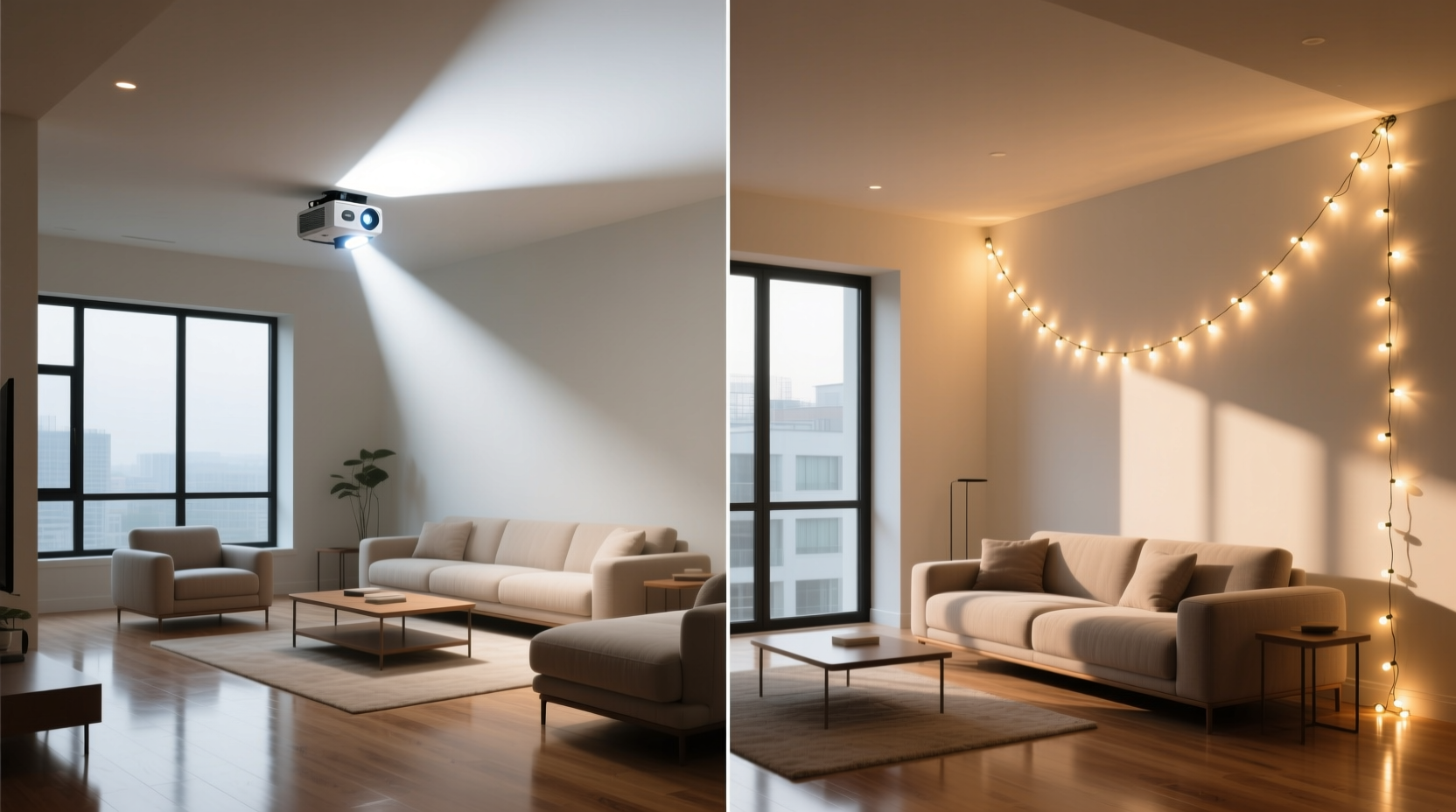
Coverage in residential lighting has three non-negotiable dimensions: spatial reach, uniformity, and functional appropriateness. A light may technically illuminate 300 square feet—but if it casts harsh shadows across a dining table or leaves the reading nook in near-darkness, its coverage fails at the human level. Projector lights (often LED-based units with adjustable optics) excel at targeted reach: they project defined shapes—circles, ovals, gobo patterns—onto walls, ceilings, or floors with minimal spill. String lights, by contrast, distribute low-intensity light along a linear path; their coverage is cumulative and additive, relying on density, length, and placement to build ambient presence.
Physics matters here. Projector lights follow the inverse-square law closely: intensity drops predictably with distance, allowing precise calculation of foot-candles at a given surface. String lights operate as a series of point sources—each bulb contributes minimally, and total lux depends heavily on proximity, wire gauge, and voltage drop over long runs. Neither is “better” universally—but misapplying either undermines coverage goals.
Projector Lights: Strengths, Limitations, and Where They Truly Cover Well
Indoor projector lights—such as architectural-grade LED wall washers, ceiling-mounted accent projectors, or portable smart projectors designed for decorative lighting—deliver unmatched control over light placement. A single 15W projector with a 40° beam angle can uniformly wash a 6' × 8' wall section at 8 feet distance, delivering 12–18 foot-candles of even illumination. When mounted correctly (e.g., recessed in a soffit or angled from a shelf), they eliminate hotspots and dark zones across vertical surfaces.
However, their coverage is inherently directional and narrow in scope. A projector pointed at a ceiling creates a soft, diffused glow only within its beam footprint—typically 4–10 feet in diameter depending on throw distance. It cannot wrap light around furniture, fill stairwells, or provide task-level brightness on countertops without multiple units. Coverage becomes expensive and complex beyond single-wall or single-object applications.
String Lights: How Density, Placement, and Type Dictate Real Coverage
String lights are often dismissed as “decorative only,” but their coverage potential is highly scalable and context-dependent. Micro-LED fairy lights (200+ bulbs per 33 feet) create gentle ambient fill when draped along shelves, mantels, or headboards—softening shadows without competing with task lighting. Commercial-grade C7/C9 incandescent or LED strings (10–25 ft, 50–100 bulbs) deliver functional ambient coverage in patios, garages, or open-concept living areas when hung in parallel rows 3–4 feet apart.
The key is understanding *linear density* and *vertical layering*. A single strand of 100 warm-white LEDs spaced 3 inches apart emits ~300–500 total lumens—insufficient for primary lighting. But five strands layered at different heights (e.g., above cabinets, along baseboards, behind sofas) generate overlapping fields that collectively raise ambient lux levels by 5–12 foot-candles across a 200 sq ft room. Unlike projectors, string lights thrive in irregular, multi-plane spaces—staircases, bookshelves, curved balconies—where directional light would require custom mounting or multiple fixtures.
Head-to-Head Comparison: Coverage Performance by Room Type
| Room / Use Case | Projector Light Coverage | String Light Coverage | Better Choice |
|---|---|---|---|
| Bedroom Accent Wall (e.g., behind bed, textured feature) |
Excellent: Even wash, color consistency, zero glare. One unit covers full 8' width. | Poor: Bulbs cast discrete dots; no uniform surface illumination. Requires dense netting (not typical). | Projector |
| Open-Plan Living/Dining Zone (500+ sq ft, mixed functions) |
Moderate: Needs 3–4 units for wall washing + ceiling downlighting. High setup complexity. | Strong: 3–4 parallel strands (ceiling perimeter + shelf + bar rail) build layered ambient light. Easy to adjust. | String |
| Kitchen Island Task Zone (requires 30–50 fc for food prep) |
Good: Focused downward beam (e.g., track-mounted projector) delivers precise, shadow-free task light. | Inadequate: Even dense strings lack intensity at counter height. Risk of glare or insufficient lux. | Projector |
| Staircase Safety & Ambiance (narrow, vertical, multi-level) |
Limited: Mounting constraints; beams may not align across treads. Risk of uneven step illumination. | Excellent: Strands installed under handrail or along tread edges provide consistent, low-level guidance and warmth. | String |
| Home Office Focus Area (desk + monitor + reading chair) |
Very Good: Adjustable arm projector eliminates screen glare while spotlighting documents or notebooks. | Weaker: Strands above desk cause reflections; under-desk placement lacks intensity for detail work. | Projector |
Real-World Example: The Renovated Loft Apartment
When interior designer Lena Ruiz renovated her 850-sq-ft downtown loft, she faced a coverage challenge: a 22-foot exposed-brick wall needed visual emphasis without sacrificing ambient brightness in the open kitchen and living zone. Initial plans called for six recessed projector lights—until voltage calculations revealed dimming issues on the longest circuit. Instead, Lena deployed a hybrid strategy grounded in coverage logic: two wide-beam (60°) projectors washed the brick wall’s center third (creating a warm, gallery-like focal point), while three 50-ft micro-LED string strands were installed in staggered layers—along the ceiling perimeter, behind the kitchen island backsplash, and beneath floating shelves. The result? The wall received intentional, high-impact coverage, while the rest of the space enjoyed seamless, glare-free ambient fill. Energy use dropped 22% versus the all-projector plan, and installation time was cut by half.
“Coverage isn’t about flooding a room with light—it’s about mapping where people look, move, and pause, then placing light exactly there. Projectors define the ‘where.’ Strings soften the ‘in-between.’ Use both, but never interchange them.” — Rafael Torres, Certified Lighting Designer (IALD), founder of Lumina Studio
Practical Decision Checklist: Choose Based on Your Space
- ✅ Do you need focused, shadow-free light on a specific object or surface? → Choose projector lights.
- ✅ Is your space irregularly shaped, multi-level, or filled with vertical elements (shelves, stairs, columns)? → String lights offer faster, more adaptable coverage.
- ✅ Do you require >30 foot-candles for detailed tasks (cooking, crafting, reading)? → Projectors deliver necessary intensity; strings rarely do.
- ✅ Are you prioritizing quick installation, repositioning, or seasonal flexibility? → Strings win—no wiring, no mounting hardware, no electrician needed.
- ✅ Does your room have high ceilings (>10 ft) or deep recesses (niches, alcoves)? → Projectors maintain intensity over distance; string light dims significantly past 6 ft.
Step-by-Step: Optimizing Coverage Without Overbuying
- Map your coverage needs by activity: Walk through each room and note where light is essential (e.g., sink area, sofa seating zone, hallway transitions). Mark these on a rough floorplan.
- Measure distances and surfaces: For projectors, measure throw distance (fixture to target) and surface dimensions. For strings, measure linear feet of intended pathways (mantels, railings, shelves).
- Calculate minimum lumens: Ambient living areas need 10–20 fc (≈100–200 lumens per 10 sq ft); task zones need 30–50 fc (≈300–500 lumens per 10 sq ft). Use this to size projector wattage or string density.
- Test before committing: Rent or borrow one projector unit and a 25-ft string kit. Install each in your highest-priority zone for 48 hours. Note where light falls short—or overwhelms.
- Layer, don’t replace: Add string lights to soften projector-washed walls. Use a narrow-beam projector to highlight art above a string-lit bookshelf. True coverage emerges from synergy—not either/or.
FAQ
Can I use indoor projector lights outdoors for patio coverage?
No—unless explicitly rated for damp/wet locations (IP65 or higher). Most indoor projectors lack weather sealing, and condensation inside optics causes permanent fogging or LED failure. Outdoor-rated projectors exist but cost 2–3× more and require GFCI-protected circuits.
Do string lights lose brightness over long runs?
Yes—especially incandescent or low-voltage LED strings. Voltage drop causes bulbs at the end of a 100-ft run to glow 30–40% dimmer than those near the plug. Mitigate this by using UL-listed “cut-and-connect” LED strings with built-in constant-current drivers, or splitting long runs into parallel 25–33 ft segments.
How many projector lights do I need for a 12x12 room?
That depends entirely on purpose. For ambient fill alone: none—you’ll need ceiling-mounted fixtures or wall sconces. For accenting one wall: 1–2. For full wall washing + ceiling uplighting + task spot: 4–6. Never size by room area alone; size by surface and function.
Conclusion
Coverage isn’t won by choosing the “brighter” or “trendier” option—it’s earned through intentionality. Projector lights give you surgical control over where light lands, making them indispensable for defining space, highlighting architecture, or enabling focused activity. String lights give you democratic, forgiving, and deeply human coverage—filling gaps, wrapping around life’s contours, and adapting as your needs evolve. The most luminous rooms aren’t lit by one technology, but by understanding when precision serves you—and when generosity does.
If you’ve wrestled with dark corners, harsh glare, or lights that look great in photos but fail in practice, revisit your coverage strategy with this lens: What does *this person*, in *this moment*, truly need light to do? Then choose—not based on specs alone, but on behavior, geometry, and grace. Your space will feel less illuminated, and more understood.




 浙公网安备
33010002000092号
浙公网安备
33010002000092号 浙B2-20120091-4
Comments
No comments yet. Why don't you start the discussion?