
In studio apartments, micro-lofts, and urban walk-ups where square footage is measured in inches rather than feet, holiday decisions carry unusual weight. A single object — especially one meant to evoke tradition, warmth, and presence — must justify its footprint, energy use, upkeep, and emotional return. That’s why the choice between an indoor projector displaying a lifelike evergreen and a real or high-fidelity artificial tree isn’t just logistical. It’s phenomenological: how does each option engage sight, sound, scent, texture, memory, and even subconscious expectation? Authenticity here isn’t about botanical accuracy alone — it’s about consistency across senses, intentionality in ritual, and resilience against the cognitive dissonance that arises when something *looks* real but *feels* hollow.
The Sensory Architecture of Authenticity
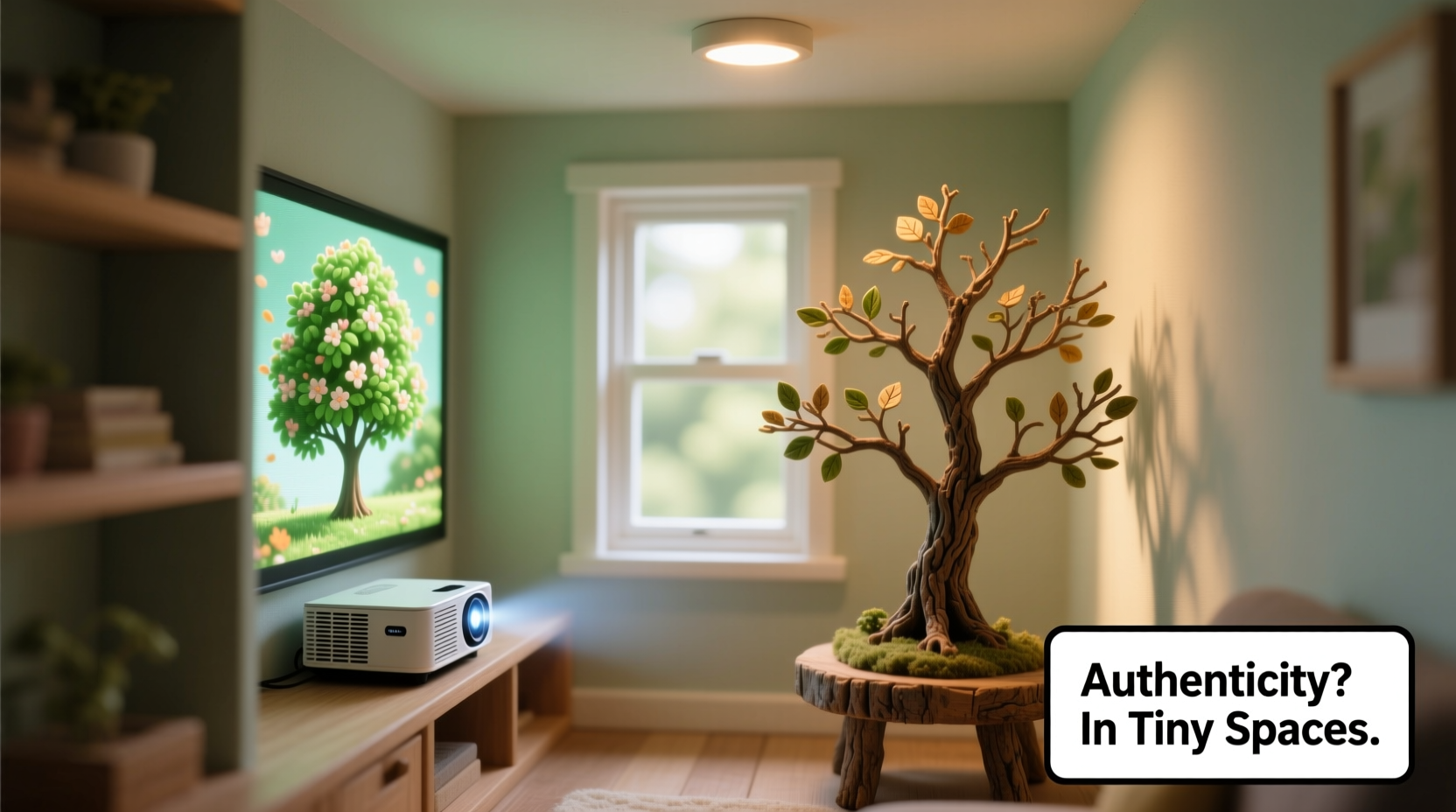
Authenticity in domestic environments is rarely binary. It emerges from coherence — the alignment of visual input with tactile feedback, ambient scent, spatial presence, and behavioral reinforcement. A physical tree occupies volume, casts shifting shadows as lights flicker, emits subtle pine resin or dry-needle aromas (especially if real), and invites touch: rough bark, pliable boughs, the slight give of branches under ornament weight. Its imperfections — a crooked trunk, asymmetrical limb distribution, or the faint crackle of drying needles — don’t diminish authenticity; they anchor it in lived reality.
A projector, by contrast, delivers exceptional visual fidelity: hyperrealistic bark textures, dynamic light refraction through virtual glass ornaments, even simulated snowfall with parallax depth. Yet it remains two-dimensional in its physical impact. It casts no shadow on the wall behind it — unless deliberately engineered with rear projection and diffusion surfaces. It emits no scent. It offers no resistance to touch. Its “presence” is optical, not spatial. This creates what environmental psychologists call *sensory attenuation*: when one or more modalities are absent or underrepresented, the brain downweights the credibility of the entire experience, even if vision is flawless.
“Authenticity in interior ritual isn’t about replication — it’s about resonance. A 3-foot tabletop tree with hand-strung cranberries resonates more deeply than a 7-foot hologram because it invites participation, tolerates imperfection, and occupies shared space with the body.” — Dr. Lena Torres, Environmental Psychologist & Author of Domestic Atmospheres
Space-Specific Realities: What “Tiny” Actually Demands
Tiny spaces impose non-negotiable constraints: floor area, ceiling height, airflow, heat load, and vertical clearance. But they also amplify psychological effects. In under-400-square-foot dwellings, every object competes for cognitive real estate. Clutter isn’t just visual — it’s neurological fatigue. This makes the *maintenance burden* of any holiday element critically important.
A physical tree — even a slim-profile 4.5-foot artificial one — requires floor space (minimum 24\" diameter base), vertical clearance (to avoid brushing ceilings or smoke detectors), and structural stability (a weighted base is non-negotiable in tight quarters). Real trees demand daily watering, needle containment, and post-holiday disposal logistics — all challenging without building-wide composting or curbside pickup.
A projector eliminates floor footprint entirely. Mounted on a ceiling bracket or shelf, it projects onto a blank wall or dedicated screen — turning negative space into focal point. It requires only power and minimal setup time. However, it introduces new constraints: ambient light control (projectors lose contrast in daytime rooms), wall surface quality (textured or dark walls degrade image fidelity), and audio limitations (most lack built-in speakers capable of replicating the low-frequency hum of real-tree lights or the gentle rustle of boughs).
Comparative Analysis: Projector vs Physical Tree
| Criterion | Indoor Projector | Physical Tree (High-Quality Artificial) | Real Cut Tree |
|---|---|---|---|
| Floor Space Required | None (wall/ceiling mounted) | 24–30\" diameter base + 6\" clearance | 24–36\" diameter base + 12\" clearance (water reservoir adds width) |
| Sensory Range | Visual (high fidelity), optional audio (limited) | Visual, tactile, mild olfactory (if scented PVC or pine-scented spray used) | Visual, tactile, strong olfactory, subtle auditory (needle rustle, sap release) |
| Setup Time | 5–15 minutes (mounting, focus, calibration) | 20–45 minutes (unboxing, branch fluffing, assembly, decorating) | 30–60 minutes (stand assembly, water filling, trimming, decorating) |
| Ongoing Maintenance | None (except occasional lens cleaning) | Weekly dusting; occasional branch repositioning | Daily watering; needle vacuuming 2–3x/week; fire safety checks |
| Lifespan (Years) | 3–7 years (lamp/bulb life, firmware obsolescence) | 8–15 years (with proper storage) | 3–4 weeks (seasonal) |
| Emotional Ritual Depth | Moderate (viewing-based; limited interaction) | High (decorating, lighting, adjusting branches) | Very High (selection, transport, trimming, watering, farewell) |
Mini Case Study: Maya’s 320-Sq-Ft Brooklyn Studio
Maya, a graphic designer living in a converted warehouse loft, faced this decision last November. Her ceiling height was 9'2\", her longest wall was 11 feet wide, and her only “floor” for a tree was a 30\" x 30\" clear zone beside her Murphy bed. She’d tried a 4-foot artificial tree two years prior — beautiful, but it blocked her path to the bathroom and made the room feel claustrophobic. Last year, she rented a projector with a 1080p laser light source and a 120-inch diagonal image. She projected onto a matte-white acoustic panel she’d already installed for soundproofing.
What surprised her wasn’t the visual impact — it was the *absence of friction*. No wrestling with branches. No worrying about pet cats knocking it over. No guilt about landfill-bound plastic after New Year’s. But she also noticed something subtle: when friends visited, they’d admire the projection, take photos, then ask, “Where’s your tree?” They’d glance around, confused, until she pointed at the wall. The disconnect was social as well as sensory. There was no shared act of *adornment* — no passing ornaments, no collaborative fluffing of boughs, no collective pause to step back and assess balance. So this year, Maya hybridized: she kept the projector for evening ambiance (dimmed lights, soft forest soundscape via Bluetooth speaker), but added a 22-inch tabletop live Norfolk Island pine in a ceramic planter — real, fragrant, touchable, and biodegradable. It sits on her dining cart, requiring zero floor space. The projector provides scale; the plant provides substance. Authenticity, for her, now lives in layered intention — not either/or.
Practical Decision Framework: 5-Step Evaluation
Choosing isn’t about superiority — it’s about alignment with your space, habits, values, and desired emotional outcome. Use this sequence to clarify your priority:
- Map Your Non-Negotiables: List hard constraints (e.g., “must fit under 8’ ceiling,” “no water sources allowed,” “pet must not chew it,” “must be packable in under 10 minutes”). Cross out options violating any.
- Rank Sensory Priorities: On a scale of 1–5, score how much you value: (a) scent, (b) touch/texture, (c) ritual participation (decorating, watering), (d) visual realism at dusk, (e) zero maintenance. Total your top three. If scent/touch/ritual dominate, lean physical. If visual realism/zero maintenance dominate, lean projector.
- Test the “First-Morning Test”: Imagine waking up on December 1st. Which option would feel most grounding before coffee? Which would spark quiet joy, not logistical calculation?
- Evaluate Long-Term Resonance: Will this choice still feel meaningful on December 23rd, after 23 days of exposure? Projectors can fatigue the eye with static imagery; physical trees deepen in character as needles settle and lights warm.
- Calculate the “Authenticity Tax”: What compromises does each option demand? A projector asks you to ignore scent and touch. A physical tree asks you to accept spatial trade-offs and upkeep. Choose the tax you’re willing to pay — consciously.
FAQ: Addressing Common Concerns
Can a projector ever feel “real enough” for someone who grew up with real trees?
Rarely — not in isolation. Neurological studies show multisensory deprivation (e.g., seeing a tree but smelling laundry detergent and feeling smooth drywall) triggers subtle stress responses, even when viewers report liking the image. However, pairing projection with complementary sensory anchors — a pine-scented diffuser, textured wool stockings hung nearby, ambient forest sounds — significantly closes the authenticity gap. It becomes environmental design, not visual substitution.
Are slim-profile artificial trees truly space-efficient, or do they just hide bulk poorly?
Most “slim” trees sacrifice branch density and tip count to achieve narrow silhouettes — resulting in sparse ornament hanging and visible metal framing. True space efficiency comes from *scale-appropriate design*, not just narrowness. A 3.5-foot full-profile tree with hinged branches stores flat and occupies less visual volume than a 5-foot “slim” tree with awkward proportions. Prioritize *volume displacement* over width alone.
Does a physical tree worsen air quality in tiny, poorly ventilated spaces?
Real trees pose minimal risk if healthy and watered — they’re natural humidifiers. However, mold spores can develop in stagnant water reservoirs, especially in warm, low-airflow rooms. Use distilled water, change it every 2–3 days, and add a capful of bleach to inhibit mold. High-quality artificial trees made from PE (polyethylene) rather than PVC emit negligible VOCs when new — unlike cheaper PVC alternatives that can off-gas chlorinated compounds for weeks.
Why “More Authentic” Isn’t the Right Question — and What to Ask Instead
Framing the choice as “which feels more authentic?” sets up a false hierarchy. Authenticity isn’t inherent in objects — it’s co-created by the person, their space, their history, and their attention. A projector used by a solo resident with mobility challenges to maintain holiday continuity for 12 years carries profound authenticity. A 2-foot tabletop cedar nurtured from seedling by a city gardener embodies rootedness no projection can replicate. The deeper question is: Which option allows me to show up fully — physically, sensorially, and emotionally — in my own space during this season?
This shifts focus from passive reception (“Does it look real?”) to active stewardship (“What can I tend, adjust, and celebrate within my actual limits?”). It honors constraint not as deprivation, but as a catalyst for intentionality. Tiny spaces don’t need miniature versions of large-space traditions — they invite reinvention. A single lit branch in a vase. A framed photo of a childhood tree, backlit softly. A playlist of forest sounds paired with a candle that smells like Douglas fir. These aren’t compromises. They’re distillations — stripping away the extraneous to reveal the essential gesture of care, memory, and light.
Conclusion: Cultivating Presence, Not Perfection
In the end, authenticity in a tiny space isn’t measured by botanical accuracy or pixel density. It’s measured by how consistently the choice supports your sense of peace, connection, and groundedness — not just on Christmas morning, but through the quiet evenings of early December, the rushed mornings of mid-month, and the reflective stillness of New Year’s Eve. A projector excels at delivering awe without encroachment. A physical tree excels at delivering intimacy without abstraction. Neither is universally superior. Both become authentic only when chosen with clarity, used with attention, and accepted with grace — flaws, limitations, and all.
Your space is not too small for meaning. It’s precisely the right size for intention. Start where you are. Measure your wall. Feel your floor. Smell your air. Then choose — not the option that looks most like someone else’s ideal, but the one that lets you breathe deeper, pause longer, and feel, unmistakably, at home.




 浙公网安备
33010002000092号
浙公网安备
33010002000092号 浙B2-20120091-4
Comments
No comments yet. Why don't you start the discussion?