
Choosing between an induction cooktop and a gas range is one of the most consequential decisions when designing or upgrading a kitchen. Both offer distinct advantages in terms of cooking performance, safety, energy efficiency, and user experience. Yet, one aspect that rarely gets adequate attention—despite its daily impact—is noise. Whether you live in an open-concept loft, share walls with neighbors, or simply value a quiet home environment, understanding how these two technologies differ in sound output can be decisive.
This comparison goes beyond flame versus magnetic fields. It's about how each system performs under real-world conditions, how they affect your lifestyle, and what trade-offs you're willing to make for speed, control, or tradition.
Cooking Performance: Speed, Control, and Responsiveness
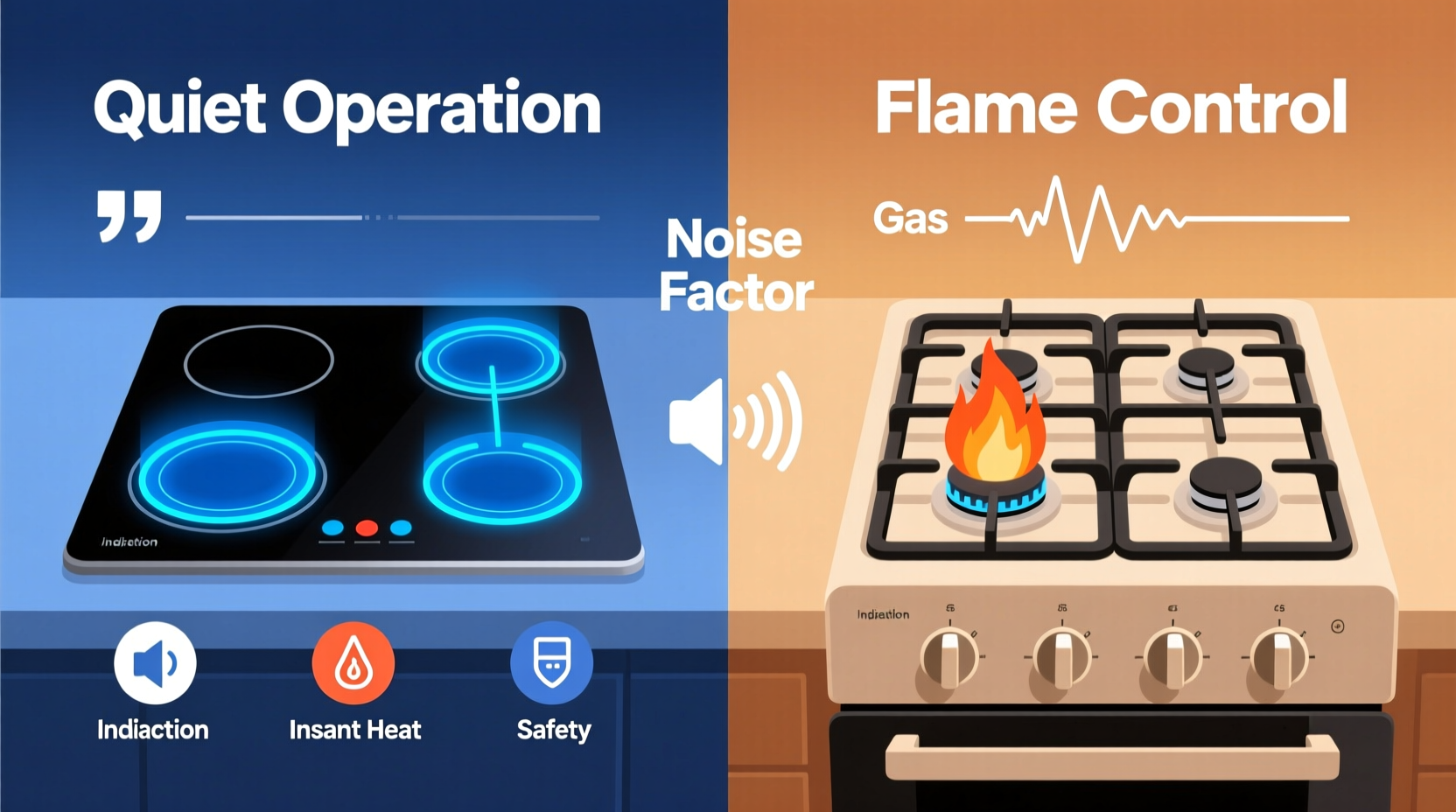
At the heart of any kitchen appliance is how well it cooks. Gas ranges have long been favored by professional chefs for their immediate visual feedback and tactile flame adjustment. Turning a knob changes the flame size instantly, allowing for fine-tuned heat modulation—especially useful when searing meats or reducing delicate sauces.
Induction cooktops, on the other hand, use electromagnetic technology to heat the cookware directly rather than the surface beneath it. This method delivers energy more efficiently, bringing water to a boil up to 50% faster than gas. Because heat is generated within the pan itself, temperature adjustments are nearly instantaneous—often quicker than gas—and far more precise at low settings, such as simmering chocolate or poaching eggs.
The precision advantage of induction becomes evident during tasks requiring sustained low heat. Gas burners often cycle between too hot and barely warm when set to low, whereas induction maintains consistent temperatures through pulsed energy delivery. However, some users report a learning curve when transitioning from gas to induction due to the lack of visible flames and different sensory cues.
Safety and Indoor Air Quality
Safety considerations extend beyond burns and fire hazards—they include air quality. Gas ranges emit combustion byproducts such as nitrogen dioxide (NO₂), carbon monoxide (CO), and formaldehyde into the home. According to a 2022 study by the Rocky Mountain Institute, homes using gas stoves without proper ventilation can exceed outdoor pollution standards for NO₂, posing risks especially to children with asthma.
“Indoor air pollution from gas stoves is a significant but underrecognized health concern. Switching to electric or induction eliminates this source entirely.” — Dr. Jonathan Levy, Professor of Environmental Health, Boston University
Induction cooktops produce no emissions during operation. The surface remains relatively cool except where in contact with the cookware, reducing the risk of accidental burns. Many models also feature automatic shut-off if no pot is detected or if overheating occurs. These features make induction particularly appealing in homes with young children or mobility-limited individuals.
However, because induction relies on electricity, power outages render it unusable unless paired with a backup generator. Gas ranges, especially those with manual ignition, continue functioning during blackouts—a crucial consideration in areas prone to storms or grid instability.
Energy Efficiency and Operating Costs
From an energy standpoint, induction is vastly superior. Approximately 85–90% of the energy consumed by an induction cooktop transfers directly to the food, compared to just 40–55% for gas. The rest of gas energy escapes as ambient heat, contributing to higher cooling loads in summer.
This efficiency translates into lower utility bills over time. While natural gas may be cheaper per BTU than electricity in some regions, induction’s faster cooking times and targeted heating often offset the price difference. In all-electric homes aiming for net-zero energy goals, induction aligns better with renewable integration and heat pump systems.
Installation costs vary significantly. Induction units typically require a dedicated 240-volt circuit and professional installation, adding $300–$800 to upfront expenses. Retrofitting older kitchens may involve electrical panel upgrades. Gas ranges need a gas line, which—if not already present—can cost even more to install safely due to plumbing modifications and permitting.
Noise Factor: A Hidden Differentiator
One of the most surprising complaints about induction cooktops isn’t about performance—it’s about sound. While both types generate noise, the nature and perception differ greatly.
Gas ranges produce a steady roar or hiss from the open flame, especially on high heat. This sound is familiar and often associated with “real” cooking. Some find it comforting; others notice it contributes to overall kitchen noise, particularly in small apartments or open layouts.
Induction cooktops, while silent in principle, can emit high-pitched whines, buzzes, or humming noises caused by electromagnetic vibrations interacting with certain cookware. This phenomenon, known as \"coil whine,\" varies depending on the pan’s material, thickness, and construction. Thin or warped pans are more likely to vibrate, amplifying the sound. At maximum power, some models emit audible fan noise from internal cooling systems.
| Noise Type | Induction Cooktop | Gas Range |
|---|---|---|
| Primary Source | Electromagnetic vibration, cooling fans | Flame combustion, gas flow |
| Pitch Level | High-frequency hum or buzz | Low-to-mid frequency hiss/roar |
| Loudness (approx.) | 45–60 dB (varies widely) | 50–65 dB (higher at max flame) |
| Audibility Beyond Kitchen | Moderate – depends on cookware | High – carries easily through space |
| Reducible? | Yes – via cookware choice, power setting | Limited – inherent to flame |
The subjective impact matters. High-frequency sounds from induction can feel more intrusive than the broad-spectrum noise of gas, even at lower decibel levels. Individuals sensitive to pitch—such as those with misophonia or hearing aids—may find induction less tolerable despite its technical quietness.
Real-World Example: Cooking in a Shared Urban Apartment
Consider Maria, a software engineer living in a converted warehouse loft in Seattle. Her kitchen opens directly into the living area, separated only by a breakfast bar. She values quiet evenings after work and frequently hosts remote meetings from her couch.
She initially installed a sleek induction cooktop for its clean look and fast boiling times. But she noticed that when sautéing onions in her favorite tri-ply stainless steel pan, a persistent buzzing sound emerged—barely audible to her, but distracting to her partner who wears hearing aids. During video calls, colleagues occasionally asked if there was a “high-pitched interference.”
After experimenting with different pots, she discovered that switching to a heavier cast iron skillet eliminated the buzz entirely. She now keeps one non-magnetic aluminum pan reserved for occasions when silence is key, using lower induction settings. Meanwhile, her neighbor downstairs upgraded to a powerful gas range and regularly fills the building stairwell with the smell of gas and the roar of flames—an issue reported to management multiple times.
Maria’s experience illustrates that noise isn't just about volume—it's about context, sensitivity, and coexistence.
Checklist: Choosing the Right Option for Your Home
Use this checklist to evaluate whether induction or gas suits your needs best:
- ✅ Do you prioritize rapid heating and precise temperature control? → Favors induction
- ✅ Are you concerned about indoor air quality or have respiratory sensitivities? → Favors induction
- ✅ Do you want to reduce long-term energy consumption? → Favors induction
- ✅ Do you frequently cook with non-magnetic cookware (e.g., copper, glass, aluminum)? → Favors gas
- ✅ Is your kitchen in a shared wall or thin-walled apartment? → Consider induction noise profile
- ✅ Do you rely on your stove during power outages? → Favors gas
- ✅ Are you willing to invest in new magnetic cookware? → Required for induction
- ✅ Do you value the traditional feel and visual feedback of flame cooking? → Favors gas
Step-by-Step Guide to Testing Induction Noise Before Buying
If noise is a concern, follow this practical process before committing to an induction cooktop:
- Identify your most-used cookware: Gather the pots and pans you use daily, especially large ones used for boiling or frying.
- Visit a showroom with demo units: Bring your cookware with you (if allowed) or confirm they stock common magnetic materials.
- Test at multiple power levels: Start at 30%, then increase to 70% and full power. Listen carefully for buzzing, humming, or fan noise.
- Place ear near the unit: Crouch down to listen from various angles, simulating proximity during cooking.
- Ask about fan behavior: Inquire when internal cooling fans activate and how loud they become under sustained use.
- Read online reviews: Search “[model number] + noisy” or “buzzing” on retailer and forum sites.
- Check return policy: Ensure you can return the unit if noise proves disruptive after home installation.
Frequently Asked Questions
Is induction cooking really quieter than gas?
Not necessarily. While induction doesn’t produce flame noise, it can generate high-pitched electromagnetic buzzing or cooling fan sounds. Subjectively, many find gas noise more acceptable because it’s broadband and familiar, whereas induction whine can feel sharper and more irritating—even at lower volumes.
Can I use my existing pots on an induction cooktop?
Only if they’re made of magnetic material. Test by holding a magnet to the base—if it sticks firmly, it should work. Common compatible types include cast iron and magnetic stainless steel. Aluminum, copper, glass, and non-magnetic stainless steel won’t heat unless they have an induction plate embedded in the base.
Does gas provide better wok cooking than induction?
Traditionalists argue yes, citing wraparound flames and high BTU output. However, modern high-power induction units (e.g., 3,700 watts+) can rival commercial gas burners in heat delivery. Wok rings designed for induction allow round-bottomed woks to sit securely and distribute heat effectively, making induction a viable option even for stir-frying.
Conclusion: Making the Right Choice for Your Lifestyle
The debate between induction cooktops and gas ranges isn’t about declaring a universal winner—it’s about matching technology to your priorities. If speed, cleanliness, and environmental impact top your list, induction offers compelling benefits. But if you cook frequently with diverse cookware, value flame-based techniques, or live off-grid, gas retains strong appeal.
The noise factor, though subtle, can tip the balance. What seems like a minor hum in a store might become a daily annoyance in a quiet home. Conversely, the constant roar of gas may go unnoticed until you try something quieter.




 浙公网安备
33010002000092号
浙公网安备
33010002000092号 浙B2-20120091-4
Comments
No comments yet. Why don't you start the discussion?