
For decades, gas has reigned supreme in both professional kitchens and homes where cooking precision matters. The visible flame, instant response to knob adjustments, and tactile feedback made gas the default choice for serious cooks. But with the rise of induction technology—offering blistering heating speeds, improved safety, and energy efficiency—a new debate has emerged: Is the speed of induction truly worth giving up the intuitive flame control of gas?
This question isn’t just about performance—it touches on cooking philosophy, kitchen design, long-term costs, and even environmental impact. Whether you're renovating your kitchen or simply weighing appliance upgrades, understanding the real trade-offs between induction and gas is essential.
How Induction and Gas Cooktops Work
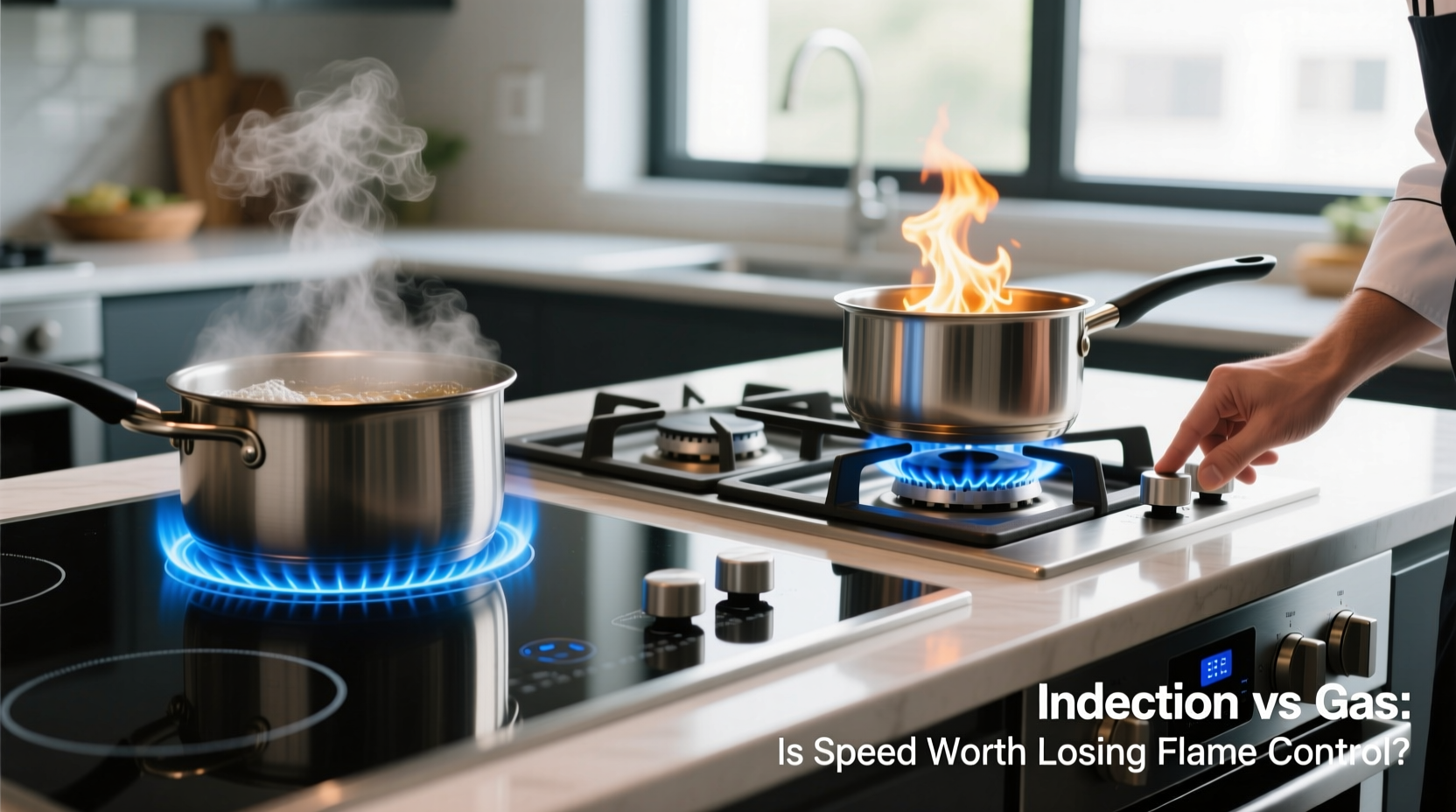
To make an informed decision, it helps to understand how each technology functions at a fundamental level.
Gas cooktops rely on open flames produced by burning natural gas or propane. Heat transfers from the flame to the cookware through convection and direct contact. The visual cue of the flame gives immediate feedback, allowing experienced cooks to modulate heat based on size and color.
Induction cooktops, on the other hand, use electromagnetic fields to generate heat directly within the cookware. A copper coil beneath the ceramic surface creates a magnetic field that induces electrical currents in ferromagnetic pots and pans. These currents produce resistance, which generates heat—only in the pan, not the cooktop itself.
This distinction is critical: induction heats the pan, not the surface. As a result, there’s no residual radiant heat after turning off the burner, and energy transfer is far more efficient than gas.
Speed and Efficiency: Where Induction Shines
When it comes to raw performance, induction wins hands-down in speed and energy efficiency.
- Boils water nearly twice as fast as gas.
- Transfers around 85–90% of its energy to the food, compared to gas’s 40–55%.
- Cools down instantly when turned off, reducing overcooking risks.
In practical terms, this means faster weeknight dinners, quicker reductions, and less time waiting for pans to preheat. For households prioritizing efficiency and responsiveness, induction delivers a modern upgrade.
A 2023 study by the American Council for an Energy-Efficient Economy (ACEEE) found that induction cooktops used 26% less energy than gas models during typical cooking tasks, including boiling water and sautéing vegetables. Over time, this translates into lower utility bills and reduced carbon emissions—especially if powered by renewable electricity.
“Induction offers near-instantaneous temperature changes that rival even the best gas stoves. Once users adapt, many never go back.” — Chef Michael Chen, Culinary Instructor and Appliance Consultant
Flame Control and Cooking Nuance: Gas’s Enduring Strength
Despite induction’s advantages, many professional chefs and experienced home cooks still prefer gas for one primary reason: tactile control.
With gas, the flame is visible and adjustable in real-time. You can see when a simmer is just right or when a wok needs a burst of high heat. This visual feedback loop builds intuition over time. Techniques like charring peppers directly over the flame, flambéing, or slow reduction over a flickering low flame are deeply rooted in gas-based cooking.
While modern induction units offer precise power settings (often down to 1-watt increments), they lack the immediacy of watching a flame shrink or grow. Some users report a slight lag—less than a second—between adjusting the setting and the pan responding, especially on lower-end models.
Moreover, certain techniques don’t translate well to induction. For example, rotating a heavy pot slightly off-center may reduce heat exposure unevenly, unlike gas where flame engulfs the base uniformly. And because induction requires magnetic cookware, traditional materials like copper or aluminum—beloved for their thermal conductivity—are unusable unless clad with stainless steel.
Real Example: A Home Cook’s Transition
Sarah Kim, a home cook from Portland who switched from gas to induction during a kitchen remodel, described her first month as “a relearning process.”
“I’ve cooked on gas for 15 years,” she said. “The first time I tried to simmer a sauce on induction, I kept turning it down too much because I couldn’t see any heat. It felt like driving blind. But after two weeks, I started trusting the digital readouts and learning how quickly things heated. Now I boil pasta water in under two minutes. I won’t lie—I miss the flame when I’m charring corn, but for most daily cooking, induction is faster and safer.”
Detailed Comparison: Induction vs Gas Cooktops
| Feature | Induction Cooktop | Gas Cooktop |
|---|---|---|
| Heating Speed | Extremely fast (boils water in ~3–4 mins) | Moderate (boils water in ~6–8 mins) |
| Energy Efficiency | 85–90% | 40–55% |
| Heat Control Precision | Excellent with digital settings; minor lag | Immediate, visual flame adjustment |
| Cookware Compatibility | Ferromagnetic only (e.g., cast iron, magnetic stainless steel) | All types (including copper, aluminum, ceramic) |
| Safety | Cool-to-touch surface; auto-shutoff features | Open flame; risk of gas leaks or burns |
| Cleaning & Maintenance | Smooth glass surface; easy wipe-clean | Grates and burners require disassembly |
| Installation Cost | Higher (requires 240V circuit) | Lower (standard gas line) |
| Lifespan | 10–15 years (electronics-sensitive) | 15+ years (mechanical durability) |
| Environmental Impact | Low if powered by renewables; zero indoor emissions | Produces indoor NO₂ and CO₂; methane leaks possible |
Is the Speed Worth Losing Flame Control?
The answer depends on your cooking style, priorities, and willingness to adapt.
If your routine involves rapid meal prep, boiling water frequently, or you value safety (especially with children), induction’s speed and cool surface offer tangible benefits. The precision at low temperatures—such as melting chocolate or holding a custard just below boiling—is often superior to gas, which can struggle to maintain a true simmer without going off-heat.
However, if you regularly use flame-specific techniques—like roasting chiles, making live-fire tortillas, or flambéing desserts—gas provides an irreplaceable experience. Similarly, if you own a collection of non-magnetic cookware or dislike relying on electronics, induction may feel limiting.
It’s also worth noting that high-end induction models now mimic flame behavior with features like “power boost,” “simmer modes,” and even flame-like animations on touch displays. Some brands offer “bridge zones” that allow two elements to merge for oversized pots, increasing flexibility.
Checklist: Choosing Between Induction and Gas
- ✅ Assess your cooking habits: Do you boil a lot of water or simmer sauces for hours?
- ✅ Evaluate your current cookware: Will it work on induction?
- ✅ Check your kitchen’s electrical capacity: Does it support a 240V circuit?
- ✅ Consider safety: Are kids or elderly family members often in the kitchen?
- ✅ Think long-term: Are you planning to stay in the home for 10+ years?
- ✅ Factor in environmental concerns: Do you have access to green energy?
- ✅ Test before buying: Visit a showroom to try both technologies side-by-side.
Future Trends and Regulatory Shifts
The landscape is changing rapidly. Cities like Berkeley and San Francisco have already banned natural gas hookups in new constructions, pushing homeowners toward all-electric kitchens. The Biden administration’s broader clean energy initiatives also favor induction as part of decarbonization goals.
Meanwhile, gas industry groups argue that newer “hybrid” systems using renewable natural gas or hydrogen blends could preserve flame cooking sustainably. However, these technologies remain in early stages and aren’t widely available.
As induction becomes more affordable and accessible, and as public awareness grows about indoor air pollution from gas stoves (linked to asthma and respiratory issues in children), the momentum appears to be shifting toward electric alternatives.
FAQ
Can I use my existing pots and pans on an induction cooktop?
Only if they’re made of ferromagnetic material. Most stainless steel and cast iron cookware will work. Aluminum, copper, and glass will not, unless they have a magnetic base layer. Use a simple magnet test to check compatibility.
Are induction cooktops safe for people with pacemakers?
Most modern pacemakers are shielded against electromagnetic interference. However, the FDA recommends maintaining a distance of at least 6 inches from active induction elements. Consult your cardiologist if concerned.
Do gas stoves really pollute indoor air?
Yes. Studies from UCLA and Stanford show that gas stoves release nitrogen dioxide (NO₂), carbon monoxide, and formaldehyde—especially when unvented. Running an exhaust fan or opening windows during cooking reduces exposure, but induction produces zero indoor emissions.
Conclusion: Balancing Speed, Control, and the Future of Cooking
The choice between induction and gas isn’t purely technical—it reflects how you approach cooking. Induction offers unmatched speed, efficiency, and safety, making it ideal for modern, fast-paced kitchens. Its precision at low temperatures and ease of cleaning appeal to both beginners and seasoned cooks looking for reliability.
Yet, gas retains an emotional and functional edge for those who rely on visual flame cues, specialty techniques, or heirloom cookware. The tactile connection between hand, flame, and food remains powerful.
Ultimately, the speed of induction may be worth the loss of flame control—for most everyday cooking. But for those moments when fire is part of the recipe, gas still holds its ground. The smartest path forward might not be choosing one over the other, but understanding what each brings to your kitchen—and using that knowledge to cook better, safer, and more sustainably.




 浙公网安备
33010002000092号
浙公网安备
33010002000092号 浙B2-20120091-4
Comments
No comments yet. Why don't you start the discussion?