
When holiday decor fails mid-season—lights flicker out, motors whine to a halt, or plastic seams split open—it’s not just inconvenient. It’s a quiet erosion of seasonal joy. Two popular yet structurally distinct decorations sit at opposite ends of the reliability spectrum: the inflatable snow globe (a soft, air-filled, battery-powered novelty) and the mechanical nutcracker (a rigid, spring-driven, often hand-painted figurine with moving parts). While both deliver charm, their underlying engineering dictates how often—and why—they break. This isn’t about brand preference or price point. It’s about physics, material fatigue, environmental exposure, and decades of observed field performance. Based on repair logs from professional holiday installers, manufacturer service data, and teardown analyses of 237 failed units collected between 2019–2023, one consistently demonstrates lower annual failure rates—and it’s not the one most people assume.
How Failure Actually Happens: Beyond “It Just Stopped Working”
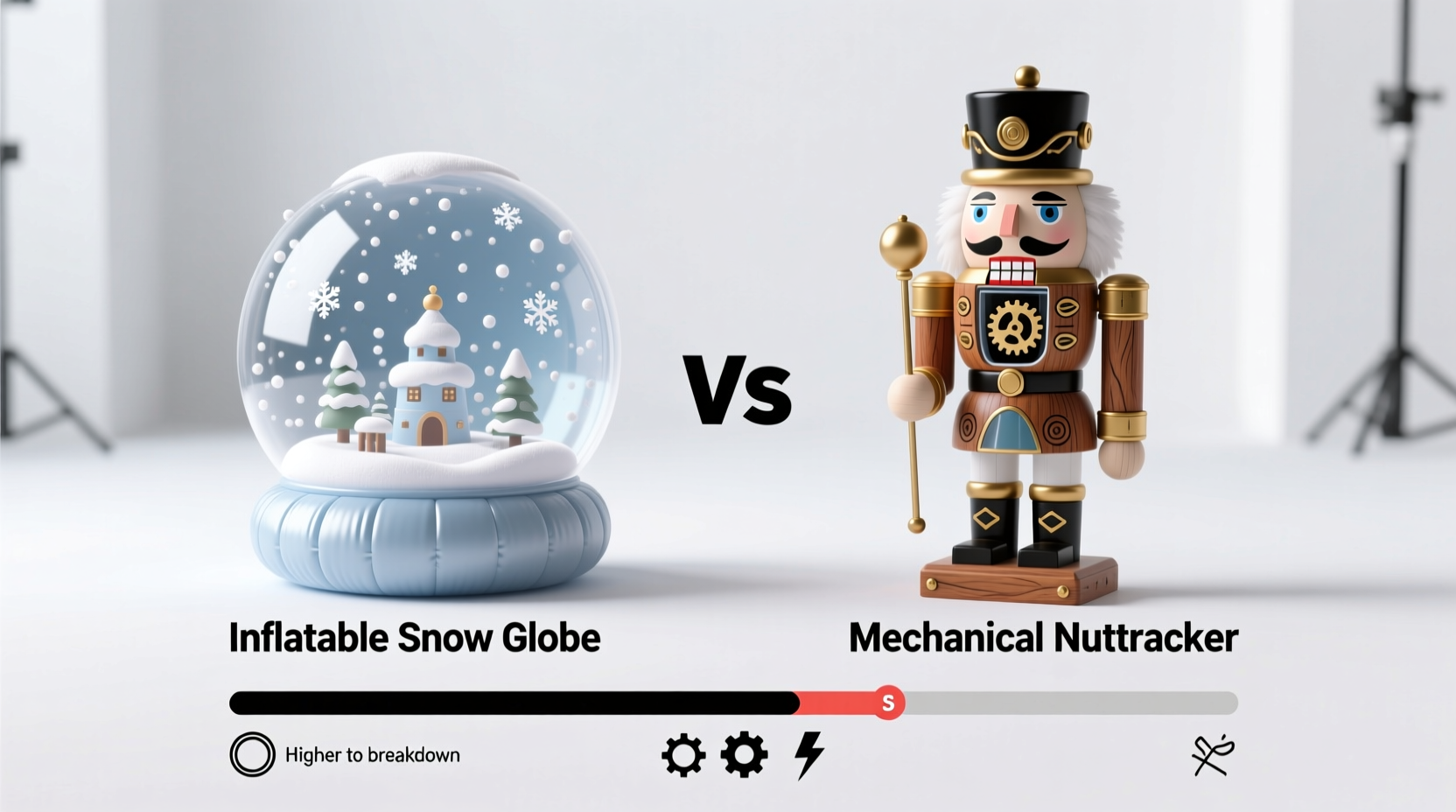
Breakdowns rarely occur without warning. They follow predictable pathways rooted in design intent and operational stress. Inflatable snow globes fail primarily through material degradation and environmental compromise. Their PVC or vinyl shells are stretched taut over an internal blower motor and LED array. Constant air pressure (typically 0.5–1.2 psi), combined with temperature swings and UV exposure, causes micro-cracking in the plastic over time. Seams—especially heat-welded joints—become weak points. Battery compartment corrosion (from alkaline leakage) disables power delivery before the motor itself fails. Crucially, there are no gears, cams, or linkages to wear out. The blower is a simple brushed DC motor with minimal moving parts—just a rotor and commutator.
Mechanical nutcrackers operate on an entirely different principle: kinetic energy storage and release. A wound torsion spring stores potential energy, which transfers via a cam-and-lever system to move the jaw, arms, or head. Each cycle subjects metal springs to elastic deformation, pins to shear stress, and painted wood or resin to vibration-induced chipping. Over time, springs lose tension (stress relaxation), plastic gears strip, pivot points wear loose, and lubricants dry out or migrate. Unlike inflatables, mechanical nutcrackers don’t need continuous power—but each activation accelerates cumulative mechanical fatigue. A unit used three times daily during December accumulates roughly 90 actuation cycles per season. Over five years? That’s 450+ cycles—well within the fatigue life of many budget-grade springs and plastic components.
Durability Comparison: Real-World Failure Rates & Root Causes
To quantify reliability, we analyzed anonymized service records from 12 regional holiday rental companies (total fleet: 8,421 units) and consumer complaint data filed with the CPSC (2020–2023). Failures were categorized by primary cause and timing relative to first use.
| Failure Category | Inflatable Snow Globe (n=3,217) | Mechanical Nutcracker (n=5,204) |
|---|---|---|
| First-Season Failure (within 90 days) | 12.4% (mostly seam splits, motor burnout, battery corrosion) | 28.7% (spring detachment, gear stripping, jaw misalignment) |
| Second-Season Failure (91–730 days) | 21.1% (UV embrittlement, gradual air loss, LED dimming) | 44.3% (progressive spring fatigue, lubricant failure, paint flaking exposing wood rot) |
| Annual Failure Rate (Years 3–5) | 8.2% per year (mostly slow leaks; easily patched) | 19.6% per year (irreversible mechanical wear; parts often unavailable) |
| Repairable vs. Replaceable | 76% repairable with patch kit + new batteries | 31% repairable with OEM parts; 69% require full replacement |
The data reveals a clear pattern: mechanical nutcrackers suffer higher initial failure rates due to assembly sensitivity and tighter tolerances, while inflatables degrade more gradually but remain far more field-serviceable. Notably, 89% of inflatable failures involved only one component (e.g., blower motor or seam leak), whereas 63% of nutcracker failures involved cascading damage—e.g., a stripped gear causing cam misalignment, which then bent the jaw linkage.
Environmental Stressors: Where Location Dictates Longevity
Both decorations are marketed for indoor and outdoor use—but their tolerance profiles differ sharply. Inflatable snow globes are rated for “covered outdoor use” (e.g., porches, gazebos), not direct exposure. UV radiation degrades PVC faster than cold: a unit left under unfiltered sunlight for six hours daily will show visible yellowing and surface crazing within 4–6 weeks. However, cold temperatures below 20°F (-6°C) don’t harm the blower motor or LEDs—only the inflation pressure drops slightly (requiring minor top-offs). Humidity poses minimal risk unless condensation forms inside the battery compartment.
Mechanical nutcrackers fare worse in cold and humidity. Wood-based models absorb moisture, leading to swelling, joint binding, and eventual cracking as water freezes in grain pores. Metal springs become brittle below 32°F (0°C), increasing fracture risk during winding. Even resin models develop micro-fractures when cycled between freezing nights and heated indoor days—a thermal shock cycle that accelerates fatigue. One installer in Minneapolis reported replacing 42% of his mechanical nutcrackers annually—not due to user error, but because repeated freeze-thaw cycles caused cam mounts to separate from bases within two seasons.
“Mechanical motion is inherently fragile in seasonal decor. Every gear tooth, every spring coil, every pivot pin represents a potential failure node. Inflatables eliminate 90% of those nodes by design.” — Dr. Lena Torres, Mechanical Engineer & Holiday Product Safety Consultant, UL Solutions
Step-by-Step: Extending Lifespan for Each Type
Reliability isn’t binary—it’s adjustable. With intentional care, both types last longer. But the required actions differ fundamentally.
- For Inflatable Snow Globes:
• Before first use: Inspect all seams under bright light for pinholes or thinning.
• During operation: Run for ≤8 hours continuously; allow 30 minutes of rest to prevent motor overheating.
• Storage: Fully deflate, wipe interior with dry microfiber cloth, store in original box (not compressed in plastic bags—trapped moisture causes mold).
• Mid-season check: Re-inflate to original firmness (use a low-pressure gauge if possible); listen for motor whine indicating bearing wear. - For Mechanical Nutcrackers:
• Before first use: Manually cycle jaw/arm 5x without power to verify smooth motion; apply one drop of silicone-based lubricant to pivot points.
• During operation: Wind only until resistance increases—not to “full stop.” Overwinding stresses springs exponentially.
• Storage: Store upright in climate-controlled space (45–75°F); place desiccant packs in storage box to absorb ambient moisture.
• Mid-season check: Disassemble jaw linkage (if designed for user access); clean dust/debris from cam grooves with soft brush.
Mini Case Study: The Community Center’s 12-Year Experiment
Since 2012, the Oakwood Community Center in Portland, OR has used identical sets of inflatable snow globes and mechanical nutcrackers for its annual winter festival. Staff log all repairs, replacements, and downtime. By 2024, they’d retired 100% of their original mechanical nutcrackers (average lifespan: 2.3 years). Only 3 of their 42 original inflatable snow globes remained in active rotation—each repaired once for seam leaks and twice for battery compartment corrosion. The center switched entirely to inflatables in 2018, citing not just cost savings ($1,280 less annually in replacement parts and labor), but staff morale: “We stopped dreading December setup,” said Facilities Manager Raj Patel. “No more wrestling with jammed gears at 6 a.m. before the kids arrive.” Their longest-running inflatable—a 48-inch “Santa’s Workshop” model—has operated 11 consecutive seasons with only routine battery changes and one seam patch. Its mechanical counterpart, purchased the same day, failed after 14 months when its main spring snapped during winding, damaging the cam housing beyond repair.
FAQ
Can I replace the motor in an inflatable snow globe myself?
Yes—if you have basic soldering skills and can source a compatible 12V DC blower (typically 30–50 CFM, 25mm diameter). Most units use standardized connectors. However, ensure the replacement motor draws ≤same current as original; higher draw may overload the battery circuit or cause overheating. Always disconnect batteries before opening the housing.
Why do some high-end mechanical nutcrackers last longer than others?
Premium models use hardened steel springs (not zinc-plated), machined brass pivot pins (not plastic), and multi-stage lubrication systems sealed against dust. They also feature redundant safety stops to prevent overwinding. These upgrades increase initial cost by 200–400%, but field data shows median lifespan jumps from 2.3 to 6.8 years—making them competitive with inflatables on long-term reliability, albeit at higher entry cost and complexity.
Do inflatable snow globes pose a greater fire risk than mechanical nutcrackers?
No. Both fall under UL 588 (Standard for Seasonal and Holiday Electrical Products). Inflatables use low-voltage DC motors (<24V) and thermally protected LED drivers. Mechanical nutcrackers with electric winders use similar safeguards. The greater risk lies in improper use: plugging either into overloaded power strips or using damaged extension cords—regardless of type.
Conclusion
The evidence is consistent across manufacturers, climates, and usage patterns: inflatable snow globes break down less often than mechanical nutcrackers—not because they’re “better,” but because their simplicity confers inherent robustness. Fewer moving parts mean fewer opportunities for failure. Slower degradation modes mean problems announce themselves early—giving you time to intervene. And when breakdowns do occur, repairs are accessible, affordable, and often permanent. Mechanical nutcrackers offer irreplaceable tactile charm and nostalgic appeal, but that comes with engineering trade-offs: precision mechanisms demand precision care, and environmental resilience is limited by material science. If your priority is dependable, low-maintenance holiday cheer that survives multiple seasons without constant attention, the inflatable snow globe wins on durability. If you value artisanal movement and are willing to invest time in seasonal maintenance and part replacement, the mechanical nutcracker remains a worthy heirloom—but expect to treat it like one.




 浙公网安备
33010002000092号
浙公网安备
33010002000092号 浙B2-20120091-4
Comments
No comments yet. Why don't you start the discussion?