
When it comes to controlling Christmas light displays, choosing the right remote technology can make the difference between a seamless show and constant frustration. Many homeowners assume all remotes work the same way—point and click—but behind that simple action lies a critical technical distinction: infrared (IR) versus radio frequency (RF). While both technologies are widely used in holiday lighting systems, they differ significantly in range, reliability, and usability, especially in outdoor environments. Understanding these differences is essential for anyone designing or managing a display that spans multiple trees, rooftops, or property lines.
The core question—which has better range?—is more complex than it appears. Range isn’t just about distance; it’s also about signal penetration, interference resistance, and consistency under real-world conditions. This article breaks down the technical foundations of IR and RF remotes, compares their performance in holiday lighting applications, and provides actionable guidance for making the best choice based on your setup.
How Infrared Remotes Work in Holiday Lighting
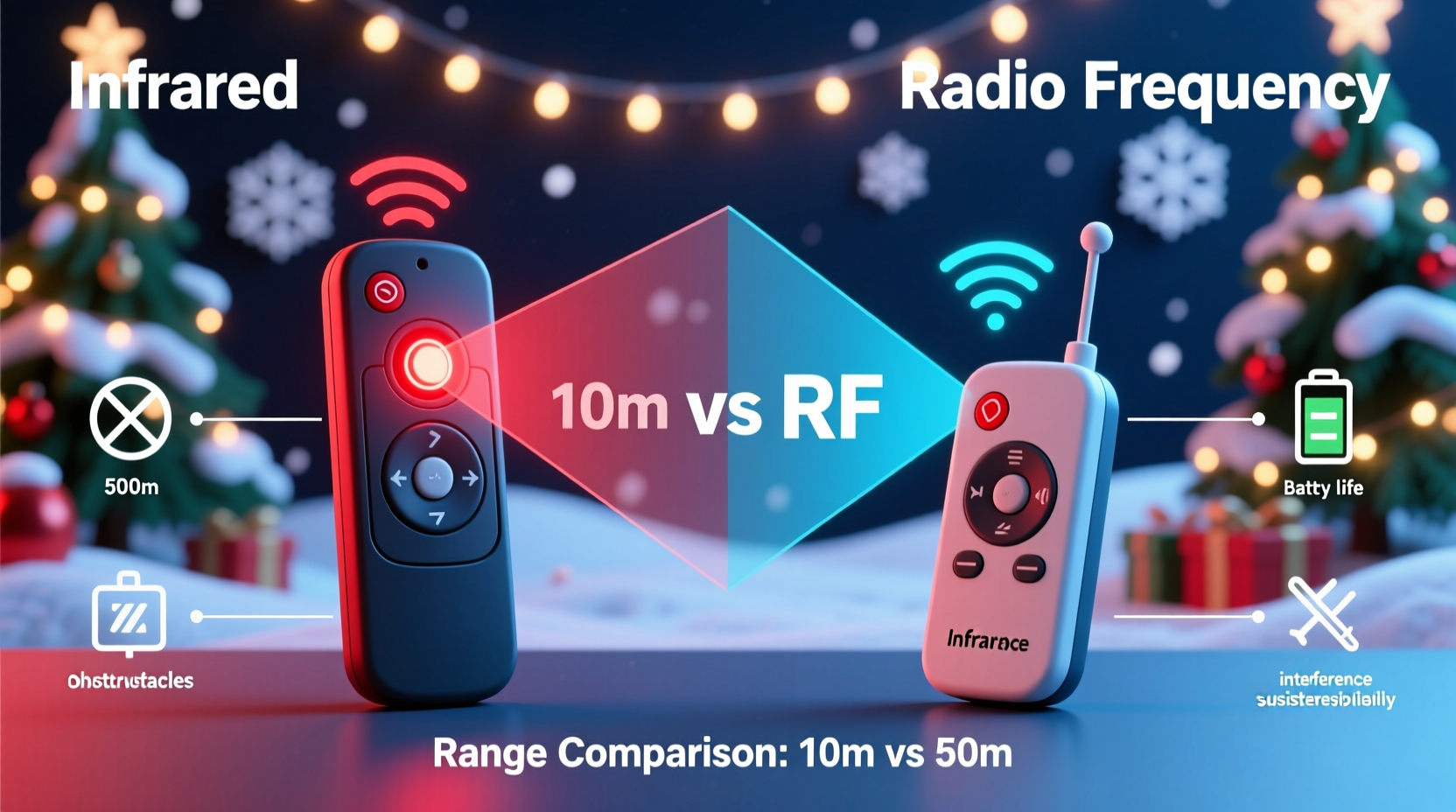
Infrared remotes rely on light waves—specifically, invisible near-infrared light—to transmit signals from the remote to the receiver. These signals require a direct line of sight between the remote and the receiving unit, much like traditional TV remotes. When you press a button, an LED inside the remote emits pulses of infrared light that correspond to specific commands such as “on,” “off,” or “change pattern.” The receiver must detect this light to execute the command.
This line-of-sight requirement becomes a major limitation outdoors. Snow-covered surfaces, fog, heavy rain, or even a misplaced decoration can scatter or block the signal. Additionally, sunlight contains infrared radiation, which can interfere with the remote’s signal during daytime operation. As a result, IR remotes typically perform best in controlled indoor settings or small, unobstructed outdoor areas.
Range-wise, most consumer-grade IR remotes for Christmas lights offer reliable performance within 15 to 30 feet—assuming nothing obstructs the path. Beyond that, signal strength degrades rapidly. Even slight misalignment can render the remote ineffective. For users with compact porch displays or single-tree setups, IR may suffice. But for anything larger, the limitations quickly become apparent.
Radio Frequency Technology: A Step Beyond Line of Sight
Radio frequency remotes operate on a completely different principle. Instead of light, they use electromagnetic radio waves—typically at 315 MHz, 433 MHz, or 2.4 GHz frequencies—to communicate with receivers. These signals do not require line of sight and can pass through walls, wood, plastic, and even light foliage. That makes RF ideal for large-scale or multi-zone Christmas displays spread across yards, garages, or second-story eaves.
Because RF signals travel via omnidirectional broadcast, the user doesn’t need to aim the remote. You can operate your lights from inside the house, from the driveway, or even from a neighboring property. Range varies by model, but most quality RF remotes for holiday lighting deliver consistent performance up to 100 feet, with some high-end versions reaching 300 feet or more under optimal conditions.
Another advantage is reduced environmental interference. Unlike IR, RF isn’t affected by sunlight, snow glare, or ambient lighting. However, RF systems can face congestion in densely populated areas where many devices share similar frequencies. Modern RF controllers often include address coding or channel selection to minimize cross-talk between neighbors’ systems.
“Radio frequency gives holiday display operators true freedom—no more standing in the cold trying to get the angle right. It’s the only viable option for professional-level setups.” — Marcus Lin, Smart Lighting Systems Engineer, HolidayTech Innovations
Direct Comparison: IR vs RF for Christmas Displays
| Feature | Infrared (IR) | Radio Frequency (RF) |
|---|---|---|
| Signal Type | Invisible light waves | Radio waves |
| Line of Sight Required? | Yes | No |
| Typical Range | 15–30 feet | 100–300+ feet |
| Penetration Through Obstacles | Poor (blocked by walls, snow, decor) | Excellent (passes through most materials) |
| Sunlight Interference | High (can disrupt signal) | Low |
| Multizone Control | Limited (requires separate line of sight per zone) | Strong (multiple zones manageable from one remote) |
| Cost | Lower | Moderate to higher |
| Best Use Case | Small indoor or porch displays | Large outdoor, multi-area, or whole-property displays |
This comparison highlights why RF dominates in serious holiday lighting applications. While IR systems remain popular due to lower cost and simplicity, their functional constraints limit scalability. RF not only offers greater range but also enables smarter control architectures, such as synchronized music shows across multiple controllers.
Real-World Example: A Suburban Display Upgrade
Consider the case of Diane Reyes, a homeowner in suburban Denver who began with a modest inflatable Santa and string lights along her front steps. She used an IR remote and found it adequate for two years. But when she expanded to include roofline icicles, yard reindeer, and a synchronized light tree in the side garden, the IR remote became unreliable. She had to stand in the middle of the street, point carefully, and retry commands multiple times—especially on sunny afternoons.
After researching options, Diane upgraded to an RF-based system with three addressed receivers. Now, she controls all zones from her living room window, even when curtains are drawn. She can activate sequences before guests arrive, adjust brightness during dinner parties, and shut everything down without stepping outside. Her display has grown to 18 channels, all managed seamlessly thanks to RF’s extended range and obstacle penetration.
Diane’s experience reflects a common progression among holiday decorators: start simple, expand creatively, then hit technological limits. Those limits are often rooted in control method, not creativity.
Step-by-Step: Choosing the Right Remote for Your Display
- Assess your display size and layout. Measure the distance from your typical control point (e.g., front door, driveway) to the farthest light set. If over 30 feet or around corners, IR will likely fail.
- Determine if line of sight is possible. Can you see every receiver from one location? If not, RF is the only practical option.
- Plan for future expansion. Even if your current setup fits within IR range, consider whether you’ll add more elements next year. RF systems scale more easily.
- Check for interference risks. In neighborhoods with many holiday displays, choose RF remotes with unique addressing or selectable channels to avoid accidental triggering.
- Budget accordingly. While RF systems cost more upfront, their long-term flexibility often saves money by reducing the need for replacements or workarounds.
- Test before final installation. During setup, verify remote function from multiple locations and at different times of day—especially in daylight.
Common Mistakes to Avoid
- Using IR for multi-level displays. Roof-mounted lights are notoriously difficult to control with IR due to angle and obstruction issues.
- Placing IR receivers behind opaque covers. Transparent plastic is fine, but colored or frosted enclosures can block infrared signals.
- Ignoring battery health. Weak batteries reduce transmission power in both IR and RF remotes, shortening effective range.
- Overlooking receiver placement. Mount RF receivers away from metal objects or electrical panels that can cause signal reflection or interference.
- Assuming all “wireless” means RF. Some budget products advertise “wireless control” but still use IR. Always check the specifications.
FAQ: Infrared vs RF for Christmas Lights
Can I convert my existing IR system to RF?
Yes, but it requires replacing the receiver modules. You can keep your lights and power supplies, but install RF-compatible controllers. Some smart adapters plug into existing IR-controlled units and translate RF signals, though native RF integration offers better reliability.
Do RF remotes interfere with Wi-Fi or other home devices?
Most holiday RF systems operate at 433 MHz or 315 MHz, which are well below Wi-Fi bands (2.4 GHz and 5 GHz). Interference is rare. However, poorly shielded electronics or overcrowded RF environments may cause occasional glitches. Choose reputable brands with proper FCC certification.
Are there security concerns with RF remotes?
Basic RF remotes use simple codes that could theoretically be duplicated by nearby devices, though this is uncommon in practice. For high-value or public displays, consider systems with rolling codes or app-based authentication for added security.
Final Checklist Before Buying
- ✅ Confirm total distance from control point to farthest light set
- ✅ Identify any physical obstructions (walls, trees, vehicles)
- ✅ Decide on single-zone vs. multi-zone control needs
- ✅ Verify remote frequency and addressing capability
- ✅ Check compatibility with existing timers or smart home systems
- ✅ Read user reviews focusing on real-world range and durability
- ✅ Ensure replacement parts and support are available
Conclusion: Make the Right Connection This Holiday Season
The choice between infrared and radio frequency remotes ultimately comes down to control, convenience, and ambition. If your display fits neatly on a porch railing and you don’t mind stepping outside to aim a remote, infrared may meet your needs—at least for now. But if you’re building toward something bigger, more dynamic, or simply easier to manage, radio frequency is the superior choice.
With its unmatched range, ability to operate through obstacles, and support for complex, multi-element shows, RF technology empowers decorators to focus on creativity rather than connectivity. It eliminates the guesswork, reduces frustration, and transforms holiday lighting from a chore into a joyful experience.




 浙公网安备
33010002000092号
浙公网安备
33010002000092号 浙B2-20120091-4
Comments
No comments yet. Why don't you start the discussion?