
In the modern kitchen, time is often the most valuable ingredient. As home cooks seek faster, more efficient ways to prepare meals, multi-cookers like the Instant Pot have surged in popularity. At the same time, the humble slow cooker—long a staple for set-it-and-forget-it meals—remains widely used. With many Instant Pots offering a \"slow cook\" function, a natural question arises: If you already own an Instant Pot, do you really need a separate slow cooker?
The answer isn’t as simple as yes or no. While the Instant Pot can replicate many slow cooker functions, there are nuanced differences in performance, convenience, capacity, and cooking outcomes that matter depending on your lifestyle, cooking habits, and expectations.
Understanding the Core Differences
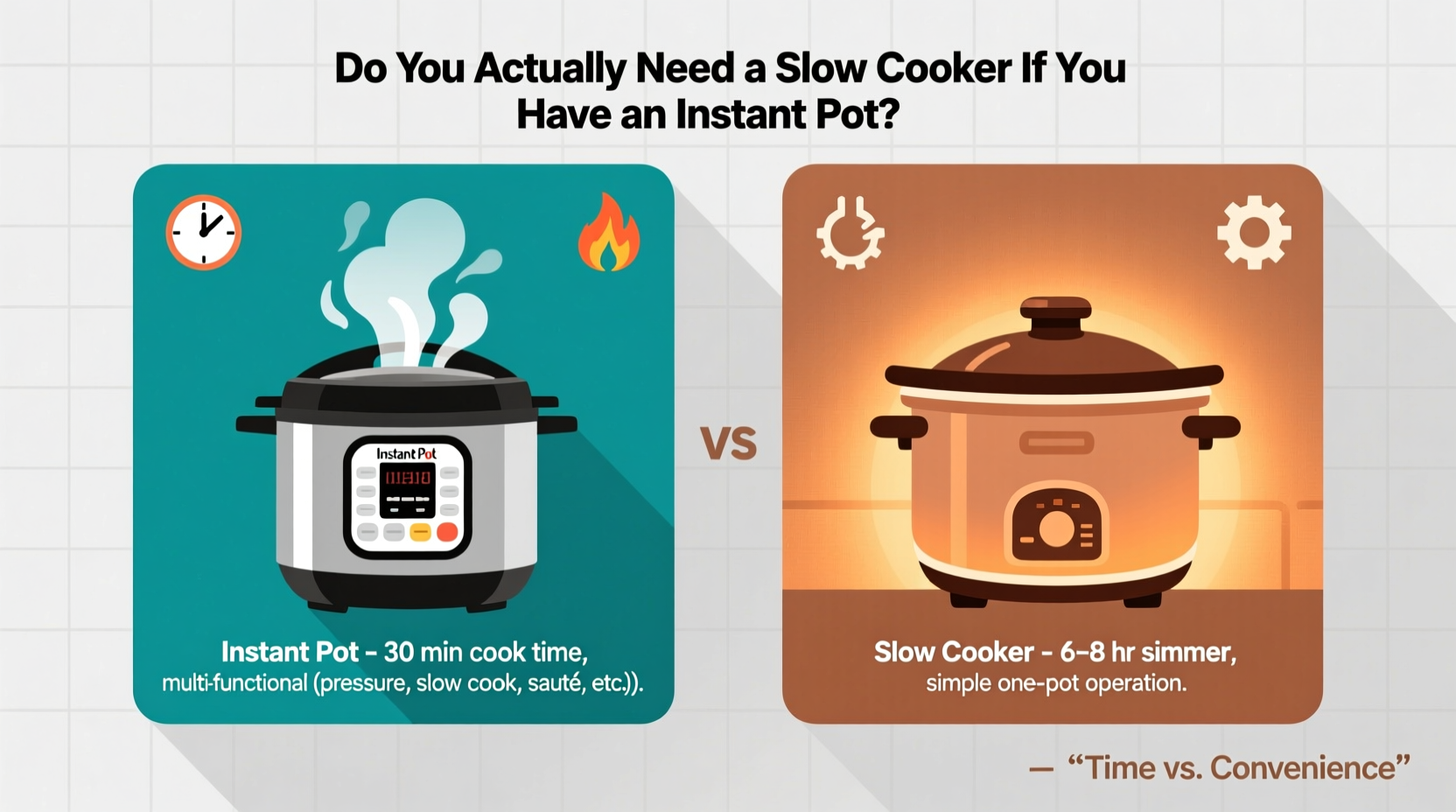
The first step in deciding whether you need both appliances is understanding how they operate differently—even when performing similar tasks.
A traditional slow cooker heats food gradually using low, consistent heat from the sides and bottom. It operates at two or three temperature settings (low, high, and sometimes warm) and typically takes 4 to 10 hours to cook meals. This method excels at breaking down tough cuts of meat, melding flavors in stews, and maintaining moisture over long periods.
The Instant Pot, by contrast, is a multi-functional electric pressure cooker. Its primary advantage lies in speed: it uses pressurized steam to cook food up to 70% faster than conventional methods. However, it also includes other modes such as sauté, steam, yogurt, rice, and—importantly—a “Slow Cook” setting. This feature mimics traditional slow cooking but with some key limitations.
“While the Instant Pot’s slow cook function works well for many recipes, it doesn’t always replicate the gentle, even heat distribution of a dedicated slow cooker.” — Chef Marcus Lee, Home Appliance Specialist
Performance Comparison: Slow Cooking Mode Face-Off
On paper, the Instant Pot's slow cook mode seems sufficient. You can set it for 1–10 hours on Low, Medium, or High, just like a classic Crock-Pot. But in practice, several factors affect results:
- Temperature control: Instant Pots tend to run hotter than traditional slow cookers, especially on “Low,” which may actually exceed the ideal slow-cooking range (around 200°F). This can lead to overcooked edges or drier textures.
- Lid fit and evaporation: The Instant Pot’s sealing lid reduces evaporation, which is great for soups but can make dishes too wet when following traditional slow cooker recipes designed for some liquid reduction.
- Startup delay: Unlike a slow cooker that begins heating immediately, the Instant Pot may take 10–15 minutes to reach target temperature, slightly altering total cook time.
- No manual adjustment: Once started, you can't easily adjust the temperature without stopping the cycle, limiting flexibility during long cooks.
Detailed Feature Comparison
| Feature | Instant Pot (with Slow Cook Function) | Traditional Slow Cooker |
|---|---|---|
| Cooking Speed | Fast (pressure cooking); moderate (slow cook mode) | Slow (4–10 hours typical) |
| Heat Distribution | Bottom-only heating; less even in slow cook mode | Surround heating; more consistent |
| Evaporation Control | Minimal (sealed lid) | Moderate (vented lid or loose fit) |
| Capacity Range | 3–8 quarts (common) | 2–8+ quarts (including large oval models) |
| Preheating/Searing | Yes (built-in sauté function) | No (unless model has it) |
| Portability | Heavier, bulkier base | Lighter, simpler design |
| Energy Efficiency | High (shorter cook times) | Moderate (longer runtime) |
| Recipe Flexibility | Multiple functions in one device | Simplified interface, fewer distractions |
This table highlights a central trade-off: versatility versus specialization. The Instant Pot offers more functions, but the slow cooker delivers more predictable, hands-off results for long simmering tasks.
Real-World Use Case: Meal Prep for a Busy Family
Consider Sarah, a working parent of two, who relies on slow-cooked meals during the week. Every Sunday, she prepares a large batch of pulled pork for tacos, chili for freezing, and bone broth for immune support. She owns an 8-quart Instant Pot and a 6-quart oval-shaped slow cooker.
Initially, she tried switching entirely to the Instant Pot, using its slow cook mode. However, she noticed her chili lacked depth—likely because the sealed environment prevented flavor concentration through gentle reduction. The pulled pork also turned out slightly stringy, possibly due to uneven heat distribution.
When she returned to her traditional slow cooker for these dishes, the results improved dramatically. The longer, gentler cook time allowed collagen to break down more fully, and the slight evaporation thickened sauces naturally. Meanwhile, she continued using the Instant Pot for weekday dinners—like quick curries, hard-boiled eggs, and steamed vegetables—where speed mattered most.
Sarah concluded: “I thought I could replace my slow cooker, but I ended up valuing both. The Instant Pot saves me time on busy nights. The slow cooker gives me better results for weekend meal prep.”
When the Instant Pot Replaces the Slow Cooker
For many users, especially those with limited counter or storage space, the Instant Pot *can* effectively replace a slow cooker—if certain conditions are met:
- You prioritize speed and convenience. If you’re looking to simplify your kitchen tools and don’t mind tweaking recipes, the Instant Pot covers most bases.
- You cook smaller portions. Most Instant Pots are round and perform best when filled between one-third and two-thirds full. Overfilling affects pressure and slow cook consistency.
- You adapt recipes accordingly. Reducing liquid, checking early, and avoiding delicate ingredients (like dairy added too soon) helps prevent mishaps.
- You value multi-functionality. If you also use pressure cooking, yogurt-making, or sautéing, consolidating into one appliance makes sense.
When You Still Need a Dedicated Slow Cooker
Despite the Instant Pot’s capabilities, there are scenarios where a standalone slow cooker remains superior:
- Oval-shaped dishes: Roasts, whole chickens, or large briskets fit better in oval slow cookers. Round Instant Pots crowd these items, leading to uneven cooking.
- All-day unattended cooking: Some users report reliability concerns with the Instant Pot’s slow cook mode over extended periods (8+ hours). Traditional slow cookers are built specifically for this purpose.
- Delicate simmering: Dishes like custards, dips, or mulled wine benefit from lower, steadier heat not always achievable in an Instant Pot.
- Ease of transport: Taking a dish to a potluck? Many slow cookers come with removable crocks. Instant Pot inner pots are heavy and awkward to carry once hot.
- Lower learning curve: For elderly users or those new to cooking, a slow cooker’s simplicity—plug in, turn dial, walk away—is easier than navigating digital menus.
“The slow cooker isn’t obsolete—it’s specialized. Like owning both a blender and a food processor, each tool has its niche.” — Lisa Tran, Culinary Educator and Kitchen Tech Reviewer
Checklist: Should You Keep Your Slow Cooker?
Use this checklist to decide whether to keep, sell, or donate your slow cooker based on your cooking style:
- ☐ Do you regularly cook large roasts or whole poultry? → Keep slow cooker
- ☐ Do you make dishes that require long, gentle reduction (e.g., tomato sauce, bone broth)? → Keep slow cooker
- ☐ Is counter space extremely limited? → Consider keeping only Instant Pot
- ☐ Do you frequently use non-slow-cook Instant Pot functions (yogurt, pressure steam, etc.)? → Instant Pot may suffice
- ☐ Are you comfortable adjusting recipes for sealed environments? → Instant Pot viable substitute
- ☐ Do you host gatherings or bring dishes to events? → Removable crock = advantage for slow cooker
Frequently Asked Questions
Can I use my Instant Pot for all the same recipes as a slow cooker?
Mostly, yes—but with adjustments. Reduce liquids by 10–20%, avoid overfilling, and monitor doneness earlier than recipe times suggest. Avoid recipes relying on gradual evaporation unless modified.
Is the Instant Pot’s slow cook function safe for 8+ hours?
Technically, yes, but some users report inconsistent temperatures during extended cycles. For safety and optimal results, avoid exceeding 8 hours unless closely monitored. Traditional slow cookers are generally more reliable for all-day cooking.
Does the Instant Pot save energy compared to a slow cooker?
Yes, significantly—when using pressure cooking. However, when using slow cook mode, energy usage is comparable. The Instant Pot may draw more power initially to heat up, while slow cookers use less wattage over longer periods.
Final Verdict: Do You Actually Need Both?
If your goal is minimalism and you're willing to adapt recipes, the Instant Pot can adequately replace a slow cooker for most everyday needs. Its ability to sear, pressure cook, and slow cook in one unit offers unmatched convenience for time-crunched households.
However, if you regularly prepare large family meals, rely on true low-and-slow techniques, or appreciate the simplicity and portability of a dedicated appliance, keeping a slow cooker adds tangible value. It’s not redundancy—it’s strategic tool selection.
Ultimately, needing a slow cooker when you own an Instant Pot depends less on technology and more on how you cook. The kitchen isn’t about having the fewest tools, but the right ones. In many cases, both appliances complement rather than compete with each other.




 浙公网安备
33010002000092号
浙公网安备
33010002000092号 浙B2-20120091-4
Comments
No comments yet. Why don't you start the discussion?