
For home cooks looking to simplify meal prep, two appliances dominate countertop conversations: the Instant Pot and the slow cooker. Both promise convenience, tender results, and set-it-and-forget-it ease. But when it comes to versatility—the ability to handle a wide range of cooking tasks, ingredients, and time constraints—one clearly pulls ahead. Understanding the strengths and limitations of each helps clarify not just which is better overall, but which is better for your kitchen.
The slow cooker has been a staple since the 1970s, ideal for long-simmered stews and family-sized roasts. The Instant Pot, introduced in 2010, combines pressure cooking with multiple functions like sautéing, steaming, yogurt-making, and even baking. While both have loyal followings, their design philosophies differ dramatically. One excels in patience and flavor development; the other in speed and multifunctionality. So which is truly more versatile?
Cooking Methods and Functional Range
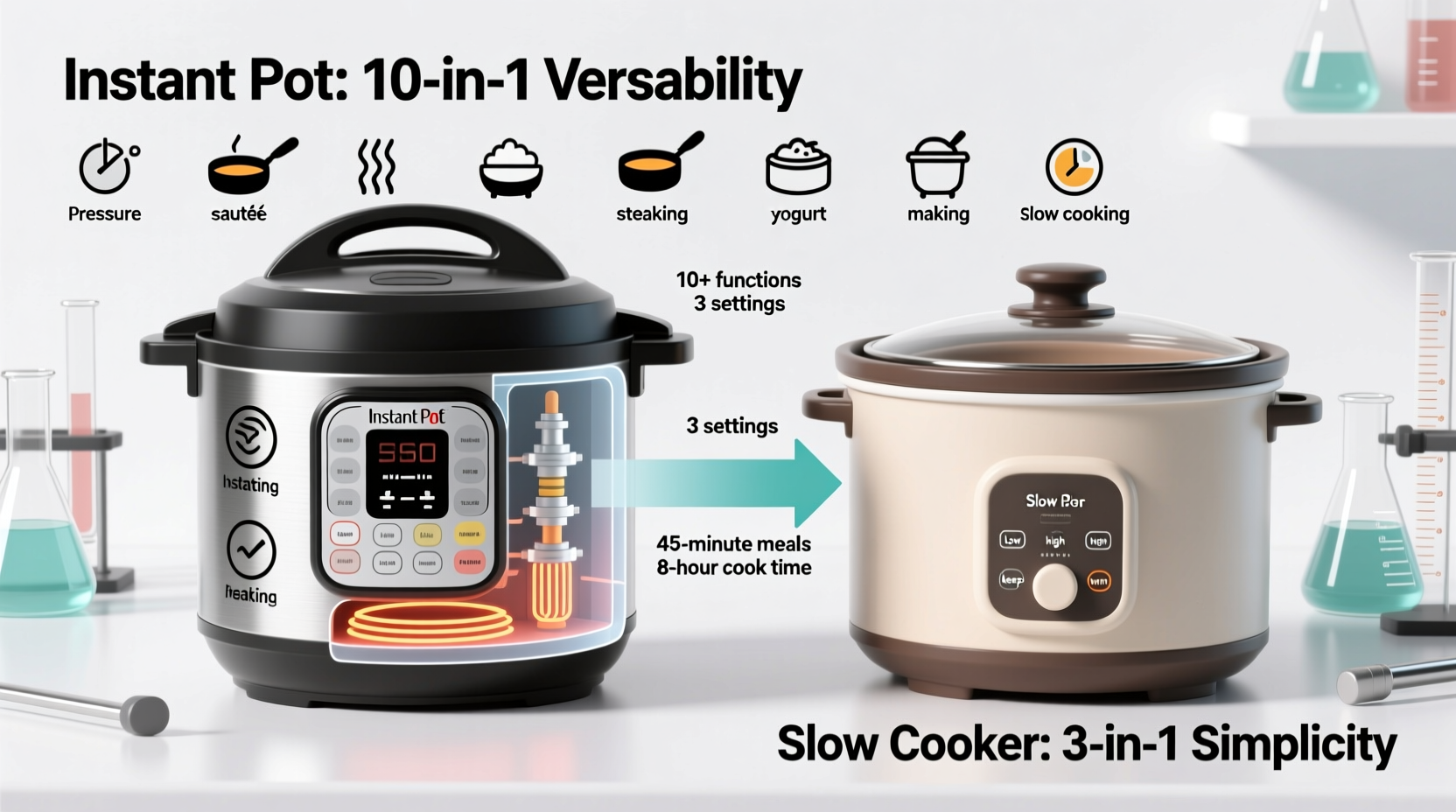
The core difference lies in how each appliance cooks—and how many ways it can do so. A traditional slow cooker operates on two or three heat settings—low, high, and sometimes warm—using low, steady heat over several hours. It’s designed for dishes that benefit from prolonged moisture-based cooking: pulled pork, beef stew, chili, and hearty soups.
In contrast, the Instant Pot is a multi-cooker. Most models offer at least seven functions: pressure cook, slow cook, sauté, steam, rice, yogurt, and keep warm. Some higher-end versions add sterilize, sous vide, and cake settings. This means you can brown meat directly in the pot before pressure cooking, make yogurt from scratch, steam vegetables, or cook rice without switching appliances.
This functional breadth gives the Instant Pot a clear edge in versatility. It replaces not just a slow cooker, but also a rice cooker, steamer, and stovetop skillet for certain applications. You can start dinner from raw ingredients entirely within the device, minimizing cleanup and maximizing control.
Time Efficiency and Daily Practicality
Time is a critical factor in modern kitchens. Slow cookers require planning—often six to eight hours on low, or three to four on high. That makes them ideal for mornings when you want dinner ready by evening. But they’re less useful if you decide at 5 PM that you need food fast.
The Instant Pot shines here. A pot roast takes 6–8 hours in a slow cooker. In an Instant Pot, it’s done in 60 minutes, including natural pressure release. Dried beans go from soak to tender in under an hour, no pre-soaking required. Hard-boiled eggs? 12 minutes from cold water to peelable perfection.
“Pressure cooking isn’t just faster—it preserves nutrients better than boiling and develops deep flavors in a fraction of the time.” — Dr. Linda Garcia, Food Scientist and Culinary Technologist
This speed doesn’t come at the cost of quality. In fact, pressure cooking often enhances texture and flavor retention, especially in tough cuts of meat or legumes. For busy households, shift workers, or last-minute planners, this responsiveness makes the Instant Pot far more adaptable to unpredictable schedules.
Recipe Flexibility and Ingredient Compatibility
Both appliances handle similar ingredients—meats, grains, legumes, vegetables—but their outcomes vary based on method.
Slow cookers excel with collagen-rich meats (chuck roast, short ribs) and fibrous vegetables (carrots, potatoes). The long, moist heat breaks down connective tissue gently, yielding fall-apart tenderness. However, they struggle with foods that require crispness or precise timing. Green beans turn mushy, poultry skin never browns, and dairy tends to curdle unless added at the end.
The Instant Pot handles a broader ingredient spectrum. It can cook delicate fish fillets in 3 minutes with steam, make creamy risotto without constant stirring, and even bake a small cheesecake using the “cake” function. Its ability to switch between modes allows layered cooking: sear chicken, deglaze, then pressure cook in sauce—all in one pot.
| Cooking Task | Slow Cooker | Instant Pot |
|---|---|---|
| Beef Stew | Excellent (6–8 hrs) | Excellent (45 mins) |
| White Rice | Poor (not designed) | Excellent (12 mins) |
| Yogurt | No capability | Yes (8–10 hrs incubation) |
| Sautéing Onions | No capability | Yes (adjustable temp) |
| Steamed Vegetables | No (unless modified) | Yes (3–5 mins) |
| Dried Beans (no soak) | Not recommended | Yes (25–40 mins) |
This table illustrates why the Instant Pot is functionally more versatile. It covers nearly all slow cooker uses while adding dozens of new ones.
Real-World Use Case: Feeding a Family on a Tight Schedule
Consider Sarah, a nurse working 12-hour shifts. She used to rely on her slow cooker, setting it before work. But her schedule changed frequently—sometimes she started at 6 AM, sometimes at 3 PM. Pre-planning meals became unreliable. On days off, she wanted quick dinners.
She switched to an Instant Pot. Now, after a late shift, she can sauté onions and ground turkey, add canned tomatoes and lentils, and pressure cook chili in 20 minutes. On weekends, she makes bone broth in 2 hours instead of 24. She even makes Greek yogurt for her kids, saving money and avoiding additives.
“It’s not just about speed,” she says. “It’s about being able to adapt. I don’t have to choose between healthy homemade food and my time anymore.”
This scenario reflects a growing trend: people value appliances that fit dynamic lifestyles. The slow cooker demands routine. The Instant Pot accommodates spontaneity.
When the Slow Cooker Still Wins
Despite the Instant Pot’s advantages, the slow cooker has irreplaceable strengths. It’s simpler to use—plug it in, add ingredients, turn it on. No learning curve for pressure valves or sealing rings. It’s also safer for unattended cooking over full workdays, with minimal risk of malfunction.
Some purists argue that slow-cooked dishes develop deeper, more rounded flavors due to extended simmering. While pressure cooking locks in taste effectively, certain braises and soups benefit from evaporation and gradual reduction—something pressure cooking prevents by design.
Additionally, slow cookers are generally cheaper. Entry-level models start around $20; Instant Pots begin at $70–$100. For someone who only wants to make Sunday pot roast or overnight oatmeal, the investment may not be justified.
Step-by-Step: Transitioning from Slow Cooker to Instant Pot
If you're considering making the switch—or adding an Instant Pot alongside your slow cooker—follow this practical guide:
- Start with familiar recipes. Convert your favorite slow cooker chili or pulled chicken recipe to the Instant Pot using online conversion guides.
- Learn the basics. Understand natural vs. quick pressure release, tristate valves, and float valve operation.
- Use the sauté function. Brown meat and aromatics in the pot before pressure cooking to enhance flavor.
- Adjust liquid ratios. Pressure cooking requires at least 1 cup of liquid; slow cooking can use less. Don’t reduce liquids too much.
- Shorten cook times. As a rule of thumb, 6–8 hours on low in a slow cooker = 45–60 minutes under pressure.
- Experiment with non-traditional uses. Try steaming dumplings, making yogurt, or cooking frozen meat safely.
- Clean properly. Remove and wash the sealing ring separately; it can retain odors if not cleaned promptly.
This transition empowers users to leverage the Instant Pot’s full potential without abandoning trusted recipes.
Frequently Asked Questions
Can an Instant Pot replace a slow cooker completely?
Yes, every Instant Pot includes a slow cook function that mimics traditional slow cooking. You can use it for 4–8 hour stews, dips, or simmered sauces just like a standalone slow cooker. However, some users note the heating element is less consistent than dedicated models, so results may vary slightly.
Is the Instant Pot safe for everyday use?
Modern Instant Pots have over 10 built-in safety mechanisms, including lid interlock, pressure sensors, and overheating protection. When used according to instructions, they are extremely safe. Never force-open the lid, and ensure the vent is clear before pressurizing.
Do I need special recipes for the Instant Pot?
Not necessarily. Many traditional recipes can be adapted. Focus on reducing cook time and maintaining adequate liquid. Numerous cookbooks and websites offer tested conversions for everything from lasagna to cheesecake.
Final Verdict: Which Is More Versatile?
Versatility means the ability to perform many different tasks effectively. By that definition, the Instant Pot is objectively more versatile than the slow cooker. It performs all slow cooker functions and adds pressure cooking, sautéing, steaming, yogurt-making, rice cooking, and more. It adapts to last-minute decisions, supports healthier cooking methods, and reduces reliance on multiple appliances.
The slow cooker remains valuable for its simplicity, affordability, and hands-off reliability. It’s ideal for those who follow predictable routines or prefer ultra-long simmers for maximum flavor diffusion. But it cannot reverse its limitations: no browning, no rapid cooking, no multi-stage preparation.
For most modern kitchens, especially those juggling time, dietary needs, and diverse meal preferences, the Instant Pot offers broader utility. It’s not just a pressure cooker—it’s a complete cooking system. Whether you’re batch-prepping meals, cooking dried beans without soaking, or making dessert, it adjusts to your needs.




 浙公网安备
33010002000092号
浙公网安备
33010002000092号 浙B2-20120091-4
Comments
No comments yet. Why don't you start the discussion?