
For decades, Intel has dominated the processor landscape, particularly in PCs and data centers. But by 2025, the semiconductor world is shifting. Samsung, long known for memory and foundry services, is aggressively expanding into custom CPU design with its Exynos and new AI-focused silicon. The question on everyone’s mind: Are Samsung’s chips truly closing the gap with Intel? The answer isn’t a simple yes or no—it depends on the use case, architecture, and ecosystem momentum.
The State of Intel in 2025
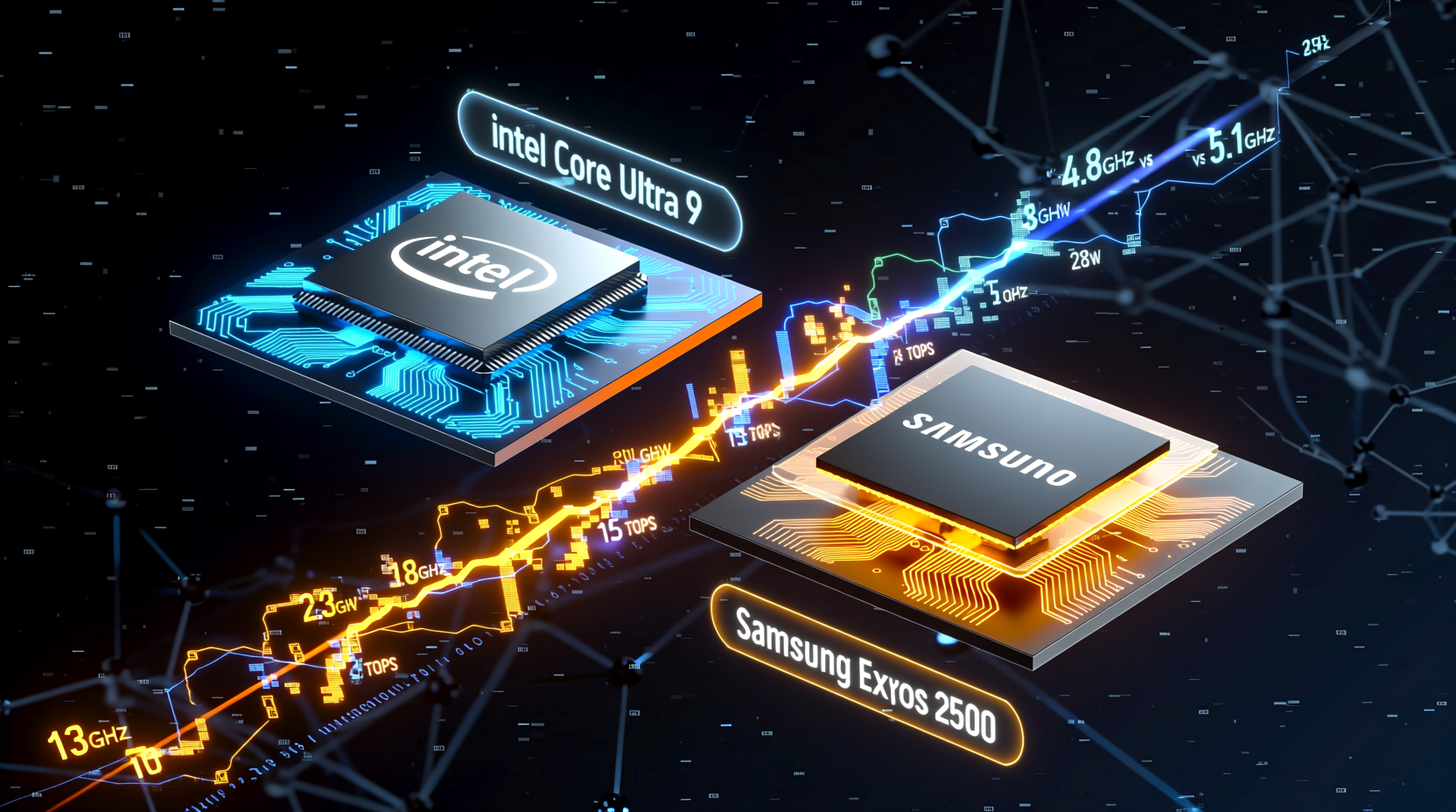
Intel remains a powerhouse in x86 architecture, especially in desktops, laptops, and enterprise servers. By 2025, the company has rolled out its 18A (1.8 nanometer-class) process node, a major leap in transistor density and power efficiency. This advancement powers the Lunar Lake and Arrow Lake CPUs, which deliver strong single-threaded performance and improved AI acceleration via integrated NPUs (Neural Processing Units).
However, Intel’s journey hasn’t been smooth. Delays in past process nodes allowed competitors to gain ground, and while its IDM 2.0 strategy—revamping manufacturing and opening foundry services—is gaining traction, market share in mobile and edge computing remains limited. In client computing, Intel still leads in raw performance for high-end workloads like video editing, engineering simulations, and gaming.
“Intel’s resurgence in process technology is real, but they’re fighting not just for performance leadership, but for relevance in an ARM-dominated mobile and AI era.” — Dr. Rajiv Khanna, Semiconductor Analyst at TechInsight Group
Samsung’s Rise in Processor Design and Fabrication
Samsung’s strength has always been vertical integration—controlling everything from chip design to fabrication and packaging. Historically, its Exynos processors underperformed compared to Qualcomm’s Snapdragon chips, leading to their phase-out in flagship Galaxy phones in favor of third-party SoCs. But 2025 marks a turning point.
Samsung Foundry now produces chips for major clients including Google (Tensor), IBM, and even NVIDIA. Internally, Samsung is investing heavily in its own CPU cores based on ARMv9 architecture, with a focus on power efficiency and heterogeneous computing. The newly launched “Exynos 2500” and “Samsung Mongoose AI” co-processor signal a serious intent to compete beyond smartphones.
Crucially, Samsung is leveraging its advanced 3GAE (Gate-All-Around FET) and 2GAP process technologies, rivaling TSMC’s 3nm and 2nm offerings. This allows Samsung to offer competitive power-to-performance ratios, particularly in mobile and edge AI applications.
Performance Comparison: Intel vs Samsung in Key Areas
| Category | Intel (Core Ultra 9 / Xeon 6) | Samsung (Exynos 2500 / Custom AI SoC) |
|---|---|---|
| Process Node | 18A (equivalent to 1.8nm) | 2GAP (2nm-class GAA) |
| Architecture | x86-64 + Intel AI Boost | ARMv9 + Custom Mongoose AI Cores |
| Single-Core Performance | ★★★★☆ (High) | ★★★☆☆ (Moderate-High) |
| Multi-Core Efficiency | ★★★☆☆ (Good) | ★★★★☆ (Excellent per watt) |
| AI Workload Handling | ★★★★☆ (Strong NPU + GPU offload) | ★★★★★ (Dedicated AI accelerator) |
| Thermal Efficiency (Smartphones/Laptops) | ★★★☆☆ | ★★★★☆ |
| Ecosystem Support | ★★★★★ (Windows, Linux, broad software) | ★★★☆☆ (Android, ChromeOS, growing AI tools) |
The table reveals a nuanced picture. While Intel maintains an edge in traditional computing tasks, Samsung excels in energy-efficient processing and AI inference—critical for mobile devices, wearables, and edge computing. For battery-powered devices, Samsung’s designs often run cooler and longer, making them ideal for next-gen AI assistants and always-on features.
Real-World Example: The 2025 Galaxy Book vs. Intel-Powered Ultrabook
Consider two premium ultraportable laptops released in early 2025: the Samsung Galaxy Book Flex powered by the Exynos 2500 with Mongoose AI, and a competing model with Intel Core Ultra 7.
In synthetic benchmarks, the Intel machine wins in Cinebench and Adobe Premiere export times. But in daily usage—web browsing, email, video conferencing, and local AI transcription—the Galaxy Book delivers 14 hours of battery life compared to the Intel model’s 9.5 hours. Additionally, the Samsung device handles real-time language translation and voice summarization more smoothly due to its dedicated AI core.
This scenario illustrates a shift: peak performance isn’t the only metric that matters. For most users, sustained responsiveness, low heat, and intelligent automation are becoming equally important—areas where Samsung’s holistic system-on-chip approach shines.
Can Samsung Challenge Intel Beyond Mobile?
The bigger question isn’t whether Samsung can match Intel in smartphones—it’s whether it can break into laptops, desktops, and servers.
In 2025, Samsung has begun supplying custom ARM-based server chips to Korean telecom providers and cloud startups focused on AI inference. These chips consume 30% less power than comparable Intel Xeon models while handling lightweight AI tasks efficiently. However, they lack full x86 compatibility, limiting adoption in legacy enterprise environments.
Meanwhile, Microsoft and Amazon are pushing ARM-based server deployments, creating opportunities for Samsung to enter via partnerships. If Samsung can offer compelling total cost of ownership (TCO) through lower power consumption and competitive pricing, it could capture niche markets—even without displacing Intel entirely.
Checklist: Evaluating Samsung vs Intel Chips in 2025
- ✅ Determine your primary workload: content creation favors Intel; mobile/AI favors Samsung.
- ✅ Check software compatibility—especially for x86-only applications.
- ✅ Evaluate battery life and thermal behavior, not just benchmark scores.
- ✅ Consider AI capabilities: Does the device need on-device intelligence?
- ✅ Look at long-term support and driver updates from the manufacturer.
- ✅ Assess ecosystem integration—does it work seamlessly with your other devices?
Future Outlook: A Multi-Architecture World
The era of one-size-fits-all processors is ending. By 2025, we’re seeing a fragmentation of computing needs: high-performance x86 for professional workstations, efficient ARM for mobile and edge, and specialized accelerators for AI and machine learning.
Intel isn’t standing still. Its hybrid architecture, combining performance and efficiency cores, borrows ideas from ARM’s big.LITTLE design. Meanwhile, Samsung is exploring RISC-V for IoT and embedded systems, further diversifying its portfolio.
Rather than a direct \"winner,\" the industry is moving toward specialization. Samsung won’t replace Intel in data centers overnight, but it is carving out strategic niches where efficiency, integration, and AI matter most.
Frequently Asked Questions
Will Samsung processors ever power Windows laptops effectively?
They already do—with limitations. Samsung has partnered with Microsoft on ARM-based Galaxy Books using Qualcomm chips. With its own Exynos platform maturing, Samsung could supply its processors for Windows on ARM devices by 2026. Full app compatibility remains a hurdle, but emulation and native ARM64 apps are improving rapidly.
Are Samsung chips better for gaming than Intel?
No—not yet. Intel’s integrated Arc graphics and strong CPU performance still dominate in gaming laptops and desktops. Samsung’s current SoCs lack discrete-level graphics and aren’t optimized for high-FPS gaming. However, for cloud gaming and mobile titles, Samsung’s power efficiency gives it an edge in sustained play sessions.
Is Samsung manufacturing better than Intel’s?
In terms of process technology, Samsung’s 2GAP and 3GAE nodes are competitive with Intel’s 18A, though yield rates and stability vary. Intel maintains tighter control over its entire stack, while Samsung Foundry serves multiple clients, creating potential bottlenecks. For now, both are neck-and-neck, but Intel’s IDM 2.0 model may give it long-term consistency advantages.
Conclusion: A New Era of Competition
Samsung’s processors are no longer afterthoughts. In 2025, they represent a credible alternative in mobile, edge computing, and AI-driven applications. While Intel still leads in raw performance and software maturity, Samsung is winning on integration, efficiency, and forward-looking design.
The real story isn’t about who’s “catching up”—it’s about how competition is driving innovation. Consumers benefit from faster advancements, better battery life, and smarter devices. Whether you rely on an Intel-powered workstation or a Samsung-driven smartphone, the future of computing is more diverse and dynamic than ever.




 浙公网安备
33010002000092号
浙公网安备
33010002000092号 浙B2-20120091-4
Comments
No comments yet. Why don't you start the discussion?