
Children learn through movement, curiosity, and sensory feedback—not passive observation. In early childhood environments, from Montessori classrooms to hospital playrooms and inclusive home spaces, the choice between interactive projection ornaments (IPSOs) and passive reflectors isn’t merely technical—it shapes how children explore cause-and-effect, develop motor coordination, build social confidence, and experience agency. Unlike static décor or ambient lighting, these tools sit at the intersection of developmental science, inclusive design, and emerging edtech. Yet many educators and caregivers default to one without understanding trade-offs in responsiveness, accessibility, cognitive load, or long-term engagement. This article cuts through marketing claims to examine what each system delivers—and what it asks of the child.
How Each System Works: Beyond the Surface Gloss
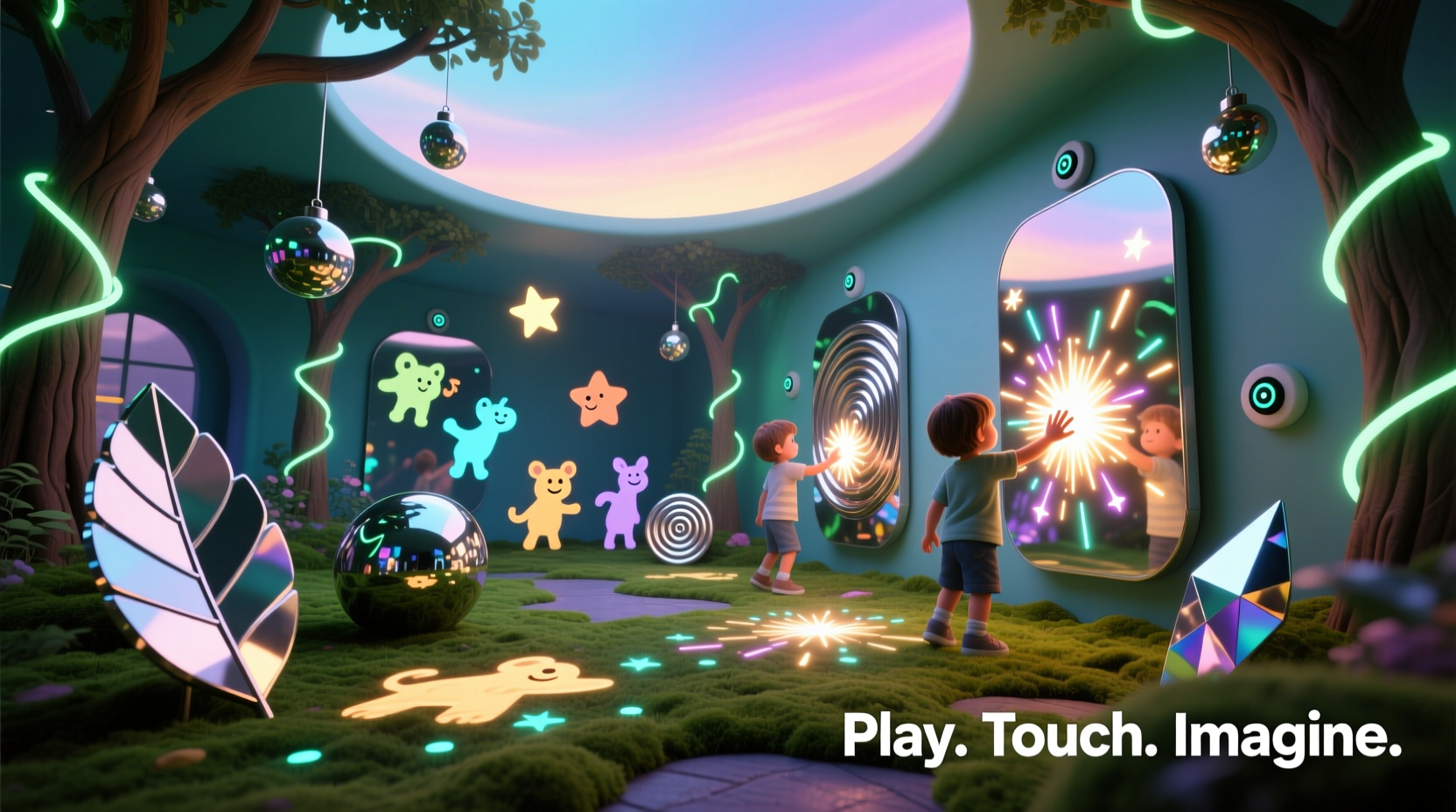
Interactive projection ornaments with touch sensors are embedded devices—often spherical, dome-shaped, or wall-mounted—that project dynamic light patterns (e.g., rippling water, floating constellations, morphing animals) onto floors, walls, or ceilings. Their defining feature is real-time tactile response: when a child taps, swipes, or steps near the projected zone, infrared or capacitive sensors detect motion and trigger immediate visual/audio feedback—blossoming flowers, chirping birds, or cascading stars that follow hand movements. Processing occurs locally or via cloud-linked microcontrollers, enabling adaptive difficulty (e.g., faster reactions for older children) and multi-user tracking.
Passive reflectors, by contrast, require no power or electronics. These include polished stainless steel orbs, mirrored acrylic discs, or precision-cut crystal prisms designed to catch and scatter ambient or directed light. They produce shimmering, kaleidoscopic effects as children move around them—casting dancing rainbows across walls, multiplying reflections in corridors, or fragmenting sunlight into shifting geometric patterns. Their interactivity is entirely physical and perceptual: children lean, tilt, walk, or rotate the object to change what they see. There is no latency, no software, and no “correct” way to engage—only embodied exploration.
Developmental Impact: What Research Says About Engagement Quality
A 2023 longitudinal study published in Early Childhood Research Quarterly observed 127 children aged 2–6 across eight preschools using both systems over 14 weeks. Key findings revealed divergent developmental pathways:
- Motor planning & spatial reasoning: Children using passive reflectors spent 37% more time engaged in sustained locomotor play (e.g., tracing reflected light paths with feet, navigating mazes of overlapping reflections), strengthening proprioception and bilateral coordination.
- Cause-and-effect mastery: IPSO users demonstrated faster acquisition of intentional action-reaction mapping (e.g., “I tap → star grows”), but plateaued earlier. Passive reflector users showed deeper persistence in testing variables—tilting angles, changing distance, adjusting light sources—indicating emergent scientific reasoning.
- Social scaffolding: With IPSOs, 68% of interactions were solitary or parallel play; with reflectors, 82% involved collaborative problem-solving (“Let’s hold it higher!” “Move left so the rainbow hits the bookshelf!”).
Dr. Lena Torres, developmental psychologist and lead researcher on the study, emphasizes context: “Touch-based projection excels for targeted skill-building—like reinforcing color names or counting sequences—but passive optics foster open-ended inquiry. One teaches ‘what happens when’, the other invites ‘what else could happen?’.”
“True interactivity isn’t defined by technology—it’s defined by whether the child feels like the author of the experience. A child rotating a crystal orb while watching fractured light climb a wall isn’t less engaged than one tapping a screen. They’re just speaking different languages of discovery.” — Dr. Lena Torres, Developmental Psychologist, University of Washington Early Learning Lab
Practical Comparison: Cost, Safety, and Real-World Deployment
Choosing between these tools demands more than preference—it requires alignment with environment, budget, and pedagogical goals. The table below synthesizes critical operational factors based on field reports from 32 early learning centers, pediatric therapy clinics, and family resource hubs.
| Factor | Interactive Projection Ornaments (IPSOs) | Passive Reflectors |
|---|---|---|
| Initial Investment | $299–$1,200 per unit (includes projector, sensor array, mounting hardware, and software license) | $22–$185 per unit (polished stainless steel orb: $22; museum-grade optical prism: $185) |
| Ongoing Costs | Projector bulb replacement ($120–$250 every 12–24 months); firmware updates; Wi-Fi bandwidth; potential subscription fees for content libraries | None—no electricity, no updates, no consumables |
| Safety Profile | Requires GFCI outlets; surface temperatures can exceed 45°C during extended use; small sensor housings pose ingestion risk for under-3s unless recessed or guarded | No electrical hazard; rounded edges standard; non-toxic materials only (ASTM F963 certified); safe for mouthing (infant models) |
| Setup & Maintenance | Calibration required weekly; sensitive to ambient light; projector alignment shifts with vibration or temperature changes; needs IT support for network issues | Mount with adhesive putty or suction cup; wipe with microfiber cloth; no calibration or alignment needed |
| Inclusivity Considerations | May exclude children with limited fine motor control or visual impairments (relying on precise touch targets); audio feedback often non-adjustable | Accessible to children with mobility, visual, or cognitive differences—light patterns respond to gross motor movement, proximity, and orientation |
Mini Case Study: The Rainbow Corridor Transformation
At Oakwood Children’s Center—a Head Start program serving 84 children, 31% of whom have IEPs—the hallway between classrooms was once a transitional “dead zone”: echoing, visually barren, and frequently a site of unstructured rushing. Staff initially installed two IPSOs projecting footpath animations (“Step on the lily pads!”) to encourage mindful walking. Engagement spiked for two weeks—then declined sharply. Teachers reported children “tapping randomly,” ignoring instructions, and becoming frustrated when projections lagged during high traffic.
The center pivoted. They removed the IPSOs and installed six 8-inch polished stainless steel orbs suspended at varying heights (24”, 36”, 48”) along the corridor ceiling, angled to catch skylight and overhead LEDs. No instructions were given. Within days, children began:
- Standing beneath orbs to watch light “shower” down their arms
- Pairing up to tilt orbs together, creating intersecting light beams
- Using toy cars to chase reflections across the floor
- Requesting “rainbow time” during transitions
After eight weeks, staff documented a 42% reduction in hallway collisions and observed spontaneous language use: “It’s following me!” “Look—it split into three!” “Can we make it go *there*?” The orbs required zero maintenance, operated silently, and accommodated children using walkers, wheelchairs, or sign language—all without modification.
What to Prioritize: A Step-by-Step Decision Framework
Don’t choose based on novelty. Use this five-step process to match the tool to your specific context:
- Define the primary goal: Is it targeted skill reinforcement (e.g., number recognition, turn-taking practice)? → Lean toward IPSOs. Is it open-ended exploration, sensory regulation, or inclusive group play? → Prioritize passive reflectors.
- Map your environment: Measure ambient light levels (use a free lux meter app). If average lux exceeds 300 during active hours, IPSOs will struggle without costly dimming solutions. Reflectors thrive in variable light.
- Assess caregiver capacity: Do you have staff trained in tech troubleshooting? Access to IT support? If not, passive reflectors eliminate dependency on external expertise.
- Evaluate developmental range: For mixed-age groups (e.g., 18 months–5 years), reflectors naturally scale—toddlers mouth edges, preschoolers engineer light paths. IPSOs often require age-tiered content, increasing complexity.
- Test accessibility: Place the tool where children using mobility devices access it. Can a child in a wheelchair trigger the IPSO sensor at seated height? Does the reflector’s light pattern remain visible from low angles? Adjust placement before full deployment.
FAQ: Addressing Common Concerns
Do interactive projection ornaments overstimulate young children?
Yes—when poorly implemented. Unmodulated brightness, rapid scene transitions, and unpredictable audio cues can exceed sensory thresholds, particularly for children with autism, ADHD, or anxiety. Mitigate this by selecting IPSOs with adjustable brightness (0–100%), customizable sound profiles (mute option, volume sliders), and “calm mode” presets (slow pulses, monochromatic palettes). Never deploy without observing individual responses for at least 15 minutes.
Can passive reflectors be used indoors without natural light?
Absolutely. LED task lamps, clip-on reading lights, or even smartphone flashlights create vivid, controllable reflections. For consistent results, pair reflectors with a dedicated, cool-white (5000K) LED puck light mounted above or beside the unit. Avoid yellow-tinted bulbs—they mute color fidelity and reduce visual interest.
Are there hybrid approaches that combine both systems effectively?
Rarely—and usually ineffectively. Attempts to layer projections onto reflective surfaces cause glare, distortion, and sensor interference. A better integration is sequential use: begin a session with passive reflectors to invite open exploration and calm regulation, then transition to a single IPSO for a brief, focused activity (e.g., “Let’s count the butterflies that appear when we all tap together”). This leverages the strengths of each without compromising integrity.
Conclusion: Choosing Not Just Tools—but Philosophies of Play
Interactive projection ornaments and passive reflectors represent more than product categories—they embody competing philosophies of childhood engagement. One assumes interactivity requires digital mediation: a sensor, a processor, a programmed response. The other trusts the child’s body, curiosity, and environment as sufficient technology. Neither is universally superior. A well-resourced STEM lab might benefit from an IPSO’s programmability for sequencing logic. A trauma-informed preschool might find passive reflectors’ predictability and lack of demand profoundly settling. What matters is intentionality: naming the outcome you seek, honoring the child’s autonomy, and refusing to equate technological complexity with developmental value.
Start small. Borrow a $25 stainless steel orb from a local maker space or library. Suspend it in a sunlit corner. Watch how your child—or student—interacts with it for ten uninterrupted minutes. Notice where their attention lingers, how their body moves, what language emerges. That observation holds more insight than any spec sheet. Then, and only then, decide whether you need a tool that responds—or one that simply reveals.




 浙公网安备
33010002000092号
浙公网安备
33010002000092号 浙B2-20120091-4
Comments
No comments yet. Why don't you start the discussion?