
Many people use the terms “introvert” and “socially anxious” interchangeably, but they describe fundamentally different experiences. One is a personality trait rooted in natural energy regulation; the other is a mental health condition marked by fear and avoidance. Confusing the two can lead to misdiagnosis, unnecessary self-doubt, or missed opportunities for support. Understanding the distinction empowers individuals to make informed choices about their well-being and recognize when quiet preferences cross into distress that warrants attention.
Introversion is not a flaw or disorder—it’s simply how some people are wired. Social anxiety, on the other hand, involves intense fear of judgment, embarrassment, or rejection in social situations, often leading to significant impairment in daily functioning. While introverts may enjoy solitude and find large gatherings draining, they don’t necessarily fear them. Socially anxious individuals, regardless of personality type, may want to connect with others but feel paralyzed by dread.
Understanding Introversion: A Personality Trait
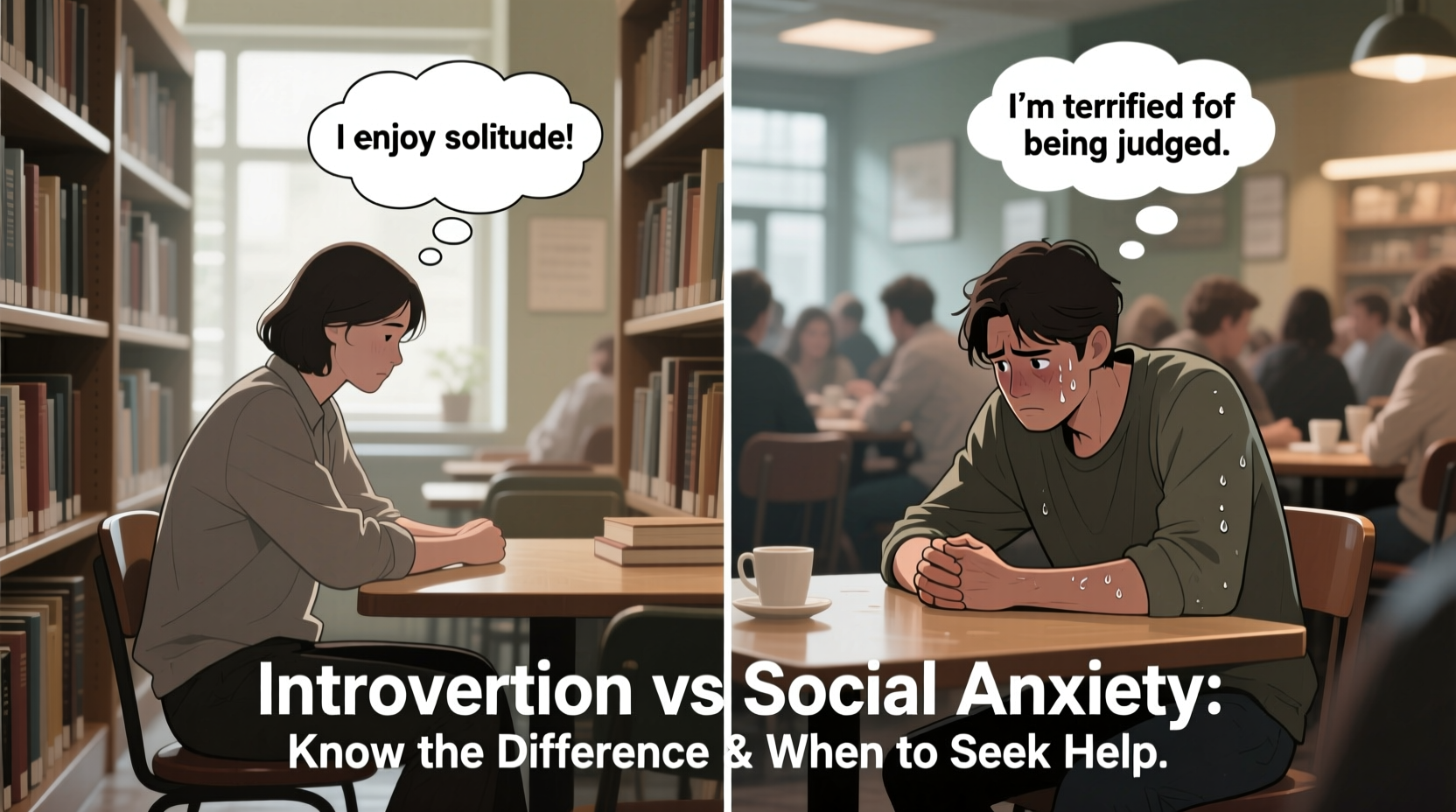
Introversion is one end of the extroversion-introversion spectrum in personality psychology. It reflects how people gain, spend, and recharge their energy. Introverts typically feel most energized when alone or in small, meaningful interactions. They often prefer deep conversations over small talk and may take time to process thoughts before speaking.
This preference isn’t about shyness or fear. An introvert might decline a party invitation because they know it will exhaust them—not because they’re afraid of being there. After socializing, they need downtime to recover, much like recharging a battery. This is a normal and healthy pattern, not a symptom of dysfunction.
Carl Jung first popularized the concept of introversion in the early 20th century, describing it as an inward-turning orientation of psychic energy. Modern research, including studies using brain imaging, suggests introverts may have higher baseline activity in regions related to internal thought, such as the frontal cortex. This neurological tendency supports deeper reflection and sensitivity to stimulation—both social and sensory.
Social Anxiety Disorder: More Than Just Nervousness
Social anxiety disorder (SAD), also known as social phobia, is a clinically recognized mental health condition. According to the Diagnostic and Statistical Manual of Mental Disorders (DSM-5), it involves a persistent fear of one or more social situations where scrutiny by others is possible. The individual fears acting in a way—or showing anxiety symptoms—that will be negatively evaluated.
This fear goes beyond typical nervousness. People with social anxiety often experience physical symptoms like rapid heartbeat, trembling, blushing, sweating, nausea, or mind going blank. These reactions occur even in low-stakes situations—ordering coffee, making eye contact, speaking up in meetings, or attending family dinners.
The emotional toll is significant. Many develop negative self-beliefs: \"I’ll sound stupid,\" \"They’ll think I’m awkward,\" \"I don’t belong here.\" These thoughts become automatic and hard to challenge. Avoidance becomes a coping mechanism, which only reinforces the fear over time.
“Social anxiety isn’t just stage fright. It’s a chronic fear of being seen, judged, or found lacking—even when no real threat exists.” — Dr. Lena Torres, Clinical Psychologist
Key Differences Between Introversion and Social Anxiety
Distinguishing between introversion and social anxiety requires looking at motivation, emotional response, and impact on life. Below is a comparison table highlighting core distinctions:
| Factor | Introversion | Social Anxiety |
|---|---|---|
| Motivation for solitude | Preference for low stimulation; need to recharge | Fear of embarrassment or negative evaluation |
| Emotional response to socializing | May feel tired afterward, but not distressed during | Experiences dread before, during, and after events |
| Desire to connect | Often enjoys deep relationships; chooses quality over quantity | Wants connection but feels blocked by fear |
| Physical symptoms | Rarely present unless overstimulated | Common: shaking, sweating, rapid heartbeat |
| Impact on functioning | Minimal; lifestyle adjustments are sufficient | Can interfere with work, education, relationships |
| Response to exposure | Gains energy from selective socializing | Avoidance worsens anxiety over time |
It’s important to note that someone can be both introverted and have social anxiety. In fact, introverts may be more vulnerable to developing social anxiety if they grow up in environments that devalue quietness or reward constant sociability. But the two are not mutually dependent—one does not cause the other.
Real-Life Example: Maya’s Story
Maya, a 28-year-old graphic designer, always preferred working remotely. She enjoyed her team’s Zoom calls but rarely joined after-work drinks. At first, colleagues assumed she was unfriendly. Over time, her manager questioned her engagement. Internally, Maya wrestled with confusion: did she dislike people, or was something wrong with her?
She loved collaborating creatively and had close friendships, but large office gatherings left her mentally drained. She didn’t avoid them out of fear—she attended when required—but needed a full day to recover. Her turning point came when asked to present her project to executives. Despite thorough preparation, she experienced panic attacks in the days leading up to it: insomnia, stomachaches, obsessive worry about stumbling over words.
Unlike her usual calm during routine interactions, this situation triggered disproportionate fear. That’s when she realized: her general preference for quiet wasn’t the issue. The intense dread around performance and judgment pointed to social anxiety, particularly in high-pressure settings. With therapy, Maya learned coping strategies and discovered she could thrive in social environments—on her own terms.
When to Seek Help: Recognizing the Threshold
There’s nothing wrong with being introverted. But if social fear begins to limit your life—turning \"I’d rather not\" into \"I can’t bear to\"—it may be time to consider professional support. Here are signs that social anxiety, not introversion, is at play:
- You avoid necessary social interactions (job interviews, doctor appointments, family events) due to fear.
- You experience physical symptoms (shaking, nausea, dizziness) before or during social encounters.
- You ruminate for hours or days after a minor interaction, convinced you embarrassed yourself.
- You turn down promotions, educational opportunities, or relationships because of social demands.
- Your anxiety causes significant distress or takes more than a few hours to recover from.
Therapy, particularly cognitive behavioral therapy (CBT), has strong evidence for treating social anxiety. CBT helps individuals identify distorted thinking patterns (“Everyone is judging me”), test those beliefs through gradual exposure, and build confidence in social competence. Medications like SSRIs may also be recommended in moderate to severe cases.
Step-by-Step Guide to Evaluating Your Experience
- Track your feelings: For one week, journal your reactions before, during, and after social events. Note energy levels, mood, and physical sensations.
- Identify patterns: Are you avoiding situations due to fatigue or fear? Is recovery time proportional to the event’s intensity?
- Assess desire vs. behavior: Do you wish you could participate more but feel held back by anxiety?
- Test discomfort tolerance: Try a mildly challenging social task (e.g., asking a stranger for directions). Observe your body and mind’s response.
- Consult a professional: A licensed therapist can differentiate between temperament and disorder using validated assessments.
Action Checklist: Responding with Clarity
Use this checklist to navigate your social experiences with greater awareness:
- ✅ Distinguish between needing rest and fearing judgment.
- ✅ Honor introversion without pathologizing it.
- ✅ Challenge avoidance behaviors if they stem from anxiety.
- ✅ Practice small exposures to build confidence (e.g., saying hello to a neighbor).
- ✅ Seek therapy if anxiety interferes with goals or well-being.
- ✅ Educate others: explain that quiet doesn’t mean unkind or disinterested.
Frequently Asked Questions
Can an extrovert have social anxiety?
Yes. Extroverts draw energy from social interaction but can still suffer from social anxiety. They may push themselves into social settings despite internal fear, leading to burnout or emotional exhaustion. Their outward sociability can mask inner struggle, making diagnosis harder.
Is social anxiety just extreme shyness?
No. While shyness involves temporary hesitation in new social situations, social anxiety is persistent, intense, and often irrational. It lasts six months or more and significantly impairs functioning. Shyness may fade with familiarity; social anxiety often persists without intervention.
Can introverts benefit from therapy?
Absolutely—but for different reasons. Introverts may seek therapy to improve communication skills, set boundaries, or navigate high-social workplaces. However, therapy is essential for social anxiety, where the goal is reducing fear and avoidance. The focus shifts from adaptation to healing.
Conclusion: Embrace Yourself, Address What Holds You Back
Introversion is a valid way of engaging with the world—not a problem to fix. Social anxiety, however, is a treatable condition that shouldn’t be normalized or ignored. The key is self-awareness: understanding your natural preferences versus the constraints imposed by fear. When social situations trigger not fatigue but terror, when avoidance becomes a prison rather than a choice, help is not a sign of weakness—it’s an act of courage.
If you’ve spent years assuming your quiet nature was the issue, only to realize anxiety has been pulling the strings, you’re not alone. Millions navigate this intersection. With the right tools—therapy, support, self-compassion—it’s possible to engage with the world authentically, whether you thrive in silence or step confidently into the spotlight.




 浙公网安备
33010002000092号
浙公网安备
33010002000092号 浙B2-20120091-4
Comments
No comments yet. Why don't you start the discussion?